* 정회원 ․ 한국산업기술시험원 환경기술본부 물환경센터 연구원 (Korea Testing Laboratory ․ [email protected]) ** 정회원 ․ 한국산업기술시험원 환경기술본부 물환경센터 주임연구원 (Korea Testing Laboratory ․ [email protected])
*** 교신저자 ․ 한국산업기술시험원 환경기술본부 물환경센터 책임연구원 (Corresponding Author ․ Korea Testing Laboratory ․ [email protected]) Received November 19, 2020/ revised November 30, 2020/ accepted January 4, 2021
Copyright ⓒ 2021 by the Korean Society of Civil Engineers
This is an Open Access article distributed under the terms of the Creative Commons Attribution Non-Commercial License (http://creativecommons.org/licenses/by-nc/3.0)
DOI: https://doi.org/10.12652/Ksce.2021.41.4.0399
www.kscejournal.or.kr
선박용 대기오염장치 폐세정수 내 질산염의 선택적 제거를 위한 이온교환수지 공정 성능 평가
김봉철*ㆍ여인설**ㆍ박찬규***
Kim, Bong-Chul*, Yeo, In-Seol**, Park, Chan-Gyu***
Selective Nitrate Removal Performance Analysis of Ion Exchange Resin in Shipboard Waste Washwater by Air Pollution Prevention Facility
ABSTRACT
From 1 January 2020, the limit for Sulphur in fuel oil used on board ships operating outside designated emission control areas will be reduced to 0.5 %. This regulation by international maritime organization (IMO) is able to significantly reduce the amount of Sulphur oxides (SOx) discharging from ships and should have environmental advantages and health for all over the world. To meet the regulation, in these days, wet scrubber system is being actively developed. However, this process leads to make washing wastewater.
In this study, we evaluated ion exchange resin system in accordance with scrubber wastewater discharge regulation by IMO.
Theoretical wastewater used as feed solution of lab scale water treatment systems. The results revealed that nitrate ion was removed selectively in spite of high TDS wash wastewater solution depending on ion exchange resin property. Moreover, it was possible to improve efficiency of the system by optimizing operating conditions.
Key words : Ion exchange resin, Nitrate, Operating condition, Selective removal, Wastewater treatment 초 록
2020년 1월 1일부터 국제해사기구(International Maritime Organization, IMO)는 선박 대기오염 규제를 지속적으로 강화하고 있으며, 배출 규제해역이 아닌 일반해역을 운항하는 전 세계 모든 적용대상 선박에 대하여 황함유량 0.5 %를 초과하지 않는 연료유를 사용하거나 이에 준하 는 대기오염 배출기준을 만족하도록 결정하였다. 최근 습식 스크러버를 통한 본 규정의 대기오염 배출기준을 만족시키려는 연구가 진행되고 있 으나, 이 기술은 폐세정수를 동시에 유발하는 문제점이 있다. 본 연구에서는 국제해사기구의 폐세정수 배출 기준을 준수하기 위한 이온교환수지 공정의 성능을 평가하였다. 모사폐세정수를 사용하여 실험실 규모의 회분식 및 연속식 실험을 진행하였다. 실험 결과 모사폐세정수의 높은 총용 존고형물에도 불구하고 이온교환수지 특성에 따라 선택적으로 질산염의 제거가 효율적으로 이루어짐을 확인하였다. 추가적으로 다양한 운영조 건을 최적화함에 따라서 제거 효율을 개선할 수 있었으며, 이를 통하여 국제해사기구의 폐세정수 배출수 수질 기준을 만족할 수 있을 것으로 판 단된다.
검색어 : 이온교환수지, 질산염, 운영 조건, 선택적 제거, 폐수 처리
환경 및 생태공학
Environmental and Ecological Engineering
1. 서 론
최근 기후변화로 인한 온실가스의 급증으로 전세계적인 피해가 급증하고 있으며, 이에 발맞추어 다양한 대기오염물질의 규제가 강화되고 있다(Kennedy et al., 2009; Liu et al., 2018; Praetorius, and Schumacher, 2009). 특히 디젤 엔진을 사용하는 선박에서 발생하는 황산화물(Sulfur oxides, SOx)은 인체 호흡기에 유해한 작용을 하거나 산성비의 원인으로 지목받고 있다(Amoatey et al., 2019; Bernard et al., 2001). 따라서 국제연합(United Nations, UN) 산하 국제해사기구(International Maritime Organization, IMO)에서는 배출규제해역(Emission Control Area, ECA)에서 2015년부터 0.1 %로, ECA 이외 해역에서는 2020년부터 0.5
%로 연료유의 황 함량을 제한하고 있다. 이에 따라 IMO MARPOL 협약을 통해 국제항해에 해당되는 모든 선박의 경우 저유황유의 사용, LNG 추진 엔진 설치 혹은 SOx 스크러버의 설치 중 적합한 방법을 선택하여 운항하도록 안내하고 있다(Ammar and Seddiek, 2020; Kontovas, 2020; Li et al., 2020). 이 중 습식 스크러버의 방법의 경우 기존 선박에서 엔진이나 연료의 교체 없이 저가의 고유황유연료를 그대로 사용할 수 있으며, 물 혹은 바다의 해수를 이용하여 낮은 운영비용으로 엔진에서 배출되는 가스를 처리할 수 있는 장점이 있어 관련된 기술이 지속적으로 개발되고 있어, 최근에는 ECA 및 향후 규제가 예상되는 질산화물(Nitrogen Oxides, NOx)을 동시에 제거하는 기술의 개발도 이루어지고 있다 (Han et al., 2017; Jiang et al., 2020; Zhou and Wang, 2020).
스크러버를 이용한 배출가스 세정에는 폐세정수가 발생하며, IMO에서는 이러한 세정수의 폐기와 관련하여 pH, 다환방향족탄 화수소(Polycyclic aromatic hydrocarbons, PAHs), 탁도, 질산염 과 같은 물질에 대해 규제 농도를 제시하고 있다(Endres et al., 2018; Teuchies et al., 2020). 이러한 폐세정수를 처리하기 위해서 사용되는 기술로 원심분리, 전기분해, 용존공기부상 등이 이용되고 있으며, 주로 탁도 및 PAHs를 분리해서 제거하는 기술이다(Rabah, 2013; Shimaoka et al., 2000). 하지만 IMO에서 규제로 제시하고
있는 질산염(규제농도 60 mg/L 미만)의 경우 이온성물질의 특성상 기존에 폐세정수 처리에 이용되는 방법으로는 제거가 어렵다.
본 연구에서는 선박 스크러버에서 사용되고 발생하는 폐세정수 의 성분 특성을 고려하여 이온성 물질 중 질산염을 선택적으로 제거하기 위한 이온교환수지 공정을 적용하여 제거성능을 확인하 였으며, 이와 함께 공정의 운영조건에 따른 성능 변화를 검토하였다.
2. 연구방법
2.1 실험장비 및 방법
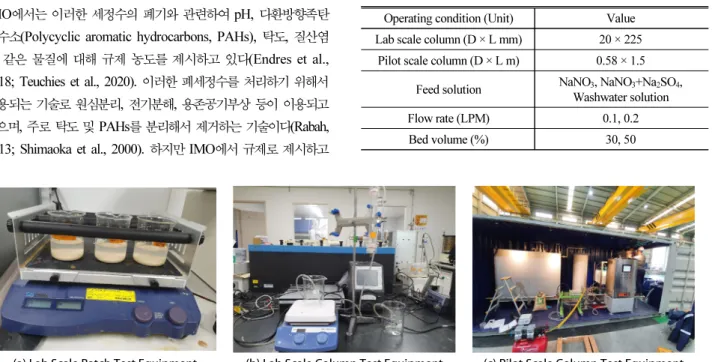
본 실험에 사용된 장비는 Fig. 1과 같이 연구실 규모의 회분식 실험장비와 컬럼을 통한 연속식 실험장비를 각각 구성하여 진행하 였다. 회분식 실험(Fig. 1(a))에서는 이온교환수지 0.6 g에 100 mL 실험 용액을 제조하여 실험을 진행하였으며, 교반기를 통해 시간에 따른 질산성 질소 농도를 측정하여 제거율을 확인하였다.
연속식 실험(Fig. 1(b))에서는 컬럼 대비 30 %의 이온교환수지 충전량, 0.2 LPM의 유량으로 원수를 유입하여 시간별 질산성 질소의 농도를 측정하여 제거성능을 확인하였다. 추가적으로 유입 용액의 조성, 유량 및 이온교환수지의 충전량과 같은 운영조건을 변화하며 이에 따른 질산염의 제거성능의 개선 정도를 확인하였다 (Table 1). 최종적으로는 연구실 규모의 실험을 바탕으로 400 L 규모의 이온교환수지 컬럼을 제작하여 파일럿 실험을 진행하였 다. 모든 실험은 상온 조건에서 진행되었다.
(a) Lab Scale Batch Test Equipment (b) Lab Scale Column Test Equipment (c) Pilot Scale Column Test Equipment Fig. 1. Experimental Equipments
Table 1. Operating Conditions for Experiments Operating condition (Unit) Value Lab scale column (D × L mm) 20 × 225
Pilot scale column (D × L m) 0.58 × 1.5 Feed solution NaNO3, NaNO3+Na2SO4,
Washwater solution
Flow rate (LPM) 0.1, 0.2
Bed volume (%) 30, 50
2.2 실험 재료
선택적 질산염 제거 실험을 위하여서 Tulsion 社의 이온교환수 지인 A-62 MP 제품과 IXOM 社의 자성이온교환수지 MIEX 제품을 이용하여 성능을 비교분석하였다. 실제 선박에서 사용하는 엔진 및 연구개발 중인 파일럿 스케일의 스크러버에서 발생하는 폐세정수를 분석한 결과를 바탕으로 Table 2와 같이 모사 폐세정수 를 제조하여 회분식 및 연속식 실험에 이용하였다.
3. 결과 및 고찰
3.1 실험실 규모 회분식 실험결과
NaNO
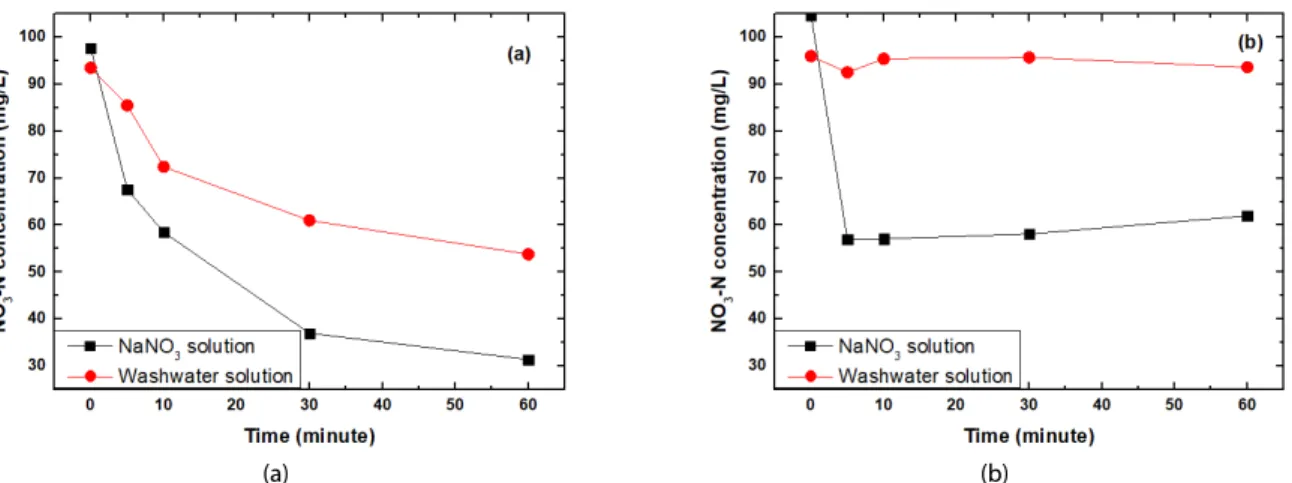
3만으로 제조한 용액으로 실험실 규모 회분식 실험을 진행한 결과 Tulsion 이온교환수지에서 67.86 ± 4.05 %, IXOM 이온교환수지에서 45.45 ± 2.26 %의 제거효율을 나타낸 것으로 확인되었다. 하지만 모사 스크러버 폐세정수를 제조하여 실험을 진행한 결과에서는 모든 이온교환수지에서 제거되는 질산성질소의 양이 줄어드는 것으로 나타났다(Fig. 2). 특히 IXOM 이온교환수지 에서는 제거가 거의 되지 않는 것으로 확인되었으며, 이는 폐세정수 내 존재하는 다른 음이온 물질들이 영향을 미친 것으로 판단된다.
이를 정성적으로 확인하기 위하여 질산염을 제외한 폐세정수의 다른 음이온 성분인 황산염과 염소의 영향성을 확인하였다(Fig. 3).
질산이온과 염소이온이 존재하는 용액에서는 두 이온교환수지 모 두 NaNO
3용액 실험과 비슷한 경향성을 나타내었으며, 이는 염소 이온이 용액 내 존재해도 질산염의 이온교환에는 크게 간섭하지 않는 것으로 판단된다. 질산이온과 황산이온이 존재하는 용액으로
Table 2. Chemical Composition of the Synthetic Scrubber WasteWash Water Solution
Material Concentration (mg/L)
Na2SO4 7812.20
MgSO4 24.07
CaCl2 66.59
NaCl 350.64
NaNO2 34.50
NaNO3 764.95
(a) (b)
Fig. 2. Nitrate Removal Performance with Various Ion Exchange Resin in Batch Test (a) Tulsion (b) IXOM Ion Exchange Resin
(a) (b)
Fig. 3. Nitrate Removal Performance with Various Feed Solutions in Batch Test (a) Tulsion (b) IXOM Ion Exchange Resin
실험한 결과에서는 Fig. 2의 모사폐세정수의 경향성과 비슷하게 나타나는 것을 확인할 수 있었다. 기존 문헌에서 논의된 바에 의하면 본 논문에 이용된 Tulsion 이온교환수지의 경우 NO
3-> SO
42-> Cl
-의 선택도를 가지고 있으며, IXOM 이온교환수지의 경우 SO
42-> NO
3-> Cl
-의 순서로 선택도를 가지고 있다고 기재되어있다(Du et al., 2019; Rokicki and Boyer, 2011).
이는 본 실험을 통해 얻어진 결과와 같은 경향성을 나타내는 것으로 판단된다.
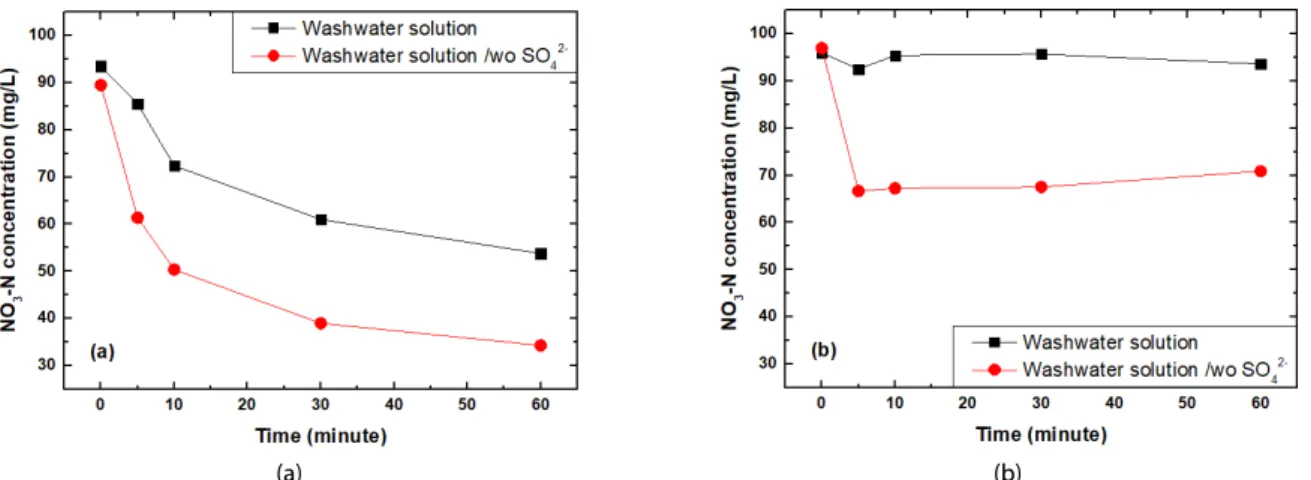
음이온 성분의 실험 결과를 모사폐세정수 조건에 대입해보기 위하여 모사폐세정수 내 황산이온성분만을 제거하여 제조한 용액 으로 실험을 진행하여 비교하였다(Fig. 4). 황산이온을 제외하고 제조한 모사 폐세정수 실험 결과 Fig. 3에서 나타난 질산이온과 염소이온 용액 실험 결과와 유사한 경향성을 보이는 것으로 나타났 으며, 이를 통하여 모사폐세정수에서 질산이온 제거에 가장 영향이 큰 음이온은 황산이온임을 확인할 수 있었다. 특히, SOx 제거가 주요목표인 선박 스크러버에서 황산이온의 존재는 불가피하므로 이온교환수지의 이온선택도에 따라 질산이온의 제거 성능이 크게 영향을 미칠 것으로 판단된다.
3.2 실험실 규모 연속식 실험결과
회분식 실험을 바탕으로 컬럼을 통한 연속식 실험을 진행하였다.
IXOM 社의 이온교환수지의 경우 이온선택도 특성상 황산이온에 영향을 매우 크게 받으므로 폐세정수 처리에 적용이 어려울 것으로 판단되어 연속식 실험에서는 제외하였다. 앞선 3.1의 결과에서와 마찬가지로 연속식 실험에서도 황산이온에 따른 성능저하가 나타 나는 것으로 확인되었다(Fig. 5). 특히 시간에 따라 제거율이 급격히 떨어짐을 확인되었으며, 이는 연속식으로 운전함에 따라 질산이온 으로 교환된 이온교환수지 발생과 충분한 접촉시간의 부족으로 인한 성능저하로 판단된다.
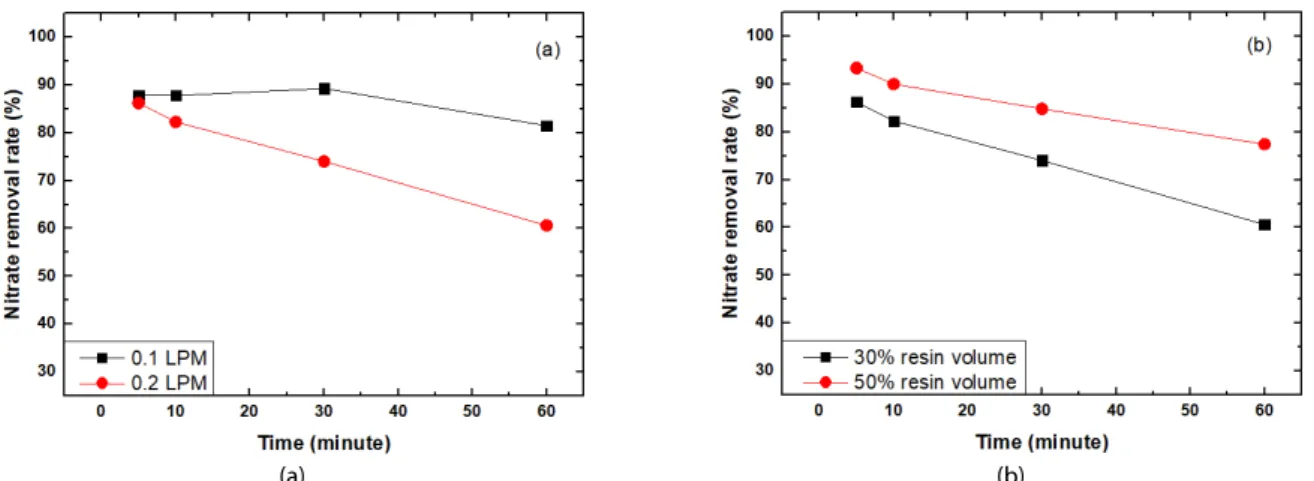
이를 해결하기 위하여 운영조건 변화에 따른 이온교환수지 공정의 성능개선효과를 확인하였다. Fig. 6(a)에서 확인할 수 있듯이 컬럼 내로 유입되는 유량을 감소시킴으로 인하여 시간에 따른 제거효율 감소 폭이 상당히 둔화되는 것을 확인할 수 있었다.
이는 유량 감소에 따라 컬럼 내 이온교환수지와 원수의 접촉 시간이 늘어남과 동시에 컬럼 내 반응하는 질산염의 총량이 줄어 들어 이온교환성능이 향상된 것으로 판단된다. 이와 더불어 이온 교환수지의 충전량을 향상시킴에 따라서도 성능이 개선됨을 확인 하였다(Fig. 6(b)). 이는 충전량 증가에 따라 전체적인 접촉 면적이 확대되어 더 많은 질산이온이 이온교환수지를 통해 제거된 것으로 판단된다.
3.3 파일럿 규모 연속식 실험결과
연구실 규모의 실험을 바탕으로 파일럿 규모의 연속식 실험을 진행한 결과를 Fig. 7에 나타내었다. 실험을 진행한 결과 파일럿 규모에서도 77.84 ± 4.75 %의 높은 질산이온 제거 효율을 나타내었
(a) (b)
Fig. 4. Nitrate Removal Performance with Various Feed Solutions in Batch Test (a) Tulsion (b) IXOM Ion Exchange Resin
Fig. 5. Nitrate Removal Performance with Various Feed Solutions in Column Test
으며, 최종 처리수가 21.65 ± 4.75 mg/L로 나타나 국제해사기구에 서 규제하고 있는 폐세정수 방류수 수질 기준을 만족하는 것으로 확인할 수 있었다.
4. 결 론
본 연구에서는 이온교환수지 공정을 이용한 선박 스크러버 폐세 정수 내 질산이온 제거성능을 평가한 결과 다음과 같은 결론을 얻을 수 있었다.
(1) 선박에서 이용되는 스크러버의 폐세정수는 다양한 이온성 물질 로 구성되어 있으며, 그 농도 또한 높으므로 유입수 성분에 따라 이온교환수지의 제거성능이 크게 영향을 미치는 것을 확인하였다.
(2) 특히, 선박 스크러버의 주요 타겟물질이 SOx이므로 높은 황산 이온이 폐세정수에 존재할 것으로 판단되며, 회분식 실험 결과 황산이온이 이온교환수지 공정을 통한 질산이온 제거에 크게 간섭영향을 미치는 것으로 확인되었다. 따라서 이온교환수지를 선정함에 있어서 이온선택도가 중요한 인자로 검토할 필요가 있을 것으로 판단된다.
(3) 연속식 실험 결과 유입 유량 및 컬럼 충전량과 같은 이온교환수 지공정의 운영조건에 따라서도 폐세정수 내 질산이온의 제거성 능이 향상되는 것을 확인하였으며, 이를 통하여 파일럿 규모 실험에서도 국제해사기구 규제농도에 만족하는 처리수 수질을 달성한 것으로 확인되었다.
결론적으로 선박 스크러버 폐세정수 내 질산이온은 이온교환수 지 공정을 통해 제거가 가능할 것으로 확인되었으며, 이온교환수지 의 이온선택도와 다양한 운영조건의 최적화를 통하여 국제해사기
구에서 폐세정수의 방류를 위한 질산이온의 규제 농도를 안정적으 로 처리할 수 있을 것으로 판단된다.
감사의 글
본 연구는 해양수산부 선박배출 미세먼지 통합저감 기술개발사업 (과제번호: 20190367)의 지원을 받아 수행되었으며, 이에 감사드립니다.
본 논문은 2020 CONVENTION 논문을 수정·보완하여 작성 되었습니다.
References
Ammar, N. R. and Seddiek, I. S. (2020). “An environmental and economic analysis of emission reduction strategies for container ships with emphasis on the improved energy efficiency indexes.”
Environmental Science and Pollution Research, Vol. 27, pp.
23342-23355.
Amoatey, P., Omidvarborna, H., Baawain, M. S. and Al-Mamun, A.
(2019). “Emissions and exposure assessments of SO
X, NO
X, PM
10/2.5(a) (b)
Fig. 6. Nitrate Removal Performance with Various Operating Conditions in Column Test
Fig. 7. Nitrate Removal Performance in Pilot Test