Anatase와 Rutile 결정상 비율에 따른 TiO2 nanotube의 OH radical 생성량 비교 연구
이효주a․이용호b․박대원c,†
서울과학기술대학교 에너지환경공학과
Comparison of OH radical generation depending on anatase to rutile ratio of TiO2 nanotube Photocatalyst
Hyojoo Leea․Yongho Leeb․Daewon Pakc,†
Department of Environmental and Energy Engineering, Seoul National University of Science and Technology (Received 8 August 2019, Revised 11 November 2019, Accepted 18 November 2019)
Abstract
This study was carried out to improve the photocatalytic reaction of TiO2 photocatalyst. During the photocatalytic reaction, OH radicals are generated and they have an excellent oxidation capability for wastewater treatment. To evaluate the OH radicals generated according to crystallographic structure of TiO2 nanotubes photocatalyst, a probe compound, 4-Chlorobenzoic acid was monitored to evaluate OH radical. Ultraviolet light was applied for photocatalytic reaction of TiO2.The 4-Chlorobenzoic acid solution was prepared at laboratory. TiO2 nanotube was grown on titanium plate by using anodization method. The annealing temperature for TiO2 nanotube was varied from 400 to 900 ℃ and the crystal forms of the TiO2 nanotube was analyzed. Depending on annealing temperature, TiO2
nanotubes have shown different crystal forms; 100% anatase (0 % rutile), 18.4 % rutile (81.6 % anatase), 36.6 % rutile (63.4 % anatase) and 98.6% rutile (1.4% anatase). As the annealing temperature increases, the rutile ratio increases. OH radical generation from 18.4 % rutile TiO2 nanotube plate was about 3.8 times higher than before annealing and 1.4 times higher than only 100 % anatase-TiO2 nanotube. The efficiency of the 18.4% rutile TiO2
nanotube was the best in comparison to TiO2 nanotube with 18.4 %, 36.6 % and 98.6 % rutile. As a result, photocatalytic ability of 18.4 % rutile-TiO2 nanotube plate was higher than 100 % anatase-TiO2 nanotube plate.
Key words : Anodization, Crystal forms, OH radical, Photocatalyst, TiO2 nanotube
a 석사과정(Master’s course Student), [email protected], https://orcid.org/0000-0002-6186-588X
b 박사과정(Ph.D. Student), [email protected], https://orcid.org/0000-0001-5995-7884
c,†Corresponding author, 교수(Professor), [email protected], https://orcid.org/0000-0002-8664-1946
This is an Open-Access article distributed under the terms of the Creative Commons Attribution Non-Commercial License (http://creativecommons.org/
licenses/by-nc/3.0) which permits unrestricted non-commercial use, distribution, and reproduction in any medium, provided the original work is properly cited.
1. Introduction
시대가 발전할수록 증가하는 인구수와 산업 활동으로 인한 환경오염을 처리하기 위한 연구가 활발히 진행되고 있다. 오 염 물질을 처리하기 위해 크게 물리적, 생물학적, 화학적 방 법이 존재한다(Kim, 2018). 이 중 화학적 처리 공법 중 하나 인 Advanced Oxidation Process (AOP) 기술은 자외선, 염소, 오존 등의 기존의 산화처리의 한계를 극복하기 위해 개발된 기술로서, 반응 후에도 독성을 남기지 않으며 강력한 살균력 과 산화력을 가진다. 광촉매 반응을 이용한 AOP 기술은 2차 오염물질이 없어 환경 친화적이며 강력한 산화력을 가진 OH radical을 생성한다는 점에서 다양한 수처리 기술에 적용되고 있다(Kim et al., 2017). AOP 기술에서 발생되는 OH radical 은 화학적 반응성이 매우 크기 때문에 선택성 없이 반응해, 높은 효율을 가진다. 주로, 과산화수소나 오존 같은 산화제 를 사용하거나, UV/TiO2, electron beam과 같이 빛이나 고에 너지파를 사용하여 OH radical을 생성한다고 문헌에 나와 있 다(Lee, 2001).
TiO2 외에 주로 사용되는 광촉매는 ZnO, Fe2O3, WO3,
SnO2, anatase-TiO2, rutile-TiO2 등이 있으며 (Ola and Valer, 2015), 서로 다른 band gap energy를 가진다. 본 연구에서는 UV/TiO2 방법을 이용하고자 한다. TiO2 광촉매는 band gap energy 이상의 광에너지를 받으면, 가전자대(valence band)의 전자(e-)가 전도대(conduction band)로 여기 되어 전자가 생 기고 가전자대에는 정공(h+)이 생성된다. 전자와 정공이 각각 표면으로 이동하여 전자는 인접한 산소분자와 결합하여 O2- 를 생성하고 정공은 H2O와 결합하여 OH radical을 생성한 다. 광촉매의 Band gap energy가 작을수록 전자-정공쌍의 분 리가 쉽게 일어나지만 재결합 또한 빠르게 진행되기 때문에 광촉매 역할로서 가장 효율적인 band gap energy를 갖는 광 촉매 연구가 가장 많이 진행되고 있다(Kim, 2014; Lee, 2016; Yao et al., 2019).
TiO2는 anatase, rutile, brookite의 3가지의 결정상을 가지며 brookite 구조의 생성을 위해서는 매우 높은 온도를 필요로 하며 상당히 불안정해 anatase상과 rutile상이 가장 일반적으 로 사용되어지고 있다. Anatase상은 다른 두 가지 형태보다 더 높은 광학적 활성을 가지며 band gap energy는 3.2eV로 UV 영역에서 388nm의 이하에서 반응하며 rutile상은 anatase 구조보다 약간 낮은 3.0eV의 band gap energy를 가지고 가시 광선 영역인 415nm 이하에서 반응한다(Koo, 2015).
Rutile상이 anatase상보다 더 안정적이지만 anatase상의 TiO2가 태양 전지 및 광촉매와 같은 응용 분야에 더 효율적 이며, 대기 및 정수, 폐수 처리 시 가장 효율적임이 입증되었 다. 하지만 순수한 anatase TiO2 광촉매보다 anatase와 rutile 상이 결합된 TiO2 광촉매가 더 활성이 높은 촉매역할을 한다 는 연구가 있다(Kim, 2018; Kim, 2005). 두 상을 결합함으로 서 전자 정공 분리를 더 향상시킬 수 있고 rutile 구조에서 문제되는 빠른 전자정공의 재결합을 억제할 수 있다. 두 상 이 결합된 TiO2는 광촉매의 특성을 그대로 유지하면서 결정
상만 변화시켜 간단한 방법으로 효율을 향상시키는 방법이 다. 따라서 두 결정상의 적절한 비율을 찾아 보다 효율적이 고 향상된 TiO2 광촉매를 얻는 것이 중요하다(Jarosz et al, 2015; Liu, et al, 2007).
두 결정상을 혼합한 TiO2 nanotube로서 열처리 온도와 시간에 따른 anatase상과 rutile상을 혼합한 연구가 particle이나 film 형 태로 다양하게 있지만(Fang, et al, 2011; Jaroenworaluck, et al, 2010; Li et al, 2009; Regonini, et al, 2010; Yang, et al, 2008;
Yu and Wang, 2010), plate 형태의 연구는 전무한 실정이다.
따라서 본 연구에서는 plate 형태의 TiO2 nantube를 온도별로 열처리하여 두 결정상이 혼합된 광촉매를 제조하여 결정상 혼 합비에 따른 OH radical 생성량을 비교하고자하였다.
2. Materials and Methods
2.1. Preparation of TiO2 nanotube plate
양극으로 50 mm × 50 mm크기에 22 mm의 타공이 있는 titanium plate (purity 99.8%)와 음극으로는 50 mm × 80 mm크기의 platinum mesh를 사용했다. Titanium plate는 표 면 세척을 위해 acetone, ethyl alcohol, deionized water로 각 각 10분 씩 초음파 처리해주었다. 양극산화 시 전해질은 2 vol% H2O와 0.2 wt% NH4F가 포함된 Ethylene glycol 용액 을 전해질로 사용하였고, 정류기는 XG150-10 (AMETEK, USA)를 사용하였다. 양극산화는 500 mL의 크기의 이중자켓 에 cooling bath를 연결하여 전해질의 온도를 초기온도로 유 지시켜주며, 150 rpm으로 교반하여 진행하였다. 양극산화 후 TiO2 표면에 남아있는 전해질을 제거하기 위해 ethyl alcohol 에 침지하여 2분간 초음파 처리하여 실온 건조하였다. 결정 상 비율에 따른 OH radical 생성량을 비교하기 위해 열처리 를 회화로 (Electric muffle furnace, JISICO, J-FM38, Korea) 를 사용하였다. 열처리 온도를 400 ℃ ~ 900 ℃의 범위에서 100 ℃차이를 두어 실험을 진행하였다.
2.2. Morphology analysis of TiO2 nanotube plate
양극산화 시 titanium plate에 인가되는 전압과 양극산화 시간 그리고 전해질 구성 성분 농도에 따라 nanotube의 형태 와 길이에 영향을 미치기 때문에 열처리 온도외의 조건은 모 두 동일하게 진행했다. 열처리 외에 조건이 모두 동일하게 양극산화하여 제작한 TiO2 광촉매가 열처리 온도가 달라도 비슷한 길이와 기공의 nanotube 형태를 나타내는지 확인하 기위해 Scanning Electron Microscope (SEM, TESCAN VEGA3, U.S.A) 분석을 진행하였다. X-ray Dffractometer (XRD, Bruker DE/D8 Advanced, 독일)를 이용하여 열처리 과정인 annealing 과정 전 후의 TiO2 nanotube plate와, Titanium plate 결정상 구조와 비율을 비교했다. scan range는 20 ~ 80°로 하였다. Diffuse Reflectance-Ultaraviolet/Visible spectrometer (DR-UV/Vis, SCINCO S-4100, Korea)를 이용 하여 결정상 비율에 따른 TiO2를 200~800nm의 파장에서 흡 광도를 측정하였다.
2.3. Analytical method of OH radical production
결정상 비율이 다른 TiO2의 OH radical 생성량을 평가하기 위해 OH radical probe compound인 4-Chlorobenzoic acid 100 ppm 용액을 이용하였다. OH radical 생성량 분석을 위 해 124 mL 부피의 아크릴 반응기를 제조하였다. TiO2
nanotube plate 광촉매 1개를 사용하였으며, 광촉매 하단에서 교반할 공간을 위해 반응기의 높이가 TiO2 nanotube plate 크 기보다 긴 형태로 가로 50 mm, 세로 70 mm, 그리고 UVC lamp (Sankyo Denki G8T5, 8 W, 254nm, Japen)를 이용하기 위해 석영관이 들어갈 수 있도록 반응기 옆면 중앙에 22 mm의 구멍을 내었다. 반응기의 구멍에 전해질의 손실을 막 기 위해 UV 빛이 통과하는 석영관을 고무 재질의 O-ring을 끼워 반응기에 고정시킨 후 UV lamp를 사용하여 실험을 진 행하였다. 4-Chlorobenzoic acid 농도 감소율 실험시간은 60 분으로 하였으며 10분마다 샘플을 채취하여 HPLC (UV detector, Younglin, Korea)에 column은 ZORBAX SB-aq (Agilent, 4.6 mm × 250 mm, U.S.A)을 사용하였다. 이동상 은 40 % acetonitrile / 60 % 0.2 % phosphate buffer (flow rate : 1 mL, UV = 254 nm)를 사용하여 농도 변화를 확인하 였다.
OH radical 생성량 계산 방법은 다음에 나열된 식 (1)과 같다.
d[pCBA]/dt = kpCBA·obs[pCBA] (1) d[pCBA]/[pCBA] = kpCBA.obsdt (2)
ln([pCBA]0/[pCBA]) = kpCBA,obst (3) where kpCBA,obs = kpCBA[OH·]ss
[OH·]ss = kpCBA,obs/kOH,pCBA (4) (kOH.pCBA=5×10⁹ M-1S-1)
식 (4)의 분해속도 상수 kpCBA.obs는 식 (3)에서 4-Chlorobenzoic acid 분해율과 시간에 따른 semi-log plot의 기울기로부터 값을 구할 수 있다 (Koo, 2015; Lee, 2016). OH radical의 probe compound인 4-Chlorobenzoic acid의 OH radical과의 반응속도 는 kOH.pCBA는 5 × 10⁹ M-1S-1로 오존(kO3/pCBA=1×10-1 M-1S-1) 및 다른 산화제보다 OH radical과의 반응성이 높다.
3. Results and Discussion
3.1. 양극산화 시간에 따른 TiO2 morphology 관찰 양극산화를 15시간 동안 60V의 전압을 인가해 주어 제작 한 TiO2 nanotube의 길이는 Fig. 1과 같다. Fig. 1을 보면 rutile 결정상의 비율이 높을수록 TiO2 nanotube의 관형구조 가 손상됨을 확인했다. 이를 확인하기 위해 TiO2 nanotube의 측면을 더 확대하여 분석한 결과 Fig. 2와 같다. 400 ℃에서 열처리한 nanotube 형태는 곧은 기둥 형태이나, rutile상이 나 타나는 700 ℃부터 nanotube 형태가 변하며 관형구조인 nanotube 구조가 변한다. 이러한 nanotube의 변화에 대해 anatase에서 rutile상으로 상전이에 의해 구조가 변한 것이라 는 연구가 있다(Fang et al, 2011).
Fig. 1. Top and cross-section of TiO2 nanotube plate annealed at different temperatures : (a) 400 ℃ (100 % anatase), (b) 500
℃ (100 % anatase), (c) 600 ℃ (100 % anatase), (d) 700 ℃ (18.4% rutile) (e) 800 ℃ (36.6% rutile), and (f) 900 ℃ (98.6% rutile).
3.2. 열처리 온도에 따른 TiO2 결정상 및 흡광도 분석 Fig. 3은 TiO2 nanotube의 결정상을 확인하기 위한 XRD 분석 결과이다. 열처리 과정을 거치지 않은 TiO2는 titanium 만 분석되었으며 결정상은 없었다. 400 ℃ ~ 600 ℃에서 열처 리된 TiO2는 102, 112, 200의 면지수에서 anatase상이 가장 높은 피크로 나타났으며 열처리 온도가 상승할수록 anatase 상의 피크는 감소하면서 rutile상의 피크가 증가하였다. 110 과 101 면지수에서 rutile상이 가장 높게 관찰되었다. 결정상 비율은 400 ℃ ~ 600 ℃에서 열처리된 TiO2는 100 % anatase, 700 ℃에서는 81.6 % anatase, 18.4 % rutile, 800 ℃에서는 63.4 % anatase, 36.6 % rutile, 900 ℃에서는 1.4 % anatase, 98.6 % rutile의 결정상을 얻었다.
Fig. 4는 Fig. 3의 XRD 분석 결과를 토대로 400 ℃ ~ 900
℃에서 열처리한 TiO2 광촉매의 결정상 비율을 그래프로 나 타낸 것이다. 400 ℃ ~ 900 ℃에서 열처리한 TiO2 광촉매에서 는 주로 anatase상이 관찰되었고, 700 ℃부터 rutile상도 함께 관찰되었다. 따라서, 600 ℃ 이하의 온도에서 열처리한 TiO2
nanotube는 rutile 상이 없는 100 % anatase상을 가짐을 확인 하였다.
열처리 온도에 변화를 주어 광촉매의 결정상 비율을 다르 게 얻었으며, Fig. 5는 TiO2 광촉매 흡광도를 비교한 그래프 이다. 그래프를 보면 가장 높은 흡광도를 보이는 파장이 100% anatase-TiO2는 334nm 부근이며, 18.4% rutile-TiO2는 346nm, 36.6% rutile-TiO2는 348nm, 98.6% rutile-TiO2는 390nm 로 나타났다. 이를 통해 rutile 비율이 높을수록 광촉 매의 흡광도 파장이 최소 42 nm, 최대 55nm 장파장으로 이 동함을 확인하였다.
Fig. 3. XRD of (a) Titanium plate, (b) no annealed TiO2, (c) TiO2 annealed at 400 ℃ (100 % anatase), (d) TiO2
annealed at 500 ℃ (100 % anatase), (e) TiO2 annealed at 600 ℃ (100 % anatase), (f) TiO2 annealed at 700
℃ (18.4% rutile), (g) TiO2 annealed at 800 ℃ (36.6%
rutile), (h) TiO2 annealed at 900 ℃ (98.6% rutile).
Fig. 2. ross-section of TiO2 nanotube plate annealed at different temperatures : (a) 400 ℃ (100 % anatase), (b) 500 ℃ (100 % anatase), (c) 600 ℃ (100 % anatase), (d) 700 ℃ (18.4% rutile) (e) 800 ℃ (36.6% rutile), and (f) 900 ℃ (98.6% rutile).
Fig. 5. UV-Vis absorbance according to anatase and rutile ratio of TiO2 nanotube.
3.3. TiO2 nanotube 결정상 구성에 따른 OH radical 생성 비교
OH radical 생성량을 계산에 필요한 kpCBA,obs를 구하기 위해 4-Chlorobenzoic acid 농도 변화에 대한 ln[pCBA]0/[pCBA]의 semi-log plot 그래프로 나타낸 것이다. 그래프는 originPro8.0 프로그램을 이용하여 나타내었다.
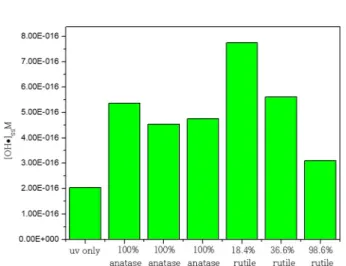
Fig. 6에서 얻은 semi-log plot의 기울기 값과 반응한 시간 을 식 (1)에 따라 계산하여 얻은 OH radical 생성 결과는 Fig. 7과 같다. 18.4 % rutile-TiO2 광촉매의 OH radical 생성 량이 7.76E-16M로, UV lamp를 단독으로 사용했을 때 생성 된 OH radical 생성량인 2.04E-16M보다 약 3.8배 높다. 100
% anatase-TiO2 중 가장 높은 OH radical 생성량의 5.37M보 다 약 1.4배 높다. 이는 anatase 결정구조보다 낮은 band gap
Fig. 6. Linear relationship between ln([pCBA]0/[pCBA]) and reaction time: (only UV □, 100% anatase-TiO2
(annealed at 400 ℃ ○, 500 ℃ △, 600℃ ▽), 18.4% rutile-TiO2 (annealed at 700 ℃ ◁), 36.6%
rutile-TiO2 (annealed at 800 ℃ ▷), and 98.6%
rutile-TiO2 (annealed at 900 ℃ ◇))
energy를 가지는 rutile 결정구조가 혼재함으로서 전자-정공 의 분리가 향상되어 광촉매 능력이 향상되었다고 판단된다.
36.6 % rutile-TiO2와 98.6 % rutile-TiO2는 18.4 % rutile-TiO2
보다 OH radical 생성량이 낮은데 이는 빛의 조사에 의해 발 생한 전자와 정공의 재결합이 빠르게 일어나는 rutile상의 특 성 (Koo, 2015) 때문이라고 판단된다. 따라서 본 연구에서 18.4 % rutile상이 혼합된 TiO2 광촉매가 100% anatase–
TiO2보다 OH radical 생성량이 높아 두 결정구조를 혼합함으 로서 광촉매의 활성이 향상되었다고 판단된다.
Fig. 4. Anatase and rutile ratio of TiO2 nanotube annealed at (a) 400 ℃ (100 % anatase), (b) 500 ℃ (100 % anatase), (c) 600 ℃ (100 % anatase), (d) 700 ℃ (18.4% rutile) (e) 800 ℃ (36.6% rutile), (f) 900 ℃ (98.6% rutile).
Fig. 7. Comparison of OH radical generation depending on anatase to rutile ratio
4. Conclusion
1. 양극산화를 통해 제조된 TiO2 nanotube 광촉매의 열처리 온도에 따른 결정상 형태를 분석한 결과, 열처리 온도가 증가 하면서 anatase상에서 rutile상으로 상이 전환됨을 관찰할 수 있었다. 700 ℃ 이상의 온도에서 열처리한 TiO2 nanotube 형 태에서는 관형구조가 손상되는 결과를 보였으며 TiO2
nanotube plate의 결정상이 anatase에서 rutile상으로 변하는 온도는 600 ~ 700 ℃ 사이임을 알 수 있었다.
2. TiO2 nanotube의 결정상 비율에 따른 광촉매 활성을 비 교하고자 열처리 온도를 400 ℃ ~ 900 ℃로 100 ℃의 차이를 두어 실험을 진행한 결과, 열처리 온도가 400 ℃ ~ 600 ℃ 일 때 anatase 결정상만 분석되었고, 700 ℃ 이상의 온도에서 rutile 결정상이 점차 증가되었다. 400 ℃에서 열처리된 TiO2
는 102, 112, 200의 면지수에서 anatase상의 피크가 가장 높 이 나타났으며 열처리 온도가 상승할수록 anatase상 피크는 감소하면서 rutile상의 피크가 상승하였고, rutile상은 110과 101 면지수에서 가장 높게 관찰되었다.
3. OH 라디칼 발생량을 측정한 결과 18.4 %의 rutile 결정 상 비율을 가지는 TiO2가 열처리 전보다 약 3.8배, 400 ℃에 서 열처리한 TiO2보다 1.4배 많은 OH radical이 생성됐다.
그리고 36.6 % rutile 결정상 비율을 가진 TiO2보다 1.4배, 98.6 % rutile 결정상 비율을 가진 TiO2보다는 2.5배 많은 OH radical이 생성됐다. 따라서 18.4%의 rutile 결정상 비율 을 가지는 TiO2의광촉매 활성도가 가장 높은 것으로 나타났 으며, 이는 TiO2 광촉매가 일정 비율의 rutile 결정상이 포함 될 때 anatase 결정구조만 있는 TiO2 보다 광촉매 활성이 높 다 가능성을 입증한 결과로 판단된다.
Acknowledgement
본 연구는 서울과학기술대학교 교내 지원을 받아 수행되었 습니다. 이에 감사드립니다.
References
Fang, D., Luo, Z. P., Huang, K. L., and Lagoudas, D. C. (2011).
Effect of heat treatment on morphology, crystalline structure and photocatalysis properties of TiO2 nanotubes on Ti substrate and freestanding membrane, Applied Surface Science, 257(15), 6451-6461.
Jaroenworaluck, A., Regonini, D., Bowen, C. R., and Stevens, R. (2010). A microscopy study of the effect of heat treatment on the structure and properties of anodised TiO2 nanotubes, Applied Surface Science, 256(9), 2672-2679.
Jarosz, M., Syrek, K., Kolodziej, J. K., Mech, J., Malek, K., Hnida, K., Lojewski, T., Jaskula, M., and Sulka, G. D.
(2015). Heat treatment effect on crystalline structure and photoelectrochemical properties of anodic TiO2 nanotube arrays formed in ethylene glycol and glycerol based electrolytes, Journal of Physical Chemistry C, 119(24), 24182-24191.
Kim, D. E., Lee, Y. H., Kim, D. W., and Pak, D. W. (2017).
The influence of current flow on OH radical generation in a Photocatalytic reactor of TiO2 nanotube plates, Journal of Korean Oil Chemists Society, 34(2), 349-356. [Korean Literatute]
Kim, S. H. (2014). Study on photocatalytic oxidation using nano-size TiO2 and UV-LED for remonal of free cyanide in mine wastewater, Master’s Thesis, Gyeongsang National University. [Korean Literature]
Kim, Y. I. (2018). Fabrication and photocatalytic activity of rutile-anatase coupled TiO2 by using surfactant, Master’s Thesis, Hanyang University. [Korean Literature]
Kim. S. M. (2005). Effect of rutile structure on TiO2 photocatalytic activity, Journal of the Korean Chemical Society, 49(6), 567-574. [Korean Literature].
Koo, H. M. (2015). Preparation of TNTA for pre-tretment of food waste leachate and characteristic assessment, Master’s Thesis, Seoul National University of Science and Technology.
[Korean Literatute].
Lee, Y. H. (2001). Investigation of the reaction pathway of OH radicals produces by fenton oxidation in wastewater treatment, Master’s Thesis, Seoul National University.
[Korean Literature]
Lee, Y. H. (2016). Evaluation of OH radical generation to nanotube Morphology of TiO2 nanotube plate, Journal of Korean Society on Water Environment, 32(5), 403-409.
[Korean Literature]
Li, G., Liu, Z. Q., Lu J., Wang, L., and Zhang, Z. (2009). Effect of calcination temperature on the morphology and surface properties of TiO2 nanotube arrays, Applied Surface Science, 255(16), 7323-7328.
Liu, Z. Y, Zhang, X. T., Nishimoto, S. S., J, M., Tryk, D. A., Murakami, T., and Fujishima, A. (2007). Anatase TiO2
nanoparticles on rutile TiO2 nanorods: A heterogeneous nanostructure via layer-by-layer assembly, Journal of Langmuir, 23(22), 10916-10919
Ola, O. and Valer, M. M. (2015). Review of material design and reactor engineering on TiO2 photocatalysis for CO2
reduction, Journal of Photochemistry and Photobiology, 24, 16-42.
Regonini, D., Jaroenworaluck, A., Stevens, R., and Browen, C.
R. (2010). Effect of heat treatment on the properties and structure of TiO2 nanotubes: phase composition and chemical composition, Surface and Interface Analysis, 42(3), 139-144.
Yang, Y., Wang, X., and Li, L. (2008). Synthesis and photovoltaic application of high aspect‐ratio TiO2 nanotube arrays by
anodization, Journal of the American Ceramic Society, 91(9), 632-635.
Yao, Q. T., Sun, J. A., Zhu, Y. J., Zhang, H., and Tong, W.
P. (2019). TiO2 coating prepared by mechanical alloying treatment for photocatalytic degradation, Surface Engineering, 35(11), 927-932.
Yu, J. G. and Wang, B. (2010). Effect of calcination temperature on morphology and photoelectrochemical properties of anodized titanium dioxide nanotube arrays, Applied catalysis B: Environmental, 94(3-4), 295-302.