http://dx.doi.org/10.12925/jkocs.2018.35.1.186
해양생물 크릴(
Euphausia superba
)이 흰쥐의 혈청 유리지방산 및 전해질 농도에 미치는 영향진동혁․오다영․강동수
1․정헌식․김동섭․이영근․성종환․김한수
✝ 부산대학교 식품공학과, 1전남대학교 해양바이오식품학과(2018년 2월 15일 접수: 2018년 3월 15일 수정: 2018년 3월 17일 채택)
Effects of Krill ( Euphausia superba ) on Free Fatty Acid and Electrolyte Concentrations in Rats
Dong-Hyeok Jin․Da-Young Oh․Dong-Soo Kang1․Hun-Sik Chung Dong-Seob Kim․Young-Geun Lee․Jong-Hwan Seong․Han-Soo Kim✝
Department of Food Science and Technology, Pusan National University, Miryang 50463, Korea
1
Department of Marine Bio Food Science, Chonnam National University, Yeosu 59626, Korea (Received February 15, 2018; Revised March 15, 2018; Accepted March 17, 2018)
요 약 : 본 연구는 식이조성에 동결 건조한 krill (
Euphausia superba
) meal을 첨가 하였을 때 Sprague Dawley계 수컷 흰쥐의 유리지방산(non-esterified fatty acid, NEFA), blood urea nitrogen (BUN), creatinine, uric acid 및 전해질에 미치는 영향에 대하여 조사를 하였다. 식이조성은 기본식이를 급여한 대조군인 GC군(krill meal 미함유)을 비롯하여 기본식이에 10.0%, 20.0%, 30.0%의 krill meal 급여군을 각각 G10군, G20군, G30군으로 구분하였다. 5주간 실험 사육한 결과, 흰쥐의 NEFA와 BUN 농도는 krill meal 급여군(G10군, G20군, G30군)에서 대조군(GC 군)보다 유의적으로 감소된 결과를 보 였고, creatinine과 uric acid 농도는 G10군에서는 GC군과 유의적 차이가 없었으나, G20군과 G30군에 서 유의적으로 감소하였다(p<0.05). 전해질 농도에서 total calcium (T-Ca)은 G20군과 G30군에서 유의 적으로 증가하였으며, 인(Pi) 농도는 각 군간에 유의적 차이가 없는 것으로 관찰되었다(p<0.05).주제어 : 크릴, 유리지방산, 크레아티닌, 혈액 요소 질소, 전해질
Abstract : The purpose of this study was to investigate the change of hematology and serum chemistry values on Sprague-Dawley rats, while used krill (
Euphausia superba
) meal diet for 5 weeks. Seven-week-old male rats were divided into four groups (n=6) and fed experimental diets containing three different krill meal contents and control group; 10.0% krill meal (G10), 20.0%krill meal (G20), 30.0% krill meal (G30), and control group (GC). Concentrations of non-esterified fatty acid (NEFA), blood urea nitrogen (BUN) in serum were significantly lower in the G10, G20,
✝
Corresponding author
(E-mail: [email protected])
G30 than GC group (
p
<0.05). Statistically significant differences, at the confidence level of 95%, for the creatinine, uric acid, electrolyte (T-Ca) parameters in the sera were observed in G20 group, G30 group. The concentration of electrolyte (Pi) in serum was no significant difference among the groups (p
<0.05). The results indicate that a krill meal diet was effectively reduce the NEFA.Keywords : Krill (Euphausia superba), Non-esterified fatty acid (NEFA), Creatinine, Blood urea nitrogen (BUN), Electrolyte
1. 서 론
생활수준의 향상 및 서구화된 식생활 증가로 인한 환경적 요소에 의해 고지혈증, 고요산혈증, 신부전, 통풍 등 만성질환이 증가하고 있으며, 이 에 따른 당뇨 및 고혈압 등에 대한 개선 방안이 요구되고 있다[1,2]. 유리지방산(non-esterified fatty acid, NEFA)의 증가는 인슐린 저항성과 관 련이 있다고 보고되어 있어, 체내 인슐린 기능이 정상일 경우 NEFA의 농도 조절이 이루어지지만 인슐린 저항성이 나타나면 NEFA를 방출하게 되 어 세포의 산화적 스트레스를 주는 것으로 알려 져 있다[3]. 산화적 스트레스로 인한 호르몬 이상 이나 신장 기능 저하 때문에 전해질의 불균형이 일어나며[4], blood urea nitrogen (BUN) 및 creatinine 농도는 신장 기능의 지표로 이용되는 데[5] 신장 기능의 장애가 발생할 경우 BUN 및 creatinine의 농도가 증가하여 급성 뇌졸중[6], 열 공성 뇌경색[7], 대동맥죽상경화 및 고혈압성 심 장병이 발생할 가능성이 높다고 보고된 바 있다 [8]. 또한, 요산은 DNA 퓨린체의 대사산물이며, 신장에서 배설되기 때문에 신장에 장애가 발생하 거나 퓨린체 대사이상에서 그 농도가 상승하면 고요산혈증(hyperuricemia)이 발생하므로 고혈압, 이상지질혈증, 당뇨, 비만 등 합병증을 동반하여 허혈성 심장질환이나 뇌혈관장애의 발병률을 높 이는 것으로 알려져 있다[9]. 남대양에서 어획되 는 크릴(
Euphausia superba
)은 양질의 단백질과 불포화지방산 및 풍부한 인지질이 다량 함유되어 있어 미래 식량 자원으로 많은 관심을 받아 왔다 [10,11]. 크릴의 불포화지방산은 심장병 및 치매 에 효과적이며 알칼리성 천연 polysaccharide를 함유하고 있어 항종양, 면역 증진, 미생물 생장억 제 기능이 있는 것으로 보고되어 있다[12-14].그러나 가공처리, 변색 및 육질의 가수분해, 갑각 에 내포된 높은 불소함량 등의 문제 때문에 식품
개발은 어려운 실정이다[15,16]. 본 연구는 krill meal을 첨가한 식이 급여가 흰쥐의 혈청 NEFA, BUN, creatinine, 요산 농도 및 전해질에 미치는 영향을 파악하여, 기능성 소재로서 활용 방안을 검토하기 위해 실시하였다.
2. 재료 및 방법
2.1. 실험 재료본 실험에 사용된 krill meal은 국립수산과학원 으로부터 동결건조시킨 후 처리된 것을 제공받아 사용하였다.
2.2. 실험 동물
평균 체중 200±10 g인 7주령된 Sprague Dawley계 수컷 흰쥐(DAEHAN BIOLINK Co., LTD, Chungcheongbukdo, Korea)를 7% 콩기름 (Ottogi, soybean oil, Gyonggido, Korea)을 함유 하는 기초식이로 1주일간 예비 사육하여 적응시 킨 후, 난괴법(randomized complete block design)에 의해 6마리씩 4군으로 metabolic cage (JD-C-71, Jeongdo, Korea)에 나누어 5주간 실 험 사육하였다. 실험 사육실의 온도 20±1℃ 및 습도 50±10%는 일정하게 유지시켰고, 명암은 12시간(7:00~19:00) 주기로 조명하였다[17]. 예 비사육 및 실험사육 등 동물실험은 부산대학교 동물실험윤리위원회의 승인(PNU-2012-0004)과 관리 감독 하에 실시되었다.
2.3. 식이조성 및 실험군
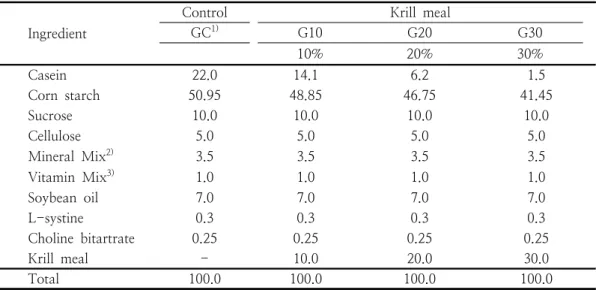
식이조성 및 실험군은 Table 1과 같다. 기본 식이를 섭취시킨 대조군(control)인 GC군, 기본 식이에 10%(G10군), 20%(G20군), 30%(G30군) krill meal을 첨가하여 섭취시켰다.
Ingredient
Control Krill meal
GC1) G10 G20 G30
10% 20% 30%
Casein 22.0 14.1 6.2 1.5
Corn starch 50.95 48.85 46.75 41.45
Sucrose 10.0 10.0 10.0 10.0
Cellulose 5.0 5.0 5.0 5.0
Mineral Mix2) 3.5 3.5 3.5 3.5
Vitamin Mix3) 1.0 1.0 1.0 1.0
Soybean oil 7.0 7.0 7.0 7.0
L-systine 0.3 0.3 0.3 0.3
Choline bitartrate 0.25 0.25 0.25 0.25
Krill meal - 10.0 20.0 30.0
Total 100.0 100.0 100.0 100.0
1)GC : control group, G10 : 10.0% krill meal group, G20 : 20.0% krill meal group, G30 : 30.0% krill meal group. 2)According to AIN-93G diet composition.
3)AIN-93G-VX vitamin mixture (MP Biomedicals, LLC, Illkirch, France).
Table 1. Compositions of experimental diet and experimental groups
2.4. 실험 동물의 처치
실험 사육 최종일에 7시간 동안 절식시키고 에 테르 마취하에 심장채혈법으로 혈액을 취하여 4℃에서 1시간 방치한 후, 분당 3,000 cycle로 20분간 원심분리하여 혈청을 얻어 실험에 사용하 였다[17].
2.5. 혈청의 생화학적 분석
혈청 중의 유리지방산(non-esterified fatty acid, NEFA) 농도는 효소법에 의해 조제된 측정 용 시약(SICDIA NEFAZYME, Eiken, Tokyo, Japan), BUN (blood urea nitrogen)은 효소법에 의해 조제된 시약(Eiken, Tokyo, Japan), creatinine은 Jaffe reaction법에 의하여 조제된 시 약(Eiken, Tokyo, Japan) 및 요산 농도의 측정은 효소법에 의해 각각 조제된 시약(Eiken, Tokyo, Japan)을 이용하여, 혈액 생화학분석기(Hitachi 7150, Tokyo, Japan)를 사용하여 분석하였다.
2.6. 전해질 농도의 정량
심장채혈법으로 채혈한 혈액에서 혈청을 분리 한 후 총 칼슘(T-Ca), phosphorus (Pi)의 전해질 은 ion selective electrode method에 의한 electrolyte analyzer (Easylyte-Plus, USA)를 사
용하여 측정하였다.
2.7. 통계 처리
분석 결과의 통계처리는 실험군 당 평균치와 표준편차를 계산하였고, 군간의 유의적인 차이는 one-way ANOVA로 분석 한 뒤
p
<0.05 수준에 서 Duncan`s multiple range test에 의하여 각 실 험군 간의 유의성을 검증하였다. 통계처리 프로그 램은 IBM SPSS statistic ver. 22를 사용하였다.3. 결과 및 고찰
3.1. Non-esterified fatty acid (NEFA) 농도 기본 식이를 급여한 대조군인 GC군과 krill meal을 첨가한 식이를 급여한 G10군, G20군,
G30군에 있어서 5주간 사육한 흰쥐의
non-esterified fatty acid (NEFA)의 농도는 Fig.
1과 같다. GC군에서 NEFA의 농도는 312.5±5.6 μEq/L (micro-equivalents per liter)로 krill meal 섭취군인 G10군 (301.7±4.8 μEq/L), G20군 (295.8±5.1 μEq/L), G30군 (296.5±5.3 μEq/L)의 NEFA 농도와 유의적인 차이(
p
<0.05) 가 있었으며 krill meal 섭취군에서 대조군보다NEFA 농도가 감소한 것을 알 수 있었다. 혈청 NEFA 농도는 인슐린 저항성에 의하여 내장 지 방조직에서 방출되어 지질대사 질환을 야기하고 비만을 초래하며 비만과 당뇨에 관련된 바이오 마커 중 하나로 사용되고 있다[18,19]. 이에 본 실험에서 NEFA 농도는 krill meal 섭취군(G10, G20, G30)에서 기본 식이 군(GC)보다 낮은 결 과로 관찰되어 인슐린 기능 개선 효과가 있을 것 으로 사료된다.
Fig. 1. Effects of krill (
Euphausia superba
) meal on concentration of non-esterified fatty acid (NEFA) in serum of rats fed the experimental diets for 5 weeks.1)The values are means±standard deviation (
n
=6). Bars with the different letters are significantly different (p
<0.05) by Duncan`s multiple range tests.3.2. Blood urea nitrogen (BUN) 농도 5주간 실험에 사용된 흰쥐의 혈청 blood urea nitrogen (BUN)의 농도는 Fig. 2에 나타내었다.
모든 군의 혈청 BUN 농도는 정상범위 (11.6~20.2 mg/dL)로 나타났으며[20], 대조군인 GC군에서 BUN 농도는 14.6±0.8 mg/dL로 가 장 높았고, G10군 12.4±1.1 mg/dL, G20군 11.7±0.9 mg/dL, G30군 11.5±1.2 mg/dL 순으 로 krill meal 섭취군 간의 유의적 차이는 없었으 나, 대조군과는 유의적으로 감소된 결과를 보였다 (
p
<0.05). 신장 기능의 지표로 이용되는 BUN은 신장 기능에 장애가 발생하면 증가한다고 알려져 있다[21].Fig. 2. Effects of krill (
Euphausia superba
) meal on concentration of blood urea nitrogen (BUN) in serum of rats fed the experimental diets for 5 weeks.1)The values are means±standard deviation (
n
=6). Bars with the different letters are significantly different (p
<0.05) by Duncan`s multiple range tests.3.3. Creatinine 농도
혈청 중의 creatinine의 농도는 Fig. 3과 같다.
모든 군의 혈청 creatinine 농도는 정상 범위 (0.2~0.9 mg/dL)로 나타났으며[22], 기본 식이를 섭취한 GC군에서 0.65±0.01 mg/dL, 10% krill meal 섭취 군인 G10군이 0.65±0.02 mg/dL로 유의적 차이가 없었으나, G20군(0.62±0.01 mg/dL)과 G30군(0.62±0.01 mg/dL)과는 유의적 차이를 보이며 creatinine의 농도가 감소된 것을 관찰할 수 있었다(
p
<0.05). Creatinine은 근육 내 에 존재하는 creatine에서 생기는 물질로 BUN과 함께 신장 기능의 지표로 이용되며 신기능부전에 서 creatinine의 농도는 상승한다고 알려져 있다 [23]. 이에 본 실험에서 krill meal 함량에 따라 BUN 및 creatinine 농도가 감소한 것으로 보아 krill meal 첨가 식이는 흰쥐의 신장 기능개선에 효과가 있는 것으로 판단된다.
Group T-Ca Pi (mEq/L)
GC 13.37±0.91a1) 11.13±0.96a
G10 14.27±0.59a 12.10±0.85a
G20 15.45±0.35b 11.20±0.85a
G30 15.90±0.28b 11.30±0.85a
1)The values are means±SD (
n
=6). Values with the different letters in the same column are significantly different (p
<0.05) by Duncan`s multiple range tests.Table 2. Effects of krill (
Euphausia superba
) meal on electrolyte in serum of rats fed the experimental diets for 5 weeksFig. 3. Effects of krill (
Euphausia superba
) meal on concentration of creatinine in serum of rats fed the experimental diets for 5 weeks.1)The values are means±standard deviation (
n
=6). Bars with the different letters are significantly different (p
<0.05) by Duncan`s multiple range tests.3.4. 요산 농도
흰쥐 혈청 중의 요산의 농도는 Fig. 4에 나타 내었으며 대조군인 GC군이 0.93±0.01 mg/dL로 가장 높았고, krill meal 식이 섭취 군에서 G10군 0.92±0.02 mg/dL, G20군 0.9±0.01 mg/dL, G30군 0.9±0.01 mg/dL로 G20군과 G30군에서 유의적으로 감소하였다(
p
<0.05). 고요산혈증은 혈 중 요산의 증가로 인해 발생하며, 증가 요인에는 여러 원인이 있지만 신기능부전으로 인해 요산가 배설되지 않아 발생하는 것으로 알려져 있으며 혈중 요산의 수준은 고혈압, 협심증 및 심부전과 같은 심혈관계질환 병태 생리에도 관련되어 있는 것으로 보고되어 있다[24]. 따라서 본 실험 결과,krill meal를 첨가한 식이는 흰쥐의 혈청 요산 농 도를 감소시키는 것으로 나타났다.
Fig. 4. Effects of krill (
Euphausia superba
) meal on concentration of uric acid in serum of rats fed the experimental diets for 5 weeks.1)The values are means±standard deviation (
n
=6). Bars with the different letters are significantly different (p
<0.05) by Duncan`s multiple range tests.3.5. 전해질 농도
혈청 중의 전해질 농도는 Table 2와 같다. 대 조군인 GC군의 total calcium (T-Ca) 농도는 13.37 ± 0.91 mEq/L로 10% krill meal을 급여 시킨 G10군(14.27 ± 0.59 mEq/L)과는 유의적 차이가 없었으나, G20군(15.45±0.35 mEq/L)과 G30군(15.90±0.28 mEq/L)에서는 유의적으로 증가하였다(
p
<0.05). 또한 인(Pi)은 GC군에서 11.13±0.96 mEq/L, G10군에서 12.10±0.85 mEq/L, G20군에서 11.20±0.85 mEq/L, G30군에서 11.30±0.85 mEq/L로 유의적(
p
<0.05) 차이 가 없는 것으로 관찰되었다. 만성신장 질환 환자는 고인산혈증, 부갑상선기능 항진증
(hyperparathyroidism), 비타민 D 결핍, phosphaturic hormone인 FGF 23의 과잉과 같은 원인으로 인해 인산화칼슘 대사 장애가 발생하여 신부전으로 진행된다고 보고되고 있으며[25], 혈 청 중 칼슘 및 인은 부갑상선 호르몬(iPTH)과 함 께 신장 기능 저하에 의한 골밀도 대사장애 환자 의 바이오 마커로 사용된다고 한다[26]. 이에 본 실험에서 흰쥐의 전해질 농도를 측정한 결과, krill meal 함량에 따른 Pi 농도의 유의적인 변화 는 관찰하지 못하였으나, T-Ca의 농도는 높아지 는 것을 알 수 있었다.
4. 결 론
Krill (
Euphausia superba
) meal이 Sprague Dawley계 수컷 흰쥐 24마리의 non-esterified fatty acid (NEFA), blood urea nitrogen (BUN), creatinine, uric acid 및 전해질에 미치는 영향을 조사하기 위하여 기본식이를 급여한 대조군인 GC군을 비롯하여 기본식이에 10%, 20%, 30%의 krill meal 급여군(G10군, G20군, G30군) 등 의 식이군으로 나누어 5주간 실험 사육한 결과, 흰쥐의 NEFA와 BUN 농도는 krill meal 급여군 (G10군, G20군, G30군)에서 대조군(GC 군)보다 유의적으로 감소된 결과를 보였고, creatinine과 요산 농도는 G10군에서는 GC군과 유의적 차이 가 없었으나, G20군과 G30군에서 유의적으로 감 소하였다(p<0.05). 전해질 농도에서 총 칼슘 (T-Ca)은 G20군과 G30군에서 유의적으로 증가 하였으며, 인(Pi) 농도는 군간에 유의적인 차이가 없는 것으로 확인되었다(p<0.05). 이상의 결과를 미루어 볼 때 krill meal은 기능성 소재로서 활용 가치가 있을 것으로 사료된다.
References
1. S. A. Kang, K. H. Jang, K. H. Hong, W.
A. Choi, K. H. Jung, I. Y. Lee, “Effects of dietary β-glucan on adiposity and serum lipids levels in obese rats induced by high fat diet”,
J. Korean Soc. Food Sci. Nutr.,
Vol.31, No.6 pp. 1052-1057, (2002).
2. C. P. Wen, K. Matsushita, J. Coresh, K.
Iseki, M. Islam, R. Katz, W. McClellan, C. A. Peralta, H. Y. Wang, D. Zeeuw, B.
C. Astor, R. T. Gansevoort, A. S. Levey, A. Levin, “Relative risks of chronic kidney disease for mortality and end-stage renal disease across races are similar”,
Kidney Int.,
Vol.86, No.4 pp. 819-827, (2014).3. M. Gil-Campos, M. C. Ramirez Tortosa, C. M. Aguilera, R. Canete, A. Gil,
“Fasting and postprandial adiponectin alterations anticipate NEFA and TNF-α changes in prepubertal obese children”,
Nutr. Metabolism Cardiovascular Diseases,
Vol.21, No.1 pp. 62-68, (2011).4. P. Manna, M. Sinha, P. C. Sil, “Taurine plays a beneficial role against cadmium- induced oxidative renal dysfunction”,
Amino Acids,
Vol.36, No.3 pp. 417-428, (2009).5. M. A. Kwon, G. S. Kim, J. K. Hong, H.
S. Jo, J. K. Kim, M. K. Yang, B. D. Lee,
“The effects of 0.45% and 0.9% saline solutions on serum sodium concentrations in chronic renal failure patients”,
Korean J. Anesthesiol.,
Vol.44, No.4 pp. 462-468, (2003).6. W. C. Lin, H. M. Shih, L. C. Lin,
“Preliminary prospective study to assess the effect of early blood urea nitrogen/creatinine ratio-based hydration therapy on poststroke infection rate and length of stay in acute ischemic stroke”,
J.
Stroke Cerebrovascular Diseases,
Vol.24, No.12 pp. 2720-2727, (2015).7. J. W. Schrock, M. Glasenapp, K. Drogell,
“Elevated blood urea nitrogen/creatinine ratio is associated with poor outcome in patients with ischemic stroke”,
Clinical Neurol. Neurosurgery,
Vol.114, No.7 pp.881-884, (2012).
8. T. Akimoto, C. Ito, M. Kato, M. Ogura, S. Muto, E. Kusano, “Reduced hydration status characterized by disproportionate elevation of blood urea nitrogen to serum
creatinine among the patients with cerebral infarction”,
Med. Hypotheses,
Vol.77, No.4 pp. 601-604, (2011).9. A. H. Wu, J. D. Gladden, M. Ahmed, A.
Ahmed, G. Filippatos, “Relation of serum uric acid to cardiovascular disease”,
Int. J.
Cardiol.,
Vol.213, pp. 4-7, (2016).10. A. Clarke, “The biochemical composition of krill, Euphausia superba Dana, from Shouth Georgia”,
J. Experimental Marine Biol. Ecol.,
Vol.43, No.3 pp. 221-236, (1980).11. H. S. Kim, M. A. Kim, Y. Duan, D. S.
Kang, S. H. Jang, J. Y. Ryu, C. S. Lee, W. K. Lee, “Studies on the nutritional components and amino acid compositions of krill (
Euphausia superba
)”,J. Environ.
Sci. Int.,
Vol.23, No.2 pp. 165-170, (2014).12. D. S. Kim, J. R. Do, I. S. Park, S. K.
Rhee, “Study on the manufacturing of chitosan using krill (
Euphausia superba
Dana) and quality characteristics”,J.
Korean soc. Applied Biological Chem.,
Vol.43, No.4 pp. 309-313, (2000).13. H. S. Kim, M. A. Kim, Y. Duan, S. H.
Jang, D. S. Kang, W. K. Lee, C. S. Lee, J.
Y. Ryu, “Fatty acid compositions, mineral and vitamin contents of the antarctic krill (
Euphausia superba
)”,J. Environ. Sci. Int.,
Vol.23, No.1 pp. 47-52, (2014).14. K. O. Kim, H. A. Moon, D. W. Jeon,
“The effect of low molecular weight chitosan on the characteristics of kimchi during fermentation”,
Korean J. Food Sci.
Technol.,
Vol.27, No.3 pp. 420-427, (1995).15. J. C. Gigliotti, M. P. Davenport, S. K.
Beamer, J. C. Tou, J. Jaczynski,
“Extraction and characterisation of lipids from antarctic krill (
Euphausia superba
)”,Food Chem.,
Vol.125, No.3 pp.1028-1036, (2011).
16. S. K. Rhee, D. S. Kim, “The effective utilization techniques of krill resources in antarctic ocean as new protein food”,
J.
Korean Professional Engineers Association,
Vol.32, No.1 pp. 90-98, (1999).17. H. S. Kim, M. A. Kim, S. H. Jang,
“Influences of Korean haw (
Crataegus pinnatifida
Bunge) on lipid concentration in hypercholesterolemia”,J. Environ. Sci.
Int.,
Vol.23, No.5 pp. 793-800, (2014).18. C. M. Aguilera, M. Gil-Campos, R.
Canete, A. Gil, “Alterations in plasma and tissue lipids associated with obesity and metabolic syndrome”,
Clinic. Sci.,
Vol.114, No.3 pp. 183-189, (2008).19. S. S. Shankar, H. O. Steinberg, “FFAs: do they play a role in vascular disease in the insulin resistance syndrome?”,
Current Diabetes Rep.,
Vol.5, No.1 pp. 30-35, (2005).20. B. H. Kang, H. Y. Son, C. S. Ha, H. S.
Lee, “References values of hematology and serum chemistry in Ktc: Sprague-Dawley rats”,
Korean J. Lab. Animal Sci.,
Vol.11, No.2 pp. 141-145, (1995).21. L. Shavit, M. Lifschitz, I. Galperin,
“Influence of enteric nutrition on blood urea nitrogen (BUN) in very old patients with chronic kidney disease (CKD)”,
Archives of Gerontology and Geriatrics,
Vol.54, No.1 pp. 228-231, (2012).22. M. C. Odden, A. R. Amadu, E. Smit, L.
Lo, C. A. Peralta, “Uric acid levels, kidney function, and cardiovascular mortality in US adults: National Health and Nutrition Examination Survey (NHANES) 1988-1994 and 1999-2002”,
American J.
Kidney Diseases,
Vol.64, No.4 pp.550-557, (2014).
23. X. Guo, Y. Qin, K. Zheng, M. Gong, J.
Wu, W. Shou, X. Cheng, X. Liangyu, E.
Xu, X. Li, L. Qiu, “Improved glomerular filtration rate estimation using new equations combined with standardized cystatin C and creatinine in chinese adult chronic kidney disease patients”,
Clinic.
Biochem.,
Vol.47, No.13 pp. 1220-1226, (2014).24. M. Volterrani, F. Iellamo, B. Sposato, F.
Romeo, “Uric acid lowering therapy in cardiovascular diseases”, Int. J. Cardiol., Vol.213, pp. 20-22, (2016).
25. E. Ritz, M. L. Gross, R. Dikow, “Role of calcium-phosphorous disorders in the progression of renal failure”,
Kidney Int.,
Vol.68, pp. S66-S70, (2005).26. S. Nakai, T. Akiba, J. Kazama, K.
Yokoyama, M. Fukagawa, Y. Tominaga, K. Iseki, Y. Tsubakihara, “Effects of serum calcium, phosphorous, and intact parathyroid hormone levels on survival in chronic hemodialysis patients in Japan”,