조림지 시비 처리에 따른 리기다소나무 벌채지 내 식재 6년 후 느티나무 조림지 토양 및 조림목 생장 특성
양아람⋅조민석 * 국립산림과학원 산림기술경영연구소
The Growth Performances and Soil Properties of Planted Zelkova serrata Trees according to Fertilization in Harvested
Pinus rigida Plantation over 6 Years after Planting
A-Ram Yang and Min Seok Cho
*Forest Technology and Management Research Center, National Institute of Forest Science, Pocheon 11186, Korea
요 1) 약: 본 연구는 조림 후 시비 처리에 따른 리기다소나무 벌채지 내 식재된 느티나무 조림지의 토양 특성 변화와 조림목
의 초기 생육 특성을 분석하여 조림목의 생존 및 품질 향상을 위한 적정 시비량을 제시하고자 수행되었다. 연구 대상지는 경기도 포천시에 위치한 광릉시험림이며, 2011년 3월 말 느티나무 용기묘 1-0을 3000본 ha-1 밀도로 식재하였다. 2011년부 터 2013년까지 매년 5월에 산림용고형복합비료(N:P:K=3:4:1)를 이용하여 3가지 수준(대조구: 무시비, F1: 180 kg ha-1, F2:
360 kg ha-1)에 따라 시비 처리를 하였다. 시비 처리 전(2011년)과 후(2012, 2017년)에 조림지의 토양 특성을 분석하였고, 느티나무 조림목의 근원경과 수고를 2011년부터 2016년까지 측정하여 H/D율과 수간 재적을 계산하였다. 시비 수준에 따 른 토양 특성은 조사 시기별 차이는 없었으나, 조림 후 시간 경과에 따라서는 전질소 및 유효인산 농도가 감소하다가 증가 하였다. 시비 수준에 따른 느티나무 조림목의 근원경, 수고 및 수간 재적 생장은 식재 2년차부터 F2 처리구에서 다른 조사 구보다 유의하게 높은 것으로 나타났으며, 이는 느티나무 조림목이 초기 생장 시 많은 양분을 필요로 하는 것을 보여준다.
또한 생존율은 대조구에서 가장 낮았는데 이는 식재 초기에 생장 저하로 하층 식생과의 경쟁에서 우위를 점하지 못했기 때문으로 판단된다. 그러나 식재 6년 후부터 F1과 F2 처리구간 조림목의 수고와 수간 재적 생장 차이가 없어 결과적으로 는 리기다소나무 벌채지 내 느티나무 식재 시 조림목의 생존 및 품질 향상과 경제적 효율성을 동시에 만족시키기 위해서는 F1 수준의 시비량을 제안할 수 있다.
Abstract: The objective of this study was to suggest a suitable amount of fertilizer using the changes in growth performances and soil properties for improving survival and quality of Zelkova serrata trees in a harvested Pinus rigida plantation. One-year-old containerized seedlings of Z. serrata were planted with the density of 3000 seedlings ha-1 in end of March 2011 at Gwangneung experimental forest, Pocheon. Solid compound fertilizer (N:P:K=3:4:1) were applied yearly in three amounts (control: no fertilization, F1: 180 kg ha-1, and F2: 360kg ha-1) every May from 2011 to 2013. We analyzed soil properties before (2011) and after (2012 and 2017) fertilization. And we measured the root collar diameter and height of Z. serrata trees from 2011 to 2016, and then calculated H/D ratio and stem volume. Soil properties at Z. serrata plantation did not show difference according to fertilization level in every investigation year. As time passed after planting, however, concentrations of total nitrogen and available phosphorus were increased from decreased. The growth of root collar diameter, height and stem volume of Z. serrata trees at F2 plot were significantly higher those at the other plots after only 2 years of fertilization. Because Z. serrata tree demand to more nutrient during the early growing period. The survival rate of Z. serrata trees at control plot was significantly lower than that at the other plots. This might be due to Z. serrata trees at control plot had not the upper
* Corresponding author E-mail: [email protected] ORCID
Min Seok Cho https://orcid.org/0000-0003-2847-8412
JOURNAL OFKOREANSOCIETY OFFORESTSCIENCE ISSN 2586-6613(Print), ISSN 2586-6621(Online) http://e-journal.kfs21.or.kr https://doi.org/10.14578/jkfs.2019.108.1.29
29
hand from competition with vegetation at the early in planting. However, the growth of height and stem volume of Z. serrata trees between F1 and F2 plots did not show difference over 6 years after planting. Consequently, we could suggest that Z. serrata trees need to F1 fertilization level for considering improving survival and quality of Z. serrata trees and economical efficiency of plantation managements after harvesting P. rigida plantation.
Key words: early growth, fertilization, reforestation, soil properties, Zelkova serrata
서 론
리기다소나무(Pinus rigida)는 1960-70년대 우리나라 주요 조림 수종의 하나로 현재 침엽수림의 약 11 %를 차 지하고 있다(KFS, 2018c). 그러나 리기다소나무는 벌기 령(국유림 30년, 공․사유림 25년)이 지나 생장이 쇠퇴하 고 있으며, 친환경적 방법으로 벌채하여 경제림, 바이오 순환림 등 경제적 가치가 높은 산림으로 조성하기 위해 갱신 확대를 추진(12천 ha 갱신, 2018년)하고 있다(Kim et al., 1996; KFS, 2018a). 이와 같이 리기다소나무림 벌 채 면적이 증가하고 있으나, 리기다소나무는 척박한 곳 에서 잘 자라는 수종으로 알려져 있어 벌채 후 토양 내 양분은 부족할 것으로 판단된다(Oh et al., 1999; Yang et al., 2013). 따라서 리기다소나무 벌채 후 성공적인 조림 을 위해서는 조림 수종 선정뿐만 아니라 토양 내 양분 증 가를 위한 시비 문제가 함께 고려되어야 한다(Park et al., 2004; Byun et al., 2007).
조림목의 초기 생장에 밀접한 영향을 주는 환경인자들 은 대기 온․습도, 광도, 토양 온․습도, 토양 양분 등으 로 알려져 있으며(Burdett et al., 1984; Kim et al., 1996;
van den Driessche et al., 2003), 이와 같은 인자들은 조림 목과 직․간접적인 상호관계를 형성하며 조림목의 생장 에 영향을 준다(Nambiar and Sands, 1993; Park et al., 2004). 예를 들어, 활엽수 조림목의 초기 생장은 토양 내 에서 이용 가능한 수분과 양분에 의해 하층 식생과 경쟁 을 하게 되며(McMillin and Wagner, 1995; Welander and Ottosson, 2000), 하층 식생과의 경쟁에서 조림목의 생존 율과 생장을 증가시키기 위해서는 시비와 같은 인위적인 양분 증가 방법을 고려할 필요가 있다(Binkley, 1986; Kolb et al., 1990; Kozlowski and Pallardy, 1996; Yoon et al., 2014). 특히 리기다소나무 벌채 후 활엽수 조림 시 초기 생장을 촉진하기 위해서는 토양 내 부족한 양분을 채우기 위해 시비 처리를 실시해야 한다(Park et al., 2004; Hwang and Son, 2006).
활엽수림은 현재 우리나라 산림의 약 32 %(2015년 2,028,855 ha)를 차지하고 있다(KFS, 2018b). 활엽수 중 에서도 느티나무(Zelkova serrata)는 경관 조림 수종으로 권장하고 있으나 용재수로서의 가치 또한 높아 경제림 (2017년 느티나무 조림면적의 70 %) 조성을 위한 조림
수종으로서도 중요한 역할을 하고 있다(Son et al., 2004;
Fukatsu et al., 2005; KFS, 2018b; Oyama et al., 2018). 지 금까지 느티나무와 관련된 연구는 양묘 및 유묘 단계의 생육 특성(Kim and Lee, 2013; Cho et al., 2017a; 2017b;
Oyama et al., 2018), 중령림 이상의 임분을 대상으로 한 생육 특성(Won et al., 2014; Park et al., 2015), 생태적 지 위 변화(Cho et al., 2014; Park, 2014) 등과 같은 연구가 대부분을 차지하고 있으며, 시비 처리에 따른 조림목의 초기 생육 특성에 관한 연구는 부족한 실정이다. 일반적 으로 활엽수는 생장기간 동안 침엽수에 비해 토양 내 많 은 양분을 필요로 하며(Smith et al., 1996; Binkley and Fisher, 2013), 특히 느티나무는 다비성 수종으로 알려져 있어 초기 생장 시 많은 양분을 필요로 하므로(Lee, 1986; Cho et al., 2015) 토양 내 양분이 부족한 리기다소 나무 벌채지 내 느티나무 식재에 관한 연구는 의미 있을 것으로 생각된다(Park et al., 2004). 따라서, 본 연구는 시 비 처리에 따른 리기다소나무 벌채지 내 식재된 느티나 무 조림지의 토양 특성 변화와 조림목의 생장 특성을 연 차적으로 분석하여 느티나무 조림목의 생존 및 품질 향 상을 위한 적정 시비량을 제시하고자 수행되었다.
재료 및 방법
1. 연구 대상지 및 조림목 식재 방법
연구 대상지는 리기다소나무림 벌채 후 느티나무를 식 재한 조림지로서 경기도 포천시에 위치한 국립산림과학 원 산림기술경영연구소 광릉시험림이며, 조림지 특성은 Table 1과 같다. 2011년 3월 말 느티나무 용기묘 1-0을 0.5 ha에 3,000본 ha-1의 밀도로 식재하였다.
2. 시비 처리 방법
2011년부터 2013년까지 매년 5월에 산림용 고형복합 비료(N:P:K = 3:4:1, KG케미칼)를 이용하여 각 조림목의 중심에서 10 cm씩 떨어진 곳에 사방으로 시비 처리를 하 였다. 본 연구에서 활용된 산림용 고형복합비료는 우리 나라 수종별 조림지 시비 연구를 통해 구명된 기준(Lee and Park, 1988; Lee et al., 2009; Hwang et al., 2003)에 의해 생장 필수 원소인 N, P, K로 구성되어 있으며, 조림 지 현장에서 시비 작업 시 용이하기 때문에 선택하여
Region Location Aspect Elevation
(m) Slope
(°)
Effective soil depth (cm)
Pinus rigida before harvesting DBH
(cm)
Height (m)
Age class
Site indexa Gwangneung 37°44′20.35″N,
127°10′50.03″E SE 175 5 40 20 16 Ⅴ 12
asite index was calculated by dominant height of Pinus rigida stands before harvesting.
Table 1. The characteristics of Zelkova serrata plantation site.
사용하였다. 시비량은 침엽수와 활엽수 시비 기준(Park et al., 2004; NIFoS, 2005)을 참고하여 세 가지 수준의 시 비 처리 방법(대조구: 무시비, F1 처리구: 21.6 kg N ha-1 + 28.8 kg P ha-1 + 7.2 kg K ha-1, F2 처리구: 43.2 kg N ha-1 + 57.6 kg P ha-1 + 14.4 kg K ha-1)을 결정하였고 F1 처리구는 4개/본, F2 처리구는 F1의 2배를 실시하였다.
조림지의 토양 특성 분석과 조림목의 생장을 측정하기 위하여 세 가지 시비 수준별로 반복구를 3개씩 임의로 배 치하여 총 9개의 조사구를 설정하였다.
3. 토양 특성 분석
토양 시료는 시비 처리 전인 2011년 4월, 처리 후 2012 년과 2017년 4월에 직경 5.5 cm 토양 시료 채취기를 이 용하여 토심 20 cm 깊이까지 조사구 당 임의의 3 지점에 서 채취하였다(n=9). 채취한 토양 시료는 48시간 이상 충 분히 음건한 다음 2 mm체(US standard No. 10)로 쳐서 분리한 후 2 mm 이하의 토양으로 토양 물리 및 화학적 특성을 분석하였다.
토성은 토양을 5 % sodium hexametaphosphate 용액으로 분 산시킨 다음 hydrometer로 측정하였고(Hydrometer법), 토양 pH는 토양과 증류수의 비율을 1:5로 희석하여 교반한 다음 pH meter(Orion Star A211, Thermo, USA)를 이용하여 측정하 였다. 전질소 농도는 Kjeldahl 증류법, 유기물 농도는 Tyurin 법, 유효인산 농도는 Lancaster법으로 측정하였다. 치환성 양 이온(Ca2+, Mg2+, K+, Na+) 농도는 Brown No.1법을 이용하여 일정량의 토양을 1N 초산암모니움으로 추출하고 추출액은 이 온분석기(ICP-OES, Optima 8300, PerkinElmer, Singapore)를 이 용하여 측정하였다(Jones Jr., 1999; RDA, 2000).
4. 생장 특성 분석
느티나무 조림목의 생장 특성을 조사하기 위하여 각 조 사구 내에서 20본씩 총 60본의 조림목을 선정한 후 2011 년 4월과 2011년부터 2016년까지 매년 9월에 디지털 캘 리퍼스와 절척을 이용하여 근원경(Root collar diameter, RCD, mm)과 수고(Height, Ht, cm)를 측정하였다. 그리고 측정된 값을 이용하여 H/D율(Ht/RCD)과 수간 재적을 계 산하였다. 수간 재적은 조림목 초기 품질을 평가하는 지
표로서 아래 식 1로 계산하였다(Pinto et al., 2011).
수간 재적(㎤ 본-1) =
(1)
5. 통계 분석
시비 수준과 시간 경과에 따른 느티나무 조림지 내 토 양 특성 차이와 시비 수준에 따른 느티나무 조림목의 근 원경, 수고, H/D율, 생존율 및 수간 재적 생장 차이를 검 정하기 위하여 분산분석(ANOVA)을 실시하였다. 각 자 료의 유의성 분석은 Duncan의 다중검정법으로 비교하였 고(P < 0.05), 모든 통계 분석에는 SAS(ver. 9.4) 프로그 램을 사용하였다.
결과 및 고찰
1. 조림지 토양 특성
느티나무 조림목 식재 후 시비 처리 전인 2011년 4월, 식재 및 시비 처리 2년차인 2012년, 식재 7년차인 2017년 에 토양 특성을 분석하였고, 시비 수준과 시간 경과에 따 른 느티나무 조림지의 토양 특성은 Table 2에 제시하였다.
1) 시비 수준에 따른 토양 특성
느티나무 조림지 내 시비 수준에 따른 토양 특성은 2011년 모래 비율, 2012년 모래 및 미사 비율, 양이온치 환용량을 제외하고는 차이를 보이지 않았다(Table 2). 이 는 조림지 내 토양 특성이 경기도 산림 토양 A층의 평균 토양 특성보다 매우 낮은 수준을 보이고 있어(Jeong et al., 2002) 초기 생장 시 모든 처리구에서 시비에 의한 양 분을 조림목이 대부분 이용하였기 때문에 시비 수준에 따른 토양 특성 변화가 미미하게 나타난 것으로 판단된 다(Yang et al., 2016).
시비 수준에 따른 2011년 토양 내 모래 비율(%)은 대 조구 53.5, F1 처리구 47.2, F2 처리구 39.0으로 F2 처리 구에서 가장 낮았으나, 2012년에는 F2 처리구에서 다른 처리구보다 모래 비율이 높고 미사 비율이 낮은 것으로 나타났다(Table 2). 이는 벌채와 조림에 따른 토양 교란
Investigation Year
Fertilization levela
Separate in
soil (%) Texture pH Total nitrogen
(%)
Available phosphorus
(mg kg-1)
Organic matter
(%)
C.E.C.
(cmolc kg-1)
Exchangeable cations (cmolc kg-1)
Sand Silt Clay Ca2+ Mg2+ K+ Na+
2011 Control 53.5a (4.9)
31.2a (4.9)
15.3a (0.1)
Sandy loam
4.7a (0.2)
0.17a (0.04)
11.3a (1.2)
5.6a (1.2)
22.2a (2.9)
1.02a (0.28)
0.53a (0.29)
0.19a (0.05)
0.09a (0.02) F1 47.2ab
(2.0) 35.1a
(0.4) 17.7a
(1.7) Loam 4.5a (0.2)
0.12a (0.01)
8.4a (0.8)
4.9a (0.5)
20.0a (0.9)
0.78a (0.11)
0.21a (0.04)
0.22a (0.10)
0.06a (0.00) F2 39.0b
(2.9) 42.4a (2.4) 18.6a
(0.6) Loam 4.5a (0.0) 0.20a
(0.02) 11.4a
(0.8) 8.3a
(1.3) 22.6a
(2.1) 1.03a (0.21)0.29a
(0.05)0.21a (0.03)0.06a
(0.00) 2012 Control 49.0b
(2.6) 34.2a (1.9) 16.8a
(1.6) Loam 4.8a (0.0) 0.11a
(0.01) 3.4a
(0.5) 4.9a
(0.7) 20.2a
(0.5) 0.58a (0.13)0.24a
(0.05)0.14a (0.02)0.02a
(0.00) F1 49.2b
(3.3) 34.8a (2.1) 16.0a
(1.4) Loam 5.0a (0.1) 0.11a
(0.01) 3.6a
(0.4) 4.5a
(0.6) 19.4ab (0.7) 0.87a
(0.20)0.38a (0.08)0.16a
(0.02)0.02a (0.0) F2 58.3a
(1.3) 28.1b (1.1) 13.5a
(0.6) Sandy loam 5.0a
(0.1) 0.09a
(0.01) 3.5a
(0.3) 5.2a
(0.9) 17.9b
(0.6) 0.68a (0.14)0.25a
(0.05)0.12a (0.01)0.02a
(0.00) 2017 Control 18.8a
(1.7) 74.9a (1.9) 6.3a
(0.5) Silt loam 4.8a
(0.1) 0.16a
(0.02) 6.6a
(1.1) 9.2a
(2.2) 18.3a
(1.2) 0.81a (0.07)0.26a
(0.02)0.18a (0.02)0.02a
(0.00) F1 17.9a
(1.5) 76.1a (1.3) 6.1a
(0.5) Silt loam 5.0a
(0.1) 0.15a
(0.02) 5.9a
(0.9) 6.1a
(1.1) 18.8a
(1.6) 1.30a (0.43)0.38a
(0.11)0.25a (0.04)0.03a
(0.00) F2 24.3a
(2.9) 70.2a (2.6) 5.5a
(0.3) Silt loam 4.9a
(0.1) 0.13a
(0.01) 6.5a
(0.5) 8.7a
(1.7) 17.7a
(1.1) 0.82a (0.30)0.24a
(0.04)0.18a (0.02)0.02a
(0.00) Values in parentheses are standard errors of mean (n=9). Small letters indicate significant differences among fertilization level in the same investigation year (P < 0.05). aControl: no fertilization, F1: 21.6 kg N ha-1 + 28.8 kg P ha-1 + 7.2 kg K ha-1, and F2: 43.2 kg N ha-1 + 57.6 kg P ha-1 + 14.4 kg K ha-1
Table 2. Soil properties before (2011) and after (2012 and 2017) fertilization according to fertilization level in Zelkova serrata plantation site.
으로 인한 변화가 나타난 것으로 판단된다(Burke et al., 1988; Kim et al., 2009). 한편 2011년과 2012년 토성은 양토와 사질 양토였고, 2017년에는 미사질양토로 나타났 는데 우리나라 산림 토양의 토성은 대부분 양토와 사질 양토로 알려져 있으며(Jeong et al., 2002), 본 연구에서도 식재 초기에 유사한 결과를 보였다.
시비 수준에 따른 양이온치환용량(cmolc kg-1)은 2012 년에만 차이가 나타났으며 대조구 20.2, F1 처리구 19.4, F2 처리구 17.9로 F2 처리구에서 가장 낮은 것으로 나타 났으며, 다른 조사 시기에는 시비 수준별 유사한 수준을 보였다(Table 2). 양이온치환용량은 토양 pH와 양의 상관 관계를 갖고 있는 것으로 알려져 있으나(Jeong et al., 2002;
Hwang and Son, 2006), 본 연구에서는 동일한 결과가 나 타나지 않았다.
2) 시간 경과에 따른 토양 특성 변화
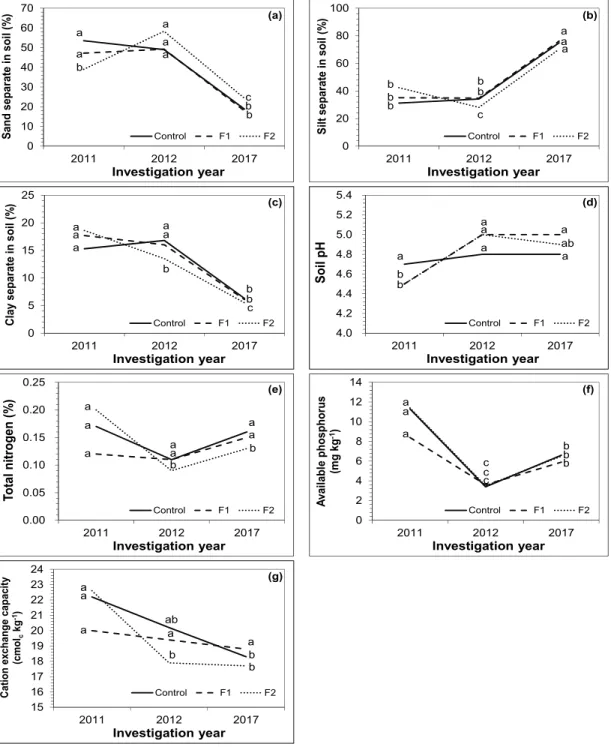
느티나무 조림지 내 시간 경과에 따른 토양 특성은 토 성, pH, 전질소, 유효인산, C.E.C., 치환성양이온 등에서 유의한 차이를 보였다(Figure 1).
토성은 시간 경과에 따라 대조구와 F1 처리구에서 모 래와 점토 비율은 감소하고, 미사 비율은 증가하였으며, F2 처리구에서는 조사 시기별 변이가 크게 나타났다
[Figure 1(a), (b), (c)]. 일반적으로 토양의 물리적 특성은 화학적 특성에 비해 단기간에 쉽게 변화하지 않는 것으 로 알려져 있으나(Jin et al., 1994) 본 연구에서는 처리구 별 조사 시기마다 토성이 다르게 나타났으며, 이는 벌채, 조림예정지 정리, 식재 등의 조성 작업 전과정에서 이루 어진 토양 교란이 시간 경과에 따라 안정화되면서 함수 율의 변화와 관련이 있는 것으로 예상된다(Burke et al., 1988; Vesterdal et al., 2008). 한편 산림 토양의 생산력에 영향을 미치는 토성이 시간 경과에 따라 변화하였으므로 느티나무 조림목이 이용할 수 있는 토양 내 수분, 양분 등 보유능력이 달라지고 있는 것으로 판단된다(Cho, 2002; Brady and Weil, 2010; Kim et al., 2014).
토양 pH는 시간 경과에 따라 대조구에서는 차이가 없 었고, F1과 F2 처리구에서는 증가하는 결과를 나타냈다 [Figure 1(d)]. 시비 처리 후 토양 pH 값의 변화에 따라 토 양 내 잠재적 양분 결핍을 추측할 수 있는데(Kim et al., 2012) 이는 Yang et al.(2013)이 보고한 경기도 리기다소 나무림 평균 pH(4.64)보다 약 0.3 높은 수준으로 토성과 동일하게 시간 경과에 따라 지력이 회복되고 있는 것으 로 판단된다.
전질소 농도는 시간 경과에 따라 대조구와 F1 처리구에 서는 차이가 없었고, F2 처리구에서는 감소하는 결과를
보였다[Figure 1(e)]. 이는 느티나무 조림목이 질소 양분을 흡수하여 생장에 이용하였을 것으로 판단된다(Kim et al., 2012). 또한 2017년에는 2012년에 비하여 약 0.04%가 증 가하였으나 시비 처리 전보다 낮은 수준을 보이고 있다.
Jeong et al.(2002)이 보고한 경기도 산림 토양 A층의 평균 전질소 농도(0.19 %)보다 낮은 수준이기 때문에 여전히
조림지 토양 내 전질소 농도는 부족한 것으로 보이며, 리 기다소나무 벌채지 내 토양 생산성 회복 및 조림목 품질 향상을 위한 시비 필요성을 보여주고 있다.
유효인산 농도는 시간 경과에 따라 2011년 > 2017년 >
2012년 순으로 세 처리구에서 모두 같은 경향을 보였다 [Figure 1(f)]. 2017년에는 2012년에 비하여 2.2-3.3 mg kg-1
a
a
b
a a
b b
a
c
0 10 20 30 40 50 60 70
2011 2012 2017
Sand separate in soil (%)
Investigation year
Control F1 F2
(a)
b
b
a
b b
a
b
c
a
0 20 40 60 80 100
2011 2012 2017
Silt separate in soil (%)
Investigation year
Control F1 F2
(b)
a
a
b
a a
b a
b
c 0
5 10 15 20 25
2011 2012 2017
Clay separate in soil (%)
Investigation year
Control F1 F2
(c)
a a
a
b
a a
b
a
ab
4.0 4.2 4.4 4.6 4.8 5.0 5.2 5.4
2011 2012 2017
Soil pH
Investigation year
Control F1 F2
(d)
a
a
a
a a
a a
b
b
0.00 0.05 0.10 0.15 0.20 0.25
2011 2012 2017
Total nitrogen (%)
Investigation year
Control F1 F2
(e)
a
c
b a
c b
a
c
b
0 2 4 6 8 10 12 14
2011 2012 2017
Available phosphorus (mg kg-1)
Investigation year
Control F1 F2
(f)
a
ab
b
a a
a a
b
b
15 16 17 18 19 20 21 22 23 24
2011 2012 2017
Cation exchange capacity (cmolckg-1)
Investigation year
Control F1 F2
(g)
Figure 1. Changes in sand (a) silt (b) and clay (c) separate in soil, pH (d), total nitrogen (e), available phosphorus (f) and cation exchange capacity (g) within soil over time after planting. Small letters indicate significant differences among investigation year in the same fertilization level (P < 0.05). Control: no fertilization, F1: 21.6 kg N ha-1 + 28.8 kg P ha-1 + 7.2 kg K ha-1, and F2: 43.2 kg N ha-1 + 57.6 kg P ha-1 + 14.4 kg K ha-1.
의 범위로 증가하였으나 시비 처리 전보다 낮은 수준을 보이고 있으며, 경기도 산림 토양 A층의 평균 유효인산 농도(34.1 mg kg-1)보다 매우 낮은 수준이기 때문에 전질 소 농도와 동일하게 여전히 조림지 토양 내 유효인산 농 도는 부족한 수준이다(Jeong et al., 2002). 토양 내 유효 인산 농도는 토양 pH가 높아질수록 증가하는 양의 상관 관계를 갖고 있으며(Hwang and Son, 2006), 시비 처리 후 토양 내 잔존 변화가 크게 나타나는 것으로 보고되어 있 으나(Kim et al., 2016) 본 연구에서는 나타나지 않았다.
이는 시비 처리를 하였음에도 불구하고 식재 당시 조림 지 토양 내 유효인산 농도가 매우 낮아 다비성 수종인 느 티나무 조림목이 초기 생장 시 이용할 수 있는 유효인산 농도가 부족하였기 때문으로 판단된다. 또한 느티나무 조림지 토양 내 시비 처리 전 유효인산 농도는 경기도 리 기다소나무림의 평균 유효인산 농도(14.4 mg kg-1)보다 낮은 수준이었다(Yang et al., 2013).
양이온치환용량은 시간 경과에 따라 대조구와 F2 처리 구에서는 감소하고 F1 처리구에서는 차이가 없었으며, 전질소, 유기물 등 다른 토양 특성들과는 다르게 시간이
경과할수록 점차 줄어드는 경향을 보였다[Figure 1(g)].
양이온치환용량은 토양 내 점토 및 유기물 농도와 정의 상관관계를 갖고 있는데(Drake and Motto, 1982) 본 연구 에서도 양이온치환용량이 감소할수록 토양 내 점토 비율 이 감소하는 정의 상관 결과가 나타났다. 또한 광물질 토 양층이 노출되어 강우나 바람에 의해 토양 내 양이온치 환용량이 감소하는 것으로 알려져 있는데(Meyer et al., 2004; Neary et al., 2005) 본 연구에서 시비 처리 전과 비 교하여 2012년에 감소하게 된 원인은 다비성 수종인 느 티나무 조림목이 초기 생장 시 이용하였기 때문으로 판 단된다.
2. 조림목 생장 특성 1) 근원경 및 수고
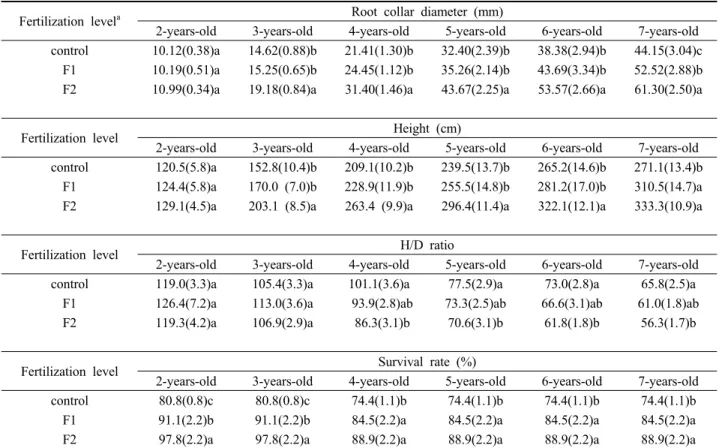
시비 수준에 따른 느티나무 조림목의 수령별 근원경과 수고는 Table 3에 제시하였으며, 근원경과 수고는 식재 2 년차인 3년생부터 차이가 나타나기 시작하였다. 3년생부 터 6년생까지 느티나무 조림목의 근원경과 수고는 F2 처 리구 > F1 처리구 = 대조구 순으로 나타났으나, 7년생
Fertilization levela Root collar diameter (mm)
2-years-old 3-years-old 4-years-old 5-years-old 6-years-old 7-years-old control 10.12(0.38)a 14.62(0.88)b 21.41(1.30)b 32.40(2.39)b 38.38(2.94)b 44.15(3.04)c
F1 10.19(0.51)a 15.25(0.65)b 24.45(1.12)b 35.26(2.14)b 43.69(3.34)b 52.52(2.88)b F2 10.99(0.34)a 19.18(0.84)a 31.40(1.46)a 43.67(2.25)a 53.57(2.66)a 61.30(2.50)a
Fertilization level Height (cm)
2-years-old 3-years-old 4-years-old 5-years-old 6-years-old 7-years-old control 120.5(5.8)a 152.8(10.4)b 209.1(10.2)b 239.5(13.7)b 265.2(14.6)b 271.1(13.4)b
F1 124.4(5.8)a 170.0 (7.0)b 228.9(11.9)b 255.5(14.8)b 281.2(17.0)b 310.5(14.7)a F2 129.1(4.5)a 203.1 (8.5)a 263.4 (9.9)a 296.4(11.4)a 322.1(12.1)a 333.3(10.9)a
Fertilization level H/D ratio
2-years-old 3-years-old 4-years-old 5-years-old 6-years-old 7-years-old control 119.0(3.3)a 105.4(3.3)a 101.1(3.6)a 77.5(2.9)a 73.0(2.8)a 65.8(2.5)a
F1 126.4(7.2)a 113.0(3.6)a 93.9(2.8)ab 73.3(2.5)ab 66.6(3.1)ab 61.0(1.8)ab F2 119.3(4.2)a 106.9(2.9)a 86.3(3.1)b 70.6(3.1)b 61.8(1.8)b 56.3(1.7)b
Fertilization level Survival rate (%)
2-years-old 3-years-old 4-years-old 5-years-old 6-years-old 7-years-old control 80.8(0.8)c 80.8(0.8)c 74.4(1.1)b 74.4(1.1)b 74.4(1.1)b 74.4(1.1)b
F1 91.1(2.2)b 91.1(2.2)b 84.5(2.2)a 84.5(2.2)a 84.5(2.2)a 84.5(2.2)a
F2 97.8(2.2)a 97.8(2.2)a 88.9(2.2)a 88.9(2.2)a 88.9(2.2)a 88.9(2.2)a
The values in parentheses are standard errors of mean (n=60). Small letters indicate significant differences among fertilization level in the same tree age (P < 0.05). aControl: no fertilization, F1: 21.6 kg N ha-1 + 28.8 kg P ha-1 + 7.2 kg K ha-1, and F2: 43.2 kg N ha-1 + 57.6 kg P ha-1 + 14.4 kg K ha-1
Table 3. The root collar diameter, height, H/D ratio and survival rate of Zelkova serrata trees according to fertilization level.
부터 근원경(mm)은 F2 처리구(61.30) > F1 처리구(52.52)
> 대조구(44.15), 수고(cm)는 F2 처리구(333.3) = F1 처리 구(310.5) > 대조구(271.1) 순으로 변화가 나타났다. 한편 느티나무 조림목이 7년생일 때 F2 처리구의 근원경 값은 대조구보다 약 1.4배, 수고는 약 1.2배 높았다.
Yang et al.(2014)은 리기다소나무 벌채지 내 느티나무 용기묘를 식재하고 지속적으로 생장 결과를 분석하였다.
그 결과 느티나무 조림목이 5년생일 때 근원경은 21.72 mm, 수고는 152.7 cm로 조사되었고, 본 연구의 대조구보 다 근원경은 약 0.7배, 수고는 약 0.6배 낮은 수준을 보였 다. 이는 토양 특성 결과에서 언급했듯이 리기다소나무 벌채지의 토양 양분과 생산성 부족에 의한 것으로 벌채 전 임분의 특성과 입지환경 차이에 따른 결과로 판단된 다. 특히 식재 사면, 경사, 유효인산, 치환성양이온 농도 등의 차이가 생장에 영향을 준 것으로 판단된다. 또한 Yang et al.(2014)의 느티나무 조림지 내 토양 특성 결과 를 보면, 시간 경과에 따라서 토양 내 전질소, 유효인산, 유기물 등이 감소하는 경향을 보였다. 그러나 본 연구 대 상지에서는 시비 처리 후 시간 경과에 따라 토양 내 pH, 전질소, 유기물 및 유효인산 농도가 감소했다가 증가하 는 결과(Figure 1)를 보여 리기다소나무 벌채 후 시비 처 리가 느티나무 조림목의 생장에 밀접한 영향을 주고 있 는 것을 알 수 있다.
Byun et al.,(2007)은 자작나무와 상수리나무 묘목을 포 트에 식재 후 3년 동안 시비 처리를 하였고 이에 따른 근 원경과 수고 생장 변화를 조사한 결과, 식재 당해부터 생 장 차이가 나타났으며 식재 3년차인 5년생일 때 시비 처 리구에서 근원경과 수고 생장 모두 대조구보다 약 3배 (자작나무), 약 7-9배(상수리나무) 높았다고 보고한 바 있 다. 이는 시비의 효과가 제한적인 공간 내에서 양분 공급 이 이루어져 급격한 생장 차이를 나타낸 것이다. 본 연구 에서는 면적의 제한이 없고 하층 식생과의 경쟁도 있어 온전히 시비의 효과를 받지 못해 포트 실험 보다는 시비 의 효과가 크게 나타나지 않은 것으로 판단되지만, 조림 지 토양 개선과 조림목의 생존 및 품질 향상을 위해서는 시비 처리가 필요한 것으로 보인다.
2) H/D율 및 생존율
시비 수준에 따른 느티나무 조림목의 H/D율은 4년생 부터 F2 처리구에서 다른 처리구보다 유의하게 낮았으 며, 모든 처리구에서 시간 경과에 따라 감소하는 경향을 보였다(Table 3). 일반적으로 5-10년생까지의 조림목은 H/D율이 낮아질수록 조림지 환경 조건에 적응하며 건조, 동해, 풍해 등으로부터 오는 피해에 대한 강한 저항성을 보이는 것으로 알려져 있다(Burdett, 1990; Cho et al.,
2012; Grossnickle, 2012). 따라서 느티나무 조림목은 안 정적으로 뿌리 활착을 하고 지속적인 생장으로 품질이 향상되고 있는 것으로 판단된다.
시비 수준에 따른 7년생 느티나무 조림목의 생존율(%) 은 대조구 74, F1 처리구 85, F2 처리구 85 등이었으며, 대조구에서 유의하게 낮은 것으로 나타났다(Table 3). 대 조구에서 생존율이 가장 낮은 것은 식재 초기에 생장 저 하로 하층 식생과의 경쟁에서 우위를 점하지 못해 다른 두 시비 처리구보다 생존율이 낮은 것으로 판단된다. 한 편 식재 후 6년이 경과되었기 때문에 기후이상, 태풍 등과 같은 자연재해나 인위적 피해를 입지 않는 이상 현재의 생존율 수준을 유지할 것으로 예상된다.
3) 수간 재적
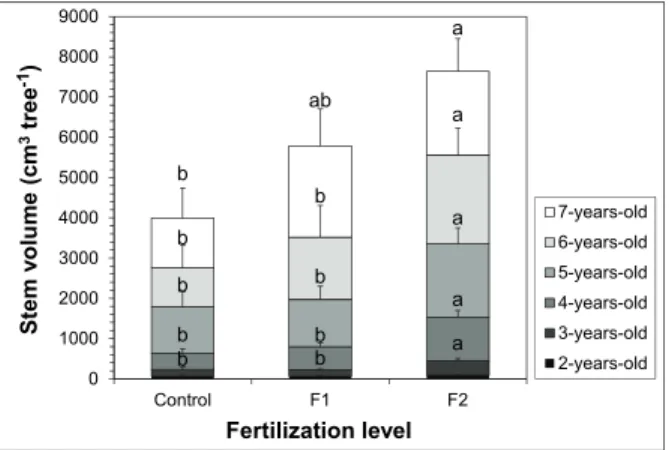
시비 수준에 따른 느티나무 조림목의 수령별 수간 재 적(㎤ 본-1)은 Figure 2에 제시하였으며, 식재 2년차인 3년 생부터 차이가 나타나기 시작하였다. 3년생부터 6년생까 지 느티나무 조림목의 수간 재적은 F2 처리구 > F1 처리 구 = 대조구 순으로 나타났으나, 7년생부터 F2 처리구 (7635) ≒ F1 처리구(5787) > 대조구(3995) 순으로 변화 가 나타났다. 한편 느티나무 조림목이 7년생일 때 F2 처 리구의 수간 재적은 대조구보다 약 1.9배 높았다. 시비 처리에 따른 결과로 식재 및 시비 2년차부터 지속적으로 시비 효과가 발현되어 시비 수준에 따른 수간 재적 생장 차이가 뚜렷하게 나타났으나, 시간이 경과할수록 비료가 소진되어 시비 효과가 감소하고 있다. 그러나 식재 초기 시비 효과에 따라 생장 촉진, 하층 식생과의 경쟁 우위, 생존율 향상 등의 긍정적 영향으로 결과적으로는 대조구 에 비해 우수한 조림목의 품질과 생존을 보여주고 있는 것으로 보인다. 또한 식재 초기 시비 후 시간 경과에 따 른 어린나무가꾸기 시비 시기 선정과 방법 등 기술 개발 에 활용할 수 있을 것으로 기대된다.
Park et al.(2004)은 리기다소나무 벌채지 내 상수리나 무를 식재하였으며, 식재 1년차에 산림용 고형복합비료 를 5개/본, 2년차에는 7개/본 씩 시비 처리하였다. 그 결 과 식재 당해부터 시비 처리에 따른 생장 차이가 나타났 으며, 식재 4년차 시비 처리구에서 상수리나무 조림목이 5년생일 때 근원경은 약 1.4배, 수고는 약 1.2배, 수간 재 적은 약 2.4배 대조구에 비해 높았다고 보고하였다. 이는 본 연구의 시비 처리 방법과 조림 수종은 다르지만 시비 처리가 조림목의 생장과 밀접한 관계가 있다는 것을 나 타내는 결과로서 시비의 필요성을 명확하게 보여주고 있다.
느티나무는 다비성 수종으로(Cho et al., 2015) 초기 생 장 시 많은 양분을 필요로 하기 때문에 F1 처리구보다 양 분이 많은 F2 처리구에서 근원경, 수고 및 수간 재적 생
b b a
b b
b b a
b a
b
a
b
ab
a
0 1000 2000 3000 4000 5000 6000 7000 8000 9000
Control F1 F2
Stem volume (cm3tree-1)
Fertilization level
7-years-old 6-years-old 5-years-old 4-years-old 3-years-old 2-years-old
Figure 2. The stem volume of Zelkova serrata trees according to fertilization level. The vertical bars represent standard errors of the mean (n=60). Small letters indicate significant differences among fertilization level in the same age (P < 0.05). Control:
no fertilization, F1: 21.6 kg N ha-1 + 28.8 kg P ha-1 + 7.2 kg K ha-1, and F2: 43.2 kg N ha-1 + 57.6 kg P ha-1 + 14.4 kg K ha-1.
장이 가장 높았던 것으로 판단된다(Lee, 1986; Hwang et al., 2013). 특히 용기묘 식재는 높은 활착과 생장에 의한 조림 성과 향상으로 이어지는 결과를 나타내기 때문에 본 연구에서도 시비 처리 효과에 대한 느티나무 조림목 의 생장 반응이 바로 나타난 것으로 보인다(Cho et al., 2012; Wilson et al., 2007). 그러나 7년생일 때 F1과 F2 처리구 간 조림목의 수고 및 수간 재적 생장 차이가 없어 져 식재 초기와 6년 후의 결과는 달라진 것을 확인할 수 있다. 이는 리기다소나무 벌채지 내 느티나무 식재 시 F1 시비 수준도 조림목의 생존과 생장은 문제없는 것으로 판단된다.
Baribault et al. (2010)은 조림목의 생장에 가장 밀접한 관계를 갖고 있는 인자로 토양 내 유효인산, 전질소, 치 환성 Ca2+ 농도라고 보고하였으며, 본 연구에서도 동일한 결과를 보였다. 결과적으로 토양 내 전질소 및 유효인산 농도가 부족한 리기다소나무 벌채지에 느티나무 식재 시 조림목의 생존 및 품질 향상과 경제적 효율성을 동시에 만족시키기 위해서는 F1 처리구 수준의 시비량을 제안할 수 있을 것으로 판단된다.
결 론
본 연구는 시비 처리에 따른 리기다소나무 벌채지 내 식재된 느티나무 조림지의 토양 특성 변화와 조림목의 생장 특성을 연차적으로 분석하여 느티나무 조림목의 생 존 및 품질 향상을 위한 적정 시비량을 제시하고자 수행 되었다.
시비 수준에 따른 느티나무 조림지 내 토양 특성은 2011년 토양 내 모래 비율, 2012년 토양 내 모래 및 미사
비율, C.E.C.를 제외하고는 차이를 보이지 않았다. 그러 나 시간 경과에 따라서는 토성, pH, 전질소, 유효인산, C.E.C., 치환성양이온 등에서 유의한 차이를 보였다. 한 편 조림목의 생장에 밀접한 관계를 갖고 있는 토양 내 전 질소와 유효인산 농도는 시비 처리 후에도 경기도 산림 토양 A층의 평균 수준에 비하여 부족한 것으로 결과가 나타났다.
시비 수준에 따른 느티나무 조림목의 근원경, 수고 및 수간 재적 생장은 식재 2년차부터 F2 처리구에서 다른 조사구보다 유의하게 높은 것으로 나타났으며, 이는 느 티나무 조림목이 초기 생장 시 많은 양분을 필요로 하는 것을 보여준다. 또한 생존율은 대조구에서 가장 낮았으 며 이는 식재 초기에 생장 저하로 하층 식생과의 경쟁에 서 우위를 점하지 못했기 때문으로 판단된다. 그러나 식 재 6년 후부터 F1과 F2 처리구 간 조림목의 수고와 수간 재적 생장 차이가 없어 시간이 경과할수록 비료가 소진 됨에 따라 시비 효과가 감소된 것으로 판단된다. 이는 식 재 초기 시비 효과에 따라 생장 촉진, 하층 식생과의 경 쟁 우위, 생존율 향상 등의 긍정적 영향으로 대조구에 비 해 우수한 조림목의 생존과 품질을 보여주는 것이다.
결과적으로 토양 내 전질소 및 유효인산 농도가 부족 한 리기다소나무 벌채지에 느티나무 식재 시 조림목의 생존 및 품질 향상과 경제적 효율성을 동시에 만족시키 기 위해서는 F1 처리구 수준의 시비량을 제안할 수 있을 것으로 판단된다.
References
Baribault, T.W., Kobe, R.K. and Rothstein, D.E. 2010. Soil calcium, nitrogen, and water are correlated with aboveground net primary production in northern hardwood forests. Forest Ecology and Management 260(5): 723-733.
Binkley, D. 1986. Forest Nutrition Management. Willey, USA.
pp. 304.
Binkley, D. and Fisher, R.F. 2013. Ecology and Management of Forest Soils. 4th Ed. Willey, USA. pp. 347.
Brady, N.C. and Weil, R.R. 2010. Elements of the Nature and Properties of soils. 3rd Ed. Pearson, USA. pp. 614.
Burdett, A.N. 1990. Physiological processes in plantation establishment and the development of specifications for forest planting stock. Canadian Journal of Forest Research 20(4): 415-427.
Burdett, A.N., Herring, L.J. and Thompson, C.F. 1984. Early growth of planted spruce. Canadian Journal of Forest Research 14(5): 644-651.
Burke, I.C., Yonker, C.M., Parton, W.J., Cole, C.V., Schimel,
D.S. and Flach, K. 1988. Texture, climate, and cultivation effects on soil organic matter content in U.S. grassland soils. Soil Science Society of America Journal 53(3):
800-805.
Byun, J.K., Kim, Y.S., Yi, M.J., Son, Y., Kim, C., Jeong, J.H., Lee, C.Y. and Jeong, Y.H. 2007. Growth response of Pinus densiflora, Larix leptolepis, Betula platyphylla var. japonica and Quercus acutissima seedlings at various levels of fertilization. Journal of Korean Forest Society 96(6): 693-698.
Cho, B.H. 2002. Soil Science. Hyangmunsa, Seoul, Korea. pp.
56-57.
Cho, K.T., Jeong, H.M., Han, Y.S. and Lee, S.H. 2014.
Variation of ecological niche of Quercus serrata under elevated CO2 concentration and temperature. Korean Journal of Environment and Biology 32(2): 95-101.
Cho, M.S., Jeong, J. and Yang, A-R. 2017a. Growing density and cavity volume of container influence major temperate broad-leaved tree species of physiological characteristics in nursery stage. Journal of Korean Forest Society 106(1):
40-53.
Cho, M.S., Kim, G.N., Lee, S.T. and Moon, H.S. 2012. Effects of fertilization treatments on growth of container and bare root seedlings of Pinus densiflora. Journal of Agriculture
& Life Science 46(2): 63-73.
Cho, M.S., Meng, L., Song, J.H., Han, S.H., Bae, K. and Park, B.B. 2017b. The effects of biochars on the growth of Zelkova serrata seedlings in a containerized seedling production system. Forest Science and Technology 13(1): 25-30.
Cho, M.S., Yang, A-R. and Hwang, J. 2015. Growth performances of container seedlings of deciduous hardwood species grown at three different fertilization treatments. Journal of Korean Forest Society 104(1): 90-97.
Drake, E.H. and Motto, H.L. 1982. An analysis of the effect of clay and organic matter content on the cation exchange capacity of New Jersey soils. Soil Science 133(5) 281-288.
Fukatsu, E., Isoda, K., Hirao, T., Takashi, m. and Watanabe, A. 2005. Development and characterization of simple sequence repeat DNA markers for Zelkova serrata.
Molecular Ecology Notes 5: 378-380.
Grossnickle, S.C. 2012. Why seedlings survive: influence of plant attributes. New Forests 43: 711-738.
Hwang, J., Cho, M.S., Kim, W.K., Kim, S.K, Park, B.B. and Lee, S.W. 2013. Development of Container Nursery Production System for High Quality Seedling. National Institute of Forest Science. Seoul, Korea. Research report 13-12. pp. 194.
Hwang, J. and Son, Y. 2006. Short-term effects of thinning
and liming on forest soils of pitch pine and Japanese larch plantations in central Korea. Ecological Research 21(5):
671-680.
Hwang, J.O., Son, Y., Yi, M.J., Byoun, J.K., Jung, J.H. and Lee, C.Y. 2003. Studies on relationship between composition and type of fertilizer and seedling. Forest Bioenergy 22(2):
44-53.
Jeong, J.H., Koo, K.S., Lee, C.H. and Kim, C.S. 2002.
Physico-chemical properties of Korean forest soils by regions. Journal of Korean Forestry Society 91(6): 694-700.
Jin, H.O., Yi, M.J., Shin, Y.O., Kim, J.J. and Jeon, S.K. 1994.
Forest Soil. Hyangmunsa, Seoul, Korea. pp. 325.
Jones Jr, J.B. 1999. Soil and Plant Analysis Laboratory Registry. 2nd Ed. Soil and Plant Analysis Council. CRC Press LLC. Florida, USA. pp. 209.
KFS (Korea Forest Service). 2018a. Annual Action Plan of Forest Resources. Korea Forest Service, Korea. pp. 312.
KFS (Korea Forest Service). 2018b. Results of Silviculture in 2017. Korea Forest Service, Korea. pp. 653.
KFS (Korea Forest Service). 2018c. Statistical Yearbook of Forestry. Korea Forest Service, Korea. pp. 444.
Kim, C., Jo, C.G., Baek, G., Park, S.W., Cho, H.S. and Ma, H.S. 2016. Soil physiochemical properties of tree plantations in a fire-disturbed forest and an undisturbed stand in Ulsan metropolitan city. Journal of Korean Forestry Society 105(2): 167-176.
Kim, C., Kim, W.S., An, H.C., Cho, H.S., Choo, G.C. and Lim, J.T. 2012. Short-term effects on soil property and leaf characteristics after soil amendment treatments in chestnut (Castanea crenata S. et Z.) orchards. Journal of Korean Forestry Society 101(3): 405-411.
Kim, C., Son, Y., Lee, W.K., Jeong, J. and Noh, N.J. 2009.
Influence of forest tending works on carbon distribution and cycling in a Pinus densiflora S. et Z. stand in Korea.
Forest Ecology and Management 257: 1420-1426.
Kim, I.S. and Lee, J.H. 2013. Geographic variation of seed characteristics and 1-year-old seedling growth of Zelkova serrata. Korean Journal of Agricultural and Forest Meteorology 15(4): 234-244.
Kim, J.H., Kim, E.K., Kim, W.T. and Yoon, Y.H. 2014. The effects of functional pipe on Zelkova serrata growth in poorly drained planting ground. Journal of Environmental Science International 23(1): 81-88.
Kim, J.S., Son, Y., Lim, J.H. and Kim, Z.S. 1996. Aboveground biomass, N and P distribution, and litterfall in Pinus rigida and Larix leptolepis plantations. Journal of Korean Forestry Society 85(3): 416-425.
Kolb, T.E., Bowersox, T.W. and McCormick, L.H. 1990.
Influence of light intensity on weed-induced stresses of
tree seedlings. Canadian Journal of Forest Research 20(5):
503-507.
Kozlowski, T.T. and Pallardy, S.G. 1996. Physiology of Woody Plants. 2nd Ed. Academic Press Inc., Oval Road, London.
pp. 411.
Lee, C.B. 1986. Dendrology. Hyangmunsa, Seoul, Korea. pp.
161.
Lee, C.Y., Jeong, J.H., Son, Y., Byun, J.K. and Koo, C.D.
2009. Forest soils. Korean Journal of Soil Science and Fertilizer 42(1): 238-258.
Lee, C.Y. and Park, B.W. 1988. Prospects and effect of forest fertilization. Journal of Korean Forestry Society 77(1):
109-115.
Lee, I.K. and Son, Y. 2004. Effects of nitrogen and phosphorus fertilization on soil chemical properties of Pinus rigida and Larix kaempferi plantations in Yangpyeong area, Gyeonggi province. Journal of Korean Forestry Society 93(5): 349-359.
McMillin, J.D. and Wagner, M.R. 1995. Effects of water stress on biomass partitioning of ponderosa pine seedlings during primary root growth and shoot growth periods. Forest Science 41(3): 594-610.
Meyer, V.F., Redente, E.F., Barbarick, K.A., Brobst, R.B., Paschke, M.W. and Miller, A.L. 2004. Plant and soil responses to biosolids application following forest fire.
Journal of Environmental Quality 33: 873-881.
Nambiar, E.K.S. and Sands, R. 1993. Competition for water and nutrients in forests. Canadian Journal of Forest Research 23(10): 1955-1968.
Neary, D.G., Ryan, K.C. and DeBano, L.F. 2005. Wildland fire in ecosystems: effects of fire on soil and water. Gen. Tech.
Rep. RMRS-GTR-42-vol.4. Ogden, UT: U.S. Department of Agriculture, Forest Service, Rocky Mountain Research Station, USA. pp. 250.
NIFoS (National Institute of Forest Science). 2005. Standard Textbook on Forest Tending Work. I. General Forest.
Korea: National Institute of Forest Science, pp. 64-73.
Oh, K.I., Cho, H.D., An, K.W. and Kim, C. 1999. Changes of ion concentrations in soil solution according to different cutting intensities and sampling times in Pinus rigida plantations. Journal of Korean Forestry Society 88(4):
438-445.
Oyama, H., Fuse, O., Tomimatsu, H. and Seiwa, K. 2018.
Variable seed behavior increases recruitment success of a hardwood tree, Zelkova serrata, in spatially heterogeneous forest environments. Forest Ecology and Management 415-416: 1-9.
Park, J.H. 2014. Phytochemical variation of Quercus mongolica Fisch. ex Ledeb. and Quercus serrata murray (Fagaceae)
in Mt. Jiri, Korea. Korean Journal of Environment and Ecology 28(5): 574-587.
Park, J.H., Jung, S.Y., Yoo, B.O., Ju, N.G., Lee. K.S., Park, Y.B. and Kim, H.H. 2015. Comparison of height and DBH growth characteristics for Quercus acuta and Quercus serrata in southern Korea. Journal of Agriculture & Life Science 49(6): 19-26.
Park, J.H., Oh, K.I., An, K.W. and Kim, C. 2004. Growth characteristics of Quercus acutissima seedlings planted in various of strip clear-cutting of Pinus rigida plantations.
Journal Korean Forestry Society 93(5): 360-371.
Pinto, J.R., Marshall, J.D., Dumroese, R.K., Davis, A.S. and Cobos, D.R. 2011. Establishment and growth of container seedlings for reforestation: A function of stocktype and edaphic conditions. Forest Ecology and Management 261(11): 1876-1884.
RDA (Rural Development Administration). 2000. Soil and Plant Analysis. National Institute of Agricultural Sciences, Rural Development Administration. pp. 202.
Smith, D.M., Larson, B.C., Kelty, M.J. and Ashton, P.M. 1996.
The Practice of Silviculture: Applied Forest Ecology. 9th Ed. Wiley, USA. pp. 537.
Son, Y., Park, I.H., Yi, M.J., Jin, H.O., Kim, D.Y., Kim, R.H.
and Hwang, J.O. 2004. Biomass, production and nutrient distribution of a natural oak forest in central Korea.
Ecological Research 19(1): 21-28.
van den Driessche, R., Rude, W. and Martens, L. 2003. Effect of fertilization and irrigation on growth of aspen (Populus tremuloides Michx.) seedlings over three seasons. Forest Ecology and Management 186: 381-389.
Vesterdal, L., Schmidt, I.K., Callesen, I., Nilsson, L.O. and Gundersen, P. 2008. Carbon and nitrogen in forest floor and mineral soil under six common European tree species.
Forest Ecology and Management 255(1): 35-48.
Welander, N.T. and Ottosson, B. 2000. The influence of low light, drought and fertilization on transpiration and growth in young seedlings of Quercus robur L. Forest Ecology and Management 127: 139-151.
Wilson, E,R., Vitols, K.C. and Park, A. 2007. Root characteristics and growth potential of container and bare-root seedlings of red oak (Quercus rubra L.) in Ontario, Canada. New Forests 34(2): 163-176.
Won, K.R., Hong, N.E., Lee, K.W., Yoo, B.O., Park, Y.B., Jung, S.Y. and Byeon, H.S. 2014. Mechanical and physical wood properties of Quercus serrata due to damaged stands in southern region of Korea. Journal of Agriculture & Life Science 48(6): 133-140.
Yang, A-R., Cho, M.S. and Hwang, J. 2014. The effects of seedling types and soil properties in relation to aspects
on the early growth of planted Zelkova serrata seedlings.
Journal of Agriculture & Life Science 48(4): 1-12.
Yang, A-R., Hwang, J., Cho, M.S. and Son, Y. 2016. The effect of fertilization on early growth of konara oak and Japanese zelkova seedlings planted in a harvested pitch pine plantation. Journal of Forestry Research 27(4):
863-870.
Yang, A-R., Hwang, J., Cho, M.S. and Song, S.W. 2013. Soil physical and chemical properties with plantation regions and stand age in Pinus rigida and Larix kaempferi plantations. Journal of Korean Forestry Society 102(4):
578-586.
Yoon, T.K., Zhao, Y., Noh, N.J., Han, S., Kang, H. and Son, Y. 2014. Early fertilization and absorbent treatments continuously enhanced windbreak tree growth and soil properties in the Hetao Plain of Inner Mongolia, China.
Forest Science and Technology 10(1): 46-50.
Manuscript Received : January 29, 2019 First Revision : February 18, 2019 Accepted : February 25, 2019