I. 서 론
심혈관계 질환은 현대사회에서 가파르게 증가하고 있 는 질환으로, 2018년 통계청 자료에 따르면 암에 이은 한국인 주요 사망원인 2위를 차지하고 있다(Shin et al., 2020). 이로 인한 사회 경제적 비용이 큰 폭으로
증가하고 있으며 이에 따라 심혈관 질환의 위험요인을 규명하고자 하는 연구들이 활발히 진행되고 있다 (Yusuf et al., 2001). 기존에 잘 알려진 고혈압, 당뇨, 대사 증후군 등 외에도 근로자를 대상으로 한 업무 스 트레스, 교대근무 여부 등 직업적 요인에 대한 심혈관계 질환 위험 요인에 대한 다양한 연구 또한 이루어졌다
https://doi.org/10.15269/JKSOEH.2021.31.2.119
국내 임금근로자에서 고용형태에 따른 hs-CRP level과의 연관성
주재한1ㆍ이준희1,2*
1순천향대학교 부속 서울병원, 2순천향대학교 의과대학
Association between Employment Status and hs-CRP Level in Korean Wage Workers
Jae-Han Joo1ㆍJune-Hee Lee1,2*
1Department of Occupational and Environmental Medicine, Soonchunhyang University Hospital, Seoul
2Department of Occupational and Environmental Medicine, Soonchunhyang University College of Medicine
ABSTRACT
Objectives: We aimed to find the relationships between employment status and hs-CRP level among Korean wage workers using the 2016 Korean National Health and Nutrition Examination (KNHANE, revised).
Methods: This study was conducted on 1,937 daytime wage workers over the age of 19 and within a normal weight range (18.5≤BMI≺25). Regular workers were defined as those granted an employment guarantee until reaching retirement age, and non-regular workers were defined as temporary, non-typical, dispatched, short-term workers and contractors. For hs-CRP, three divisions were classified as recommended by the Centers for Disease Control and Prevention (CDC) and American Heart Association (AHA) with less than 1.0 mg/L indicating low risk of cardiovascular disease, above 1.0 mg/L and below 3.0 mg/L considered moderate risk, and more than 3.0 mg/L indicating high risk. To find the relationship between work type and hs-CRP level in Korean wage workers, multinominal logistic regression analysis was performed.
Results: For non-regular workers, the odds ratio of the cardiovascular moderate-risk group and cardiovascular high-risk group was statistically significant compared to regular workers. After adjusting for factors such as gender, age, subjective health status, income, education, smoking, and physical labor, the odds ratio of the cardiovascular high-risk group was statistically significant.
Conclusions: In this study, the relationship between non-regular workers and high hs-CRP level was examined. Based on this, institutional strategies should be pursued to prevent and manage cardiovascular disease among non-regular workers.
Key words: employment status, hs-CRP, non-regular worker, the Korean National Health and Nutrition Examination (KNHANE)
*Corresponding author: June-Hee Lee, Tel: 02-709-9452, E-mail: [email protected]
Department of Occupational and Environmental Medicine, Soonchunhyang University Hospital, Seoul. 59, Daesagwan-ro, Yongsan-gu, Seoul, Republic of Korea, 04401
Received: April 29, 2021, Revised: May 20, 2021, Accepted: June 29, 2021
Jae-Han Joo http://orcid.org/0000-0003-2043-8491 June-Hee Lee http://orcid.org/0000-0002-7682-6023 This is an Open-Access article distributed under the terms of the Creative Commons Attribution Non-Commercial License (http://creativecommons.org/licenses/by-nc/3.0) which permits unrestricted non-commercial use, distribution, and reproduction in any
(Tenkanen et al., 1997; Engström et al., 2006;
Kivimäki & Kawachi, 2015). 이에 더해 심혈관 질환 의 예방 및 조기진단을 위한 연구들도 진행되었으며 대 표적인 예로 high-sensitivity C-reactive protein (hs-CRP)가 있다. 염증성 생체지표로 잘 알려진 CRP 는 주로 간에서 생산되는 급성기 단백질로서 감염이나 염증 반응의 정도를 반영해 심혈관 질환의 주요 예측인 자로 이용되고 있다(Ridker, 2003).
1990년 이후 측정 민감도가 향상된 hs-CRP가 개발 되었고 2000년대 초 미국 질병통제 예방센터(Centers for Disease Control and Prevention, CDC) 및 미 국심장협회(American Heart Association, AHA)에서 는 hs-CRP를 심혈관 질환의 위험도 평가 및 예후를 추 정하는 지표로 사용할 것을 권고 하였다(Myers et al., 2004).
1997년 외환위기 이후 기업들의 인건비 절감과 구조 조정으로 인한 비정규직의 급증은 심각한 사회문제로 대두되어 왔다. 2019년 10월 통계청에서 발표한 자료 에 따르면 2018년 8월 기준 비정규직 근로자는 전체 임금근로자의 36.4%로 2007년 36.6% 이후 최고수준 을 나타냈다(Korea S, 2018). 또한, 외국의 경우에도 대부분의 유럽연합 회원국에서 1990년대까지 비정규직 의 비율이 30%까지 증가하고 있으며 앞으로 더욱 증가 할 것으로 예측하고 있다(Marmot, 1999; Holmlund
& Storrie, 2002).
비정규직의 증가는 소득 불평등 및 직업의 불안정성 등을 야기할 수 있으며 이러한 직업 불안정성은 개인의 심리적 건강, 근로 의욕 및 직업 만족도 등에 부정적인 영향을 미칠 수 있다. 뿐만 아니라 가족 구성원에게까지 커다란 영향을 미치고 있다(Bartley & Ferrie, 2001;
Keum & Cho, 2001). 선행 연구결과에 따르면 낮은 직 업적 계급을 가진 사람일수록 교대근무, 대기오염, 낮은 업무 통제력 등을 포함한 열악한 환경에서 일할 가능성 이 높다고 하였다. 여기서 말하는 낮은 직업적 계급이란 육체적 노동을 의미하며 이는 비정규직 근로자의 비율이 정규직에 비해 높은 직종이다(Evans & Kantrowitz, 2002). 비정규직 근로는 과도한 음주나 흡연으로 인한 건강의 위험성이 높아지고 각종 암 및 여러 원인으로 인 해 사망에 영향을 미친다는 연구들이 보고되고 있다 (Kivimäki et al., 2003).
몇 가지 기존연구의 예를 보면, Kim et al.(2020)이 발표한 연구에서 직업분류(Managers, Professionals,
Clerks, Services workers, Sales workers, Bule- collar workers, unemployed)에 따른 hs-CRP Level과의 연관성을 규명하고자 하였고, Owen et al.
(2003)이 발표한 연구에선 사회 경제적 지위에 따른 CRP Level과의 연관성을 규명하고자 하였다. Ramsay et al.(2008)이 발표한 연구에서는 직업 분류에 따른 CRP를 포함한 염증 마커 Level과의 연관성을 규명하 고자 하였으며 Pedersen et al.(2017)이 발표한 연구 에선 폐경 후 여성에서 사회 경제적 지위에 따른 CRP Level과의 연관성을 규명하고자 하였다.
이와 같이 기존 연구에서 직업 분류 또는 사회 경제 적 지위에 따른 CRP Level과의 연관성을 살펴본 논문 은 다수 있었으나 정규직 및 비정규직에 대한 연구는 없었으며 국내의 경우에도 최근 직업 분류에 따른 hs-CRP Level과의 연관성을 살펴본 연구가 있었으나 역시 정규직 및 비정규직 고용형태에 관한 연구는 극히 드문 실정이다.
따라서 본 연구에서는 국내 임금 근로자들에서 정규 직 및 비정규직의 고용형태에 따른 hs-CRP Level과의 연관성을 알아보고자 한다.
Ⅱ. 대상 및 방법
1. 연구 대상
국민건강영양조사는 보건복지부 산하 질병관리본부 에서 시행하는 전국 규모의 국민 건강 및 영양상태에 관한 국가 대표 통계조사이다. 이를 통해 산출된 통계와 수집된 자료를 바탕으로 국민 건강증진을 위한 보건정 책과 프로그램, 연구 등에 활용한다. 조사구는 192개로 표본 조사구 내에서 양로원, 군대, 교도소 등의 시설 및 외국인 가구 등을 제외한 적절가구 중 계통추출법을 이 용하여 23개 표본가구를 선정하였다. 표본가구 내에서 는 적정가구원 요건을 만족하는 만 1세 이상의 모든 가 구원을 조사 대상자로 선정하였다. 국민건강영양조사에 서 hs-CRP Level의 측정은 국민건강영양조사 제 6기 3차년도인 2015년부터 포함되었고, 본 연구에서는 제 7기 국민건강영양조사 1차년도(2016)를 이용하였다.
제 7기 국민건강영양조사 1차년도(2016)에는 총 8,150명이 참여하였다. 이 중 만 19세 이상 성인을 대 상으로 하므로 미성년자는 제외하였다. 임금근로자를 대상으로 한 연구이므로 자영업자, 고용주, 무급 가족 종사자 및 모름/무응답 등 불충분한 대답을 한 자를 제
외하였다. 최종적으로 정상체중(18.5≤BMI≺25)을 가 진 주간근무(day-time work)를 하는 국내 임금근로자 (1,937명)을 대상으로 연구를 수행하였다.
2. 변수 설정
일반적 특성으로는 성별(male, female), 나이(<30years, 30-39years, 40-49years, 50-59years, ≥60years), 결 혼여부(unmarried, married, divorced, etc.), 주관적 건강상태(good, normal, poor), 소득수준(high, low), 학력(≤middle school, high school, ≥college), 흡연 (never-smoker or ex-smoker, current smoker) 및 음주여부(≤once a month, ≥twice a month) 등으로 분류하였고, 직업적 특성으로 주당 근무시간(>40hours,
≤40hours), 육체노동 여부(non-physical, physical), 정규직 및 비정규직 여부(regular workers, non- regular workers) 등으로 분류하였다.
독립변수인 고용형태는 정규직의 경우 정년까지 고용 이 보장된 경우로, 비정규직의 경우 한시적, 비전형, 단 시간 근로자 및 도급 등으로 정의하였다.
종속변수인 hs-CRP의 경우 미국 질병관리본부 (CDC) 및 미국 심장학회(AHA)의 권고에 따라 3분위로 분류하였으며, hs-CRP < 1mg/L 인 경우 심혈관 저 위 험군, 1mg/L ≤ hs-CRP ≤ 3mg/L 인 경우 심혈관 중간 위험군, hs-CRP > 3mg/L 인 경우 심혈관 고 위 험군으로 정의하였다.
3. 통계 방법 및 분석
통계프로그램은 SPSS ver. 26.0를 사용하였고, 통계 방법은 기술통계, 교차분석, 다항 로지스틱 회귀분석을 이용하였다. 유의수준은 0.05로 설정하였다.
Ⅲ. 결 과
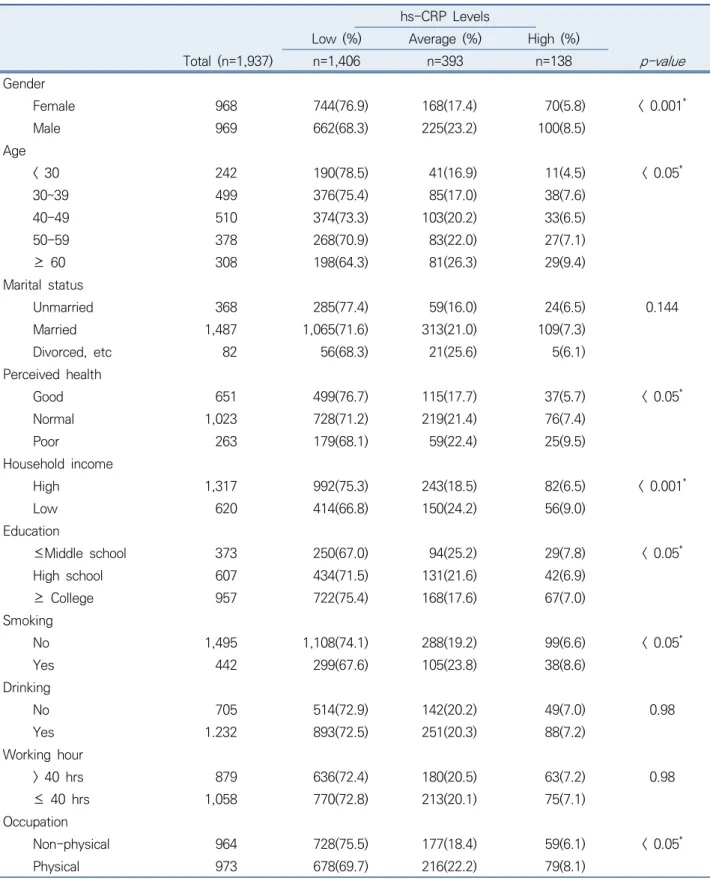
Table 1는 일반적 및 직업적 특성에 따른 hs-CRP Level과의 분포를 확인하기 위하여 카이제곱 검정을 시 행하였다. hs-CRP Level > 3인 심혈관 고 위험군은 여 성에서 5.8%, 남성에서 8.5%로 남성에서 비율이 높았 고 연령 30세 미만에서 4.5%, 30세 이상 39세 미만에 서 7.6%, 40세 이상 49세 미만에서 6.5%, 50세 이상 59세 미만에서 7.1%, 60세 이상에서 9.4%로 연령이 증가함에 따라 hs-CRP Level이 높은 경향을 보였다.
또한, 주관적 건강상태가 나쁜 경우에서 9.5%, 보통인
경우 7.4%, 좋은 경우 5.7%로 주관적 건강상태가 나빠 질수록 역시 심혈관 고 위험군의 비율이 높았다. 소득수 준이 낮은 경우에서 9.0%, 높은 경우에서 6.5%로 소득 수준이 낮을수록 심혈관 고 위험군의 비율이 높았으며 중졸 이하의 학력에서 7.8%, 고졸에서 6.9%, 대졸 이상 에서 7.0%로 역시 학력이 낮을수록 심혈관 고 위험군 의 비율이 높은 경향을 보였다. 흡연을 하는 경우 8.6%, 흡연을 하지 않는 경우 6.6%로 흡연을 하는 경우에서 더 높았으며 육체노동을 하는 경우 8.1%, 육체노동을 하지 않는 경우 6.1%로 육체노동을 하는 경우에 hs- CRP Level이 높은 경향을 보였다.
Table 2는 정규직 및 비정규직 고용형태에 따른 hs-CRP Level과의 분포를 확인하기 위하여 카이제곱 검정을 시행하였다. 비정규직인 경우 심혈관 고 위험군 의 비율이 8.2%, 정규직인 경우 6.0%로 비정규직인 경 우에 hs-CRP Level이 유의하게 높은 것을 확인할 수 있다.
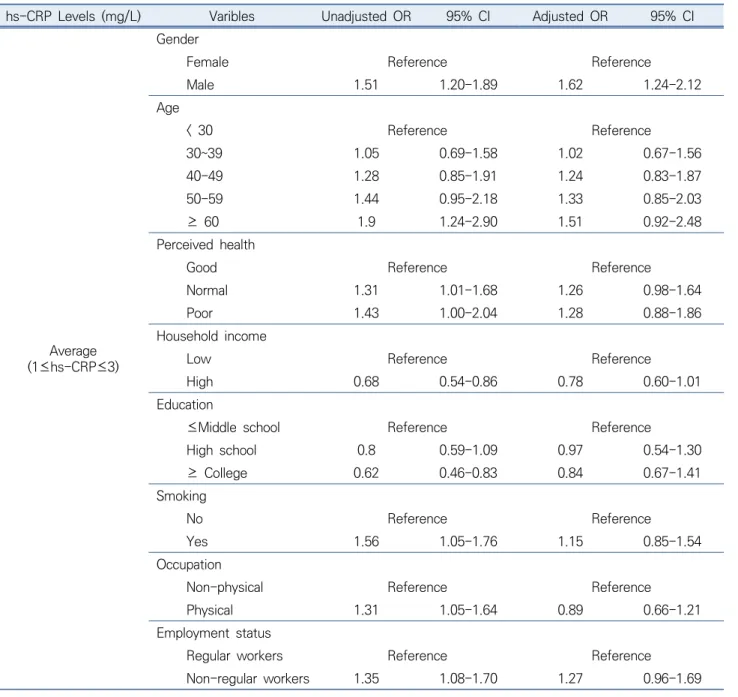
Table 3는 앞선 Table 1 및 Table 2에서 유의미한 결과를 나타낸 변수들에 대해 심혈관 저 위험군 (hs-CRP < 1)을 참고치로 하여 심혈관 중간 위험군(1
≤ hs-CRP ≤ 3) 및 심혈관 고 위험군(hs-CRP > 3)과 의 연관성을 파악하기 위해 로지스틱 회귀분석을 시행 하였다.
hs-CRP Level 1미만을 참고치로 하였을 때, hs-CRP Level 1 이상 3 이하인 심혈관 중간 위험군에서, 여성 대비 남성에서 보정 전 OR 1.51 (95% CI 1,20-1.89), 보정 후에는 OR 1.62 (95% CI 1.24-2.12)를 보였고, 연령의 경우 30세 미만 대비 60세 이상의 연령에서 OR 1.9 (95% CI 1.24-2.90)으로 유의한 결과를 보였다.
또한, 주관적 건강상태 좋음 대비 보통에서 보정 전 OR 1.31 (95% CI 1.01-1.68), 좋음 대비 나쁨에서 보 정 전 OR 1.43 (95% CI 1.00-2.04) 으로 유의하였고, 소득 수준이 낮음 대비 높음에서 OR 0.68 (95% CI 0.54-0.86)으로 유의한 결과를 보였다.
학력 수준 중졸 이하 대비 대졸 이상에서 보정 전 OR 0.62 (95% CI 0.46-0.83), 비흡연 대비 흡연을 하 는 경우 보정 전 OR 1.56 (95% CI 1.05-1.76)으로 유 의한 결과를 보였다. 직업적 특성에서 비 육체노동 대비 육체노동을 하는 경우 보정 전 OR 1.31 (95% CI 1.05-1.64), 정규직 대비 비정규직에서 보정 전 OR 1.35 (95% CI 1.08-1.70)으로 유의한 결과를 보였다.
hs-CRP Level 1 미만을 참고치로 하였을 때, hs-
hs-CRP Levels
Low (%) Average (%) High (%)
Total (n=1,937) n=1,406 n=393 n=138
p-value
Gender
Female 968 744(76.9) 168(17.4) 70(5.8) < 0.001*
Male 969 662(68.3) 225(23.2) 100(8.5)
Age
< 30 242 190(78.5) 41(16.9) 11(4.5) < 0.05*
30~39 499 376(75.4) 85(17.0) 38(7.6)
40-49 510 374(73.3) 103(20.2) 33(6.5)
50-59 378 268(70.9) 83(22.0) 27(7.1)
≥ 60 308 198(64.3) 81(26.3) 29(9.4)
Marital status
Unmarried 368 285(77.4) 59(16.0) 24(6.5) 0.144
Married 1,487 1,065(71.6) 313(21.0) 109(7.3)
Divorced, etc 82 56(68.3) 21(25.6) 5(6.1)
Perceived health
Good 651 499(76.7) 115(17.7) 37(5.7) < 0.05*
Normal 1,023 728(71.2) 219(21.4) 76(7.4)
Poor 263 179(68.1) 59(22.4) 25(9.5)
Household income
High 1,317 992(75.3) 243(18.5) 82(6.5) < 0.001*
Low 620 414(66.8) 150(24.2) 56(9.0)
Education
≤Middle school 373 250(67.0) 94(25.2) 29(7.8) < 0.05*
High school 607 434(71.5) 131(21.6) 42(6.9)
≥ College 957 722(75.4) 168(17.6) 67(7.0)
Smoking
No 1,495 1,108(74.1) 288(19.2) 99(6.6) < 0.05*
Yes 442 299(67.6) 105(23.8) 38(8.6)
Drinking
No 705 514(72.9) 142(20.2) 49(7.0) 0.98
Yes 1.232 893(72.5) 251(20.3) 88(7.2)
Working hour
> 40 hrs 879 636(72.4) 180(20.5) 63(7.2) 0.98
≤ 40 hrs 1,058 770(72.8) 213(20.1) 75(7.1)
Occupation
Non-physical 964 728(75.5) 177(18.4) 59(6.1) < 0.05*
Physical 973 678(69.7) 216(22.2) 79(8.1)
*hs-CRP : high sensitivity C-reactive protein
*hs-CRP Levels : Low < 1mg/L, 1mg/L ≤ Average ≤ 3mg/L, High > 3mg/L
Table 1. General characteristics and distribution of study participants according to serum hs-CRP* level
hs-CRP Levels
Low (%) Average (%) High (%)
Total (n=1,937) n=1,406 n=393 n=138
p-value
Employment status
Regular workers 955 725(75.9) 173(18.1) 57(6.0) < 0.05*
Non-regular workers 982 681(69.3) 220(22.4) 81(8.2)
*hs-CRP : high sensitivity C-reactive protein
*hs-CRP Levels : Low < 1mg/L, 1mg/L ≤ Average ≤ 3mg/L, High > 3mg/L
Table 3. Multinominal logistic regression models for hs-CRP levels
hs-CRP Levels (mg/L) Varibles Unadjusted OR 95% CI Adjusted OR 95% CI
Average (1≤hs-CRP≤3)
Gender
Female Reference Reference
Male 1.51 1.20-1.89 1.62 1.24-2.12
Age
< 30 Reference Reference
30~39 1.05 0.69-1.58 1.02 0.67-1.56
40-49 1.28 0.85-1.91 1.24 0.83-1.87
50-59 1.44 0.95-2.18 1.33 0.85-2.03
≥ 60 1.9 1.24-2.90 1.51 0.92-2.48
Perceived health
Good Reference Reference
Normal 1.31 1.01-1.68 1.26 0.98-1.64
Poor 1.43 1.00-2.04 1.28 0.88-1.86
Household income
Low Reference Reference
High 0.68 0.54-0.86 0.78 0.60-1.01
Education
≤Middle school Reference Reference
High school 0.8 0.59-1.09 0.97 0.54-1.30
≥ College 0.62 0.46-0.83 0.84 0.67-1.41
Smoking
No Reference Reference
Yes 1.56 1.05-1.76 1.15 0.85-1.54
Occupation
Non-physical Reference Reference
Physical 1.31 1.05-1.64 0.89 0.66-1.21
Employment status
Regular workers Reference Reference
Non-regular workers 1.35 1.08-1.70 1.27 0.96-1.69
Table 2. Distribution of serum hs-CRP* level by employment status
CRP Level 3 초과인 심혈관 고 위험군에서는 여성 대비 남성에서 보정 전 OR 1.65 (95% CI 1.15-2.35), 보정 후에는 OR 1.76 (95% CI 1.16-2.68)를 보였고, 연령의 경우 30세 미만 대비 60세 이상의 연령에서 OR 2.53 (95% CI 1.23-5.21)으로 유의한 결과를 보였다.
또한, 주관적 건강상태 좋음 대비 나쁨에서 보정 전 OR 1.88 (95% CI 1.10-3.22), 보정 후에는 OR 1.82 (95% CI 1.04-3.18)으로 유의하였고, 소득 수준이 낮
음 대비 높음에서 OR 0.61 (95% CI 0.43-0.88)으로 유의한 결과를 보였다.
학력 수준과 흡연 여부에 대해서는 유의한 결과를 보 이지 않았으며, 직업적 특성에서 비 육체노동 대비 육체 노동을 하는 경우 보정 전 OR 1.44 (95% CI 1.01- 2.05), 정규직 대비 비정규직에서 보정 전 OR 1.51 (95% CI 1.06-2.16), 보정 후에는 OR 1.59 (95% CI 1.02-2.45)으로 유의한 결과를 나타냈다.
hs-CRP Levels (mg/L) Varibles Unadjusted OR 95% CI Adjusted OR 95% CI
(hs-CRP>3) High
Gender
Female Reference Reference
Male 1.65 1.15-2.35 1.76 1.16-2.68
Age
< 30 Reference Reference
30~39 1.75 0.87-3.49 1.4 0.84-3.46
40-49 1.52 0.75-3.08 1.11 0.76-3.16
50-59 1.74 0.84-3.59 1.27 0.85-3.82
≥ 60 2.53 1.23-5.21 1.94 0.95-4.89
Perceived health
Good Reference Reference
Normal 1.41 0.94-2.12 1.39 0.92-2.12
Poor 1.88 1.10-3.22 1.82 1.04-3.18
Household income
Low Reference Reference
High 0.61 0.43-0.88 0.71 0.48-1.07
Education
≤Middle school Reference Reference
High school 0.83 0.51-1.37 1.32 0.73-2.38
≥ College 0.8 0.51-1.27 1.74 0.88-3.46
Smoking
No Reference Reference
Yes 1.43 0.96-2.12 1.11 0.70-1.74
Occupation
Non-physical Reference Reference
Physical 1.44 1.01-2.05 1.23 0.78-1.95
Employment status
Regular workers Reference Reference
Non-regular workers 1.51 1.06-2.16 1.59 1.02-2.45
*hs-CRP : high sensitivity C-reactive protein Table 3. Continued
Ⅳ. 고 찰
본 연구를 통해 비정규직 근로자에서 정규직 근로자 에 비해 높은 hs-CRP Level을 나타내는 것을 확인하 였다. 또한, 주관적 건강상태가 좋음 대비 나쁨에서 높 은 hs-CRP Level 과의 연관성을 확인할 수 있었다.
본 연구에서 hs-CRP Level 1미만을 참고치로 하였 을 때, hs-CRP Level이 1 이상 3 이하인 심혈관 중간 위험군 및 hs-CRP Level이 3 초과인 심혈관 고 위험 군 모두에서 여성보다 남성에서 보정 전, 후 모두에서 높은 hs-CRP Level의 유의한 결과를 보였다. 기존의 연구들을 살펴보면 성별에 따른 hs-CRP Level의 차이 에 대해서는 논란이 되고 있지만, 일본인을 대상으로 한 연구 및 한국인들 대상으로 한 연구에서 여성보다 남성 에서 hs-CRP Level이 높아 본 연구의 결과와 일치하 였다(Yamada et al., 2001; Kim at el., 2003). 이에 반해 Rutter et al.(2004)이 미국에서 시행한 연구에서 는 남성보다 여성에서 hs-CRP Level이 더 높았으며 Marques-Vidal P et al.(2002)이 프랑스인을 대상으 로 한 연구에서는 남, 녀 간에 hs-CRP Level의 유의한 차이가 없었다. 이는, 연구 대상자들의 여러 개인적 특 성인 연령, 흡연 여부, 체질량 지수 및 인종적 차이 등 hs-CRP Level에 영향을 미칠 수 있는 여러 요인들의 차이로부터 기인한 것이라고 생각된다.
또한, 본 연구 결과 hs-CRP Level 1미만을 참고치 로 하였을 때, hs-CRP Level이 1 이상 3 이하인 심혈 관 중간 위험군에서 정규직 대비 비정규직에서 비록 보 정 후에는 유의한 결과를 얻진 못했지만 보정 전 높은 hs-CRP Level을 나타내는 것을 확인하였다. 또한, hs-CRP Level이 3 초과인 심혈관 고 위험군에서는 정 규직 대비 비정규직에서 보정 전, 후 모두에서 높은 hs-CRP Level의 유의한 결과를 보였다. 기존의 연구들 을 살펴보면, Virtanen et al.(2013)의 연구에서 개인 이 주관적으로 느끼는 직업의 불안정성 등이 심혈관계 질환의 발생을 높일 수 있다고 하였다. 이는 직업의 불 안정성 등이 높은 비정규직에서 심혈관 질환의 발생 위 험이 높아질 수 있고 이는 정규직 대비 비정규직에서 높은 hs-CRP Level과의 연관성을 유추해 볼 수 있다.
또한, Siegrist & Marmot(2004)의 연구에서는 정규직 에 비해 비정규직의 경우 심혈관계 질환을 비롯한 여러 정신질환 발생이나 주관적 건강상태가 악화될 확률이 높다고 하였고 이를 바탕으로, 비정규직에서 심혈관계
질환의 평가 및 예후 지표인 hs-CRP Level의 증가를 유추해 볼 수 있다.
본 연구에서는 주관적 건강상태와 hs-CRP와의 연 관성 또한 확인할 수 있었다. 심혈관 고 위험군에서 주 관적 건강상태가 좋다고 응답한 경우를 참고치로 하였 을 때, 나쁨이라고 답한 경우일수록 hs-CRP가 상승하 는 위험도가 높은 결과를 보였다. 심뇌혈관계 질환 등 의 만성질환은 합병증 및 후유증으로 인해 삶의 질을 저하시키고 활동에 제한을 가져올 가능성이 높았다. 이 러한 만성질환자의 경우 주관적 건강상태가 양호하지 못할 가능성이 높으며 hs-CRP 상승이 동반된 경우가 많았다(Guyatt et al., 1993; Rubin & Peyrot, 1999; Carod-Artal et al., 2000; Haffner, 2006).
이를 바탕으로 본 연구에서 주관적 건강상태가 좋음 대비 나쁨에서 hs-CRP Level이 유의하게 높은 결과 가 나왔을 것으로 생각된다. 본 연구에서 만성질환 등 을 가지고 있으며 주관적 건강상태가 나쁘다고 인식하 는 결과를 가지고 있는 군에서 유의하게 높은 결과를 얻었다. 이를 바탕으로 비정규직에서 hs-CRP 상승이 유의하게 높은 결과를 얻었다는 것은 만성질환이나 주 관적인 건강수준의 영향만큼 비정규직이라는 직업적 요인이 건강에 직접적인 영향을 줄 수 있다는 것을 확 인 할 수 있었다.
본 연구의 제한점으로는, 설문응답자의 고용형태에 따른 현재 또는 과거의 근로기간이 결과에 영향을 미칠 수 있으나 제 7기 국민건강영양조사는 이에 대한 설문 이 빠져 있다. 또한, 본 연구는 단면연구이므로 인과성 을 밝혀내기 어려운 점이 있다. 그러나, 본 연구를 통해 비정규직에서 추후 연구에서는 고용형태에 따른 현재 및 과거의 근로기간에 대한 설문을 통해 보다 정확한 결과를 도출하는 것이 필요할 것으로 생각된다.
본 연구의 강점으로는, 국민건강영양조사는 대규모 집단을 대상으로 한 전국단위 조사로 개인의 사회적, 경 제적 수준과 위치를 조사하고 이에 더불어 개인의 생활 습관 및 건강상태를 종합적으로 조사한 것으로 한 국가 를 대표하는 자료로서 큰 의미가 있다고 할 수 있다. 또 한, 이러한 대규모 데이터를 활용해 정규직 및 비정규직 고용형태에 따른 hs-CRP Level과의 연관성을 알아본 국내 최초의 시도이므로 큰 의의가 있다. 본 연구를 통 해 비정규직 근로자와 높은 hs-CRP Level과의 연관성 이 있음을 확인하였고, 이를 바탕으로 근로 취약군에 해 당하는 비정규직 근로자의 심혈관 질환 예방 및 관리가
이루어 질 수 있도록 제도적인 장치가 뒷받침 되어야 할 것으로 생각된다.
Ⅴ. 결 론
본 연구를 통해 한국 임금 근로자에서 근로형태에 따 른 hs-CRP Level과의 연관성에 대해 살펴보았다. 주간 근무를 하는 정상체중을 가진 비정규직 근로자에서 정 규직에 비해 높은 hs-CRP Level과의 연관성이 있음을 확인하였다. 또한, 주관적 건강상태가 좋음 대비 나쁨에 서 높은 hs-CRP Level 과의 연관성을 확인할 수 있었 다. 또한 만성질환과 주관적 건강상태 이외에 직업적인 요인으로 근로 취약군인 비정규직의 영향을 확인 할 수 있었다. 따라서 향후 비정규직 근로자의 건강관리를 통 해 hs-CRP를 낮추고 이를 통한 심혈관계 질환 위험요 인을 감소시킬 수 있는 정책적인 접근이 필요할 것으로 생각된다. 마지막으로 추후 우리 연구의 제한점을 보완 한 보다 체계적이고 전향적인 후속연구를 통해 비정규 직 근로자의 건강향상에 도움이 되는 연구가 추가적으 로 나올 수 있기를 기대한다.
References
Bartley M, Ferrie J. Glossary: unemployment, job insecurity, and health. Journal of Epidemiology &
Community Health 2001;55(11):776-81. DOI:
http://dx. doi.org/10.1136/jech.55.11.776
Carod-Artal J, Egido JA, González JL, Varela de Seijas E.
Quality of life among stroke survivors evaluated 1 year after stroke: experience of a stroke unit. Stroke 2000;31(12):2995-3000. DOI: https://doi.org/10.
1161/01.STR.31.12.2995
Engström G, Hedblad B, Rosvall M, Janzon L, Lindgärde F. Occupation, marital status, and low-grade inflammation: mutual confounding or independent cardiovascular risk factors? Arteriosclerosis, thrombosis, and vascular biology 2006;26(3):643-8.
DOI: https://doi.org/10.1161/01.ATV.0000200100.
14612.bb
Evans GW, Kantrowitz E. Socioeconomic status and health: the potential role of environmental risk exposure. Annual review of public health 2002;
23(1):303-31. DOI: https://doi.org/10.1146/annurev.
publhealth.23.112001.112349
Guyatt GH, Feeny DH, Patrick DL. Measuring health-
related quality of life. Annals of internal medicine 1993;118(8):622-9. DOI: https://doi.org/10.7326/
0003-4819-118-8-199304150-00009
Haffner SM. The metabolic syndrome: inflammation, diabetes mellitus, and cardiovascular disease. The American journal of cardiology 2006;97(2):3-11.
DOI: https://doi.org/10.1016/j.amjcard.2005.11.010 Holmlund B, Storrie D. Temporary work in turbulent
times: the Swedish experience. The economic journal 2002;112(480):F245-F69. DOI: https://doi.
org/10.1111/1468-0297.00042
Keum J, Cho J. Job instability in the Korean labor market:
comparison before and after the IMF economic crisis. Journal of Labour Economics 2001;24(1):
35-66
Ki C-S, Suh J-Y, Kim B-S, Kang J-H, Kim H, et al. High sensitivity C-reactive protein as an independent risk factor for essential hypertension. American journal of hypertension 2003;16(6): 429-433. DOI: https://
doi.org/10.1016/S0895-7061(03)00566-1
Kivimäki M, Vahtera J, Virtanen M, Elovainio M, Pentti J, Ferrie JE. Temporary employment and risk of overall and cause-specific mortality. American journal of epidemiology 2003;158(7):663-8. DOI: https://doi.
org/10.1093/aje/kwg185
Kivimäki M, Kawachi I. Work stress as a risk factor for cardiovascular disease. Current cardiology reports 2015;17(9):1-9. DOI: https://doi.org/10.1007/
s11886-015-0630-8
Kim Y, Zaitsu M, Tsuno K, Li X, Lee S, Jang S-n, et al.
Occupational Differences in C-Reactive Protein Among Working-Age Adults in South Korea. Journal of occupational and environmental medicine 2020;
62(3):194-201. DOI: 10.1097/JOM.000000000000 Korea S. Korean social trends 2016. Daejeon: Statistics 1781
Korea. 2018:1-24
Marmot MG. Job insecurity in a broader social and health context. WHO Regional Publications European Series 1999:1-10
Marques-Vidal P, Mazoyer E, Bongard V, Gourdy P, Ruidavets JB et al. Prevalence of insulin resistance syndrome in southwestern France and its relationship with inflammatory and hemostatic markers. Diabetes Care 2002;25(8):1371-1377.
DOI: https://doi.org/10.2337/diacare.25.8.1371 Myers GL, Rifai N, Tracy RP, Roberts WL, Alexander RW,
Biasucci LM, et al. CDC/AHA workshop on markers of inflammation and cardiovascular disease:
application to clinical and public health practice:
report from the laboratory science discussion group.
Circulation 2004;110(25):e545-e9. DOI: https://doi.
org/10.1161/01.CIR.0000148980.87579.5E
Owen N, Poulton T, Hay FC, Mohamed-Ali V, Steptoe A.
Socioeconomic status, C-reactive protein, immune factors, and responses to acute mental stress. Brain, behavior, and immunity 2003;17(4):286-95. DOI:
https://doi.org/10.1016/S0889-1591(03)00058-8 Pedersen JM, Budtz-Jørgensen E, De Roos A, Garcia L,
Lund R, Rod NH, et al. Understanding the relation between socioeconomic position and inflammation in post-menopausal women: education, income and occupational prestige. The European Journal of Public Health 2017;27(6):1074-9. DOI: https://doi.
org/10.1093/eurpub/ckx070
Ramsay S, Lowe GD, Whincup PH, Rumley A, Morris RW, Wannamethee SG. Relationships of inflammatory and haemostatic markers with social class: results from a population-based study of older men.
Atherosclerosis 2008;197(2):654-61. DOI: https://
doi.org/10.1016/j.atherosclerosis.2007.02.022 Ridker PM. Connecting the role of C‐reactive protein and
statins in cardiovascular disease. Clinical Cardiology:
An International Indexed and Peer‐Reviewed Journal for Advances in the Treatment of Cardiovascular Disease 2003;26(S3):39-44. DOI: https://doi.org/
10.1002/clc.4960261508
Rubin RR, Peyrot M. Quality of life and diabetes.
Diabetes/metabolism research and reviews 1999;
15(3):205-18. DOI: https://doi.org/10.1002/(SICI) 1520-7560(199905/06)15:3<205::AID-DMRR29>
3.0.CO;2-O
Rutter MK, Meigs, JB, Sullivan LM, D’Agostino Sr RB, &
Wilson PW. C-reactive protein, the metabolic syndrome, and prediction of cardiovascular events in the Framingham Offspring Study. Circulation, 2004;
110(4):380-385. DOI: https://doi.org/10.1161/01.
CIR.0000136581.59584.0E
Shin H-Y, Kim J, Lee S, Park MS, Park S, Huh S.
Cause-of-death statistics in 2018 in the Republic of Korea. Journal of the Korean Medical Association/
Taehan Uisa Hyophoe Chi 2020;63(5).
Siegrist J, Marmot M. Health inequalities and the psychosocial environment-two scientific challenges.
Social science & medicine 2004;58(8):1463-73.
DOI: https://doi.org/10.1016/S0277-9536(03)00349-6 Tenkanen L, Sjöblom T, Kalimo R, Alikoski T, Härmä M.
Shift work, occupation and coronary heart disease over 6 years of follow-up in the Helsinki Heart Study.
Scandinavian journal of work, environment & health 1997:257-65
Virtanen M, Nyberg ST, Batty GD, Jokela M, Heikkilä K, Fransson EI, et al. Perceived job insecurity as a risk factor for incident coronary heart disease:
systematic review and meta-analysis. Bmj 2013;
347. DOI: https://doi.org/10.1136/bmj.f4746 Yamada S, Gotoh T, Nakashima Y, Kayaba K, Ishikawa S
et al. Distribution of serum C-reactive protein and its association with atherosclerotic risk factors in a Japanese population: Jichi Medical School Cohort Study. American journal of epidemiology 2001;
153(12):1183-1190. DOI: https://doi.org/10.1093/
aje/153.12.1183
Yusuf S, Reddy S, Ôunpuu S, Anand S. Global burden of cardiovascular diseases: part I: general considerations, the epidemiologic transition, risk factors, and impact of urbanization. Circulation 2001;104(22):2746-53. DOI:https://doi.org/10.1161/
hc4601.099487
<저자정보>
주재한(전공의), 이준희(교수)