Korean J Environ Agric (2011) Online ISSN: 2233-4173 Vol. 30, No. 4, pp. 390-394 http://dx.doi.org/10.5338/KJEA.2011.30.4.390 Print ISSN: 1225-3537
Expression of Anti-breast Cancer Monoclonal Antibody in Transgenic Plant
Deuk-Su Kim,
1†Yingxue Shao,
1†Jeong-Hwan Lee,
1†Joon-Sik Yoon,
1Se-Ra Park,
1Young-Kug Choo,
1Kyung-A Hwang
2and Kisung Ko
1*1
Department of Biological Science, Institute of Biotechnology, College of Natural Sciences, Wonkwang University, Iksan 570-749, Korea
2
Department of Agrofood Resources, National Academy of Agricultural Science, Rural Development Administration (RDA), Suwon, Korea
Received: 11 November 2011 / Accepted: 28 November 2011
ⓒ 2011 The Korean Society of Environmental Agriculture
*교신저자(Corresponding author),
Phone: +82-63-850-6088; Fax: +82-63-857-8837;
E-mail: [email protected]
†These authors contributed equally to this paper.
390
Abstract
BACKGROUND: Plant expression system for mass production of recombinant proteins has several advantages over other existing expression systems with economical and safety issues. Breast cancer is a cancer originating from breast tissue and comprises almost 25% of all cancers in women world widely. Lewis-Y antigen is difucosylated oligosaccharide and is carried by glycoconjugates at cancer cell surface. In this study, the anti-breast cancer mAb BR55, which recognizes the epitope Lewis-Y, was expressed in the plant expression system.
METHODS AND RESULTS: We have developed plant system for production of mAb BR55 with or without KDEL (the ER retention signal). This ER retention signal was attached to C-terminus of protein to help retain the recombinant glycoprotein carrying oligomannose glycans and enhance glycoprotein accumulation. PCR analysis was performed and confirmed the presence of recombinant genes. Western blot validated that the recombinant proteins mAb BR55 with or without KDEL were expressed in transgenic plants, moreover, the expression level of the mAb BR55 with KDEL was higher compared to the mAb BR55 without KDEL.
CONCLUSION: These results indicate that KDEL fusion is a good way to produce proteins and plant can be an ideal expression system to obtain proteins and enhance accumulation of proteins.
Key Words: Breast BR55, cancer, KDEL, Monoclonal antibody Recombinant protein, Transgenic plant
Introduction
Monoclonal antibody BR55 recognizes the Lewis-Y oligosaccharide antigen (LeY), which is predominantly over expressed on breast, lung, ovary and colon cancers (Nichols et al ., 1985; Fernandes et al ., 1991; Nemoto-Sasaki et al ., 2001). Mouse mAb BR55 (IgG2a) inhibits tumor growth and kills human cancer cells xenotransplanted in nude mice (Steplewski et al., 1991). Under physiological conditions, LeY is expressed mainly during embryogenesis but is restricted to granulocytes and epithelial surfaces in adult tissue (Dettke et al., 2000).
Recently plants have become a prospective replacement bioreactor for currently available production systems to manufacture biopharmaceuticals (Koprowski, 2005; Ko and Koprowski, 2005). Plant expression system is considered to be a promising expression system that can efficiently produce recombinant protein in large quantities (Góra-Sochacka et al ., 2009). Many therapeutic
Open Access
Research Article
and diagnostic mAbs have been expressed successfully in plants, including full-length immunoglobulins (Ig), Fab fragments, single variable domains, antibody-fusion proteins, single-chain antibodies, etc. (Ko et al ., 2003;
Koproswski, 2005; Schillberg et al ., 2003; Stoger et al ., 2002). However, plant-derived proteins may cause allergenic responses to mammlians due to the presence of α(1,3)-fucose and β(1,2)-xylose, which are absent in mammalian glycans (Ko et al., 2003). To avoid the plant-derived specific N- glycan structure, we tried to generate an oligomannose glycan structure by retaining the recombinant protein in the endoplasmic reticulum (ER). Addition of the ER retrieval KDEL (the ER retention motif, Lys-Asp-Glu-Leu) or KDEL sequences at the C-terminus of a secreted protein is enough for its retention in the plant ER and results in a high accumulation of recombinant proteins in plant cells (Gomord et al ., 1997; Pagny et al ., 2000; Ko et al ., 2000).
In this study, we expressed anti-breast cancer mAb BR55 without and with KDEL in transgenic tobacco plants. The presence of recombinant genes was confirmed by PCR analysis for genomic DNA.
The expression of mAb BR55 either fused with KDEL or not was demonstrated by western blot.
Western blot result also showed that the expression level of KDEL-tagged mAb BR55 was higher than that of non-KDEL-tagged mAb BR55. Taken together, plants can be used as an ideal expression
system for recombinant mAb production, where its production can be enhanced by KDEL-mediated ER.
Materials and Methods
Construction of plant expression vector
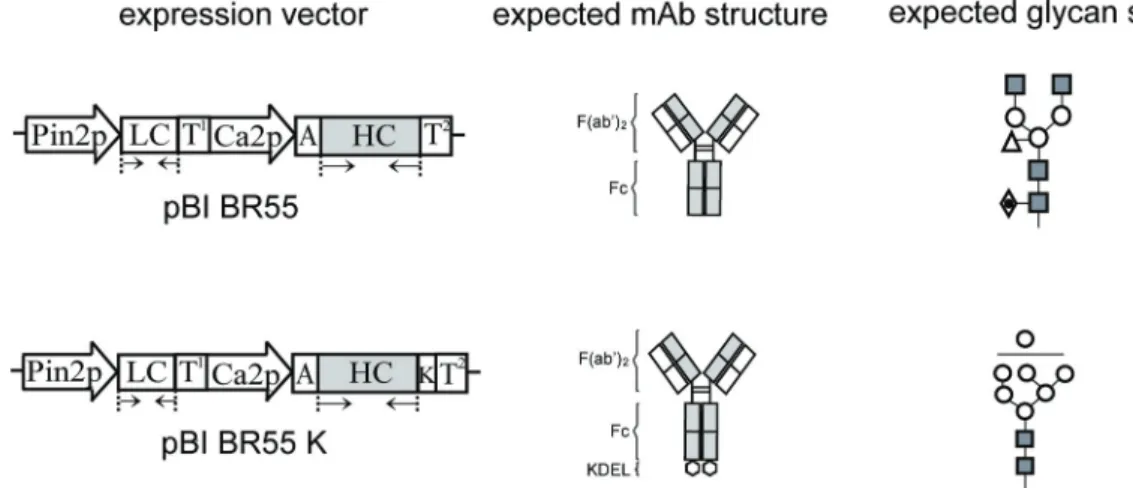
The cDNA fragments encoding anti-human breast cancer mAb BR55 heavy chain (HC), heavy chain fused with KDEL (HCK) and light chain (LC) were cloned to a pGEM-T Easy vector (Promega, Fitchburg, WI). The recombinant vectors were then transformed into DH5α competent cells for amplification. Plasmids were isolated using Plus Plasmid Mini Kit (NucleoGen, Daejeon, Korea) and cut by restriction enzymes (XbaI and BamHI for plasmid carrying HC or HCK encoding genes; BamHI and PstI for plasmid carrying LC encoding genes). The HC or HCK and LC genes were cloned under the control of the cauliflower mosaic virus 35S promoter with duplicated upstream B domains (Ca2 promoter) and the untranslated leader sequence of alfalfa mosaic virus RNA4 (Ko et al ., 2005) or the potato proteinase inhibitor II (Pin2) promoter (Ko et al ., 2000) into plasmid pBI525, respectively. The HC or HCK and LC expression cassettes were transferred as Hin dIII- Eco RI or Hin dIII- Hin dIII fragments, respectively, into the plant expression vector pBI121, yielding plasmid pBI BR55 or pBI BR55K (Fig. 1).
Fig. 1. Construction of plant vectors to express mAb BR55 and mAb BR55K and the expected glycan structures. Two gene expression cassettes were designed for plant transformation. The gene expression cassette had two different promoters (Pin2p, promoter of Pin2 gene from potato; Ca2p, cauliflower mosaic virus 35S promoter with duplicated upstream B domain) for expression of each LC and HC of antibody. T1, terminator of Pin2 gene from potato; LC and HC, cDNA of LC and HC of mAb BR55, respectively; A, untranslated leader sequence of alfalfa mosaic virus RNA4; T2, terminator of nopaline synthase (NOS) gene; K, KDEL ER retention signal. Arrow (→ ←), PCR amplification region.
Plant Transformation
Tobacco ( Nicotiana tabacum ) leaf pieces were used for Agrobacterium- mediated transformation ( Agrobacterium tumefaciens LBA4404) (Ko et al ., 2003). After transformation, leaf pieces were transferred to Murashige and Skoog based medium containing kinetin (1 μg/ml), indoleacetic acid (0.1 μg/ml), carbenicillin (500 μg/ml), and kanamycin (100 μg/ml). Established transgenic tobacco lines were later transferred to Magenta™
vessels (Sigma-Aldrich, St. Louis, MO) for subsequent generations (Fig. 2).
BR55 BR55 K
Fig. 2. Transgenic tobacco plants. BR55, transgenic plant which expressed mAb BR55; BR55K, transgenic plant which expressed mAb BR55K.
PCR analysis of genomic DNA
Genomic DNA was isolated from the fresh leaf tissue of transgenic and non-transgenic plants using a DNA extraction kit (iNtRON Biotechnology, Seoul, Korea) according to the manufacturer’s recommendations.
PCR analysis of genomic DNA was performed in order to confirm the presence of the recombinant genes using the following primer pairs: for HC or HCK, forward primer 5’-TCT AGA ATG CAT CCA ACG AGG-3’, reverse primer 5’-GGA TCC TTA ACC CGG AGT CCG-3’; for LC gene in both BR55 and BR55K, forward primer 5’-GCG GAT CCA TGC TAC CGG CC-3’, reverse primer 5’-CGC TGC AGT TAA CAT TCG TTC CTG-3’. PCR was performed with 30 cycles of 94°C for 20 sec, 60°C for 20 sec, and 72°C for 1 min. Non-transgenic plants were used as negative control, while the reverse transformed pBI121 vector (from Agrobacterium to DH5α) containing either the BR55 or BR55K encoding genes was used as a positive control. The expected size of the DNA products for HC or HCK was∼1,542 bp while LC was∼771 bp (Fig. 3).
Fig. 3. PCR analysis of transgenic lines for the presence of both LC and HC genes in plant genomic DNA.
DNA isolated from leaves of 4 BR55K transgenic lines and 3 BR55 lines. +, positive control, the reverse transformed pBI121 vector containing either mAb BR55 or BR55K encoding genes; NT, non-transgenic plant.
Western Blot Analysis
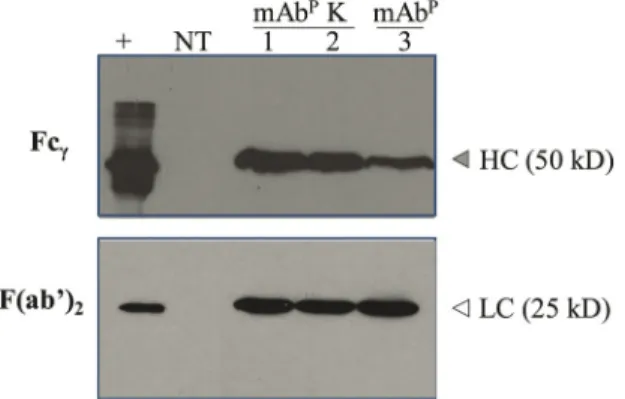
Samples from transgenic plants were collected and analyzed for mAb BR55 content. Briefly, leaf pieces (100 mg) of plants were homogenized in 3 volumes of 1 × PBS buffer. Proteins were resolved by 12.5% SDS-PAGE and transferred to a nitrocellulose membrane (Bio-Rad Laboratories, Hercules, CA).
The membrane was blocked with blocking buffer (3% skim milk in 1 × PBS) overnight and incubated for 2 h at room temperature with goat anti-mouse Fc
γ-and F(ab’)
2-specific antibodies conjugated to horseradish peroxidase (Jackson ImmunoResearch, West Grove, PA) diluted 1:5,000 in blocking buffer. After washing, reactive protein bands were visualized with Amersham
™ ECL™ Prime Western Blotting Detection Reagent (GE Healthcare, Little Chalfont, UK) (Fig. 4).
Fig. 4. Immunoblot analysis of mAb BR55 and mAb BR55K expression in transgenic plants. mAbPK, mAb BR55K;
mAbP, mAb BR55; +, positive control, mAb CO17-1A derived from mammalian cells; NT, non-transgenic plant. The bands of HC (50 kDa) and LC (25 kDa) were detected with HRP-conjugated goat anti-mouse Fcγ- or F(ab’)2-specific antibodies, respectively.
Results and Discussion