A Real-time Pedestrian Detection based on AGMM and HOG for Embedded Surveillance
Thanh Binh Nguyen†, Van Tuan Nguyen††, Sun-Tae Chung†††
ABSTRACT
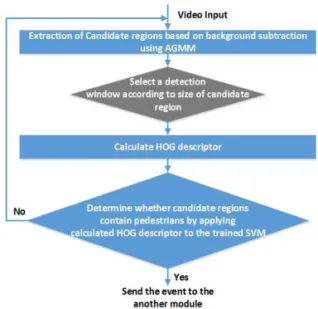
Pedestrian detection (PD) is an essential task in various applications and sliding window-based methods utilizing HOG (Histogram of Oriented Gradients) or HOG-like descriptors have been shown to be very effective for accurate PD. However, due to exhaustive search across images, PD methods based on sliding window usually require heavy computational time. In this paper, we propose a real-time PD method for embedded visual surveillance with fixed backgrounds. The proposed PD method employs HOG descriptors as many PD methods does, but utilizes selective search so that it can save processing time significantly.
The proposed selective search is guided by restricting searching to candidate regions extracted from Adaptive Gaussian Mixture Model (AGMM)-based background subtraction technique. Moreover, approximate computation of HOG descriptor and implementation in fixed-point arithmetic mode contributes to reduction of processing time further. Possible accuracy degradation due to approximate computation is compensated by applying an appropriate one among three offline trained SVM classifiers according to sizes of candidate regions. The experimental results show that the proposed PD method significantly improves processing speed without noticeable accuracy degradation compared to the original HOG-based PD and HOG with cascade SVM so that it is a suitable real-time PD implementation for embedded surveillance systems.
Key words: Pedestrian Detection, Embedded Surveillance, HOG, AGMM
※ Corresponding Author : Sun-Tae Chung, Address:
(156-743) Dept. of Smart Systems Software, Soongsil Univ., 369, Sangdo-Ro, Dongjak-Gu, Seoul, Korea, TEL : +82-2-820-0638, FAX : +82-2-821-7653, E-mail : cst@
ssu.ac.kr
Receipt date : Aug. 4, 2015, Revision date : Nov. 10, 2015 Approval date : Nov. 12, 2015
†††School of Electronic Engineering, Soongsil University (E-mail : [email protected])
†††School of Electronic Engineering, Soongsil University (E-mail : tuannguyen}@ssu.ac.kr)
†††Dept. of Smart Systems Software, Soongsil University
※ This work was supported by the Soongsil University Research Fund.
1. INTRODUCTION
Pedestrian detection (PD) has attracted much attention in the last years due to its direct applica- tions to many domains such as automotive safety, visual surveillance, robotics, traffic controls, and so on [1,2,3]. During the last decade, various PD methods have been proposed to improve accuracy (detection ratio) and processing speed [1-23].
Along with those researches, many significant progresses have been achieved. However, current state-of-the-art PD technology still needs more improvements for reliable and embedded applica-
tions such as embedded visual surveillance. More- over, the improvement of detection quality by de- vising multiple features and complex classification algorithms causes more computational burden, which makes real-time pedestrian detection more difficult for embedded systems. A trade off be- tween the preciseness and computation cost of processing need to be considered carefully.
To improve the processing speed performance of PD, many ideas have been exploited [16,21]; bet- ter features [5,8,10,11], better classifier [6,13,15, 19,20], prior contextual knowledge [18], cascades [6,19,27], coarse-to-fine search [15], branch and
bound search [7] and so on. All these approaches basically utilize the well-known, ‘slide window’
paradigm for detecting pedestrians. Sliding win- dow paradigm [7,25] requires exhaustive search with detection windows over position and scale in the whole scene images, where a classifier tests for object presence for each candidate image window.
A single-scale detection requires classifying around more than several tens or hundreds of thousands windows per image, thus the number of search windows grows by an order of magnitude for multi-scale detection, which is the major caus- es for high computational burden of sliding win- dow-based object detection.
Recently, in order to avoid exhaustive sliding window search across images, selective search methods [24,25] for object detection have been pro- posed and shown noticeable improvements with respect to detection speed. However, these se- lective search methods adopt some complicated segmentations to isolate the plausible regions, which still requires some sizable computational processing time.
In this paper, we concentrate on pedestrian de- tection for some specific application domains such as visual surveillance where the backgrounds are fixed [2]. One good thing about pedestrian de- tection for a specific application domain is that one can utilize the application domain prior knowledge.
In visual surveillance for designated areas, the background is fixed as opposed to image-based driver assistance systems where background is changing. Thus, the pedestrians appear as moving foreground objects. In intelligent visual surveil- lance systems, the moving foreground objects are extracted by the minimum bounding boxes of fore- ground blobs. Foreground blobs under fixed back- grounds are usually extracted by background sub- traction methods, among which AGMM (Adaptive Gaussian Mixture Model)-based background sub- traction is well known to work successfully even
under complex background scenes. Since the bounding boxes of foreground blobs are highly plausible candidate regions for pedestrians, one had better search pedestrians only in the extracted candidate regions. This kind of selective search can save search processing time significantly.
In this paper, we propose a reliable real-time pe- destrian detection method for embedded visual surveillance, where search of pedestrians is re- stricted to the candidate regions obtained as mini- mum bounding boxes of foreground blobs ex- tracted by AGMM-based background subtraction.
The feature vector adopted in this paper for pedes- trian detection on the candidate regions is HOG descriptor. HOG-like features based on some form of gradient histograms [5,10] are popularly utilized alone or to be combined with other features for more accurate performance of pedestrian detection.
The proposed PD method first extracts fore- ground blobs using AGMM-based background subtraction, takes the minimum bounding boxes of each foreground blobs as candidate regions for pe- destrian existence and calculates HOG descriptors on candidate regions only, not on the whole scene.
Since pedestrian sizes for the purpose of visual surveillance can be varying depending upon dis- tance between humans on the field of view and surveillance camera, the proposed PD method chooses to adopt detection windows of three differ- ent sizes (16 × 32, 32 × 64, 64 × 128), and trains SVM classifiers in offline using HOG descriptor for the detection window of each size. Then, it applies the calculated HOG descriptors on each candidate region to the suitable SVM classifier according to the size of each candidate region. The calculation of HOG descriptor for each candidate image win- dow requires not low computational cost, so that we use approximate calculation of the HOG de- scriptors. In addition, the proposed PD method de- velops an implementation in fixed-point arithmetic mode, which saves processing time further.
Possible accuracy degradation due to approximate
Fig. 1. Processing stages of HOG-based pedestrian detection proposed in [5].
computation is compensated by applying an appro- priate one among three offline trained SVM classi- fiers according to sizes of candidate regions.
Through experiments, it is shown that the pro- posed PD method can achieve much faster pedes- trian detection without noticeable accuracy per- formance degradation compared to OpenCV im- plementation [26] of the original HOG-based PD [5] and HOG with cascade SVM classifier [27].
Thus, the proposed PD method can be considered to be implemented in real-time on an embedded system.
The rest of the paper is organized as follows.
Section 2 introduces backgrounds and related works necessary for understanding the con- tributions of the paper. Section 3 describes our pro- posed pedestrian detection method. Experimental results are discussed in Section 4, and finally the conclusion is presented in Section 5.
2. BACKGROUNDS AND RELATED WORKS
2.1 AGMM-based Background Subtraction The rationale in ‘background subtraction’ for de- tecting foreground objects in videos from static cameras (the background scene of camera is fixed) is to detect the foreground objects from the differ- ence between the current frame and a reference frame, often called ‘background model’. AGMM (Adaptive Gaussian Mixture Model) [28] is a stat- istical background modeling which is well-known to be effective for extracting foreground objects in complex background scenes like crosswalk scenes.
The pedestrians under static surveillance cameras can be extracted as foreground objects by AGMM- based background subtraction method.
Background subtraction methods are sensitive
to lighting variations and scene clutters, and have difficulty in handling the grouping and fragmenta- tion problems, and moreover foreground objects extracted from background subtraction methods are not guaranteed to include pedestrians.
2.2 HOG Descriptor
The essential idea behind the Histogram of Oriented Gradient (HOG) descriptors [5] is that lo- cal object appearance and shape within an image can be characterized by the distribution of intensity gradients or edge directions.
Fig. 1 shows processing stages of HOG-based pedestrian detection proposed in [5]
The HOG descriptor is roughly calculated as follows. First, an image window is divided into small spatial regions (cells), and then for each cell, a local 1-D histogram of gradient directions or edge orientations over the pixels of the cell is accu- mulated into orientation bins of evenly distributed over 0〬~ 180〬〬 (“unsigned” gradient). For improved accuracy, the local histograms is contrast-nor- malized by calculating a measure of the intensity across a larger region of the image, called a block, and then using this value to normalize all cells within the block. This normalization results in bet- ter invariance to changes in illumination and shadowing. The final HOG descriptor is then the vector of all components of the normalized cell re- sponses from all of the blocks in the detection window.
The OpenCV HOG implementation of [5] use 9 orientation bins, a cell of 8 × 8 pixel size and a block of 16 × 16 pixel size (2 × 2 cells), a detection window of 64 × 128 pixel size, and for contrast nor- malization, adopts L2-Hys, L2-norm followed by clipping (limiting the maximum values of the nor- malized descriptor vector to 0.2) by default.
The HOG descriptor has a few key advantages over other descriptors. Since the HOG descriptor operates on localized cells, the method upholds in- variance to geometric and photometric trans- formations, except for object orientation. HOG has been proved to be the most stable and effective feature vector for pedestrian detection. On the oth- er hand, HOG descriptor is not computationally light, and moreover, HOG descriptor itself is not scale invariant as opposed to Haar-like or SIFT feature vectors, which may incur a huge computa- tion time for processing the multi-scale object detection.
2.3 Multi-scale Object detection based on sliding windows
In sliding window approach [7,16,25], a detection window, which is expected to contain the wanted object tightly, is scanned over the whole image frame. Then, for each image window, object fea- tures like HOG are extracted and applied to a clas- sifier which determines whether the image window contains the considered objects or not. The classi- fier is usually trained for each detection window in offline mode. Since sliding window approach re- duces the detection problem to a binary classi- fication problem (object existence or non-existence in a detection window), training the classifier to work well is very important for good performance.
The sliding window approach has been tested in- tensively and found to be very effective for object detection, even under image frames of low to me- dium resolution [16].
Since objects appears in different sizes in im- ages and most of useful object features are not scale invariant, multi-scale object detection has been developed. Sliding window-based multi-scale object detection largely have three approaches [13];
1) (dense image pyramid) one classifier is ap- plied to several scaled images generated from the original image frame.
2) (classifier pyramid) several level classifiers
for each object size model are trained and each classifier is applied to the image frame con- sequently.
3) (hybrid approach) several classifiers are ap- plied to several scaled images which generated from the original image frame.
The original HOG application to pedestrian de- tection [5] adopted the dense image pyramid approach. [19] uses classifier pyramid approach.
[16] groups pedestrians by their image size (height in pixels) into three scales: near (80 or more pix- els), medium (between 30-80 pixels) and far (30 pixels or less). This division into three scales is motivated by the distribution of sizes in the data- set, human performance and automotive system requirements. And, [16] notes that 69% of the pe- destrians from most pedestrian datasets lie in the medium scale. In the context of similar ob- servation, [5] chooses a detection window of 64x128 size and detects pedestrians of bigger sizes by applying the 64×128 detection window into down-scaled image pyramids of the original image frame.
[13] and our proposed PD method utilize hybrid approach to detect pedestrians of several different sizes effectively.
2.4 Related Works
Pedestrian (human) detection has high demand from society and industry because of its direct ap- plications in car safety, surveillance, robotics, and so on so that it has attracted much research and development efforts and many noticeable methods have been proposed and tested during the last dec- ade [1-23]. Most of successful methods are based on the sliding window approach [7,16,25], and thus sliding window-based PD works are reviewed with a focus on detection speed improvement.
As explained in Section 2.3, selection of features characterizing objects effectively and construction of a well-working classifier are two main pillars in the paradigms for object detection. Objects usu-
Fig. 2 Approaches to sliding window-based multiscale object detection [13].
ally have different postures and shapes. Deform- able objects like humans or occluded objects may not be characterized enough by features, but more effectively with a suitable object model like dis- criminately trained part-based model (DPM). DPM [14] and its variants[3, 15] are systematically out- matched by methods using a single component and no parts [21], casting doubt on the need for parts.
Recent work has explored ways to capture de- formations entirely without parts [22].
Features proposed and tested during the past decade include Haar-like [4], HOG [5], HOG-like [1], LBP (Local Binary Pattern) [6,10], Covariance matrix [9], integral channel features[11], bag-of- words over dense SIFT [7], combination of these features [8,10,11,13], and so on. Even though multi- ple features show better accuracy performance, they usually cost more processing time. Also, re- cent research [8,9] shows that HOG alone is not best but still a competitive feature.
For a given set of features, the choice of classi- fier has a substantial impact on the resulting speed and quality, often requiring a trade-off between these two. Boosted classifier, SVM, and neural networks are popularly adopted as a classifier for sliding-window based object detection. In the work on MultiFtrs [8], it was argued that, given enough features, Adaboost and linear SVM perform roughly the same for pedestrian detection. Defi- nitely, nonlinear SVMs such as latent SVM and HIK SVM performs better accuracy but it costs more computational time.
As a result, linear classifiers such as Adaboost,
and linear SVMs are more commonly used. Recent work on the linear approximation of nonlinear ker- nels seems a promising direction. A frequently used method for speeding up classifiers is a cas- cade idea, which splits classifiers up into a se- quence of simpler classifiers. By having the first stages prune most of the false positives, the aver- age computation time is significantly reduced [6].
In general, image processing greatly benefits from prior knowledge. For pedestrian detection, the presence of a single dominant ground plane has of- ten been used as prior knowledge to improve both speed and quality [15,18].
Common detection methods require resizing the input image and computing features multiple times (refer to Fig. 2(a)). [4] showed the benefits of
“scaling the features not the images”, however such approach cannot be applied directly to HOG- like feature because of blurring effects. [19] pre- sented the first detector based on orientation gra- dients that requires no image resizing. The core idea of [19] is to move the resizing of the image from test time to training time (Fig. 2(b)). Since the PD method in [19] can approximate the feature responses across scales, it can decide how to adjust a given stump classifier to classify correctly, as if the feature response had been computed at a differ- ent scale. This can be seen as a “better classifier”.
This improvement provides a ∼ 3.5 times algo- rithmic speed-up on the features computation stage.
Recently, in order to avoid exhaustive sliding window search across images, selective search
Fig. 3. Working flow of the proposed method (at testing).
methods [24,25] for object detection have been pro- posed and shown noticeable improvements with respect to detection speed. However, these se- lective search methods adopt some complicated segmentations to isolate the plausible regions, which still requires some sizable computational processing time. The proposed method in this pa- per is similar to the selective search methods, but is different from them in the sense that our pro- posed PD method applies searches to foreground object candidate regions extracted by background subtraction while those selective searches of [24, 25] are applied to regions segmented by grouping or other segmentation algorithms, which is more heavier than background subtraction method like AGMM-based one.
Some works on a sliding window-based pedes- trian detection for visual surveillance with fixed cameras have been reported [2,23]. [2] discussed how to automatically transfer a generic pedestrian detector to a scene-specific detector in static video surveillance without manually labeling samples from the target scene, and did not deal with how to improve processing speed. Even though [23]
searches pedestrians on regions of interest ex- tracted by background subtraction similar to our proposed PD method, it is different from ours at least in 3 ways; 1) [23] simply applies frame differ- ence and the extracted ROI may be less plausible as a pedestrian container than that by AGMM adopted in this paper. 2) [23] applies a SVM classi- fier trained with HOG features in one size of de- tection window (64 × 128) and verifies more se- curely with covariance matrix whether the ex- tracted ROI contains pedestrians or not. But, [23]
does not mention how to deal with when the ex- tracted ROIs have sizes less than 64×128, which happens when the camera needs to monitor far view scenes. On the other hand, our proposed PD method uses three SVM classifiers trained with HOG features in three sizes of detection windows (16 × 32, 32 × 64, 64 × 128) so that it can detection
small sized pedestrians. Also, ours uses approx- imate HOG feature in order to speed up processing.
3) [23] does not provide detailed experimental re- sults as opposed to ours.
3. THE PROPOSED REAL-TIME PEDESTRIAN DETECTION
Fig. 3 shows the working flow for the proposed pedestrian detection method as a module under the common embedded system.
3.1 Extraction of Candidate Regions using AGMM- based background subtraction
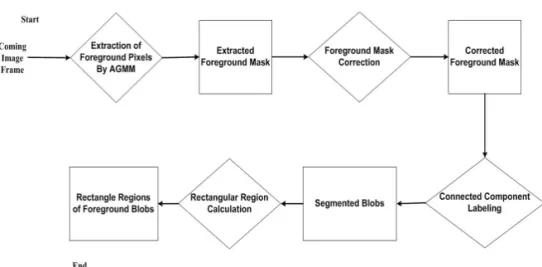
Under a fixed surveillance camera, one can model the scene without any foreground objects (humans, vehicles or some other objects) as a background scene. Then, pedestrians on the scene can be found on foreground blobs, which identifies regions of foreground blobs, a collection of fore- ground pixels. For pedestrian detection purpose, a minimum bounding box of a foreground mask is extracted as a candidate region which may contain pedestrians.
To extract foreground blobs from a frame image, we adopt AGMM-based background subtraction method[28]. Fig 4. shows the steps of our adopted
Fig. 4. Steps of the adopted AGMM-based candidate region extraction.
AGMM-based extraction of candidate regions for foreground pedestrians [29].
Fig. 5. shows some resulting images associated with steps in Fig. 4.
(a) (b) (c) (d)
Fig. 5. The result images of candidate region extraction steps of Fig. 4. ; (a) original image, (b) Fore- ground mask, (c) corrected foreground mask, (d) candidate region; rectangle region of the corrected foreground mask
3.2 Applying HOG-based PD to the candidate regions
3.2.1 Approximate calculation of HOG descriptors on candidate regions
In order to reduce computation time of HOG de- scriptors, the proposed PD method approximates calculation of HOG descriptors’ gradient in a less computation time by reducing the number of ori- entation binning for the cell histogram to 4 from 9, originally chosen in [5] over 0〫∼180°.
Less number of the orientation bins is reported to show performance degradation. But, in the pro- posed PD method, possible degradation owing to less number of orientation bins is compensated by
applying a suitable SVM classifier among three SVM classifiers trained in three different sizes of detection windows (16 × 32, 32 × 64, 64 × 128). Then, noticeable accuracy performance degradation is not observed through extensive experiments.
3.2.2 Block normalization
For block normalization scheme, we adopt L2- Hys as in OpenCV implementation of HOG-based PD [26]. L2-Hys is L2-norm followed by clipping (limiting the maximum values of the normalized descriptor vector to 0.2), where normalization by L2-norm is to normalize the unnormalized descrip- tor vector by .
3.2.3 Hybrid Sliding Windows
As mention in Section 2.3, the original HOG- based PD [5] scans a detection window across all of the dense image pyramids. The proposed PD has only to scan a detection window over the candidate regions. Each candidate region is expected to con- tain a pedestrian tightly, if it contains one.
In the similar way to [5], one may apply one de- tection window for image pyramids of the candi- date regions. However, in this paper, we apply a different detection window of the appropriate size according to the size of each candidate region. The selected detection windows are of three sizes; 16
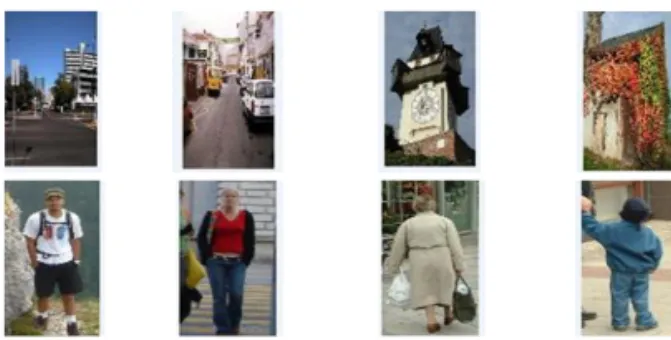
Fig. 6. Some sample images in INRIA pedestrian data- base.
× 32, 32 × 64, and 64 × 128. If the candidate region is less than 16 × 32, it is discarded. If it is greater than 64 × 128, the proposed PD method applies the detection window of 64 × 128 to the down-scaled image pyramids of the candidate region. It is noted that the minimum down-scaled image is not less than 64 × 128. Otherwise, the proposed PD method applies the detection window with the size close to that of each candidate region.
As mentioned in Section 2.3, this hybrid ap- proach computationally has advantage over the original image pyramid approach. The three classi- fiers are trained in offline mode, and in the testing stage, the proposed PD can save a lot of computa- tional time since it does not have to scan the down-scaled image pyramids or just have only to scan a few down-scaled image pyramids. Also, as mentioned earlier, it is observed that applying a suitable SVM classifier according to the size of the candidate regions compensate the possible accu- racy degradation due to approximate computation.
3.3 Training Support Vector Machine
For classification of the HOG descriptors, we adopt relatively computationally light linear SVM, which evaluates.
(1)
The weight vector and the bias are de- termined during the training phase of the SVM. If
, it is determined that pedestrian is de- tected, otherwise not. We trained SVM using sam- ple images from INRIA database [30]. Training sample data set consists of two parts; positive im- ages (pedestrian images) and negative images (non-pedestrian images). The data set was scaled to three different sizes to train three SVM classi- fiers proportional to level 1 = 16 × 32, level 2 = 32 × 64, and level 3 = 64 × 128. Fig. 6 shows some example images in INRIA database.
3.4 Fixed-point mode Computation
Many processing steps including computation of HOG descriptors, classifying by SVM, and so on require floating-point arithmetic. Even in PC envi- ronments, fixed-point operations are faster than floating-point operations. In the embedded envi- ronments, many of embedded processors, espe- cially DSP, support only fixed-point integer com- putation. The processing with floating-point arith- metic is usually more precise but computationally heavier than the fixed-point arithmetic.
In order to reduce the numerical impreciseness due to fixed-point computation, we adopt Q-format for approximating floating-point computations more precisely in fixed-point integer computations.
As is known, Q-format is a fixed point number format where the number of fractional bits (and optionally the number of integer bits) is specified.
For example, a Q10 number has 10 fractional bits.
For our proposed PD method, we apply Q10 fixed- point arithmetic for calculating HOG descriptors, SVM training, and SVM classification, and all oth- er computational processing as a maximized opti- mum of shifting. The choice of the number of frac- tional bits depends on the maximum value of vari- ables during processing. If one selects a small number for fractional bits, the margin of error in calculations becomes large and the preciseness of the computing result will be reduced. On the con- trary, if one desires the number of fractional bits too big, then the result of formular which applies addition or multiplication to model with a list of
(a)
(b)
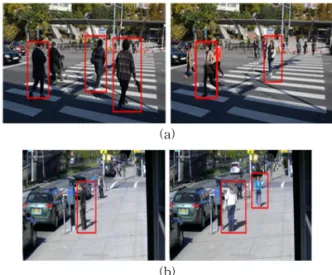
Fig. 7. The result of applying the proposed method; (a) Video 1, frame 126 and 488. (b) Video 2, frame 480 and 700.
Table 1. Comparison with respect to accuracy
Method Name
Video 1 Video 2
Miss Rate
(%) False positive
per frame Miss Rate
(%) False positive per frame
OpenCV-HOG-PD 20 0.80 20.5 0.67
HOG with Cascade SVM [27] 19 0.77 19.3 0.62
Proposed method in floating-point mode 21.5 0.88 21.3 0.67
Proposed method in fixed-point mode 22 0.92 22.4 0.69
vector's elements may produce value which cannot be expressed by 32 bit integer number.
Through the experiments, it is found that the fixed-point processing using Q10 format even in the PC environments achieves significant speed improvements without severe performance degra- dation, and that the fixed-point implementation helps a lot to make the proposed PD method oper- ate in real-time for DSP like TI DSP DM6437.
4. EXPERIMENTAL RESULTS
For performance evaluation of the proposed method, we implemented it in both conventional floating-point mode and the fixed-point mode, and compared the implementations with the PD im- plemented in Open-CV library [26] (hereafter, OpenCV-HOG-PD) and the HOG with cascade SVM [27] with respect to accuracy and processing time. The OpenCV-HOG-PD implements ‘HOG + SVM’ [5]. The HOG with cascade SVM we uti- lized in this paper for comparison is what we re- trained the object detection with cascade SVM of [27] using HOG descriptors for pedestrian de- tection.
For testing, we prepared two videos. Video1 is taken about the crosswalk at near Soongsil University, Seoul, Korea. It consists of 901 frames of 1920 x 1080. Video2 is a street view movie ob- tained from Internet and it consists of 1856 frames of 1920 × 1080. Testing Windows PC has a pro- cessor Core i7 2600 of 3.4GHz and main memory of 8GB.
Our employed measure for the correct detection is PASCAL measure [16], which determines cor- rect object detection if the area of overlap exceed 50%:
∪
∩
(2)
Fig. 7 shows some result images from applying the proposed PD method to Video 1 and Video 2.
We compared our proposed PD method with OpenCV-HOG-PD and HOG with cascade with respect to accuracy and processing time. The ex- perimental results of Table 1 show the comparison with respect to accuracy.
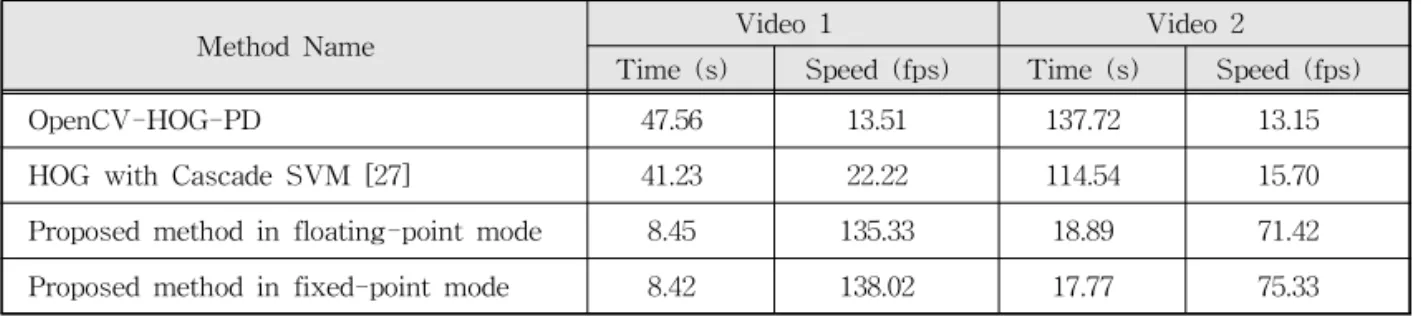
Table 2 shows the comparison experimental re- sults among HOG-PD, HOG with cascade SVM and the proposed methods in two arithmetic modes of floating-point and fixed-point with respect to
Table 2. Comparison with respect to processing time
Method Name Video 1 Video 2
Time (s) Speed (fps) Time (s) Speed (fps)
OpenCV-HOG-PD 47.56 13.51 137.72 13.15
HOG with Cascade SVM [27] 41.23 22.22 114.54 15.70
Proposed method in floating-point mode 8.45 135.33 18.89 71.42
Proposed method in fixed-point mode 8.42 138.02 17.77 75.33
processing time. It is noted that the original frame sizes are scaled down to 480 × 320 before process- ing.
The experimental results in Table 1 and Table 2 show that the proposed method performs faster than OpenCV-HOG-PD [26] and HOG with Cas- cade SVM [27] without noticeable accuracy per- formance degradation. The implementation in fixed-point showed faster processing time with marginal accuracy degradation compared float- ing-point implementation. HOG with cascade SVM [27] generally shows better precise and processing speed [16] compared to conventional HOG-SVM approach, but the cascading classifiers employed in HOG with cascade SVM [27] will not be very useful for our proposed method. Since the cascad- ing classifiers achieves processing speedup by dis- carding unplausible negative samples sequently through cascading SVM classifiers, speedup gain will be greater when the number of negative sam- ples are far more than that of positive samples. In our proposed PD method, the candidate regions by AGMM is likely to include pedestrians. Thus, ap- plying cascading classifiers to candidate regions may not have any computational gain much.
The implementation in fixed-point mode was easily ported into TI DM 6437 DSP Processor with fixed-point arithmetic only supported, and it was found to show 10 fps processing speed for input video resolution of 720 × 480 with scaled-down 480
× 320 for internal processing.
5. CONCLUSIONS
In this paper, we proposed an improved real- time pedestrian detection (PD) method for em- bedded visual surveillance. The proposed PD method utilizes selective search, but not exhaustive search required for original HOG-based PD meth- ods by restricting searching to candidate regions extracted by AGMM-based background sub- traction. The proposed PD method first extracts foreground blobs as candidate regions for pedes- trians, computes approximate HOG descriptors on the candidate regions, not on the whole scene frame and determines whether the candidate re- gions contain pedestrians by applying the calcu- lated HOG descriptors to one of the three trained SVMs according to sizes of the candidate regions.
In order to speed up processing more, all computa- tions are done in fixed-point mode without notice- able accuracy degradation by utilizing Q-format.
This fixed-point implementation was easily ported into fixed-point DSPs such as TI 6437 processor and the ported proposed PD method was found to run in real-time.
Through experiments, it is shown that our pro- posed method in both floating-point mode and fixed-point mode is much faster without noticeable accuracy performance degradation compared to OpenCV-HOG-PD[26] and HOG with Cascade SVM [27].
REFERENCE
[ 1 ] A. Shashua, Y. Gdalyahu, and G. Hayun,
"Pedestrian Detection for Driving Assistance Systems: Single-Frame Classification and System Level Performance," P roceedings of IEEE Intelligent Vehicles Symposium, pp.
13-18, 2004.
[ 2 ] X. Wang, M. Wang, and W. Li, “Scene- Specific Pedestrian Detection for Static Video Surveillance,” IEEE Transactions on Soft- ware Engineering, Vol. 36, No. 2, pp. 361-374, 2014.
[ 3 ] J. Yan, X. Zhang, Z. Lei, S. Liao, and S.Z. Li,
“Robust Multi-Resolution Pedestrian Detec- tion in Traffic Scenes,” Proceeding of IEEE Conference on Computer Vision and Pattern Recognition, pp. 3033-3040, 2013.
[ 4 ] P. Viola and M. Jones. “Robust Real-Time Face Detection,”International Journal of Com- puter Vision, Vol. 57, Issue 2, pp. 137-154, 2004.
[ 5 ] N. Dalal and B. Triggs, “Histograms of Oriented Gradients for Human Detection,”
P roceeding of IEEE Conference on Compu- ter Vision and Pattern Recognition, pp. 886- 893, 2005.
[ 6 ] Q. Zhu, M.C. Yeh, and K.T. Cheng, “Fast Human Detection using a Cascade of Histo- grams of Oriented Gradients,”P roceeding of IEEE Conference on Computer Vision and P attern Recognition, pp. 1491-1498, 2006.
[ 7 ] C.H. Lampert, M.B. Blaschko, and T.
Hofmann. "Beyond Sliding Windows: Object Localization by Efficient Subwindow Search,"
P roceeding of IEEE Conference on Compu- ter Vision and P attern Recognition, pp. 1-8, 2008.
[ 8 ] C. Wojek and B. Schiele, “A Performance Evaluation of Single and Multi-Feature People Detection,” Lecture Notes in Compu- ter Science, Vol. 5096, pp. 82-91, 2008.
[ 9 ] O. Tuzel, F. Porikli, and P. Meer, “Pedestrian Detection via Classification on Riemannian Manifolds,” IEEE Transactions on Pattern
Analysis and Machine Intelligence, Vol. 30, No. 10, pp. 1713-1727, 2008.
[10] X. Wang, T.X. Han, and S. Yan, “An HOG- LBP Human Detector with Partial Occlusion Handling,”Proceeding of IEEE International Conference on Computer Vision, pp. 32-39, 2009.
[11] P. Dollar, Z. Tu, P. Perona, and S. Belongie,
“Integral Channel Features,” P roceeindg of The British Machine Vision Conference, pp.
91.1-91.11, 2009.
[12] P. Dollar, C. Wojek, B. Schiele, and P. Perona,
“Pedestrian Detection: A Benchmark,” Pro- ceeding of IEEE Conference on Computer Vision and Pattern Recognition, pp. 304-311, 2009.
[13] P. Dollar, S. Belongie, and P. Perona, “The Fastest Pedestrian Detector in the West,”
P roceeding of The British Machine Vision Conference, pp. 68.1- 68.11, 2010.
[14] P.F. Felzenszwalb, R. Girshick, D. McAllester, and D. Ramanan, “Object Detection with Discriminatively Trained Part-Based Models,”
IEEE Transactions on Pattern Analysis and Machine Intelligence, Vol. 32, Issue 9, pp.
1627-1645, 2010.
[15] D. Park, D. Ramanan, and C. Fowlkes, “Mul- tiresolution Models for Object Detection,”
Proceeding of European Conference on Com- puter Vision, pp. 241-254, 2010.
[16] P. Dollar, C. Wojek, B. Schiele, and P. Perona,
“Pedestrian Detection: An Evaluation of the State of the Art,” IEEE Transactions on Pattern Analysis and Machine Intelligence, Vol. 34, Issue 4, pp. 743-761, 2011.
[17] M. Pedersoli, A. Vedaldi, and J. Gonzalez. “A Coarse-to-Fine Approach for Fast Deform- able Object Detection,” Proceeding of IEEE Conference Computer Vision and Pattern Recognition, pp. 1353-1360, 2011.
[18] P. Sudowe and B. Leibe, “Efficient Use of Geometric Constraints for Sliding-Window
Object Detection in Video,” Proceeding of International Conference on Computer Vision Systems, pp. 11-20, 2011.
[19] R. Benenson, M. Mathias, R. Timofte, and L.
Van Gool, “Pedestrian Detection at 100 Frames per Second,” P roceeding of IEEE Conference on Computer Vision and Pattern Recognition, pp. 2903-2910, 2012.
[20] P. Sermanet, K. Kavukcuoglu, S. Chintala, and Y. LeCun, “Pedestrian Detection with Unsu- pervised Multi-Stage Feature Learning,”
P roceeding of IEEE Conference Computer Vision and Pattern Recognition, pp. 3626- 3633, 2013.
[21] R. Benenson, M. Omran, J. Hosang, and B.
Schiele, “Ten Years of Pedestrian Detection, What Have We Learned?,” P roceeding of European Conference on Computer Vision, pp. 613-627, 2014.
[22] B. Hariharan, C.L. Zitnick, and P. Dollár,
“Detecting Objects using Deformation Dic- tionaries,” Proceeding of IEEE Conference Computer Vision and Pattern Recognition, pp. 1995-2002, 2014.
[23] K.M Bhuvanarjun and T.C. Mahalingesh,
“Pedestrian Detection in a Video Sequence using HOG and Covaraince Method,”Interna- tional J ournal of Electrical and Electronics Engineers, Vol. 7, Issue 1, pp. 183-190, 2015.
[24] K. van de Sande, J. Uijlings, T. Gevers, and A. Smeulders, “Segmentation as Selective Search for Object Recognition,”Proceeding of IEEE International Conference on Computer Vision, pp. 1879-1886, 2011.
[25] J. Hosang, R. Benenson, Piotr Dollár, and B.
Schiele,“ What Makes for Effective Detection Proposals?,” IEEE Transactions on Pattern Analysis and Machine Intelligence, Accepted, 2015.
[26] OpenCV Library, http://opencv.org/, 2015. 11.
30.
[27] X. Yang, C. Yi, L. Cao, and Y. Tian, “Media- CCNY at TRECVID 2012: Surveillance Event Detection,” NIST Trecvid Workshop, 2012.
[28] C. Stauffer and C, W.E.L Grimson, “Adaptive Background Mixture Models for Real-Time Tracking,” P roceeding of Conference on Computer Vision and Pattern Recognition, pp. 246-252, 1999.
[29] T.B. Nguyen, S.T. Chung, and S.W. Cho, “An Effective Moving Cast Shadow Removal in Gray Level Video for Intelligent Visual Surveillance,” Journal of Korea Multimedia Society, Vol. 17, No. 4, pp. 420-432, 2014.
[30] INRIA Person Dataset, http://pascal.inrialpes.
fr/data/human/, 2015. 11. 30.
Thanh Binh Nguyen He was born in Viet Nam in 1984. He received the B. Eng.
degree in computer science from the University of Science, Ho Chi Minh, Viet Nam, in 2005, the M.Sc. degree in information and telecommunication engineering from the University of SoongSil, Seoul, South Korea, in 2010, and pursuing the Ph.D. program in engineering at the University of SoongSil, Seoul, South Korea, from 2012. He had worked as a software developer for 3 years from 2005 at Viet Nam. He is currently a prin- cipal software R&D researcher at Embedded Vision Inc., Seoul, South Korea, and has been a research as- sistant at Embedded Real-time Computing Lab., University of Soongsil, Seoul, South Korea. His re- search interests cover the design and analysis of vari- ous smart embedded software system, IoT and also intelligent image, video analytic algorithms which are applied to visual surveillance, recognition systems, and etc.
Van Tuan Nguyen He was born in Vietnam in 1991.
He received the B.E degree in electronics and computer en- gineering from Hanoi Universi- ty of Science and Technology, Hanoi, Vietnam, in 2014. He is currently a research assistant at Embedded Real-time Computing Laboratory, Soongsil University, Seoul, South Korea. His main areas of re- search interest are embedded systems, image process- ing, visual surveillance, recognition systems and ma- chine learning.
Sun-Tae Chung
He received B.E. degree from Seoul National University, and M.S. degree and Ph.D. degree in Electrical Eng. and Computer Science from the University of Michigan, Ann Arbor, USA, in 1986 and 1990, respectively.
Since 1991 until, he had been with the School of Electronic Eng. at the Soongsil university, Seoul, Korea. Since 2015, he is now affiliated with Depart- ment of Smart Systems Software, Soongsil University, which has been established in 2015 for education and researches focusing in the area of industrial fields needing embedded systems and smart software tech- nologies His research interests include: computer vi- sion, realistic media, visual surveillance, biometrics, digital signage, and embedded systems.
![Fig. 1. Processing stages of HOG-based pedestrian detection proposed in [5].](https://thumb-ap.123doks.com/thumbv2/123dokinfo/4767882.517535/3.892.129.764.1042.1100/fig-processing-stages-hog-based-pedestrian-detection-proposed.webp)
![Fig. 2 Approaches to sliding window-based multiscale object detection [13].](https://thumb-ap.123doks.com/thumbv2/123dokinfo/4767882.517535/5.892.164.733.937.1096/fig-approaches-sliding-window-based-multiscale-object-detection.webp)