Vol. 46, No. 4, pp. 496 - 502, 2005
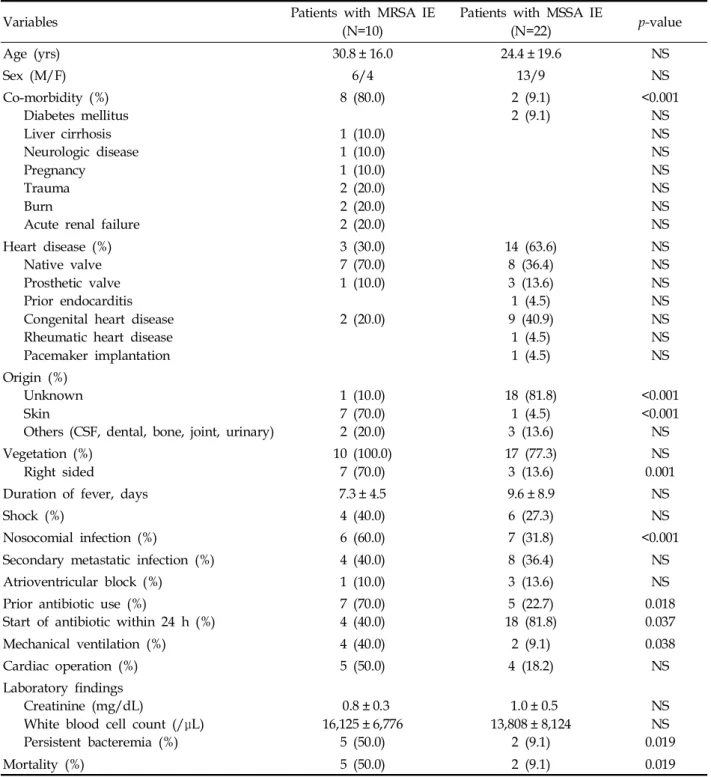
Our objective was to assess the clinical factors that would reliably distinguish methicillin-resistant S. aureus (MRSA) from methicillin-susceptible S. aureus (MSSA) endocarditis. A retrospective cohort study of clinical features and mortality in patients with MRSA and MSSA endocarditis between March 1986 and March 2004 was performed in a 750-bed, tertiary care teaching hospital. A total of 32 patients (10 MRSA [31.3%] vs 22 MSSA [68.7%]) were evaluated. Their mean age and sex ratio (male/female) were as follows: 30.8 ± 16.0 vs 24.4±19.6 years old and 6/4 vs 13/9, for MRSA and MSSA infective endocarditis (IE), respectively. Univariate and multi- variate analyses revealed that persistent bacteremia was sig- nificantly more prevalent in MRSA IE (OR, 10.0 [1.480- 67.552]; p, 0.018). There was a higher mortality trend for MRSA IE (50.0%) than for MSSA IE (9.1%) (p=0.019).
However, persistent bacteremia was not associated with higher mortality (p>0.05). These results indicate that if persistent bacteremia is documented, the likelihood of MRSA endo- carditis should be viewed as high, and the patient's anti- staphylococcal therapy should be prolonged and/or changed to a more "potent" regimen.
Key Words: Staphylococcus aureus, bacteremia, endocarditis
INTRODUCTION
Infective endocarditis (IE) is a serious septic dis- ease that can be life-threatening, unless effective therapy is initiated under the correct diagnosis. Al- though there have been many developments and im- provements in diagnostic and therapeutic methods,
the clinical diagnosis of infective endocarditis re- mains sometimes difficult and the annual incidence, morbidity, and mortality are still relatively high.
1,2Among IE-causing pathogens, S. aureus endo- carditis has a higher mortality than endocarditis caused by most other microorganisms.
1,3-12Overall mortality associated with S. aureus bacteremia ranges from 11.9%
13to 46.5%.
14Age, co-morbidity, shock, inappropriate empirical therapy, bactere- mia acquired in intensive care unit (ICU) and severe sources of infection may be independent predictors for mortality.
15Since the 1980s, the incidence of S. aureus bacte- remia has increased due to the extensive use of indwelling intravenous catheters.
16,17Predisposing factors for methicillin-resistant S. aureus (MRSA) infection include severe underlying conditions, prolonged hospital stay, previous antibiotic treat- ment, and nasal MRSA carriage.
16,18Since nosocomial S. aureus bacteremias are in- creasingly due to MRSA, it is important to iden- tify clinical features of endocarditis that can help distinguish between MRSA and MSSA infections.
Few data exist comparing the relative rates and clinical characteristics of endocarditis due to MRSA and MSSA.
The aim of this study was to assess clinical fac- tors that would reliably distinguish between MRSA and MSSA endocarditis in order to quickly and properly manage MRSA IE.
MATERIALS AND METHODS
We performed a retrospective cohort study
A Comparison of Clinical Features and Mortality among Methicillin-Resistant and Methicillin-Sensitive Strains of Staphylococcus aureus Endocarditis
Hee Jung Yoon,
1,2Jun Yong Choi,
1,2Chang Oh Kim,
1,2June Myung Kim,
1,2and Young Goo Song
1,21