• 검색 결과가 없습니다.

Clinical Predictors of Survival in Idiopathic Pulmonary FibrosisJi Hye Kim, M.D., Jin Hwa Lee, M.D., Yon Ju Ryu, M.D., Jung Hyun Chang, M.D.

N/A
N/A
Protected

Academic year: 2022

Share "Clinical Predictors of Survival in Idiopathic Pulmonary FibrosisJi Hye Kim, M.D., Jin Hwa Lee, M.D., Yon Ju Ryu, M.D., Jung Hyun Chang, M.D."

Copied!
7
0
0

로드 중.... (전체 텍스트 보기)

전체 글

(1)

Tuberc Respir Dis 2012;73:162-168

CopyrightⒸ2012. The Korean Academy of Tuberculosis and Respiratory Diseases. All rights reserved.

Clinical Predictors of Survival in Idiopathic Pulmonary Fibrosis

Ji Hye Kim, M.D., Jin Hwa Lee, M.D., Yon Ju Ryu, M.D., Jung Hyun Chang, M.D.

Department of Internal Medicine, Ewha Womans University School of Medicine, Seoul, Korea

Background: Idiopathic pulmonary fibrosis (IPF) is a progressive disease. Effective treatment is not currently available and the prognosis is poor. The aim of our study was to identify clinical predictors of survival in patients with IPF.

Methods: By using medical record database of a university hospital, we reviewed the records of patients who had been diagnosed as having IPF from January 1996 through December 2007.

Results: Among 89 patients considered as having interstitial lung disease (ILD) on computed tomography (CT) of the chest, 22 were excluded because of the diagnosis of other ILDs or connective tissue disease, and finally, 67 met the criteria of IPF. The mean age at the diagnosis of IPF was 70 years (range, 41∼87 years) and 43 (64%) were male. The mean survival time following the diagnosis of IPF was 40 months (range, 0∼179 months). Among them, 28 cases were diagnosed as the progressive state of IPF on the follow-up CT examination, and the mean duration between diagnosis of IPF and progression was 31 months. Multivariate analysis using Cox regression model revealed that body mass index (BMI) less than 18.5 kg/m

2

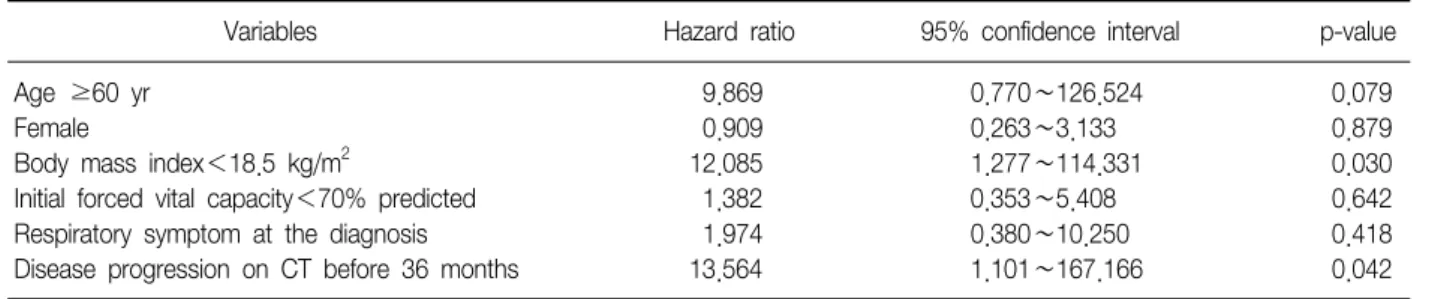
(p=0.030; hazard ratio [HR], 12.085; 95% confidence interval [CI], 1.277∼114.331) and CT progression before 36 months from the diagnosis of IPF (p=0.042; HR, 13.564;

95% CI, 1.101∼167.166) were independently associated with mortality.

Conclusion: Since low BMI at the diagnosis of IPF and progression on follow-up CT were associated with poor prognosis, IPF patients with low BMI and/or progression before 36 months following the diagnosis should be closely monitored.

Key Words: Idiopathic Pulmonary Fibrosis; Body Mass Index; Disease Progression

Address for correspondence: Jin Hwa Lee, M.D.

Department of Internal Medicine, Ewha Womans University School of Medicine, 911-1, Mok 5-dong, Yancheon-gu, Seoul 158-710, Korea

Phone: 82-2-2650-6007, Fax: 82-2-2655-2076 E-mail: [email protected]

Received: Apr. 13, 2012 Revised: May 14, 2012 Accepted: Aug. 29, 2012

CCIt is identical to the Creative Commons Attribution Non-Commercial License (http://creativecommons.org/licenses/by-nc/3.0/).
Introduction

Idiopathic pulmonary fibrosis (IPF) is the most com- mon type of idiopathic interstitial lung diseases. It has chronic symptoms and is a progressive disease that de- velops gradual pulmonary interstitial fibrosis. It has poor prognosis and no effective treatment. In the past, lung biopsy was essential to confirm IPF. In particular, as IPF has temporal heterogeneity, open or thoraco-

scopic lung biopsy under general anesthesia was recom-

mended to obtain relatively large tissues from various

areas. In a clinical practice, however, as most patients

with IPF are old and have substantial comorbidity such

as cardiovascular disease, the risks of surgical lung bi-

opsy may outweigh the benefits of establishing a secure

diagnosis of IPF. According to the guideline presented

by the American Thoracic Society (ATS) and European

Respiratory Society (ERS) in 2000, a patient can be diag-

nosed with IPF if he/she satisfies all of three major diag-

nostic criteria (pulmonary function insufficiency of re-

strictive type, radiological characteristics of IPF on the

high-resolution computed tomography (HRCT) of chest,

no evidence of other diseases) and three or more of

four minor diagnostic criteria when it is difficult to con-

duct a biopsy although biopsy is a principle

1

. In 2011,

ATS, ERS, the Japanese Respiratory Society (JRS), and

the Latin-America Thoracic Association (ALAT) pre-

(2)

sented a new guideline by referring to the recom- mendations of the Society of Thoracic Radiology and Pulmonary Pathology Society

2

. The diagnostic criteria (2011) are as follows: first, no other causative factor of pulmonary fibrosis should be present. Second, typical HRCT findings of chest should be available if lung biop- sy is unavailable. Third, IPF should be confirmed by histopathology and radiology if lung biopsy is conducted. Thus, the new guideline emphasizes an in- terdisciplinary approach including clinical, and radio- logical, and pathological examinations. Accordingly, this study was retrospectively conducted to investigate factors affecting patients' prognosis in patients with IPF according to the 2011 diagnostic criteria.

Materials and Methods

The medical records of patients, who were diagnosed with IPF at Ewha Womans University Mokdong Hospital from January 1, 1996 to December 31, 2007, were reviewed. Among patients who had been suspected of having interstitial lung disease on chest CT, those who satisfied the diagnostic criteria

2

for IPF presented by the ATS, ERS, JRS, and ALAT were selected as subjects.

Pulmonary function test was conducted in a stable state using Vmax spectra 22 (SensorMedics, Yorba Linda, CA, USA) according to the ATS guideline

3

. The last fol- low-up date was May 7, 2010. The patients who sur- vived until the last follow-up and patients who died be- fore the last follow-up were classified into the survival group and death group, respectively. This study was re- viewed and approved by the Institution Review Board of Ewha Womans University Mokdong Hospital.

Statistical analysis was conducted using SPSS version 18.0 (SPSS Inc., Chicago, IL, USA). Fisher's exact test or chi-square test was conducted to compare categorical variables between the two groups, whereas Student's t-test was conducted to compare continuous variables between the two groups. Survival curves were obtained using the Kaplan-Meier method, and the two survival curves were compared using Log rank method. The ef- fect of variables on the survival was assessed using Cox

proportional-hazards model.

Results

Among 89 patients who had been suspected of hav-

ing interstitial lung disease on chest CT, 67 patients

were diagnosed with IPF except for 22 patients who

were diagnosed with other types of interstitial lung dis-

ease or connective tissue disease. The mean age of the

patients at the time of diagnosis was 70 years (range,

41∼87 years). The mean age of the survival and death

groups were 64 years and 72 years, respectively, which

showed a statistical significance (p=0.003). There were

forty-three male patients (64.2%). They consisted of 14

patients (73.7%) from the survival group and 29 patients

(60.4%) from the death group, which showed no gen-

der difference (p=0.307). At the time of diagnosis, the

mean body mass index (BMI) of the patients was 22.7

kg/m

2

, which showed no significant difference between

the two groups (p=0.119). Fifty-three patients (80.3%)

had symptom such as coughing, sputum, dyspnea, and

hemoptysis at the time of diagnosis. They consisted of

12 patients (63.2%) from the survival group and 41 pa-

tients (87.2%) from the death group, which showed a

significant difference (p=0.026). The mean forced vital

capacity (FVC) was 71.2% predicted. The survival group

had 80.1% predicted, whereas the death group had

67.3% predicted, which showed a significant difference

(p=0.023). However, no significant differences in forced

expired volume in one second/FVC, total lung capacity,

and diffusing capacity for carbon monoxide (DLco)

were found between the two groups. At the time of di-

agnosis, the 7 patients showed emphysematous change

on chest CT. They consisted of 5 from the survival

group and 2 from the death group, which showed a

significant difference (p=0.017). The mean survival time

was 40 months (range, 0∼179 months), of whom 28

patients showed exacerbation on the follow-up chest

CT, and the mean period between diagnosis and ex-

acerbation was 31 months. The survival group had a

mean period of 48 months, and the death group had

a mean period of 21 months, which showed a sig-

(3)

Table 1. Characteristics of patients with IPF

Variable Total (n=67) Survivors (n=19) Non-survivors (n=48) p-value

Age at diagnosis, yr 69.9±9.9 64.2±10.9 72.1±8.6 0.003

Male 43 (64) 14 (74) 29 (60) NS

Initial body mass index, kg/m

2

22.7±2.9 23.6±2.2 22.3±3.1 NS

Symptoms at diagnosis 53 (80) 12 (63) 41 (87) 0.026

FVC % predicted 71.2±20.2 80.1±12.5 67.3±21.8 0.023

FEV

1

/FVC, % 82.4±21.9 83.9±14.9 85.1±13.4 NS

DL

CO

% predicted 67.5±27.0 69.9±24.7 66.5±28.3 NS

TLC % predicted 75.9±29.7 80.5±17.8 74.2±33.2 NS

Emphysematous finding on initial chest CT 7 (10) 5 (26) 2 (4) 0.017

Disease progression after diagnosis, mo 30.7±29.2 48.2±36.9 20.9±18.7 0.015

Treatment with steroid 15 (23) 4 (24) 11 (23) NS

Survival time after diagnosis, mo 39.5±38.5 80.9±38.7 23.1±23.1 <0.001

The value of data was mean±standard deviation or number (%).

IPF: idiopathic pulmonary fibrosis; NS: not significant; FVC: forced vital capacity; FEV

1

: forced expiratory volume in 1 second; DL

CO

: diffusing capacity for carbon monoxide; TLC: total lung capacity; CT: computed tomography.

Table 2. Prognostic factors of IPF by multiple Cox regression analyses

Variables Hazard ratio 95% confidence interval p-value

Age ≥60 yr 9.869 0.770∼126.524 0.079

Female 0.909 0.263∼3.133 0.879

Body mass index<18.5 kg/m

2

12.085 1.277∼114.331 0.030

Initial forced vital capacity<70% predicted 1.382 0.353∼5.408 0.642

Respiratory symptom at the diagnosis 1.974 0.380∼10.250 0.418

Disease progression on CT before 36 months 13.564 1.101∼167.166 0.042

IPF: idiopathic pulmonary fibrosis; CT: computed tomography.

Figure 1. Comparison of overall survival by Kaplan-Meier method. (A) Disease progression on computed tomography

(CT) before 36 months following the diagnosis. (B) Initial body mass index. p-value by Log rank test.

(4)

nificant difference (p=0.015) (Table 1). In multivariate analysis using Cox regression model, various factors that were reported to be related to prognosis in many pre- vious studies were analyzed altogether. Among the fac- tors such as age, gender, respiratory symptoms, BMI, FVC, and period between diagnosis and exacerbation, the prognosis was poorer in the patients with BMI

<18.5 kg/m

2

than in the patients with BMI≥18.5 kg/m

2

(p=0.030; hazard ratio [HR], 12.085; 95% con- fidence interval [CI], 1.277∼114.331). The prognosis was also poorer in the patients with period between di- agnosis and exacerbation on follow-up HRCT <36 months than in the patients period between diagnosis and exacerbation ≥36 months (p=0.042; HR, 13.564;

95% CI, 1.101∼167.166) (Table 2, Figure 1).

Discussion

The survival time of patients with IPF varies depend- ing on diagnosis time. That is, it depends on the time of radiological abnormality, symptom onset, and diagnosis. It was reported that reticular opacity of the bilateral base shown in chest X-ray occurred several years before the onset of symptoms, and the symptoms began 1,000 days after radiologic abnormalities in pa- tients who were diagnosed with IPF via biopsy or chest X-ray

4

. In addition, many studies reported that the symptoms occurred 1∼2 years before being diagnosed with IPF

5-12

. Thus, IPF was reported to be diagnosed five or more years after the onset of symptoms

4

. A com- parison of the survival following its diagnosis showed that the median value of the survival time after symp- tom onset was approximately 48 months or less. Studies that were conducted following the classification of new idiopathic interstitial pneumonia reported that the me- dian value of the survival time was 2∼4 years, and that the 5-year survival rate was 20∼40%

6-12

. In addition, patients with IPF had high mortality, but the change in pulmonary function was insignificant

13,14

. This is likely to be attributable to the fact that IPF showed stepwise progression rather than gradual progression, thereby re- sulting in high mortality

15

. Therefore, an intensive man-

agement of IPF is important during the aforementioned acute stage.

The acute exacerbation of IPF means the sudden de- terioration of underlying pulmonary diseases, which can secondarily occurs following the occurrence of in- fection, pulmonary embolism, pneumothorax, and heart failure

16

. According to 2008 report on patients with idio- pathic interstitial pneumonia, the death of patients with IPF were reported to be caused by respiratory failure 44%, pneumonia 31%, lung cancer 9%, cardiovascular disease 5%, and others 10% due to exacerbation. It was, however, difficult to distinguish acute exacerbation with pulmonary infection

2

. Meanwhile, acute exacerbation occurs without clear reason

17-19

, and this acute ex- acerbation stage occurs from time to time, and is also correlated with high mortality

17-24

. A follow-up study conducted on 168 patients with IPF reported that 21%

of the patients died during a period of 76 weeks

(median), of whom 47% died of acute exacerbation

25

.

According to the results of studies on the prognosis of

IPF, various factors, such as old age, male, dyspnea,

smoking history, reduced pulmonary function, radio-

logical abnormality, increased neutrophils or eosino-

phils in the bronchoalveolar lavage, honeycombing

opacity on HRCT, and fibroblast foci on biopsy, were

shown to be associated with poor prognosis

26-28

. In this

study, however, as bronchoalveolar lavage and/or surgi-

cal biopsy were rarely conducted, it was impossible to

investigate the correlation with these factors. Among the

factors that have been known to be associated with

prognosis, the age, gender, pulmonary function, and

presence of symptoms showed no statistical signifi-

cance. Meanwhile, the patients with underweight had

poorer prognosis. However, few studies have been con-

ducted to investigate the correlation of BMI with prog-

nosis in patients with IPF. BMI, which is calculated by

dividing body weight (kg) by height (m)

2

, is used as

a marker that is measured by the World Health

Organization for obesity management. As it can easily

identify the nutritional state of patients, it is also used

for checking malnutrition in addition to obesity. Patients

are classified into underweight (<18.5 kg/m

2

), normal

(5)

(18.5∼24.99 kg/m

2

), overweight (25∼29.99 kg/m

2

), and obese status (≥30 kg/m

2

)

29

. As the correlation of chronic obstructive pulmonary disease (COPD) with BMI has been well known, BODE index that is com- prised of BMI, airway obstruction, dyspnea, and ex- ercise capacity has played an important role as a pre- dictor of all-cause mortality in patients with COPD.

Patients with moderate or severe COPD commonly have underweight. This was reported to be associated with increased metabolism and energy consumption as a re- sult of systemic inflammatory response associated with pulmonary diseases. In addition, decreased pulmonary function was reported to be associated with decreased survival time in cystic fibrosis patients with malnutrition status

30-32

. However, few studies have been conducted to investigate the correlation of BMI with survival time in patients with IPF. Cano et al.

33

reported that BMI was associated with prognosis of patients with restrictive pulmonary impairment, and that the BMI was one of mortality predictors in 446 patients who had chronic res- piratory failure due to various causes. Among the afore- mentioned patients, 162 patients had restrictive pulmo- nary impairment

33

, but most of whom were patients with chest wall disorders or kyphoscoliosis. Unfortuna- tely, in that study, as the ratio of patients with interstitial lung disease or IPF was not shown, and the result was obtained from patients who had chronic respiratory fail- ure due to various causes, it was difficult to directly cor- relate BMI with mortality risk caused by IPF

33

. It was reported that high BMI contributed to the extension of the survival time of patients with IPF

34

, and that malnu- trition status caused thymic atrophy and reduced T-lym- phocyte function, thereby increasing infection risk and decreasing the survival

35,36

. Although it is difficult to make a conclusion on the association of BMI with the prognosis of IPF based on the results of the afore- mentioned studies alone, a further study is required to investigate the association of BMI with the prognosis of IPF. The guidelines of the ATS and ERS (2011) classified risk factors of mortality into two groups; baseline factors include level of dyspnea, DLco<40% predicted, desatu- ration≤88% during 6-minute walk test, extent of honey-

combing on HRCT, and pulmonary hypertension, and longitudinal factors include increase in level of dyspnea, decrease in FVC by >10% absolute value, decrease in DLco by >15% absolute value, and worsening of fib- rosis on HRCT. However, no assessment criteria for fol- low-up interval of HRCT or extent of fibrosis on HRCT has been established yet

2

. It is necessary to diagnose disease progression by assessing the status of patients in an interval of 4∼6 months. In the case of clinical exacerbation, it is necessary to check dyspnea, O

2

satu- ration, FVC, and DLco in a shorter interval. If 6-minute walk test is available, it is also recommended

2

. As echo- cardiography, which is conducted in patients with inter- stitial lung disease to assess pulmonary arterial hyper- tension, is not accurate

37

, echocardiography alone is not recommended for assessing pulmonary arterial hypertension. Disease such as lung cancer, coronary ar- tery disease, or pulmonary embolism may affect prog- nosis, but it is unclear if annual HRCT test to check con- current disease is useful

2

. It was reported that IPF pa- tients with concurrent emphysema had poorer prog- nosis than those without emphysema. A long-term oxy- gen therapy could be required to treat both diseases, and the both diseases could have pulmonary hyper- tension as a concurrent disease. As emphysema, how- ever, did not significantly affect patient survival, it is un- clear if emphysema is a factor representing poor prog- nosis

2,38,39

. In this study, five and two patients with em- physema were included in the survival and death groups, respectively, which showed that the number of patients with emphysema was higher in the survival group than in the death group. However, due to the small patient number, it was statistically insignificant.

Although all patients in this study were evaluated for

survival status, the number of subject was so small that

selection bias could have occurred. In addition, the

multivariate analysis showed that among factors that

were considered correlated with prognosis in previous

studies, the presence of respiratory symptom and de-

creased pulmonary function at the time of diagnosis

were not associated with prognosis, but low BMI and

radiological exacerbation were associated with prog-

(6)

nosis. Although this result seems to be inconsistent with the previous results, it is meaningful as it shows a possi- bility that BMI could be associated with not only COPD but also IPF. Furthermore, it could be helpful for de- termining the interval to conduct HRCT.

In conclusion, patients who had low BMI at the time of diagnosis and patients who showed radiologic pro- gression on follow-up CT before 36 months after diag- nosis had poor prognosis. Thus, these patients should be more carefully managed to reduce the risk of acute exacerbation.

References

1. American Thoracic Society; European Respiratory So- ciety. American Thoracic Society/European Respiratory Society International Multidisciplinary Consensus Class- ification of the Idiopathic Interstitial Pneumonias. This joint statement of the American Thoracic Society (ATS), and the European Respiratory Society (ERS) was adopt- ed by the ATS board of directors, June 2001 and by the ERS Executive Committee, June 2001. Am J Respir Crit Care Med 2002;165:277-304.

2. Raghu G, Collard HR, Egan JJ, Martinez FJ, Behr J, Brown KK, et al. An official ATS/ERS/JRS/ALAT state- ment: idiopathic pulmonary fibrosis: evidence-based guidelines for diagnosis and management. Am J Respir Crit Care Med 2011;183:788-824.

3. Standardization of Spirometry, 1994 Update. American Thoracic Society. Am J Respir Crit Care Med 1995;152:

1107-36.

4. Kim DS, Collard HR, King TE Jr. Classification and nat- ural history of the idiopathic interstitial pneumonias.

Proc Am Thorac Soc 2006;3:285-92.

5. Nagai S, Nagao T, Kitaichi M, Izumi T. Clinical courses of asymptomatic cases with idiopathic pulmonary fib- rosis and a histology of usual interstitial pneumonia.

Eur Respir J 1998;11:131s.

6. Bjoraker JA, Ryu JH, Edwin MK, Myers JL, Tazelaar HD, Schroeder DR, et al. Prognostic significance of histo- pathologic subsets in idiopathic pulmonary fibrosis.

Am J Respir Crit Care Med 1998;157:199-203.

7. Nagai S, Kitaichi M, Hamada K, Nagao T, Hoshino Y, Miki H, et al. Hospital-based historical cohort study of 234 histologically proven Japanese patients with IPF.

Sarcoidosis Vasc Diffuse Lung Dis 1999;16:209-14.

8. Collard HR, King TE Jr, Bartelson BB, Vourlekis JS, Schwarz MI, Brown KK. Changes in clinical and phys- iologic variables predict survival in idiopathic pulmo- nary fibrosis. Am J Respir Crit Care Med 2003;168:538- 42.

9. Flaherty KR, Mumford JA, Murray S, Kazerooni EA, Gross BH, Colby TV, et al. Prognostic implications of physiologic and radiographic changes in idiopathic in- terstitial pneumonia. Am J Respir Crit Care Med 2003;

168:543-8.

10. Jegal Y, Kim DS, Shim TS, Lim CM, Lee SD, Koh Y, et al. Physiology is a stronger predictor of survival than pathology in fibrotic interstitial pneumonia. Am J Respir Crit Care Med 2005;171:639-44.

11. Nicholson AG, Colby TV, Dubois RM, Hansell DM, Wells AU. The prognostic significance of the histologic pattern of interstitial pneumonia in patients presenting with the clinical entity of cryptogenic fibrosing alve- olitis. Am J Respir Crit Care Med 2000;162:2213-7.

12. Travis WD, Matsui K, Moss J, Ferrans VJ. Idiopathic nonspecific interstitial pneumonia: prognostic sig- nificance of cellular and fibrosing patterns: survival comparison with usual interstitial pneumonia and des- quamative interstitial pneumonia. Am J Surg Pathol 2000;24:19-33.

13. Raghu G, Brown KK, Bradford WZ, Starko K, Noble PW, Schwartz DA, et al. A placebo-controlled trial of interferon gamma-1b in patients with idiopathic pulmo- nary fibrosis. N Engl J Med 2004;350:125-33.

14. Demedts M, Behr J, Buhl R, Costabel U, Dekhuijzen R, Jansen HM, et al. High-dose acetylcysteine in idio- pathic pulmonary fibrosis. N Engl J Med 2005;353:

2229-42.

15. Scientific Committee of the Korean Academy of Tuber- culosis and Respiratory Diseases. 2008 National Survey of Idiopathic Interstitial Pneumonia in Korea. Tuberc Respir Dis 2009;66:141-51.

16. Panos RJ, Mortenson RL, Niccoli SA, King TE Jr. Clinical deterioration in patients with idiopathic pulmonary fib- rosis: causes and assessment. Am J Med 1990;88:396- 404.

17. Kondoh Y, Taniguchi H, Kawabata Y, Yokoi T, Suzuki K, Takagi K. Acute exacerbation in idiopathic pulmo- nary fibrosis. Analysis of clinical and pathologic find- ings in three cases. Chest 1993;103:1808-12.

18. Ambrosini V, Cancellieri A, Chilosi M, Zompatori M,

Trisolini R, Saragoni L, et al. Acute exacerbation of idi-

opathic pulmonary fibrosis: report of a series. Eur

Respir J 2003;22:821-6.

(7)

19. Akira M, Hamada H, Sakatani M, Kobayashi C, Nishioka M, Yamamoto S. CT findings during phase of accelerated deterioration in patients with idiopathic pulmonary fibrosis. AJR Am J Roentgenol 1997;168:79- 83.

20. Azuma A, Nukiwa T, Tsuboi E, Suga M, Abe S, Nakata K, et al. Double-blind, placebo-controlled trial of pirfe- nidone in patients with idiopathic pulmonary fibrosis.

Am J Respir Crit Care Med 2005;171:1040-7.

21. Kim DS, Park JH, Park BK, Lee JS, Nicholson AG, Colby T. Acute exacerbation of idiopathic pulmonary fibrosis:

frequency and clinical features. Eur Respir J 2006;27:

143-50.

22. Parambil JG, Myers JL, Ryu JH. Histopathologic features and outcome of patients with acute exacerbation of idi- opathic pulmonary fibrosis undergoing surgical lung biopsy. Chest 2005;128:3310-5.

23. Kubo H, Nakayama K, Yanai M, Suzuki T, Yamaya M, Watanabe M, et al. Anticoagulant therapy for idio- pathic pulmonary fibrosis. Chest 2005;128:1475-82.

24. Kondoh Y, Taniguchi H, Yokoi T, Nishiyama O, Ohishi T, Kato T, et al. Cyclophosphamide and low-dose pre- dnisolone in idiopathic pulmonary fibrosis and fibros- ing nonspecific interstitial pneumonia. Eur Respir J 2005;25:528-33.

25. Martinez FJ, Safrin S, Weycker D, Starko KM, Bradford WZ, King TE Jr, et al. The clinical course of patients with idiopathic pulmonary fibrosis. Ann Intern Med 2005;142(12 Pt 1):963-7.

26. King TE Jr, Schwarz MI, Brown K, Tooze JA, Colby TV, Waldron JA Jr, et al. Idiopathic pulmonary fibrosis: re- lationship between histopathologic features and mor- tality. Am J Respir Crit Care Med 2001;164:1025-32.

27. Flaherty KR, Colby TV, Travis WD, Toews GB, Mumford J, Murray S, et al. Fibroblastic foci in usual interstitial pneumonia: idiopathic versus collagen vas- cular disease. Am J Respir Crit Care Med 2003;167:

1410-5.

28. Nicholson AG, Fulford LG, Colby TV, du Bois RM, Hansell DM, Wells AU. The relationship between in- dividual histologic features and disease progression in idiopathic pulmonary fibrosis. Am J Respir Crit Care

Med 2002;166:173-7.

29. World Health Organization. Obesity: preventing and managing the global epidemic. Report on a WHO Consultation. WHO Technical Report Series No. 894.

Geneva: World Health Organization; 2000.

30. Nici L, Donner C, Wouters E, Zuwallack R, Ambrosino N, Bourbeau J, et al. American Thoracic Society/

European Respiratory Society statement on pulmonary rehabilitation. Am J Respir Crit Care Med 2006;173:

1390-413.

31. Stark LJ, Powers SW. Behavioral aspects of nutrition in children with cystic fibrosis. Curr Opin Pulm Med 2005;11:539-42.

32. Davis PB. Cystic fibrosis since 1938. Am J Respir Crit Care Med 2006;173:475-82.

33. Cano NJ, Pichard C, Roth H, Court-Fortuné I, Cynober L, Gérard-Boncompain M, et al. C-reactive protein and body mass index predict outcome in end-stage respira- tory failure. Chest 2004;126:540-6.

34. Alakhras M, Decker PA, Nadrous HF, Collazo-Clavell M, Ryu JH. Body mass index and mortality in patients with idiopathic pulmonary fibrosis. Chest 2007;131:

1448-53.

35. Tilg H, Moschen AR. Adipocytokines: mediators linking adipose tissue, inflammation and immunity. Nat Rev Immunol 2006;6:772-83.

36. Savino W. The thymus gland is a target in malnutrition.

Eur J Clin Nutr 2002;56 Suppl 3:S46-9.

37. Arcasoy SM, Christie JD, Ferrari VA, Sutton MS, Zisman DA, Blumenthal NP, et al. Echocardiographic assess- ment of pulmonary hypertension in patients with ad- vanced lung disease. Am J Respir Crit Care Med 2003;167:735-40.

38. Mejía M, Carrillo G, Rojas-Serrano J, Estrada A, Suárez T, Alonso D, et al. Idiopathic pulmonary fibrosis and emphysema: decreased survival associated with severe pulmonary arterial hypertension. Chest 2009;136:10-5.

39. Cottin V, Nunes H, Brillet PY, Delaval P, Devouassoux

G, Tillie-Leblond I, et al. Combined pulmonary fibrosis

and emphysema: a distinct underrecognised entity. Eur

Respir J 2005;26:586-93.

수치

Table  2.  Prognostic  factors  of  IPF  by  multiple  Cox  regression  analyses

참조

관련 문서

#define 에서 인자 사용 예제 compoundassign.c... 관계와

▪ 실세계의 객체에서 불필요한 부분을 제거하여 필요한 부분만을 간결하고 이해하기 쉬운 클래스 로 만드는 작업. ▪

However, the mean 25(OH)D values were decreased significantly with decreasing eGFR levels in moderate and severe chronic kidney disease stages.. Also, the mean ACR

을 지 의 대 Hyun Kyung Kim ․ Sung Kee Ryu Ji Young Park ․ Jae Woong Choi Yong Bum Cho ․ Chang Sup Song Yu Min Jung ․ Jong Kwan Jung Kyung Jin Lee ․ Dong Geum

(바) “액체 밀봉드럼 (Liquid seal drum)”이라 함은 플레어스택의 화염이 플레어시 스템으로 거꾸로 전파되는 것을 방지하거나 또는 플레어헤더에

In this group of high-risk patients with severe COVID-19 pneumonia, treatment with lenzilumab was associated with a significantly shorter time to clinical improvement compared

[r]

Kim, Hwa-Jung, Hyung-Kyu Nam, Wee-Haeng Hur, Jung-Youn Lee, Jae-Woong Hwang, Ji-Yeon Lee, Yu-Seong Choi, Dong-Won Kim, Jin Young Park. National