External cross-validation of bioelectrical impedance analysis for the assessment of body composition in Korean adults
Hyeoijin Kim
1*, Chul-Hyun Kim
2*, Dong-Won Kim
3, Mira Park
4, Hye Soon Park
5, Sun-Seek Min
2, Seung-Ho Han
2, Jae-Yong Yee
2, Sochung Chung
6and Chan Kim
2§1
Measurement and evaluation in sports science, Soonchunhyang University, Chungman 336-745, Korea
2
Department of Physiology and Biophysics, Antiaging Research Center, School of Medicine, Eulji University, 143-5, Yogdu-dong, Chung-gu, Daejeon 301-832, Korea
3
Department of Anesthesiology and Pain Medicine, College of Medicine, Hanyang University, Seoul 133-792, Korea
4
Department of Preventive Medicine, School of Medicine, Eulji University, Daejeon 301-832, Korea
5
Department of Family Medicine, Asan Medical Center, Seoul 138-736, Korea
6
Department of Pediatrics, Konkuk University Medical Center, School of Medicine, Konkuk University, Seoul 143-729, Korea
Abstract
Bioelectrical impedance analysis (BIA) models must be validated against a reference method in a representative population sample before they can be accepted as accurate and applicable. The purpose of this study was to compare the eight-electrode BIA method with DEXA as a reference method in the assessment of body composition in Korean adults and to investigate the predictive accuracy and applicability of the eight-electrode BIA model. A total of 174 apparently healthy adults participated. The study was designed as a cross-sectional study. FM, %fat, and FFM were estimated by an eight-electrode BIA model and were measured by DEXA. Correlations between BIA_%fat and DEXA_%fat were 0.956 for men and 0.960 for women with a total error of 2.1%fat in men and 2.3%fat in women. The mean difference between BIA_%fat and DEXA_%fat was small but significant (P < 0.05), which resulted in an overestimation of 1.2 ± 2.2%fat (95% CI: -3.2-6.2%fat) in men and an underestimation of -2.0 ± 2.4%fat (95% CI: -2.3-7.1%fat) in women. In the Bland-Altman analysis, the %fat of 86.3% of men was accurately estimated and the %fat of 66.0% of women was accurately estimated to within 3.5%fat. The BIA had good agreement for prediction of %fat in Korean adults. However, the eight-electrode BIA had small, but systemic, errors of %fat in the predictive accuracy for individual estimation. The total errors led to an overestimation of %fat in lean men and an underestimation of %fat in obese women.
Key Words: Body composition, bioelectrical impedance analysis, cross-validation, Dual Energy X-ray Absorptiometry
Introduction
10)The quantification of body composition into its fat and fat-free mass (FFM) components is an essential key to the evaluation of its impact on health outcomes. An adequate amount of body fat and FFM are linked with physical fitness, good health and longevity, whereas an excess of body fat, namely obesity, causes or exacerbates chronic diseases including cardiovascular disease, diabetes and cancer [1-4]. Significant overall prevalence of obesity has been reported in the last decade in both developed and developing countries, and the epidemic of obesity poses a major challenge to the prevention of chronic disease worldwide [4,5]. Epidemiological studies of body composition seek to determine the relationships between chronic diseases and body composition, health outcomes, prevalence and prevention. Clinical settings also routinely need to assess body composition for
diagnosis, treatment of disease and intervention strategy. Large- scale, easy-to-obtain, and accurate estimations of body composition are becoming a priority in clinical settings and epidemiological studies [6-8]. Such estimations frequently rely on the use of anthropometry in the form of the body mass index (BMI) and skinfold thickness.
As an indicator of body fatness, BMI is well correlated with body fatness and is practical when using body mass and standing height. However, an important limitation of the BMI is that it does not take into account the distinction between fat and FFM.
Skinfold thickness measurements estimate fat and FFM but, although easy to perform, require skilled technicians, which limits their accuracy and reproducibility [9].
Given the limitations of anthropometry, alternative methods have been introduced. Among them, bioelectrical impedance analysis (BIA) is suitable for use in large-scale epidemiological
*
Hyeoijin Kim and Chul-Hyun Kim are Co-first authors
§Corresponding Author: Chan Kim, Tel. 82-42-259-1631, Fax. 82-42-259-163, Email. [email protected]
Received: December 28, 2010, Revised: June 14, 2011, Accepted: June 14, 2011
ⓒ
2011 The Korean Nutrition Society and the Korean Society of Community Nutrition
This is an Open Access article distributed under the terms of the Creative Commons Attribution Non-Commercial License (http://creativecommons.org/licenses/by-nc/3.0/)
which permits unrestricted non-commercial use, distribution, and reproduction in any medium, provided the original work is properly cited.
studies and clinical settings. BIA allows operator-independent measurement and accurate determination of FFM and fat mass as well as practical features including safety, readiness, and easiness of use. Studies reported that the BIA models were valid against acceptable reference methods. BIA is more practical and accurate than anthropometry [10-12]. Some national surveys and clinical practices have begun to estimate body composition by BIA models [13-16].
However, BIA models for body composition are applicable only in populations that were validated for use in BIA, because the BIA model is dependent upon a statistical regression model derived in a specific population. A number of studies have shown that the inter-population difference in body composition charac- teristics produced different validity of various prediction equations across populations, according to sex, age, and ethnicity. Therefore, the validity must be confirmed based on the population using the BIA model [8,16-19].
The Korean population in Asia is suffering from obesity and obesity-related diseases with high morbidity and mortality [20, 21]. Therefore, simple and valid measurement of body composition has become more important for epidemiologic studies in the Korean population. Recently an eight-electrode BIA model was developed in Korea for assessment of body composition and was even granted patents and approval for use from several countries including Korea, Japan, the United States, and in Europe [22,23].
This eight-electrode BIA model uses a recently developed segmental multi-frequency BIA device with 8-point electrodes that estimates body composition in the standing position, and provides both whole-body and segmental estimates of fatness.
Thus, it is an attractive and convenient device [24-25]. This device can overcome the shortcomings of the 4-electrode foot-to- foot single frequency BIA device and the 4-electrode hand-to- foot single frequency BIA device with high reproducibility and sensitivity. The segmental multi-frequency BIA was reportedly more accurate and less biased than single frequency BIA and bioelectrical spectroscopy (BIS), resulting in better prediction of body composition [24-26]. Furthermore this eight-electrode BIA does not require standardization of the subject’s posture before BIA, giving easy and rapid measurement. However, this BIA model has not been validated on independent samples from these nations. Therefore, the predictive accuracy and applicability in the Korean population are unknown. The eight-electrode BIA can be validated against dual-energy x-ray absorptiometry (DEXA), hydrodensitometry, and total body potassium. DEXA is one reference method that has been validated against independent methods such as in vivo neutron activation, total body potassium, and hydrodensitometry [27,28].
The purpose of this study was to compare the eight-electrode BIA with DEXA as a reference method in the assessment of body composition in the Korean adult population and to investigate the predictive accuracy and applicability of the eight-electrode BIA model.
Subjects and Methods
Subjects
This study was conducted from 2002 to 2003. A sample of healthy individuals was studied in the validation study of body composition. The inclusion criteria for selection were that the subjects were apparently healthy and distributed over the whole range of age and BMI. 174 healthy adults, 80 men and 94 women, were recruited through advertisements in the local media. All subjects underwent a preliminary assessment in a health check-up.
None of the subjects had any known major systemic disease that would change the body composition abruptly. Each subject provided written informed consent and all protocols were approved by the Institutional Review Boards of the Konkuk University Medical Center (ID: KUH1090009).
Anthropometric measurements
All measurements were conducted on the same day after the subjects had fasted for at least four hours. During all measurements, subjects were instructed to put on only standardized light clothes and to remove all metal items, accessories and shoes. Height was determined to within 0.1cm by a wall-mounted stadiometer, and body weight was measured to the nearest 0.1 kg on an electronic scale. BMI was calculated as body weight in kilograms divided by height in meters squared.
Dual-energy X-ray absorptiometry
Total body composition, including fat mass, soft lean body mass, body mineral content (BMC) and fat-free mass (FFM), were measured by DEXA (DPX-L, Lunar Radiation, Madison, WI) as the reference method. Percent body fat (%fat) was computed by the manufacturer’s software (version 1.3z). The measurements were performed in medium scan mode with the subject lying in a supine position, and the scanning time was about 20min. Calibration was performed daily against the standard block to control the possible baseline drift. A single expert analyzed all DEXA scans.
Bioelectrical impedance analysis
Body composition was assessed by a bioelectrical impedance
analysis system (InBody 4.0, Biospace Co., Seoul, Korea) that
was developed for the Korean population. After wiping the
subject’s palm and sole with an electrolyte tissue, the subject
stood with soles in contact with the foot electrodes and grabbed
the hand electrodes. Other data, including sex, height, weight,
and age, were input into the instrument. The eight-electrode BIA
system measured multiple segmental impedances (right arm, left
arm, trunk, right leg, left leg) with multi-frequency (5, 50, 250,
500 kHz) from eight-polar tactile electrodes.
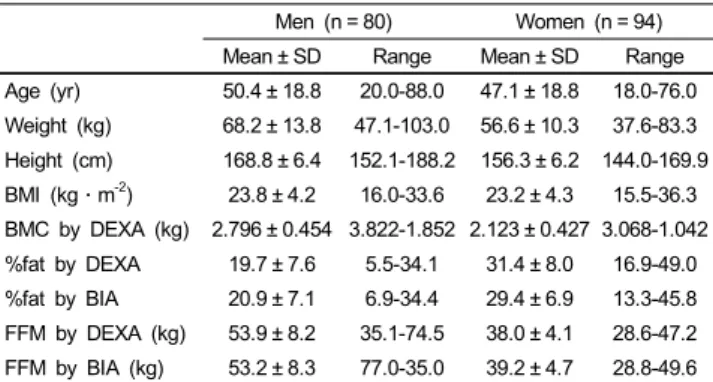
Men (n = 80) Women (n = 94)
Mean ± SD Range Mean ± SD Range
Age (yr) 50.4 ± 18.8 20.0-88.0 47.1 ± 18.8 18.0-76.0 Weight (kg) 68.2 ± 13.8 47.1-103.0 56.6 ± 10.3 37.6-83.3 Height (cm) 168.8 ± 6.4 152.1-188.2 156.3 ± 6.2 144.0-169.9 BMI (kg․m-2) 23.8 ± 4.2 16.0-33.6 23.2 ± 4.3 15.5-36.3 BMC by DEXA (kg) 2.796 ± 0.454 3.822-1.852 2.123 ± 0.427 3.068-1.042
%fat by DEXA 19.7 ± 7.6 5.5-34.1 31.4 ± 8.0 16.9-49.0
%fat by BIA 20.9 ± 7.1 6.9-34.4 29.4 ± 6.9 13.3-45.8 FFM by DEXA (kg) 53.9 ± 8.2 35.1-74.5 38.0 ± 4.1 28.6-47.2 FFM by BIA (kg) 53.2 ± 8.3 77.0-35.0 39.2 ± 4.7 28.8-49.6 BMI, body mass index; BMC, bone mineral content measured by DEXA (kg); %fat, total body percent fat; FFM, Fat free mass
Table 1. Characteristics of the population for the validity study
Fig. 1. Relationship between %fat by BIA and %fat by DEXA
Fig. 2. Relationship between Individual residuals and mean of the measured (y) and predicted (y’) %fat
Statistical methods
The impedance values of the total body were calculated by summing the segmental impedance values, and the eight-electrode BIA system automatically displayed measurements of fat mass,
%fat, and FFM. Residual scores of %fat (BIA_%fat minus DEXA _%fat) and residual scores of FFM (BIA_FFM minus DEXA _FFM) were calculated for each subject and plotted against mean of the eight-electrode BIA and DEXA. In order to evaluate prediction errors, we categorized the residual scores of %fat into three groups in men and women: i) under -3.5%fat, ii) between -3.5%fat and + 3.5%fat, iii) over + 3.5%fat. Similarly, we categorized the residual scores of FFM into three groups for men:
i) under -3.5 kg FFM, ii) between -3.5 kg FFM and + 3.5 kg FFM, iii) over 3.5 kg FFM. For residual scores of FFM in women, we also categorized the individuals into three groups, but ± 2.8 kg FFM was used as the criterion [29]. The statistical significance of the average difference between DEXA and BIA was analyzed by the paired t-test. The Pearson’s correlation coefficient was tested for the relationship between the eight-electrode BIA and DEXA. We performed linear regression analysis with the eight-electrode BIA as the independent variable and DEXA as the dependent variable. The limits of agreement on %fat and FFM were analyzed by Bland-Altman analysis. To check the association between the level of %fat and the number of individuals in upper/lower limit, we used Fisher’s exact test and we used Bonferroni correction for multiple comparisons. The SPSS statistical software (version 11.0) was used for the statistical analysis. A two-tailed significance level of 5% was chosen as a type I error.
Results
Subject characteristics
The characteristics of the population in this validation study are shown in Table 1. The ages of the participants ranged from 18 to 88yr, and the men were 3.3 years younger than the women on average with no significant difference (P = 0.243). The height,
weight, adiposity (FM, %fat and BMI) and FFM in both men and women varied from high to low status. The adult men had significantly higher values of BMC and FFM. The BMI was comparable to the nationally representative data from the Korean National Health and Nutrition Examination Survey in 2005 [30]
by age and sexes (23.7 ± 3.1 vs. 23.8 ± 4.2 in adult men and 23.1 ± 3.2 vs. 23.2 ± 4.3 in adult women from KNHNES and this study, respectively), showing that the population of this study was representative for body composition of Korean adults.
Comparison of BIA_%fat with DEXA_%fat
Plots of %fat as derived from BIA versus DEXA for men and
women are displayed in Fig. 1. There was high correlation
between %fat estimated by BIA (BIA_%fat) and %fat measured
by DEXA (DEXA_%fat) in men and women with a total error
of 2.1%fat in men and 2.3%fat in women, rated as ‘excellent
Man Woman
N < -3.5%fat > 3.5%fat N < -3.5%fat > 3.5%fat
Young adults 26 0 5 (19.2%)* 36 9 (25.0%) 0
Middle-aged 21 0 4 (19.0%) 24 12 (50.0%) 0
Old-aged 33 0 2 (06.1%) 34 10 (29.4%) 1
Total 80 0 11 (34.0)† 94 31 (33.0%) 1 (1.1%)
Young adults = 18-39yrs, Middle-aged = 40-59years, Old-aged = more than 60years,
* = n (%), †= significantly different from men’s residuals at P< 0.05 Table 2. Individual differences exceeding ± 3.5%fat in the age groups
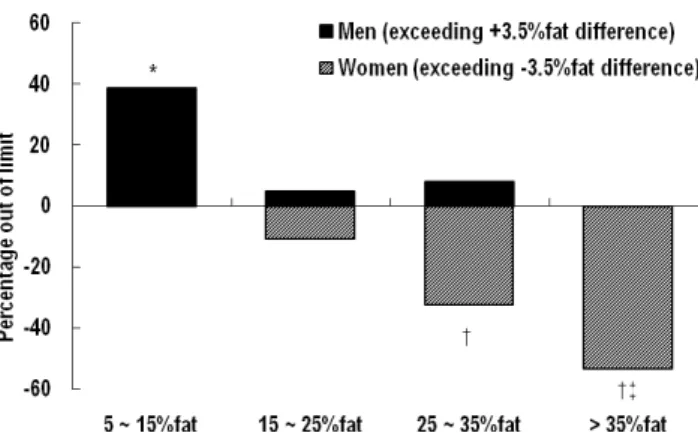
Fig. 3. Percentage of residuals out of upper-limit in men and lower-limit in women. *P< 0.05 from the 15-25%fat group and 25-35%fat group in men, †P<
0.05 from the 15-25%fat group in women, ‡P< 0.10 from the 25-35% group in women.
Fig. 4. Relationship between FFM by BIA and FFM by DEXA
Fig. 5. Relationship between individual residuals and mean of the measured (y) and predicted (y’) FFM
(≤ 2.5%fat)’ by Lohman’s criteria [29]. The mean of the difference between BIA_%fat and DEXA_%fat was small but significant (both men and women: P < 0.05, Table 1), which resulted in an overestimation of 1.2 ± 2.2%fat in men and an underestimation of -2.0 ± 2.4%fat in women. The Bland-Altman plots for residual scores (the individual differences of %fat from BIA minus DEXA) against the individual means of the two methods are shown in Fig. 2. The cases out of limit of agreement of differences were 11 men (13.8%, > 3.5%fat) and 31 women (33.0, < -3.5%fat) (Fig. 2, Table 2). The correlation coefficient (r
y’-y,mean) between the individual means of the two methods and the residual scores of %fat was significant and negative for both men (r = -0.248) and women (r = -0.469). The %fat was overestimated at lower extremes in men and underestimated at upper extremes in women in the %fat distribution (Fig. 2).
In Table 2, we compared the distribution among residual score groups across sex groups. There was a significant difference in the number of people in three residual scores between the sexes (P < 0.0001, by Fisher’s Exact Test), indicating that sex was a factor of total error. In Fig. 3, which stratified the subjects into
%fat groups (5-15%fat, 15-25%fat, 25-35%fat, > 35%fat), there were significant differences in the rates of out of limit among
%fat groups in men and women (P < 0.05). The lean group (5-15%fat) had a higher rate of out of limit (> 3.5%fat) than the normal (15-25%fat, P < 0.01) or obesity groups (25-35%fat, P = 0.075) in men, while the more fatty group had a higher rate of out of limit (< -3.5%fat) in women (Fig. 3).
Comparison of BIA-FFM with DEXA-FFM
Plots of FFM as derived by BIA versus DEXA for men and women are shown in Fig. 4. The correlation coefficient (r
y,y’) between FFM by BIA (BIA_FFM) and FFM by DEXA (DEXA _FFM) was very high in both men (r = 0.982, P < 0.001) and women (r = 0.956, P < 0.001) and the total error was 1.6 kg in men and 1.2 kg in women, rated as ‘ideal (men: < 2.5 kg, women:
< 1.5 kg)’ by Lohman’s criteria [29]. With high correlation and ideally low total error, the predictions of FFM by BIA in men and women were accurate. However, the mean of the difference between BIA and DEXA was small but significant (both men and women: P < 0.05), which resulted in an underestimation of 0.8 ± 1.6 kg FFM in men and an overestimation of 1.2 ± 1.4 kg FFM in women. The Bland-Altman plots for the residual scores of FFM are shown in Fig. 5. In men, negative differences were found in 55 individuals (68.8% of men), and 3 individuals (3.8%
of men) were out of the lower limit of agreement (-3.5 kg FFM)
with no one out of the upper limit (+ 3.5 kg FFM). In women,
Men Women
BIA, β (SEM) Intercept, Mean (SEM) SEE r2 BIA, β (SEM) Intercept, Mean (SEM) SEE r2
%fat 1.030 (0.036) -1.825 (0.787) 2.25 0.914 1.113 (0.034) -1.339 (1.026) 2.26 0.921
FFM (kg) 0.972 (0.021) 2.218 (1.149) 1.57 0.964 0.836 (0.027) 5.210 (1.061) 1.22 0.956
β = regression coefficient; (SEM) = standard error of the mean; SEE = standard error of estimate; r2= determinant coefficient; All β’s significant (P< 0.05)
Table 3. Bivariate regression of DEXA-measured body composition as a dependent variable and BIA-predicted body composition as an independent variable