625 Copyright © 2012 The Korean Society of Cardiology
Korean Circulation Journal
Introduction
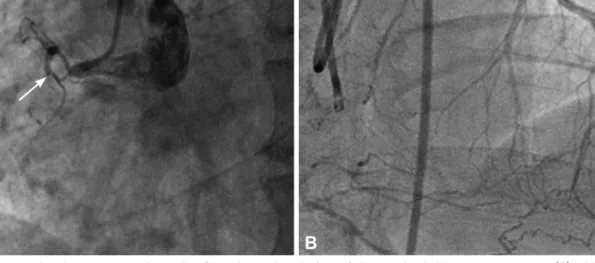
Percutaneous coronary intervention (PCI) for chronic total oc- clusion (CTO) has a lower success rate than PCI for non-CTO le- sions. A CTO lesion was defined as an obstruction of a coronary ar- tery with thrombolysis in myocardial infarction or a flow grade of 0, with an estimated duration of at least 3 months prior to the event.
In 1990, the first retrograde approach technique was applied for CTO via a degenerated saphenous vein graft. Over the next 2 de- cades, septal collateral branches were considered to be novel access for the retrograde approach.
Variable and new retrograde techniques were reported over the next few years, including the following: kissing wire technique, kn- uckle wire technique, the controlled antegrade and retrograde sub- intimal tracking (CART) technique, the reverse CART technique, the
Case Report
http://dx.doi.org/10.4070/kcj.2012.42.9.625 Print ISSN 1738-5520 • On-line ISSN 1738-5555
Reverse Controlled Antegrade and Retrograde Subintimal Tracking in Chronic Total Occlusion of Right Coronary Artery
Yeon-Hwa Kim, MD 1 , Seung Hwan Hwang, MD 1 , Chur Hoan Lim, MD 1 , Hye Mi An, MD 1 , Hee Jong Kim, MD 1 , Se Gwon Moon, MD 1 , Won Yu Kang, MD 1 , Sun Ho Hwang, MD 1 , Weon Kim, MD 2 , and Wan Kim, MD 1
1
Division of Cardiology, Department of Internal Medicine, Gwangju Veterans Hospital, Gwangju,
2