The Study of Types of Learners' Production in Second Language Acquisition
-Focused on three types of production in Korean Kindergarteners
Soojin Kim
(Hanyang University)
Km, Soojin. (2009). The Study of Types of Learners' Production in Second Language Acquisition. Linguistic Research 26(3), 199-211. The purpose of this paper is to investigate the types of learners' production in order to further our understanding of the role of the learners' production in second language acquisition and of the possible effects of teachers' role to induce learners' production and to reduce using Korean during English classes. Data collection was done though a Non-Participant Observation by the researcher. The researcher observed English classes taught by the native teacher for two weeks in D kindergarten located in Seocho-doing Kagnam-gu, Seoul, Korea. From this study, the major types of learners' production can be observed and the researcher categorized learners' English production in three major types-imitate speech, formulaic speech and creative speech, Based on the findings, the researcher compared and contrasted the types of learners' production by their Korean age. In a 5-year-old class, imitate speech is the most frequent output among their production whereas in 6 and 7-year-old classes, formulaic speech is the most frequent output in their production.
In this study, the researcher provided the types of learners' production information and insisted of necessity of the further studies on the learners' production and roles of English teachers. (Hanyang University)
Key Words second language acquisition, types of learners' production, output, proficiency, communicative ability, silent period, imitate speech, formulaic speech, creative speech
Applicable Languages: Korean, English, etc.
Applicable Levels: Kindergarten, Elementary, Secondary, etc.
I. Introduction
Most language learning researchers agree that output is necessary to increase fluency. In other words, learners must practice producing second language utterances to use their interlanguage system confidently and routinely.
According to Swain (1995), the activity of producing the target language may push learners to become aware of gaps and problems in their current second language system; it provides them with opportunities to reflect on, discuss and analyze these problems explicitly; and of course, it provides them with opportunities to experiment with new structures and forms. It is necessary here to clarify exactly what is meant by learners' production. The early stage of second language acquisition is often characterized by a silent period, by the use of formulaic speech, and by creative speech, which indicates that both structural and semantic simplification.
First, the silent period is necessary for the young children in their first language acquisition to discover what language is. However, in second language acquisition, the silent period does not occur to every student. That is, not all learners go through a silent period. For example, Huang and Hatch (1978) showed that a five-year-old Taiwanese boy appears to have begun talking in English almost immediately, although most of his early utterances involved imitation. Naiman et al. (1978) claim in their studies of 'good language learners' that they begin to speak right from the start. It is difficult to find evidence for the argument that languages are learned mainly through imitation. However, this does not mean that imitation has no role in language acquisition. Moreover, children do not imitate everything they hear, but often imitate certain words or phrases selectively which they are in the process of learning. Some learners may find that they get benefits from chances to imitate samples of the new language, and imitation is important in developing their proficiency in pronunciation and intonation.
Second, formulaic speech is the memorization of certain chunk of phrases or sentences without internalized knowledge of their components. Krashen and Scarcella (1978) distinguish routines and patterns to refer to whole utterances learnt as memorized chunks and to utterances that are partially unanalyzed and have one or more open slots. The formulaic speech, known as prefabricated patterns, is easily found in pocket bilingual phrase book such as "I don't know",
"I can't speak English", "How much is it?", etc. This kind of formulaic speech can consists of entire scripts like greeting sequences, which the learner can memorize because they are fixed and predictable. Formulaic speech can be observed in the speech of native speakers as well. Pawley and Syder (1983) argue that achieving native-like control involves not only learning a rule system that will generate an infinite number of sentences, but also memorized sequences and lexicalized sentence stems. Thus, routines and patterns typically manifest target language morphology and syntax. Each formula is closely related to the performance of a particular language function, which is communicatively important to the leaner.
Learners learn formulas because it reduces the learning burden while maximizing communicative ability. Over time the learner gradually and systematically replaced with target forms. That is, formulaic speech serves as the basis for subsequent creative speech when the learner comes to realize the utterances initially understood and used as whole consist of discrete constituents ways. However, there were some controversies over its effectiveness. Bohn (1986) concludes that formulas serve only short-term production. Krashen and Scarcella (1978) also argue that formulaic speech and rule-created speech are not related. Even if they are right, they almost surely underestimate the importance of formulas for second language learners. As Pawley and Syder (1983) have shown, mastering a set of lexicalized sentence stems for learners will enable them to produce language efficiently. Therefore, the development of native-like second language ability requires the memorization of a number of formulaic patterns.
Third, the learner's early creative utterances are typically truncated, consisting of one or two words, with both grammatical functors and content words missing.
Structural simplification involves the omission of grammatical functors such as auxiliary verbs, articles, plural s, and past tense ed etc. Semantic simplification involves the omission of content words such as noun, verbs, adverbs and adjectives etc (Ellis, 1982). Both structural and semantic simplification may occur either because learners have not yet acquired the necessary linguistic forms or because they are unable to access them in the production of specific utterances.
In other words, they may reflect processes of language acquisition or of language production. There is some evidence to suggest that learners, particularly children, tend to begin speaking first in single-word utterances and then in increasingly longer utterances, many of which are novel (Saville-Troike, 1988).
In order to further our understanding of the role of the learners' production in second language acquisition and of the possible effects of teachers' role to induce learners' production and to reduce using Korean during the English class, the purpose of this study is to investigate the types of learners' production that can be observed in Korean kindergarteners when they work with a native English teacher.
II. Methods 1. Participants
This study involved 86 kindergarteners on May 15th (week 1) and 165 kindergarteners on May 22nd (week 2) in 2006 in their English classes with the native teacher. All were enrolled in D Kindergarten located in Seocho-dong, Kangnam-gu, Seoul, Korea. They have English classes three times a week with the Korean teacher and once a week with the native teacher. On May 15th, the researcher could not observe all of the classes, because the two of the classes went to the field trip on that day. Therefore, the researcher visited them again on May 22nd to observe all of the classes. J, the native teacher who is from New Zealand, has been teaching Korean kindergarteners for 2 years.
2. Data Collection
Data collection was done through a Non-Participant Observation by the researcher. Non-Participant Observation is one kind of qualitative research, in which the researcher observes and takes notes or records of the observed activity, but without any controlling or guidance that can be affect the phenomena such as patterns of second language behavior. In this study, the researcher observed the classes and took filed notes English classes taught by the native teacher for two weeks. Data were collected through three 30-minute classroom observations (week 1) and five 25-minute classroom observations (week 2). Due to the kindergarten schedule, the researcher could not observe all the classes in week 1, so visited and observed them again following week. After careful 2 weeks of observaion, the researcher transcribed all the field notes and sorted in a systematic way.
Week 1 Week 2 10:10-10:40 Gaenari (6) 10:05-10:30 Gaenari (6) 10:40-11:10 Byeongari (5) 10:30-10:55 Byeongari (5) 11:10-11:40 Haenim (7) 10:55-11:20 Haenim (7) 11:20-11:45 Jangmi (6) 11:45-12:10 Dalim (7)
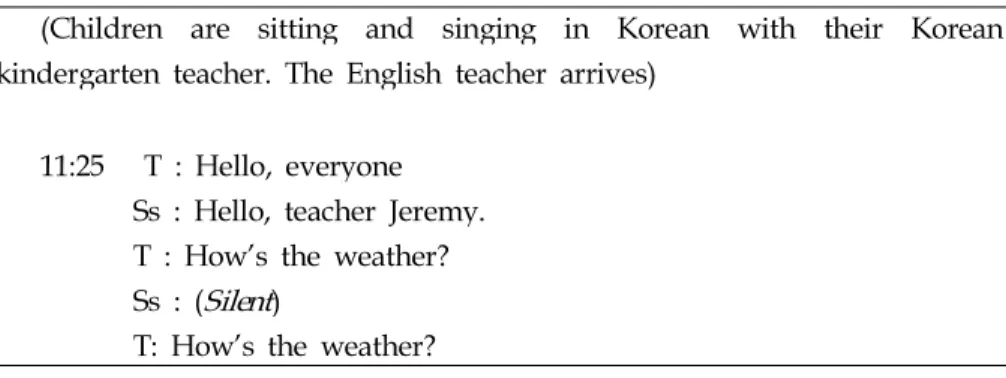
(Children are sitting and singing in Korean with their Korean kindergarten teacher. The English teacher arrives)
11:25 T : Hello, everyone Ss : Hello, teacher Jeremy.
T : How's the weather?
Ss : (
Silent
)T: How's the weather?
Table 1. Non-Participant Observation Schedule
* Gaenari, Byeongari, Haenim, Jangmi, Dalim are the names of the classes.
** The numbers in parentheses are children's Korean age
III. Findings
1. Types of production
In this study, the researcher categorized four major types of production:
Korean, Imitate Speech, Formulaic Speech and Creative Speech. As shown in Table 2, formulaic speech can be easily observed in greetings and farewells such as "Hello, teacher Jeremy", "See you later, teacher" etc. Imitate speech can be observed typically when they learn new words and sentences. When the teacher introduces a new concept, he wants learners to repeat after him or the CD player. Whenever there were communication break downs, the researcher could observe that the children used Korean to understand each other. However, the researcher could rarely observe the creative speech. Creative speech observed in this study came out of the learners who are very competent in English.
Table 2. Excerpt from a Field Note Narrative
S1 : It's sunny.
T : Good. It's sunny
(
Gesture: both hands up: means.. he wants everybody to say together
) Ss : It's sunny.T : Good.
S2 : I'm thirsty. (
T couldn't hear..
)11:27 T : (
Open the Big Book "family tree"
) Who is this ? Ss : This is my father.T : Who is this ? Ss: This my mother.
T : Who is this ? Ss: This my brother.
T : Who is this ? Ss: This my sister.
T : Who is this ? Ss: This my me.
T : (
error correction
) This is me. MyUpsseo(없어)
! Ss : This is me.Chant (
along the CD
) 11:30 T : Where is my mom ?(
Gesture: puts his right hand on his forehead and looks around
) T : Where is my mom?Ss : Where is my mom ? T : Mom is in the living room.
Ss : Mom is in the living room.
T : Dad is in the bedroom.
Ss : Dad is in the bedroom.
2. Use of Korean
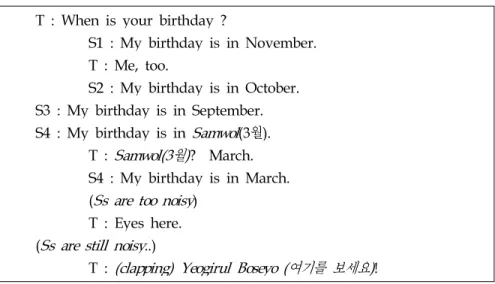
There is not much use of Korean during the English classes. That is still less than the researcher expected before the observation. However, what is interesting is that the native English speaking teacher used more Korean than expected. He used Korean when he could not control the class or when he thought that there was a communication break down. For instances, "
Yeogirul Boseyo(여기를 보세요)
", "You twoT : When is your birthday ?
S1 : My birthday is in November.
T : Me, too.
S2 : My birthday is in October.
S3 : My birthday is in September.
S4 : My birthday is in
Samwol
(3월).T :
Samwol(3월)
? March.S4 : My birthday is in March.
(
Ss are too noisy
) T : Eyes here.(
Ss are still noisy.
.)T :
(clapping) Yeogirul Boseyo (여기를 보세요)
!(Teacher introduces a new unit) T : New year's day is in January.
Ss : New year's day is in January.
stop talking,
Arasseo(알았어)
?" and "Ahndae(안돼)
". He usually uses Korean to get learners' attention. He also uses Korean to correct learners' production such as "myUpsseo(없어)
. Just me. This is me." etc. Whereas learners usually uses Korean which has nothing to do with the content of the class such as chatting with the friend sitting next to them and telling the teacher about their friends. They also used Korean when they could not know the word in English. For example, "My birthday is inSamwol(3 월)
" (see Table 3).Table 3. Korean - Excerpt from a Field Note Narrative
3. Use of Imitate Speech
As shown in Table 4, when teacher introduces new sentences, he makes learners repeat after him. Sometimes, he makes learners repeat after the CD player. The learners follow the CD player or the teacher and practice the words and sentences over and over again. Drill and practice is the typical activity for learners to produce words and sentences in their English class.
Table 4. Imitate Speech - Excerpt from a Field Note Narrative
T : Thanksgiving day is in November.
Ss : Thanksgiving day is in November.
T : Christmas is in December.
Ss : Christmas is in December.
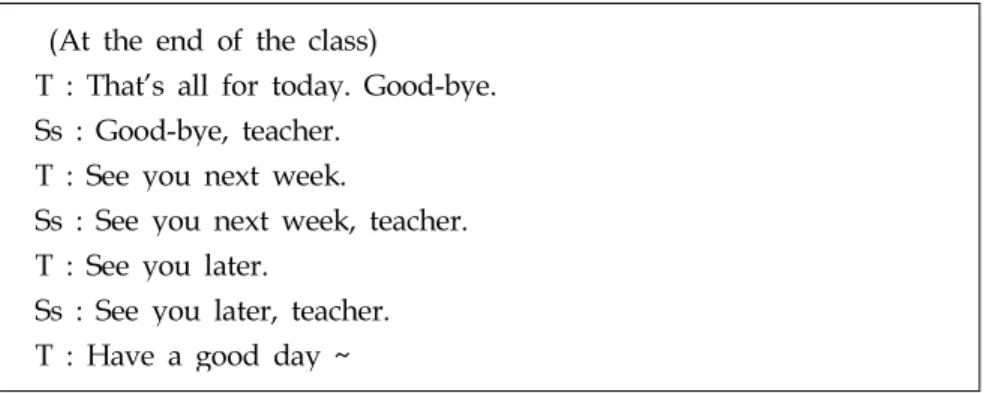
(At the end of the class)
T : That's all for today. Good-bye.
Ss : Good-bye, teacher.
T : See you next week.
Ss : See you next week, teacher.
T : See you later.
Ss : See you later, teacher.
T : Have a good day ~
(While the teacher is putting the cards on the board, one student is talking by himself)
S1: (When the teacher puts the Christmas card on the board) That's for Christmas!
4. Use of Formulaic Speech
Typically, formulaic speech can be observed in greetings and farewells such as "Good morning, teacher", "Good bye, teacher", etc. It is also viewed in the sentences what they have already learned; therefore, the learners know what the teacher asks them to produce.
Table 5. Formulaic Speech - Excerpt from a Field Note Narrative
5. Use of Creative Speech
There is a 7-year-old kindergartener that has just moved into Korea from abroad. He almost said all the creative speech such as "I'm thirsty", "That's for Halloween" etc.
Table 6. Creative Speech - Excerpt from a Field Note Narrative
S!: (When the teacher puts the Halloween card on the board) That's for Halloween!
etc.
age N Korean Imitate speech Formulaic speech Creative speech 5 23 6 /46 (13%) 21/46 (45.7%) 19/46 (41.3%) 0 (0%) 6 28 3/24 (12.5%) 8/24 (33.3%) 13/24 (54.2%) 0 (0%)
7 35 0 (0%) 8/40 (20%) 28/40 (70%) 4/40 (10%)
86
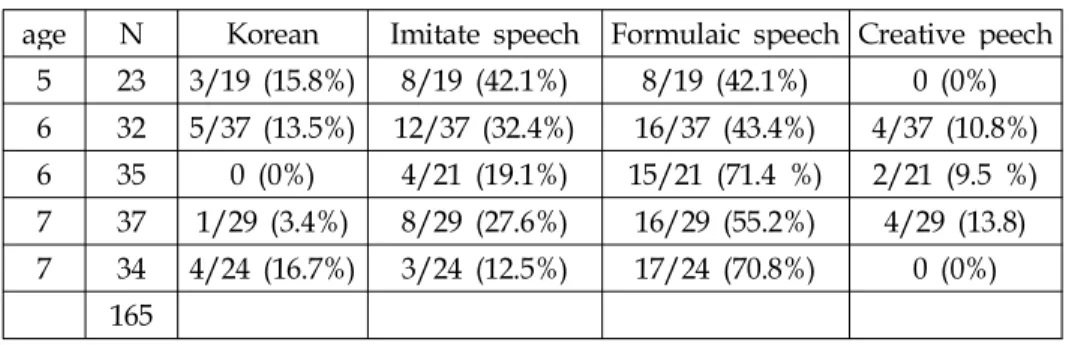
age N Korean Imitate speech Formulaic speech Creative peech 5 23 3/19 (15.8%) 8/19 (42.1%) 8/19 (42.1%) 0 (0%) 6 32 5/37 (13.5%) 12/37 (32.4%) 16/37 (43.4%) 4/37 (10.8%) 6 35 0 (0%) 4/21 (19.1%) 15/21 (71.4 %) 2/21 (9.5 %) 7 37 1/29 (3.4%) 8/29 (27.6%) 16/29 (55.2%) 4/29 (13.8) 7 34 4/24 (16.7%) 3/24 (12.5%) 17/24 (70.8%) 0 (0%)
165
In Table 7, the frequency of the types of production observed in the first week was tabulated.
Table 7. Frequency of the types of production (Week 1)
On the first week, in a 5-year-old class, the researcher observed 6(13%) talks of Korean out of 46 student talks, 21(45.7%) imitate speech of English and 19(41.3%) formulaic speech of English. In a 6-year-old class, the researcher observed 3(12.5%) talks of Korean out of 24 student talks, 8(33.3%) imitate speech of English and 13(54.2%) formulaic speech. In a 7-year-old class, the researcher observed 8(20%) talks of imitate speech of English out of 40 student talks, 28(70%) formulaic speech and 4(10%) creative speech.
In Table 8, the frequency of the types of production observed in the second week was tabulated.
Table 8. Frequency of the types of production (Week 2)
On the second week, in a 5-year-old class, the researcher observed 3(15.8%) talks of Korean out of 19 student talks, 8(42.1%) imitate speech of English and 8(42.1%) formulaic speech. In a 6-year-old class with 32 students, the researcher observed 5(13.5%) talks of Korean out of 37 student talks, 12(32.4%) imitate speech of English, 16(43.4%) formulaic speech and 4(10.8%) creative speech. In a 6-year-old class with 35 students, the researcher observed 4(19.1%)talks of imitate speech of English out of 21 student talks, 15(71.4%) formulaic speech, and 2(9.5%) creative speech. In a 7-year-old class with 37 students, the researcher observed 1(3.4%) talk of Korean out of 29 student talks, 8(27.6%) imiatate speech of English, 16(55.2%) formulaic speech and 4(13.8%) creative speech. In a 7-year-old class with 34 students, the researcher observed 4(16.7%) talks of Korean out of 24 student talks, 3(12.5%) imiatate speech of English and 17(70.8%) formulaic speech.
IV. Discussions
From this study, the major types of learners' production can be observed.
There are three major types of learners' production in English: imitate speech, formulaic speech, and creative speech. Firstly, imitate speech is typically observed when the teacher introduces new words and sentences. The teacher says the new words, phrases, and sentences first and then the learners echo the teacher. Secondly, formulaic speech is observed either in greetings and farewells or in well- structured situations, for example, in the situation of what they have already learned and practiced before. Thirdly, creative speech, which is rarely observed, can come out of the learners who are competent in English. In addition, the researcher added learners' speech of Korean, because the language teachers should know the context when learners use their L1 so that they can facilitate their learners' production of target languages.
Based on the findings, the researcher compared and contrasted the types of production by their age. As shown in Table 9, in 5-year-old kindergarteners, imitate speech-formulaic speech-Korean form a series that descends. In 6-year-old kindergarteners, formulaic speech-imitate speech-Korean-creative speech form a series that descends. In 7-year-old kindergarteners, formulaic speech-imitate speech-creative speech-Korean form a series that descends Interestingly, there is no creative speech in the earliest age whereas there is a little creative speech in
older age. However, it can not be said that the increased use of creative speech is due to developmental processes, because of the children who had already been exposed to English in L1 setting.
Table 9. Frequency of the types of production by age
age Korean Imitate speech Formulaic speech Creative speech 5 9/65 (13.8%) 29/65 (44.6%) 27/65 (41.5%) 0/65 (0%) 6 8/82 (9.7%) 24/82 (29.3%) 44/82 (53.7%) 6/82 (7.3 %) 7 5/93 (5.4 %) 19/93 (20.4 %) 61/93 (65.6%) 8/93 (8.6 %)
V. Implications
Research in the study of types of learners' production has significant practical applications. In summarize of the findings in this study, in a 5-year-old class, imitate speech (44.6%) is the most frequent output among their production whereas in 6 and 7 year-old classes, formulaic speech (53.7% and 65.6%) is the most frequent output in their production. The learners' production in second language acquisition can be considered as evidence of their comprehension. That explains why the imitate speech is more frequent in the younger classes.
Generally, people expect that there is not much learners' production in kindergarten English classes. However, the researcher could actually observe different types of learners' production in the Korean kindergarten English classes.
In this study, providing the types of learners' production information has been shown to be effective in the inducing learners' production and make suggestions for the real English class teachers and researchers for further studies as well. To give an actual instance, J, the native English teacher in the class that the researcher observed, induced his learners' production using a variety of his own ways. When the learners are silent, he made a gesture using his both hands up to encourage them to speak. When he thinks that the learners' silence means that they do not understand what is going on, the teacher uses Korean to help them to understand the context. Sometimes, especially for the youngest learners, he exaggerates the shape of his mouth so that they catch what they have to say.
That sounds extremely simple but it was amazingly powerful in reality.
People might also think that children may use much more Korean than adult
learners in English classes. However, when children work with a native English teacher, they do not use Korean as much as people expected. The researcher actually observed that some kindergarteners spoke Korean during the class such as "
Eguh Ddo Haeyo(이거 또 해요)?", "Siruh(싫어)", and "Jigeuhwah(지겨워)
" etc. The reason why that the decrease of using children's Korean in J's class is that he could not understand so he was not able to respond to them. That is the main reason why the portion of children's using Korean has been decreased gradually.This has been approved that the principle of teaching English through English.
The results of the present study suggest the need for further investigations of the role of learners' production and teachers' role to induce the learners' production in second language acquisition for longer period. This study limited its period of non-participant observation. It is also necessary to recognize individual variation such as their background, etc. Further studies on the learners' production and roles of teachers show potential for facilitating second language comprehension and raising learner awareness to them.
References
Bohn, O. 1986. 'Formulas, frame structures and stereotpes in early syntactic development:
some new evidence from L2 acquistion'. Linguistics 24, pp.185-202 Ellis, R. 1982. 'The origins of interlanguage'. Applied Linguistics3, pp.207-223.
Ellis, R. 1984. Classroom Second Language Development. Oxford: Pergamon.
Ellis, R. 1994. The study of second language acquisition. Oxford: Oxford University Press.
Erdener, V. D. and Burnham, D. K. 2005. 'The role of audiovisual speech and ortho- graphic information in nonnative speech production'. Language Learning 55(2), pp.191-228.
Krashen, S. and R. Scarcella. 1978. 'On routines and patterns in second language acquis- ition and performance'. Language Learning28, pp.283-300.
Lightbown, M. and N. Spada. 1999. How languages are learned. 2nd Edition. Oxford:
Oxford University Press.
Mitchell, R. and Myles, F. 2004. Second Language Learning Theories.2nd Edition. London:
Hodder Arnold.
Pawley, A. and F. Syder. 1983. "Two puzzles for linguistic theory: nativelike selection and nativelike fluncy' in Richards and Schmidt (eds.) 1983.
Saville-Troike, M. 1988. 'Private speech in a second language learning strategies during
the "silent period"'. Journal of Child Language15, pp.567-590.
Seliger H. W. and Sholamy E. 1989. Second Language Research Methods. Oxford University Press.
Sueyoshi, A. and Hardison, D. M. 2005. 'The role of gestures and facial cues in second lan- guage listening comprehension'. Language Learning, 55(4), pp.661-699.
Swain, M. 1995. Three functions of output in second language learning. Oxford: Oxford University Press.
Kim, Soojin
Dept. of English Education, Hanyang University, Seoul, Korea C.P.: 010-5688-4319
E-MAIL: [email protected], [email protected]
Received: 2009. 11. 16 Revised: 2009. 12. 14 Accepted: 2009. 12. 26