http://dx.doi.org/10.5468/ogs.2016.59.1.39 pISSN 2287-8572 · eISSN 2287-8580
Introduction
Hysterectomy is one major surgery in the field of gynecol- ogy with various indications. Advances in surgical technique and materials have allowed hysterectomy to be less invasive and have reduced the number of complications. Currently, total laparoscopic hysterectomy (TLH) is widely performed in gynecologic surgery following its introduction by Reich et al.
in 1989 [1]. Compared with abdominal hysterectomy, laparo- scopic hysterectomy has many benefits including cosmetic ef- fect, low infection rate, low pain, short postoperative hospital stay and a low postoperative adhesion rate [1-5].
Total laparoscopic hysterectomy via suture and ligation technique
Hye Won Kang, Ji Won Lee, Ho Yeon Kim, Bo Wook Kim, Chong Soo Moon
Department of Obstetrics and Gynecology, Gangdong Sacred Heart Hospital, Hallym University College of Medicine, Seoul , Korea
Objective
The term ‘total laparoscopic hysterectomy (TLH) with classical suture method’ refers to a surgical procedure performed using only sutures and ligations with intracorporeal or extracorporeal ties, without using any laser or electronic cauterization devices during laparoscopic surgery as in total abdominal hysterectomy. However, the method is not as widely used as electric coagulation equipment for TLH because further advances in technology and surgical technique are required and operative time can take longer. In the current study, we evaluated the benefits of the classical suture method for TLH.
Methods
This study retrospectively reviewed patients who received TLH using the classical suture method from August 2005 to April 2014. The patients' baseline characteristics were analyzed, including age, parity, cause of operation, medical and surgical history. Surgical outcomes analyzed included the weight of the uterus, operative time, complications, changes in hemoglobin level, blood transfusion requirements, and postoperative hospital stay.
Results
Of 746 patients who underwent TLH with the classical suture method, mean operation time was 96.9 minutes. Mean average decline in hemoglobin was 1.6 g/dL and transfusion rate was 6.2%. Urinary tract injuries were reported in 8 patients. Urinary tract injuries comprised 6 cases of bladder injury and 3 cases of ureter injury. There were no cases of vaginal stump infection, hematoma, bowel injury or abdominal wound complication. All cases involving complications occurred before 2010.
Conclusion
The classical suture method for TLH presents tolerable levels of complications and blood loss. Advanced surgical skill is expected to decrease operation time and complications.
Keywords: Classical suture; Hysterectomy; Laparoscopy
Articles published in Obstet Gynecol Sci are open-access, distributed under the terms of the Creative Commons Attribution Non-Commercial License (http://creativecommons.
org/licenses/by-nc/3.0/) which permits unrestricted non-commercial use, distribution, and reproduction in any medium, provided the original work is properly cited.
Copyright © 2016 Korean Society of Obstetrics and Gynecology Received: 2015.6.3. Revised: 2015.8.3. Accepted: 2015.8.8.
Corresponding author: Chong Soo Moon
Department of Obstetrics and Gynecology, Gangdong Sacred Heart Hospital, Hallym University College of Medicine, 150 Seongan-ro, Gangdong-gu, Seoul 05355, Korea
Tel: +82-2-2224-2259 Fax: +82-2-2224-2265 E-mail: [email protected]
http://orcid.org/0000-0003-4980-4424
Hysterectomy using laparoscope was classified into 9 dif- ferent methods in 1992 by the American Association of Gy- necologic Laparoscopists [2,3]. Laparoscopic-assisted vaginal hysterectomy was a popular method in the early years of hysterectomy using laparoscopes. TLH was performed more frequently with advances in laparoscope equipment and the introduction of the uterine manipulator with colpotomizer and pneumooccluder balloon (RUMI). In addition, laparoscopic radical hysterectomy and lymphadenectomy are frequently performed for gynecologic malignancy. Recently, single port assisted and robotic assisted TLH have also been performed for the advantages of cosmetics and improved surgeon dex- terity and surgical precision, respectively.
The laparoscope is widely used in gynecology. Conventional bipolar electrocautery is commonly used because of its con- venience, time savings and decreased blood loss, but thermal injury can occur in the surrounding tissue. The term ‘TLH with classical suture method’ refers to a surgical procedure per- formed using only sutures and ligations with intracorporeal or extracorporeal ties, without using any laser or electronic cauterization devices during laparoscopic surgery as in to- tal abdominal hysterectomy. However, the classical suture method for TLH is not as widely used as electric coagulation equipment because further advances in technology and surgi- cal technique are required and operative time can take longer.
In the current study, we evaluated the benefits of the classical suture method for TLH.
Materials and methods
This study retrospectively reviewed TLH by the classical suture method performed at the Gangdong Sacred Heart Hospital, Hallym University, Seoul, Korea. Between August 2005 and April 2014, 746 patients who underwent TLH by the classi- cal suture method were analyzed. All patients were operated upon by the same surgeon. Inclusion criteria included all be- nign uterine diseases and early stage malignancy.
The patients’ baseline characteristics were analyzed, in- cluding age, parity, cause of operation, medical and surgical history. Weight of the uterus, operative time, complications, changes in hemoglobin level, blood transfusion requirements and postoperative hospital stay were recorded and analyzed.
The decline in hemoglobin level was determined by the differ- ence between the preoperative and postoperative day 1 he- moglobin levels. Blood transfusions were performed in cases of symptomatic patients and in asymptomatic patients with hemoglobin level less than 7 g/dL. Patient follow-up visits oc- curred 4 weeks after surgery.
Operations were performed on patients under general anes- thesia. All patients were positioned in the lithotomy position and draped in a sterile fashion. The RUMI was inserted for visibility during surgery, as well as protection of the bladder and ureter. The first 10-mm port was placed through the um- bilicus, and a second 5-mm port was placed in the left lower quadrant site. Two 5-mm ports were placed in the suprapubic and right lower quadrant sites. Depending on whether the ovary was removed, round ligament and ovarian ligament or
Fig. 1. Round ligament and ovarian ligament were sutured by the laparoscopic extracorporal technique (A). The proximal site was cut, and the distal site was reinforced by loop (B).
A B
infundibulopelvic ligament were sutured by the laparoscopic extracorporal technique using delayed absorbable polyglactin 1-0 suture (Laploop, Sejong Medical, Paju, Korea) (Fig. 1A).
The proximal site was cut by laparoscopic endoscissor, and the distal site was reinforced by delayed absorbable polyglactin 1-0 round loop (Fig. 1B). The front and back of the broad liga- ment were carefully peeled off using endoscissors. After the uterovesical peritoneum had been cut by the endoscissors, the bladder was separated from the uterus. After moving the uterus using the RUMI, the circumferential culdotomy was performed along the protrusion sites using a monopolar cut- ter. The uterine vessel and cardinal ligament on both sides were sutured by the laparoscopic extracorporal technique us- ing delayed absorbable polyglactin 1-0 suture (Fig. 2A). The proximal site was cut by laparoscopic endoscissors, and the distal site was reinforced by delayed absorbable polyglactin 1-0 round loop (Fig. 2B). A tenaculum was placed through the vagina and the uterus was grasped, pulled into the vagina, and removed. The exposed vaginal stump was closed four times using a figure-of-eight suture by the laparoscopic intra- corporal technique using four delayed absorbable polyglactin 1-0 sutures. At this time, each uterosacral ligament and vagi- nal edge pair were sutured together from both sides to avoid uterine prolapse. To complete the reconstruction of the pelvis, the peritoneum of pelvic floor and bladder side were sutured by the laparoscopic extracorporal technique using delayed ab- sorbable polyglactin 1-0 suture. To confirm urinary tract injury, we identified the peristalsis of both ureters. In addition, if a patient was suspected of having a urinary tract injury, indigo-
carmin dye 5 mL and furosemide 10 mg (Lasix 20 mg/2 mL) were injected intravenously to determine whether there was spillage into the abdominal cavity. Intravenous pyelography was checked at 1 day post-hospital. After irrigation and he- mostasis, the peritoneum was closed.
Results
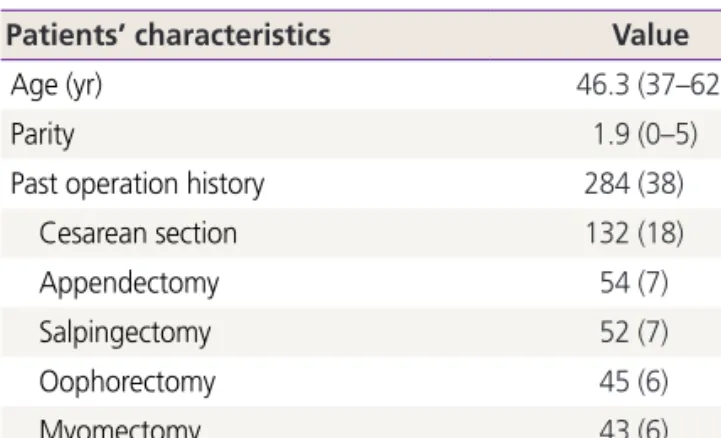
Table 1 shows the characteristics of the patients who under- went TLH by the classical suture method. Of 746 total pa- tients, the mean age was 46.3 years with range of 37 to 62 years, and median parity was 1.9 times with range of 0 to 5 times. Of the patients, 284 had undergone prior abdominal surgery and the most common operation was cesarean sec- tion followed by appendectomy, salpingectomy, oophorec- Fig. 2. The uterine vessel and cardinal ligament were sutured by the laparoscopic extracorporal technique (A). The proximal site was cut, and the distal site was reinforced by loop (B).
A B
Table 1. Patients’ characteristics (n=746)
Patients’ characteristics Value
Age (yr) 46.3 (37–62)
Parity 1.9 (0–5)
Past operation history 284 (38)
Cesarean section 132 (18)
Appendectomy 54 (7)
Salpingectomy 52 (7)
Oophorectomy 45 (6)
Myomectomy 43 (6)
Others 24 (3)
Data are given as median (range) or number (%).
tomy, and myomectomy.
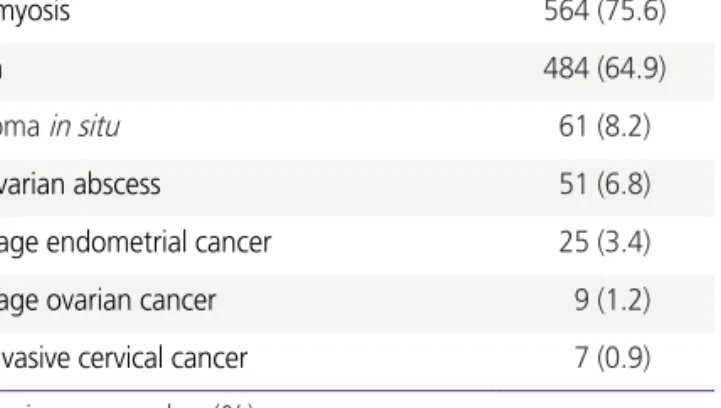
As shown in Table 2, the most common indications for TLH were adenomyosis (n=564) and uterine leiomyoma (n=484).
The other indications included carcinoma in situ of the cervix (n=61), tubo-ovarian abscess (n=51), and early stage gyneco- logic cancer (n=41).
Table 3 shows the surgical outcome of the patients who underwent TLH with the classical suture method. The mean weight of the uterus was 325 g with range of 80 to 520 g.
Mean operation time was 96.9 minutes with a range of 55 to 170 minutes. Mean average decline in hemoglobin was 1.6 g/
dL (range, 0.3 to 3.7) and transfusion rate was 6.2% (n=46).
The inserted hemovac was removed at 2 days after surgery, and the mean hospital stay was 4.1 days.
Total complication included 11 of 746 cases (1.5%). Urinary tract injuries were reported in 8 patients (1.1%). Urinary tract injuries included 6 cases of bladder injury (0.8%) and 3 cases
of ureter injury (0.4%). Of these, one patient had both blad- der and ureter damage. Only one patient was readmitted for pulmonary thromboembolism management. There were no cases of vaginal stump infection, hematoma, bowel injury or abdominal wound complication.
Table 4 shows the incidence of complications by comparing instances before and after the year 2010. All cases involving complications occurred before 2010.
Discussion
In the current study, ligations of round, ovarian, infundibulo- pelvic ligament and uterine arteries were performed with the classical suture method and this method for TLH was found to produce tolerable complications. A recent review article reported the rate of urinary tract injury for TLH was 0.56%
to 1.24%. The rate of bladder injury for TLH was 0.38% to 1.04% and the rate of ureter injury for TLH was 0.15% to 0.53% [6]. In our study, urinary tract injuries included 8 of 746 cases (1.1%) and comprised 6 bladder injuries (0.8%) and 3 ureter injuries (0.4%). There were no cases of vaginal stump infection, hematoma, bowel injury or abdominal wound complication. Furthermore, all complication that we reported occurred before 2010; no complications have occurred since 2010.
A history of cesarean delivery, prior abdominal surgery and/
or laparotomy, endometriosis, adhesions, broad ligament fibroids, and low-volume surgeons are among the most com- monly cited risk factors for urinary tract injuries [7]. In our cases that had urinary tract injury, there was tubo-ovarian abscess, severe endometriosis, or previous multiple cesarean Table 3. Surgical outcomes (n=746)
Surgical outcome Value
Uterus weight (g) 325 (80–520)
Operation time (min) 96.9 (55–170)
Hemoglobin changes (g/dL) 1.6 (0.3–3.7)
No. of patients received transfusion 46 (6.2)
Post-op hospital stay (day) 4.1 (3–9)
Total complications 11 (1.5)
Bladder injury 6 (0.8)
Ureter injury 3 (0.4)
Vaginal injury 1 (0.1)
Pulmonary embolism 1 (0.1)
Neuropathy 1 (0.1)
Data are given as median (range) or number (%).
Table 2. Indications for hysterectomy (n=746)
Indication Value
Adenomyosis 564 (75.6)
Myoma 484 (64.9)
Carcinoma in situ 61 (8.2)
Tubo-ovarian abscess 51 (6.8)
Early stage endometrial cancer 25 (3.4)
Early stage ovarian cancer 9 (1.2)
Microinvasive cervical cancer 7 (0.9)
Data are given as number (%).
Table 4. Postoperative complications Postoperative
complication Before 2010
a)(n=359) After 2010
b)(n=387)
Total complications 11 (3.1) 0
Bladder injury 6 (1.7) 0
Ureter injury 3 (0.8) 0
Vaginal injury 1 (0.3) 0
Pulmonary embolism 1 (0.3) 0
Neuropathy 1 (0.3) 0
Data are given as number (%).
a)