1. INTRODUCTION
The satellite signals used in navigations such as Global Positioning System (GPS) and Global Navigation Satellite System (GLONASS) experience signal delays as signals are passed through the ionosphere and troposphere until they reach the users on the ground. The ionospheric delay occurred while passing through the ionosphere is an error that degrades the navigation performance, which should be removed to perform an accurate navigation. It is also used as data to study the ionospheric environment of the earth.
Disturbances occurred in the ionosphere can be detected
ABSTRACT
This study introduces MATLAB Graphical User Interface (GUI)-based software to monitor ionospheric disturbances. This software detects ionospheric disturbances using Global Positioning System (GPS) and Global Navigation Satellite System (GLONASS) measurements, and estimates a location of the disturbance source through the detected disturbance. In addition, this software includes a sky plot making function and frequency analysis function through wavelet transform. To evaluate the performance of the developed software, data of 2011 Tohoku earthquake in Japan were analyzed by using the software. The analysis results verified that the ionospheric disturbances were detected through GPS and GLONASS measurements, and the location of the disturbance source was estimated through the detected disturbance.
Keywords: monitoring software, ionospheric disturbances, epicenter estimation, MATLAB GUI
by analyzing the ionospheric delay of satellite signals. The ionospheric disturbance occurs by events occurred in space such as solar wind as well as natural disasters such as volcano eruptions, earthquakes, and tsunami or events occurred on the ground such as rocket launch or mine explosion (Komjathy et al. 2016). Among them, studies on the detection of the ionospheric disturbance due to earthquakes through the ionospheric delay of GPS measurements have been conducted (Tsugawa et al. 2011, Jin et al. 2015, Song et al.
2018).
Existing studies proposed an algorithm that detected the ionospheric disturbance using GPS measurements, and algorithm that estimated the location of the disturbance source. This study developed a software based on MATLAB Graphical User Interface (GUI) to detect the ionospheric disturbance automatically as well as to estimate the location of the disturbance source by applying GPS and GLONASS measurements to the proposed algorithm in the previous studies.
Since the development of software that monitors the ionospheric disturbance using real-time measurements has a limit, the software in this study aimed at detecting Received Feb 26, 2019 Revised Mar 12, 2019 Accepted Mar 13, 2019
†
Corresponding Author E-mail: [email protected]
Tel: +82-2-880-7395 Fax: +82-2-878-0559
Bu-Gyeom Kim https://orcid.org/0000-0001-7769-1493
Seonho Kang https://orcid.org/0000-0001-6802-105X
Deokhwa Han https://orcid.org/0000-0002-5549-5413
Junesol Song https://orcid.org/0000-0002-3423-2972
Hyoungmin So https://orcid.org/0000-0001-5279-8833
Kap Jin Kim https://orcid.org/0000-0001-7078-2376
Changdon Kee https://orcid.org/0000-0002-8691-7068
the ionospheric disturbance using post-processing data of already known events. The event information and GPS and GLONASS measurements at the corresponding dates can be entered in the developed software, and the ionospheric disturbance can be detected through input data and the location of the disturbance source can be estimated. A study by Kang et al. (2018) was referred to in the disturbance detection algorithm and a study by Tsai et al. (2011) was referred to in the algorithm that estimated the disturbance source location. In addition, this software includes a function of sky plot production and analysis on disturbance frequency.
In Chapter 2, overall structure of the software and data processing procedure, and analysis techniques used are explained. In Chapter 3, processing results by the software using the actually occurred earthquake data are presented, and its performance is evaluated.
2. MONITORING IONOSPHERIC DISTURBANCES SOFTWARE
2.1 Component of Software
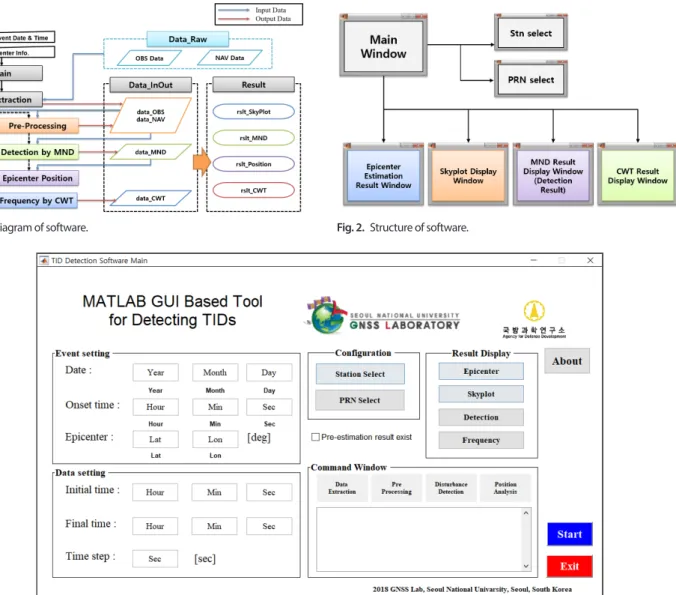
Fig. 1 shows the schematic diagram of the software.
The software detects an ionospheric disturbance utilizing GPS and GLONASS measurements on already occurred events, and estimates the location of the disturbance source accordingly. Thus, post-processing Receiver INdependent Exchange (RINEX) format data are used as an input data.
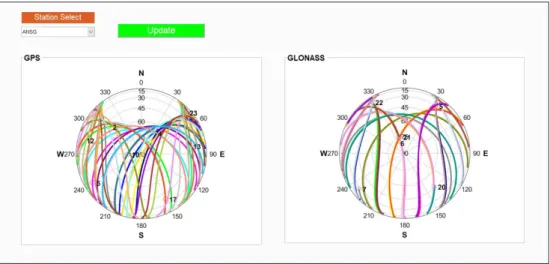
Fig. 2 shows the structure diagram of the developed software. As shown in the figure, two setup screens and four result screens are displayed in the main window. Fig. 3 shows the main window of the software, which is implemented. In the main window, there are two input areas; one is to input information about events to be analyzed, and the other is Fig. 1. Diagram of software.
Fig. 3. Main window of software for surveillance of ionospheric disturbances.
Fig. 2. Structure of software.
2.2 Algorithm of Software
2.2.1 Algorithm of ionospheric disturbances detection
As mentioned in the introduction, this software detects the ionospheric disturbance using the ionospheric delay of GPS and GLONASS measurements. The ionospheric delay in GPS measurements is calculated through the combination of carrier phase measurements of L1 and L2 frequencies which have a relatively small noise.
1 2
1 1 2 2
1 ( )
1 1
L L
I φ φ I N λ N λ ε
γ γ
= − = + − +
− −
(1)
Here, Î refers to the ionospheric delay calculated through the measurement combination. Φ refers to the carrier phase measurements, and γ refers to the square of the L1/L2 frequency ratio. I refers to the ionospheric delay at the carrier wave, N refers to the integer ambiguity of each measurement, λ refers to the wavelength of each measurement, and ε refers to the remaining error element. The equation that calculates the ionospheric delay by the combination of carrier measurements is the same as in GLONASS measurement.
However, since frequencies of satellites in GLONASS differ, every satellite in GLONASS has different γ in Eq. (1), which is different from GPS measurement equation.
Kang et al. (2018) proposed a method that detects the ionospheric disturbance by removing the bias component and trend due to the daily change in the ionospheric delay calculated through GPS measurements as well as reducing a noise level. The software in this study detected the ionospheric disturbance using the Minimum Noise Derivative (MND) proposed by Kang et al. (2018). In the MND, the ionospheric delay is assumed as a combination of Gaussian noise and linear trend.
f g v = + (2)
Here, f refers to the ionospheric delay of the measurement
calculated through the combination, g refers to the ionospheric delay of the signal, and v refers to the Gaussian noise. Here, the ionospheric delay at the location which is n epoch away from the i-th epoch can be expressed by Eq.
(3) due to the linear assumption. If Eq. (3) is then arranged by f
i', which is a change in the ionospheric delay, (n-1) measurements of change in the ionospheric delay at the i-th epoch can be acquired. Eq. (4) is arranged to calculate the change in the ionospheric delay that produces minimum noise by combining the measurements. As presented in Eq. (4), the change in the ionospheric delay is arranged as a linear combination of the ionospheric delays of N epochs.
The coefficient of the linear combination can be calculated through Eq. (5).
'
1
( 1)
i n i i
f
+ −= + − f n f (3)
'
1 1 2 2
...
i N N
f = c f c f + + + c f (4)
6 (2( 1) ( 1)) ( 1) ( 1)
c
kk N
N N N
= − − −
− + (5)
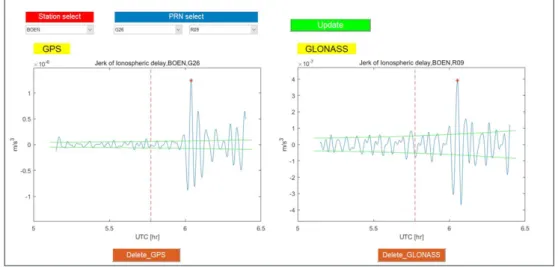
The MND is a technique that calculates a derivative while reducing noise as explained in the above. The ionospheric delay where the MND was applied three times to remove the trend sufficiently was selected as monitoring value of the disturbance detection. Fig. 4 shows the example of the detected disturbance.
2.2.2 Algorithm of epicenter estimation
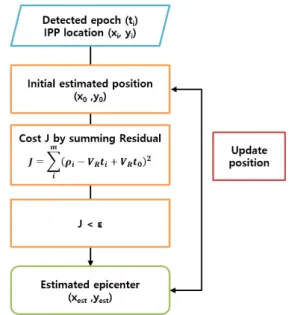
In the algorithm of the software that estimates the disturbance source location, a two-dimensional (2D) propagation model, where the disturbance occurred in the disturbance source and reached at 350 km vertically and then propagated in the horizontal direction, was used. Fig.
5 shows the 2D propagation model. This model assumed
Fig. 4. Example of detected ionospheric disturbance.
that the plane location of the disturbance source was the same between the ground and the ionosphere because the disturbance arrived at the ionosphere vertically from the ground and then propagated horizontally. The data used in the location estimation of the disturbance source were the detection time of the ionospheric disturbance and the Ionospheric Pierce Point (IPP) location at that time. The IPP refers to the location where satellite signals pass through the ionosphere height of 350 km altitude.
Fig. 6 shows an example of the disturbance detection time. As shown in the figure, the disturbance was detected at the first peak epoch in the upper direction, which exceeded the threshold after 10 min of the earthquake. The reason for selecting the region of interest after 10 min of the earthquake was because it took around 10 min for the disturbance occurred on the ground to reach the ionosphere according to the study by Liu et al. (2010). Moreover, the first peak in the upper direction was selected as the disturbance detection time since our data processing results revealed a relatively constant peak occurrence time in the first upper direction
assuming that the estimation error would be the smallest when the same wave was detected from all data used in the epicenter location estimation in the 2D propagation model.
The location at that epoch was designated as IPP latitude and longitude which were defined as the location where GNSS satellite signals pass through the ionosphere height of 350 km altitude.
The distance from the disturbance source to IPP where the disturbance was detected in the 2D propagation model can be expressed as Eq. (6).
(
0)
i