Vol. 19, No. 6, pp. 26-32, December 2015
De-NOx Characteristics of V 2 O 5 SCR according to the Ratio of TiO 2 Crystal Structures
Choong-Kil Seo*† and Jaeyoung Bae**
(Received 22 July 2015, Revision received 30 October 2015, Accepted 02 November 2015)
Abstract: The purpose of this study is to investigate the de-NOx performance characteristics according to the TiO
2crystal structures ratio of V
2O
5SCR catalysts. The anatase(100%) SCR catalyst showed the highest desorption peak of 80ppm at about 250℃, and NH
3was not desorbed at 500℃. It can be confirmed that there was many NH
3desorbed at a high temperature among other various crystal structures, which is because the catalyst was more acidized to increase the intensity of acid sites as the content of subacid sulfate ions(NH
2SO
4) in the rutile phase increases. The anatase/rutile(7%/93%) SCR had the smallest width of de-NOx performance drop according to thermal aging, and had strong durability against thermal aging.
Key Words:Diesel engine, Catalyst, SCR, TiO
2, Structure
*
†
Choong-kil Seo(corresponding author) : Department of Automotive & Mechanical Engineering, Howon university.E-mail : [email protected], Tel : 063-450-7215
**Jaeyoung Bae : Chemistry, Keimyung University
1. Introduction
Regulation of emission for vehicles is much stricter, including demands for zero emission.
Recently, regulation of NOx, SOx, and CO
2emitted from ship diesel engines has been introduced and enforced, and thus, urgent response to the regulation is required. Taking diesel combustion characteristics into consideration, NOx emitted from diesel engines is mostly produced in the localized high-temperature reaction zone and PM(particulate matter) in diffusion combustion zones. Recent research into NOx reduction includes studies on LNT(lean NOx trap)
1), SCR(selective catalytic reduction)
2,3), and combined system of LNT and SCR for after-treatment systems.
V
2O
5-WO
3-TiO
2SCR has often been used as a
stationary catalyst, but was not commercialized for vehicles because of the toxicity of V. On the other hand, owing to its high light-off performance, resistance to sulfur poisoning, and low cost, V
2O
5-WO
3-TiO
2SCR catalyst is great for ships, and thus its market demand is increasing. With these tendencies and tightened regulations on exhaust gases(NOx and SOx) taken into consideration, it is crucial to examine the effects according to the TiO
2crystalline structure of V
2O
5-WO
3-TiO
2SCR catalyst for diesel engines. So far, basic studies on the anatase and rutile crystal structure characteristics of vanadia SCR catalysts and the effect of V
2O
5and WO
3have been performed
4-6). However, a study on the de-NOx performance and adsorption and desorption feature according to the ratio of anatase and rutile crystal structures is meaningful.
The purpose of this study is to investigate the
de-NOx performance characteristics according to the
TiO
2crystal structures ratio of V
2O
5-WO
3-TiO
2SCR.
2. Experimental setup and method
2.1 Catalyst preparation
4 kinds of SCR catalysts were manufactured to assess the de-NOx performance according to the TiO
2crystal structure. The ratio of the crystal structures of anatase phase and rutile phase was determined as follows. Sulfate ions(NH
2SO
4) were added to the TiCl
4of rutile phase, a strong acid, in a designated distilled water while being stirred for 8 hours at a synthetic temperature of 90℃, where the ratio of the TiO
2crystal structure of anatase phase increased as the content of sulfate ions increased, and the calcination condition was 3h at 400℃.
4 types of V
2O
5-based SCR according to the TiO
2crystal structure were manufactured as follows.
The vanadia SCR was manufactured using an impregnation method, and a 3V
2O
5-10WO
3-87TiO
2SCR catalyst was manufactured by impregnating the TiO
2precursor with V
2O
5and WO
3inregular sequence. A catalyst powder was loaded into a carrier of 400 CPSI at a rate of 88g/L and calcinated for 2h at 500℃.
Table 1 shows the specification for the 4 types of TiO
2. The specific surface area of an A(100%) crystal structure, in which the anatase crystal structure was 100%, was 123m
2/g, and decreased as the ratio of the rutile crystal structure increases. The A/R(7%/93%) crystal structure shows 31m
2/g, so the reaction sites is small to decrease the performance of catalysts. The crystal size of the 4 types of TiO
2was 10~20nm, where mesopores were well developed. The size and size distribution of particles on the catalyst surface were observed by Transmission Electron Microscopy(TEM, JEM- 2000FXII(200kV), JEOL) equipped with an energy dispersive X-ray(EDX) detector.
Table 1 The specifications according to TiO
2crystalline structure
Structure Ratio(%) BET Size(nm)
Anatase 100 123 11.6
Anatase/rutile 62/38 78 18.9/15 Anatase/rutile 49/51 77 17.2/16.4 Anatase/rutile 7/93 31 10.9/20.1
2.2 NH
3adsorption and desorption The SCR catalysts tests were performed on their monolithic forms using a fixed-bed-flow reactor system
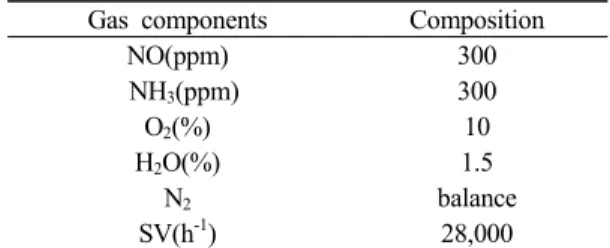
1). Table 2 shows the model gas composition for evaluating SCR. The SCR catalyst was refreshed for 30 min under a nitrogen atmosphere at 500℃
and the reaction experiments were carried out. The experiment of NH
3adsorption was carried out at a catalyst temperature of 120℃ with 300 ppm of NH
3with N
2balance. NH
3-temperature programmed desorption(TPD) experiments were conducted at a heating rate of 10℃/min after NH
3was sufficiently adsorbed at a temperature of 120℃ and the catalyst was flushed in a nitrogen atmosphere. The NH
3used for the TPD test was measured using an FTIR analyzer at real-time intervals of 5sec.
Table 2 Model gas composition for evaluating SCR Gas components Composition
NO(ppm) 300
NH
3(ppm) 300
O
2(%) 10
H
2O(%) 1.5
N
2balance
SV(h
-1) 28,000
3. Experimental results and discussion
3.1 Catalyst characterization
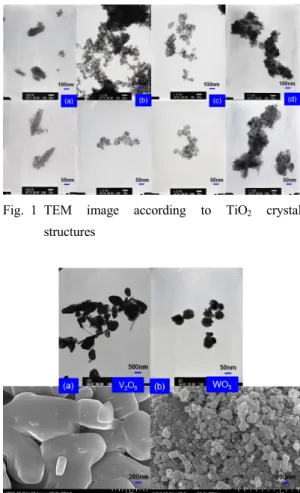
Fig. 1 shows the TEM image according to the
TiO
2crystal structure. The particle size of the
A(100%) crystal structure is as small as about
10nm, with a high degree of dispersion, which increases the specific surface area of a catalyst to improve the performance of the catalyst. The particles of TiO
2, whose ratio of the anatase/rutile crystal structure is 62/38 and 49%/51%, shows a trend of agglomerating a little. In addition, the specific surface areas are 78 and 77 m
2/g, which decreases as much as 37% more than the anatase crystal structure. The Fig. 1(d), in which the ratio of the anatase/rutile crystal structure is 7%/93%, can be said to be almost a rutile phase, and the specific surface area is 31m
2/g, which decreases 75% more than the anatase phase. The particles are long and show a trend of agglomeration, and this property minifies the reaction site when particles are loaded to decrease the performance.
Fig. 1 TEM image according to TiO
2crystal structures
Fig. 2 TEM/SEM images of V
2O
5and WO
3Fig. 2 shows the TEM/SEM image of basic substances forming a vanadia SCR. The Fig. 2 (a) shows V
2O
5having a selectivity against the NOx reduction. This is of a non-crystal shape and has a large particle size of about 400-2,000nm, being 1,000nm on average. This melts at a high temperature of 1473℃, and the WO
3, which gets the catalyst structure to be well formed, is fundamentally of a circular shape, but partially of an irregular structure, and shows a particle size of about 50nm.
(a) Several TiO
2crystal structures
(b) V
2O
5and WO
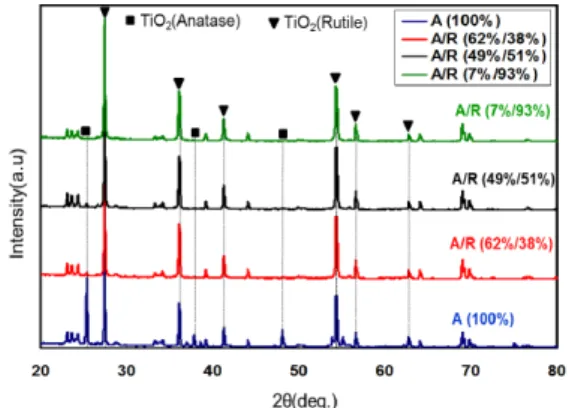
3Fig. 3 XRD spectra of several TiO
2crystal structures(a) V
2O
5and WO
3precusor(b)
Fig. 3 shows the crystal structure of various TiO
2and the XRD spectra of V
2O
5and WO
3precusor. In the Fig. 3(a), the A(100%) shows main peaks at 2θ
=26˚and 38˚. The A/R(7%/93%) TiO
2, most of
which is a rutile crystal structure, shows main peaks at 2θ=28˚ and 37˚. The A/R(62%/38%) and A/R (49%/51%) samples, in which a anatase crystal structure and a rutile crystal structure are combined, show a trend that the intensity of main peaks at an anatase and rutile phase decreases, but the main peaks one a chcrystal were well generated. The Fig.
3(b) shows the XRD spectra of V
2O
5and WO
3, a major catalyst substance of vanadia SCR.
3.2 Adsorption and desorption characteristics of SCR catalysts according to the TiO
2crystal structure
Fig. 4 shows the adsorption characteristics of the SCR catalyst according to crystalline structure at the conditions of NO 300ppm, O
210%, and N
2balance.
For a A(100%) catalyst, the saturation condition was reached at more than 1200sec. As shown in the Table 1, the A(100%) SCR catalyst, whose specific surface area of BET is biggest, shows a lot of NH
3stored amount. The A/R(62%/38%) and A/R (49%/51%), in which an anatase crystal structure and a rutile crystal structure are combined, reach saturation at 600 and 800sec. Generally, the NH
3stored amount of the A(100%) SCR catalyst is biggest, and there are many active sites to improve the NOx reduction performance.
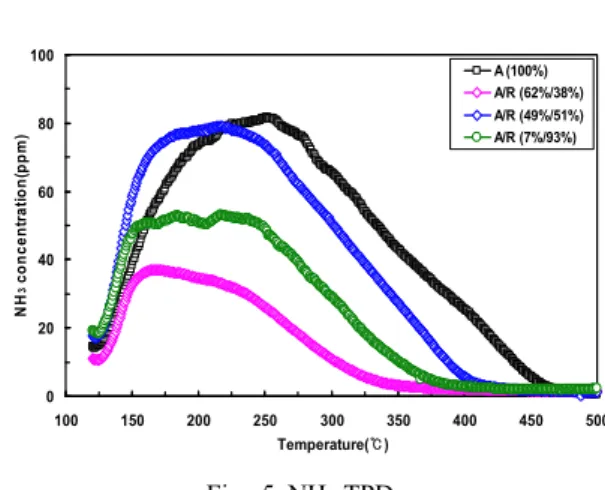
Fig. 5 represents the NH
3–TPD results obtained while increasing the catalyst temperature by 10℃
/min after NH
3adsorption for catalyst temperatures of 120℃. The A(100%) SCR catalyst shows the highest desorption peak of 80ppm at about 250℃, and NH
3is not desorbed at 500℃. It can be confirmed that there are many NH
3desorbed at a high temperature among other various crystal structures, which is because the catalyst is more acidized to increase the intensity of acid sites as the content of subacid sulfate ions(NH
2SO
4) in the rutile phase increases. For the A/R(7%/93%) SCR, 50ppm of NH
3are desorbed at 150~250℃, which shows
that the desorbed amount is small and the NH
3is desorbed at a low temperature. It can be said that for the NH
3desorbed at a low temperature, the physically adsorbed NH
3was desorbed, and for the NH
3desorbed at a middle and high temperature, the chemically stored NH
3was desorbed. In the end, the intensity of acid sites should be proper during a series of processes such as adsorption, reaction and desorption so that the reaction velocity of a catalyst can be improved.
0 50 100 150 200 250 300 350
0 200 400 600 800 1000 1200
Elapsed time(s)
NH3 Concentration(ppm)
A (100%) A/R (62%/38%) A/R (49%/51%) A/R (7%/93%)
Fig. 4 NH3 adsorption characteristics of 3V2O5- 10WO3-87TiO
2according to the TiO
2crystal structures
0 20 40 60 80 100
100 150 200 250 300 350 400 450 500
Temperature(℃)
NH3 concentration(ppm)
A (100%) A/R (62%/38%) A/R (49%/51%) A/R (7%/93%)
Fig. 5 NH
3-TPD
3.3 De-NOx performance of thermally
aged SCR catalysts
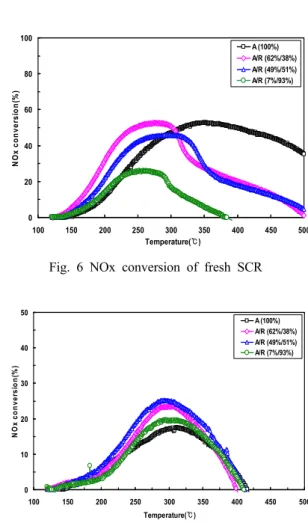
Fig. 6 shows the de-NOx characteristics of fresh SCR catalysts according to crystal structures. The A(100%) SCR, with the most NH
3stored amount, reaches LOT50 at about 300℃, and shows the highest NOx purification performance of 35% at a high temperature of 500℃. This has a high NOx purification performance at a middle and high temperature compared to other SCR catalysts, which is because the intensity of acid sites increased as the number of sulfate ions(NH
2SO
4) increased. The A/R(62%/38%) and A/R(49%/51%) SCR catalysts show a trend that the NOx conversion performance is improved at below 300 and 270℃ compared to the A(100%) SCR, but decreases rapidly at above 400℃. This shows a trend that the low temperature activity is improved compared to the A(100%) SCR, which is because the physical adsorption characteristics are good to accelerate the reduction reaction velocity between NH
3and NOx. The A/R(7%/93%) SCR, with the smallest specific surface area(31m
2/g) and the biggest crystal size(10.9/20.1nm), shows the highest purification rate of 23% and the smallest NOx conversion performance window width at 250℃.
Fig. 7 shows the de-NOx performance of the 4 types of SCR catalysts according to thermal aging for 10h at 700℃. The catalyst A(100%) aged thermally for 10h at 700℃ shows a NOx conversion rate of 16% compared to the fresh catalyst at about 310℃, and shows a crystal structure most vulnerable to thermal aging. The A/R(7%/93%) SCR catalyst has the smallest width of de-NOx performance drop according to thermal aging, and has strong durability against thermal aging. The A/R (62%/38%) and A/R(49%/51%) SCR, with almost the same specific surface area(78/77 m
2/g), show a de-NOx performance of 25% at about 300℃, showing the same NOx conversion performance trend. Of them, the A/R(49%/51%) SCR shows the highest NOx conversion performance among the 4
types of SCR catalysts as the content of rutile crystal structures with strong durability against thermal aging increases a little.
0 20 40 60 80 100
100 150 200 250 300 350 400 450 500
Temperature(℃)
NOx conversion(%)
A (100%) A/R (62%/38%) A/R (49%/51%) A/R (7%/93%)
Fig. 6 NOx conversion of fresh SCR
0 10 20 30 40 50
100 150 200 250 300 350 400 450 500
Temperature(℃)
NOx conversion(%)
A (100%) A/R (62%/38%) A/R (49%/51%) A/R (7%/93%)