Chapter 13. Heat Transfer to Fluids with Phase Change
Phase change ~ addition or subtraction of heat at constant or nearly constant T Æ condensation of vapors & boiling of liquids
(Ex. condensation, evaporation, distillation, drying, crystallization …)
Film-type condensation (막상응축):
more common
continuous layer of liquid Dropwise condensation (적상응축):
begins to form at microscopic nucleation sites (tiny pits, scratches, dust specks, …)
tube surface – extremely thin film of negligible thermal resistance Æ h for dropwise condensation ~ 5 to 10 times h for film-type condensation.
Heat Transfer from Condensing Vapors
wall
vapor
film (resistance to heat flow)
Film-type: Both the steam and the metal tube are clean.
Dropwise: unwetted cooling surface & contaminated vapor drop promoters ~ mercaptans on copper alloy
oleic acid “
(cf. steel & aluminum ~ difficult to give drop) Æ For normal design, film-type condensation is assumed.
Ex.) Vertical tubes unstable & difficult
to maintain
condensate film을 통해 conduction으로만 열전달이 일어나는 경우로 가정
δ
f x
h = k
local film thickness (usually, 1/100 ~ 1/1,000 of tube diameter)
3 / 1 2 cos 3
⎟⎟
⎠
⎞
⎜⎜
⎝
⎛ Γ
= ρ β
δ µ
f g
f
angle from the vertical ( = 0) ∴ --- Eq. (4.59)
Fig. 13.1. Film thickness & local coefficients for methanol, descending film of condensate.
Γ : condensate loading
~ mass rate per unit length of periphery (b: breadth of the film)
) ( b
m&
=
hx
∴ (of vertical surface)
3 / 2 1
3 ⎟⎟
⎠
⎞
⎜⎜
⎝
⎛
= Γ
f f f
k g
µ ρ
* Pool boiling of saturated liquid
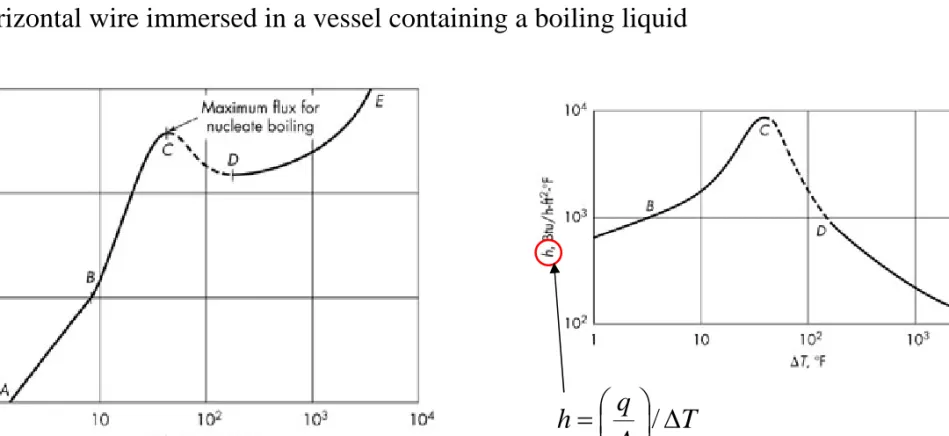
. Horizontal wire immersed in a vessel containing a boiling liquid
A T h q ⎟ ∆
⎠
⎜ ⎞
⎝
=⎛ /
Fig. 13.5. h vs. , boiling of water at 1 atm on a horizontal wire.
(Fig. 13.4를 변환시킨 그래프)
∆T Fig. 13.4. Heat flux vs. temperature drop, boiling water at
212 oF on an electrically heated wire: AB, natural
convection; BC, nucleate boiling; CD, transition boiling;
DE, film boiling (Tw: wire T; T: boiling liquid T).
Four segments (from Figs. 13.4 & 5)
Natural convection (자연대류: line AB): slope of 1.25
Nucleate boiling(핵비등: line BC): slope of 3 ~ 4
Point C: critical temperature drop (임계온도강하) peak flux를 나타내는 온도
Transition boiling (전이비등: line CD):
Heat flux and h both fall as T drop is raised.
Point D: Leidenfrost point (heat flux가 최소인 점) Film boiling (막비등: line DE):
As T drop increases, the heat flux rises but h falls.
Film boiling is not usually desired because h is low for high T drop.
Radiation(복사: beyond point E):
Radiation heat transfer becomes important at very high T drop.
25 .
T1
A a
q = ∆
∴ --- Eq. (13.19) Eq. (12.72)와 일치
Effect of bubble formation of interfacial tension
Interfacial tension between liquid & heating surface (a) Small --- Bubble will pinch off easily.
(b) Intermediate
(c) Large --- Bubble tends to spread along the surface
& blanket the heat transfer area.