Properties of β-Galactosidase from Lactobacillus zymae GU240, an Isolate from Kimchi, and Its Gene Cloning
Huong Giang Le
1, Zhuang Yao
1, Jeong A Kim
2, Se Jin Lee
1, Yu Meng
1, Ji Yeong Park
1, and Jeong Hwan Kim
1,2*
1
Division of Applied Life Science (BK21 Plus), Graduate School,
2Institute of Agriculture and Life Science, Gyeongsang National University, Jinju 52828, Republic of Korea
Received: February 27, 2020 / Revised: April 11, 2020 / Accepted: April 13, 2020
Introduction
β-galactosidase (β-D-galactoside galactohydrolase, EC 3.2.1.23), most commonly known as lactase, is a member of the family of glycosyl hydrolases that are known to catalyze the hydrolysis of the β-1,4-D-galactosidic link- age of lactose to its constituting monosaccharides, glu- cose and galactose [1].
β-galactosidase (β-Gal) is an important enzyme for lac- tic acid bacteria (LAB), especially for starters used for production of dairy products. One of the important pre- requisites for lactic starter is the ability to utilize lactose in milk, and quickly produces acids such as lactate and
acetate, which contributes to preservation and flavor of dairy products [2]. Many studies have been done on β- Gals and the structural genes from various LAB. Two types of β-Gals, β-Gal and phospho-β-Gal, exist among LAB depending upon employed lactose transport sys- tems [3]. In a Lac permease system, lactose enters into cell as an unmodified form and hydrolyzed by β-Gal into glucose and galactose. In a PEP (phosphoenol pyruvate)- PTS (phosphotransferase) system, lactose is phosphory- lated during transport and hydrolyzed by phospho- β-Gal into galactose 6-phosphate and glucose inside cells [4].
Some β-Gals from LAB are heterodimers consisting of a large subunit (72 kDa) encoded by lacL and a small sub- unit (35 kDa) encoded by lacM [5, 6]. β-Gal from Esche- richia coli is a homotetramer consisting of a 110 kDa subunit encoded by lacZ [7].
β-Gal gene from E. coli is used in molecular biological Lactobacillus zymae GU240 was previously isolated from Kimchi, a Korean fermented vegetable, as a strong GABA producer. The strain showed β-galactosidase (β-Gal) activity on MRS agar plates with X-gal.
When growth and β-Gal activities of GU240 were measured using MRS (glucose, 2%, w/v) and MRSL (lac- tose, 2%, w/v) broths, cells were found to grow slowly in MRSL, and the β-Gal activity (36 units at 4 h) was lower than that of cells grown in MRS (94 units at 16 h). The highest OD
600value of the culture in MRS was 1.6 at 24 h at 37 ℃, whereas that of the culture in MRSL was 0.6 at 16 h. β-Gal activity of the culture in MRS reached the maximum (95.6 u/ml) at 16 h, decreased thereafter, and was not detected at 48 h. β-Gal activity for culture in MRSL reached its highest (36 u/ml) at 4 h and decreased gradually, but some activity (11.05 u/
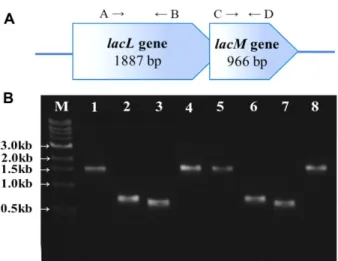
ml) still remained at 72 h. The structural gene encoding β-Gal in L. zymae GU240 was cloned as a 3.1 kb frag- ment, and DNA sequencing confirmed the presence of complete lacLM genes. lacLM genes from L. zymae GU240 showed 98 −99% homologies in nucleotide sequences with other lacLM genes from L. brevis. Reverse transcription (RT)-PCR confirmed the operon structure of lacLM. The results indicated that L. zymae GU240 might be in the process of losing the ability to grow rapidly on lactose-containing medium, such as milk, due to adaptations to plant environments, including kimchi .
Keywords:
Lactobacillus zymae GU240, β-galactosidase, lacLM, Kimchi
*Corresponding author
Tel: +82-55-772-1904, Fax: +82-55-772-1909 E-mail: [email protected]
© 2020, The Korean Society for Microbiology and Biotechnology