초고압 처리가 우유의 미생물학적 및 이화학적 특성에 미치는 영향
이지은1, 최은지1, 박선영2, 전가영3, 장자영1, 오영준1, 임슬기1, 김태운2, 이종희2, 박해웅2, 김현주1, 전정태4, 최학종1*
1세계김치연구소대사기능성연구단
2세계김치연구소미생물발효연구단
3연세대학교식품영양학과
4부산대학교식품영양학과
Received: June 2, 2014 / Revised: July 5, 2014 / Accepted: July 7, 2014
서 론
최근식품원료와제품의신선도를최대한유지하면서유 통기한을 연장하기 위한 최소가공기술(minimal process technology)에대한관심이높아지고있다. 최소가공기술중 초고압처리법(High Pressure Processing, HPP)은비열(非 熱)가공(non-thermal process) 기술로서액체또는고체식 품을포장하거나포장하지않은상태로 100-1,000 MPa의정
수압(hydrostatic pressure)의 압력을 처리하는 기술이다. HPP는식품의맛, 향, 영양성분에변화를주지않으면서미 생물을사멸시키고효소를불활성화시켜효소의작용에의 한쓴맛, 냄새의발생을억제하는첨단가공기술로서모든공 정이비가열처리되는것이특징이다[8].
우유는인류가 10,000여년전부터식품으로사용해온영
양적으로균형이맞춰진완전식품으로 2011년현재전세계 우유생산량은 7억3천만톤에달하며, 6억명이상의인구가
우유를소비하고있다[26]. 현재가장많이사용되는우유의
살균(pasteurization)방법은열처리법이며, 63oC에서 30분간 가열하는 방식인 Low Temperature Long Time (LTLT), 72-75oC에서 15초간열처리하는 High Temperature Short Time (HTST), 135oC에서 2초간살균하는 Ultra-High Tem- Effects of High Pressure Treatment on the Microbiological and Chemical Properties of Milk
Jieun Lee1, Eun-Ji Choi1, Sun Young Park2, Ga Young Jeon3, Ja-Young Jang1, Young Jun Oh1, Seul Ki Lim1, Tae-Woon Kim2, Jong-Hee Lee2, Hae Woong Park2, Hyun Ju Kim1, Jung Tae Jeon4, and Hak-Jong Choi1*
1Metabolism and Functionality Research Group, 2Microbiology and Fermentation Research Group, World Institute of Kimchi, Gwangju 503-360, Republic of Korea
3Food Science and Nutrition, Yonsei University, Seoul 120-749, Republic of Korea
4Food Science and Nutrition, Pusan National University, Busan 609-735, Republic of Korea
High pressure processing (HPP) is a non-thermal method used to prevent bacterial growth in the food industry. Currently, pas- teurization is the most common method in use for most milk processing, but this has the disadvantage that it leads to changes in the milk’s nutritional and chemical properties. Therefore, the effects of HPP treatment on the microbiological and chemical properties of milk were investigated in this study. With the treatment of HPP at 600 MPa and 15oC for 3 min, the quantity of microorganisms and lactic acid bacteria were reduced to the level of 2-3 log CFU/ml, and coliforms were not detected during a storage period of 15 d at 4oC. An analysis of milk proteins, such as α-casein, β-casein, κ-casein, α-lactalbumin, β-lactoglobulin by on-chip electorophoresis revealed that the electrophoretic pattern of the proteins from HPP-treated milk was different from that of conventionally treated commercial milk. While the quantities of vitamins and minerals in HPP-treated milk were seen to be comparable to amounts found in raw milk, the enzyme activity of lipase, protease and alkaline phosphatase after HPP treat- ment was reduced. These results suggest that HPP treatment is a viable method for the control of undesirable microorganisms in milk, allowing for minimal nutritional and chemical changes in the milk during the process.
Keywords: High pressure treatment, milk, microbial reduction, chemical property
*Corresponding author
Tel: +82-62-610-1729, Fax: +82-62-610-1850 E-mail: [email protected]
© 2014, The Korean Society for Microbiology and Biotechnology
perature (UHT) 방식이가장많이사용되고있다. 이러한가 열살균법은우유의단백질및비타민 C와같은성분을변성 시키는단점이있으며특히, 고온살균과정중변성된유단 백은신생아에게항원으로작용하여심각한알레르기를유
발하기도한다[12]. 알레르기를유발하는주요유단백은α-
lactalbumin (α-la), β-lactoglobulin (β-lg) 및 casein이며, 때때로 bovine serum albumin 및 lactoferrin도문제가되
기도한다[23]. 가열살균처리과정에서변성된알레르기유
발 유단백질은 섭취 후 소화효소인 trypsin 또는 chymo-
trypsin에 의하여 분해된 후 생체 알레르기 유발 항체인
immunoglobulin (Ig) E와결합을하게되어알레르기를유
도한다[1]. 알레르기저감을위한우유의비가열살균기술
로 HPP 처리가적용되고있으며[11], 최근 연구에의하면
HPP 처리우유의 β-lg은 trypsin에의하여가수분해후에도 IgE와결합하는능력을상실한다고보고되었다[16]. 우유에
고압처리시물리적특성이변한다는연구는 1899년처음
보고되었으나[9], HPP 처리가우유의고분자성분에미치는 효과에대한세부적인연구는비교적근래에연구가시작되 었다[25]. HPP 처리는 casein micelle에결합된 mineral을용 해시켜 casein 입자를작게만들어우유의혼탁도(turbidity) 를감소시키는효과를보여 cheese 제조에바람직하게우유 의성질을변화시킨다[10, 24]. 또한, HPP 적용조건에따라 whey protein 및 serum protein을변성시켜유단백질매개 알레르기를저감시키는효과를나타낸다[2]. HPP에의한미 생물의생육저해효과는 HPP 조건(압력, 시간, 온도, cycle 등) 및적용식품의조성, 특성, 미생물의생리학적상태에영향 을받는다. 우유의경우, 대부분의효모나곰팡이는압력에 민감한것으로나타났으나[24], 세균은상대적으로높은압 력조건이필요하다. 그람양성균은그람음성균보다압력에 높은저항성을나타내는데그람음성균의경우, 25oC 기준, 300-400 MPa에서 10분간처리하였을때생육저해효과가있 었으며, 그람양성균의 25oC 기준, 500-600 MPa에서 10분간 처리하였을경우효율적인생육저해효과가나타난다[25]. 종
합적으로 HPP 처리가 LTLT 처리법정도의살균효과를나
타내기위해서는원유를 400-500 MPa 수준으로압력을가
하였을경우원유에존재하는병원성균및부패균의생육을
저해할수있는것으로나타난다[4]. 따라서최소가공기술인
HPP는우유의살균에적용함으로써우유고유의신선도, 향, 색, 그리고맛을유지하면서도안전한우유살균조건을개발 하는연구가필요하다.
본연구에서는비가열살균방법인 HPP를사용하여우유 에처리하였을때, 우유내잔존미생물, 우유단백질성분 의변화, 기타우유성분의이화학적변화를기존의가열살 균처리와비교하여분석하였다.
재료 및 방법
우유 시료
본연구에사용된원유와고압살균처리한 HPP 우유는
A사에서 공급받았으며, 가열살균 우유 시료로는 LTLT,
HTST 및 UHT 살균법처리우유를시중마트에서구입하여
사용하였다. 우유의 HPP 처리
우유 시료의 HPP 처리는 Baotou Kefa High Pressure Technology (Baotou, China)사의 5L-HPP-600MPa 장비를 이용하여 550-600 MPa의조건으로수행하였다.
우유의 잔존 미생물 분석
HPP 처리후잔존하는미생물분석은다음과같이수행
하였다. 550 MPa (HPP A, 550 MPa에서 3분간 HPP 처리) 및 600 MPa (HPP B, 600 MPa에서 3분간 HPP 처리)의 조건에서 3분간처리한 HPP 우유를 4oC에서 15일동안저 장하면서일반세균수, 유산균수및대장균군수를측정하였 다. 저장기간에따라시료를채취하여멸균식염수에순차적 으로 희석하여일반세균은 Plate Count Agar (PCA) 배지 (BD Difco, Detroit, MI, USA), 총 유산균은 BCP Plate Count (BCP) 배지(Eiken Chemical Co., Tochigi, Japan), 대장균군은 3M PetrifilmTM E. coli/Coliform plates (3M Co., St. Paul, MN, USA)에도말하였다. 도말된 PCA 배지 는 30oC에서 48시간, BCP 배지는 30oC에서 72시간, 3M Petrifilm은 30oC에서 24시간각각배양하였고, BCP 배지의 경우 GasPak EZ Container System (BD, Sparks, MD, USA)을사용하여혐기조건에서배양하였다. 배양후 30-300 개의집락을형성한배지만을계수하였다.
우유의 유단백 변성도 측정
우유의 HPP 처리시단백질변성정도를알아보기위하
여원유와각각 570, 590 및 600 MPa의조건에서 3분또는 5분간처리한 HPP 우유, 대조군으로 LTLT, HTST, UHT 처 리우유의α-casein, β-casein, κ-casein, α-la, β-lg의함량을 Nitsche [18]의방법을변형하여 on-chip 전기영동방법으로 측정하여비교하였다. 시료의단백질은 13,000 ×g에서 1시 간동안원심분리하여지방층을제거하고남은상등액을이 용하여 측정하였다. Lab-on-a-chip 측정과 시료 전처리는 Agilent Protein 80 Kit Quick Start Guide에따라 처리하 였으며, 2100 Bioanalyzer (Agilent Technologies, Santa Clara, CA, USA)을이용하여전기영동한후단백질분리패 턴을비교· 분석하였다.
효소활성 측정
초고압처리에따른우유 lipase, protease, alkaline phos- phatase 및 lactoperoxidase 활성변화측정은실험항목에따 라 vortex mixer를이용한균질및원심분리기를이용한지 방층제거등의전처리과정을거친우유를사용하여측정 하였다. Lipase 저해활성은 Park 등[19]의방법을변형하여 측정하였다. 10 nM p-nitrophenyl phosphate 용액 0.1 ml과 50 mM potassium phosphate (pH 7.5) 완충액 0.8 ml를혼 합하고여기에 0.1 ml의우유를가한뒤 37oC에서 15분간반 응시킨후유리된 p-nitrophenol의양을 405 nm에서흡광도 를측정하였다. Protease 활성은 Gupta 등[6]과 Gutelben 등[7]의 방법을 변형하여 측정하였다. 0.5% casein 용액 0.1 ml을 37oC에서 10분간반응시킨후 0.1 ml의우유를가 한 뒤 다시 37oC에서 10분간 반응시켰다. 여기에 0.4 M trichloroacetic acid 용액 0.2 ml을가해 37oC에서 25분간방 치시킨뒤침전물을 0.4 μm syringe filter로여과하였다. 여 과액 0.1 ml에 0.4 M Na2CO3 0.5 ml과 Folin-Ciocalteu’s phenol reagent액 (Sigma-Aldrich, St. Luis, MO, USA) 0.1 ml을가하여 37oC에서 20분간발색시킨뒤냉각하여생 성된 tyrosine의 양을 660 nm에서 측정하였다. Alkaline phosphatase의 활성은 Alkaline Phosphatase Assay Kit (Abcam, Cambridge, MA, USA)를제조사의방법에따라측 정하였고, lactoperoxidase의 활성은 Enzyme-linked Immunosorbent Assay Kit For Lactoperoxidase (Cloud- Clone Co., Houston, TX, USA)를사용하여제조사의방법 에따라측정하였다.
우유의 비타민 및 미네랄 측정
시료의 Vitamin A의잔존 함량측정은 Vitakit (Crystal Chem Inc., Chicago, IL, USA), Vitamin B1 함량 측정은 VitaFast Vitamin B1 (R-Biopharm, Darmstadt, Germany), ascorbic acid 함량 측정은 Ascorbic Acid Assay Kit (Bio- Assay Systems, Hayward, CA, USA)를사용하여측정하였 다. 칼슘의 함량은 QuantiChrom Calcium Assay Kit (Bioassay Systems), 마그네슘의 함량은 QuantiChrom Magnesium Assay Kit (Bioassay Systems)을사용하여제 조사의방법에따라측정하였다.
통계분석
모든실험값은평균과표준편차로표시하였다. 얻은실험 값의통계분석은 SPSS 18.0 (SPSS Inc., Chicago, IL, USA) 을이용하여일원분산분석(one-way analysis of variance)을 실시하였고, 실험군간의유의성은 Duncan’s multiple range test (p < 0.05) 수준에서검증하였다.
결과 및 고찰
원유의 HPP 처리에 따른 미생물 분석
HPP 처리에따른우유의살균효과를알아보기위하여원
유를 15oC에서 550 및 600 MPa의조건으로각각 3분동안
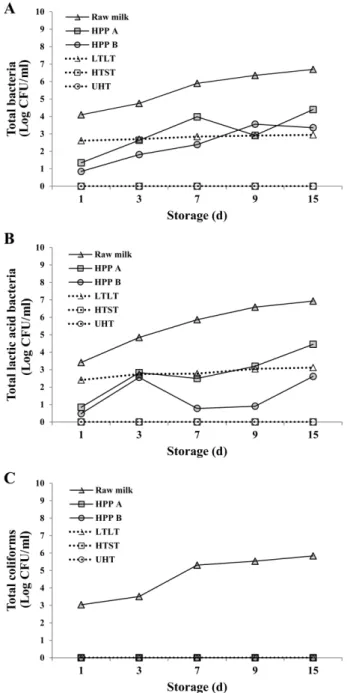
Fig. 1. (A) Total bacteria, (B) Total lactic acid bacteria, (C) Total coliforms from raw milk or high pressure-treated milk during storage at 4oC. HPP A; high pressure-treated raw milk at 550 MPa for 3 min, HPP B; high pressure-treated raw milk at 600 MPa for 3 min.
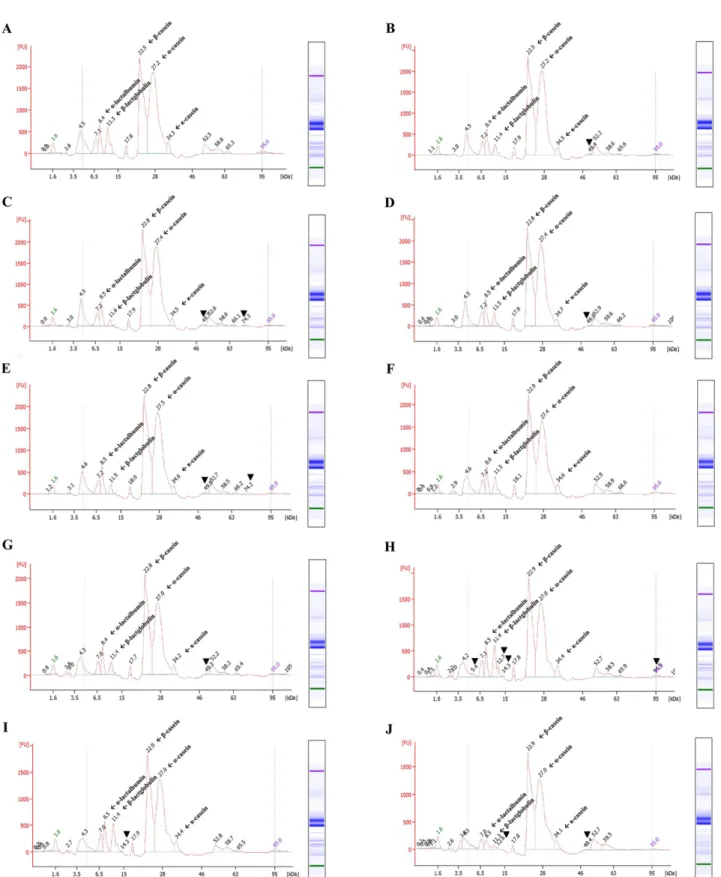
Fig. 2. Electrophoreogram and gel-like image of high pressure-treated of heat treated protein in milk. (A) Raw milk, (B) high pressure process (HPP)-treated raw milk at 570 MPa or 3 min, (C) HPP treated raw milk at 570 MPa, 5 min, (D) HPP treated raw milk at 590 MPa, 3 min, (E) HPP treated raw milk at 590 MPa, 5 min, (F) HPP treated raw milk at 600 MPa, 3 min, (G) HPP treated raw milk at 600 MPa, 5 min, (H) LTLT, (I) HTST, (J) UHT. Arrows indicate potentially denatured milk proteins.
초고압처리를하였으며, 그후시료를 4oC에서 15일간저 장하면서일반세균, 유산균및대장균군수의변화를측정하 였다. Fig. 1에나타낸바와같이저장 1일차대조구로사용 된비살균우유의일반세균수는 4.09 Log CFU/ml로나타났 으며, HPP A의경우 1.34 Log CFU/ml로대조구에비하여 2.75 Log CFU/ml 감소하였고, HPP B는 0.85 Log CFU/ml 로 3.25 Log CFU/ml 정도감소하였다. 이는 HPP의처리압 력이높을수록효율적으로일반세균이제어되는것을나타
낸다. 또한저장기간중 HPP 처리구의일반세균수는대조
군과비교하여약 2-3 Log CFU/ml의감소효과를유지하였 다. 가열살균우유시료인 HTST와 UHT는 15일동안일반
세균이검출되지않았으나, LTLT 처리우유는저장 15일차
일반세균이약 3 Log CFU/ml 수준으로검출되었다. 이러한 결과는 600 MPa의압력하에 3분간우유를 HPP 처리할경
우 LTLT 수준으로살균효과를갖는다는것을나타낸다. 유
산균의경우비살균대조군의경우 3.41 Log CFU/ml로 HPP A의 Log CFU/ml 보다 2.56 Log CFU/ml 정도감소하였고,
HPP B는 Log CFU/ml로 2.93 Log CFU/ml 만큼감소하였 다. 550 MPa 조건보다 600 MPa 처리조건이더큰유산균 제어효과를나타냈으며, 이러한경향은일반세균과마찬가 지로 15일간저장중꾸준히유지되었다. 대장균군의수는
초기비살균우유에서 3.04 Log CFU/ml로검출되던것이
15일차에서 5.85 Log CFU/ml로증가하였으나, HPP 처리군 에서는 모두 불검출 되었다. Huppertz 등[10]은 원유를 600 MPa로처리할경우 4 Log CFU/ml 이상의일반세균감 소효과가나타난다고보고하였는데본연구에서는 2-3 Log
CFU/ml 정도의일반세균및유산균제어효과가나타났다.
이는각각의연구에사용한초고압살균기의크기및초고압 처리시간등이다른것에기인한것으로사료된다. HPP 처리에 따른 우유의 단백질 변성도 측정
최근들어우유를가열살균함에따라 3차단백질구조가 파괴되어변성이일어나게되고이로인해우유의영양소파 괴및인체에, 특히신생아에게알레르기를유발하는문제가
Fig. 3. Effect of high pressure treatment of milk at 550 MPa, 570 MPa and 600 MPa for 3 min or 5 min on the enzyme activity of (A) lipase, (B) protease, (C) alkaline phosphatase and (D) lactoperoxidase. The means (±SD) of three independent experiments are shown.
보고되어왔다[12]. 본연구에서는초고압처리를통한우유 의단백질변성도를기존의가열처리우유와비교해보았으며, 그결과는 Fig. 2에나타내었다. HPP 처리우유와가열살균
우유의단백질변성도를비교하기위하여원유를 570, 590
및 600 MPa의조건에서각각 3, 5분동안초고압처리를하 였으며, 이를 LTLT, HTST 및 UHT 처리 우유와함께 on-
chip 전기영동법을사용하여우유단백질의변성도를비교·
분석하였다. Electropherogram 상에서α-la, β-lg, α-casein, β-casein 및κ-casein은각각 8.5 kDa, 11.6 kDa, 22.8 kDa, 27.4 kDa 및 34.5 kDa의분자량위치에서나타남을확인하
였으며, 시판중인가열살균우유는 HPP 처리우유보다단
백질의종류가다양하게나타났다. 이는변성된유단백을전 기영동으로분석할때전형적으로나타나는현상으로가열
살균처리군에비해 HPP 처리군에서단백질변성이약하게
일어나는것을의미한다.
HPP 처리에 따른 우유의 잔존 효소활성 측정
우유를가열살균할경우대부분의효소는불활성화되거 나효소활성이급격하게감소하는데, HPP 처리가우유효 소 활성에 미치는 영향을 알아보고자 lipase, protease, alkaline phosphatase 및 lactoperoxidase의활성을측정하 였다. Fig. 3A에나타낸바와같이, lipase는 HPP 처리시원 유에비하여효소활성이급격히감소하였으며, 3분보다 5 분처리시에활성이더욱감소하였다. 더욱이 HPP 처리에
따른 lipase의활성이가열살균우유보다유의적으로낮게
관찰되는것으로보아, HPP 처리는가열살균보다도 lipase
를 효율적으로 불활성화 시키는 것을 확인하였다. 또한 protease의경우역시 HPP 처리가가열살균보다 protease 활성을효율적으로불활성화시키는것으로관찰되었다(Fig.
3B). 하지만 UHT 처리우유에서는 protease 활성이전혀검
출 되지 않는 것으로 보아 우유에 존재하는 protease는
HTST 살균법이상의고온에서활성이소실됨을알수있었
다. Alkaline phosphatase는 570 MPa 조건에서 5분, 590 및 600 MPa 조건에서 3 또는 5분처리시에효소활성이유 의적으로감소하였으며, LTLT 및 HTST 우유보다효소활 성이더욱감소하였다(Fig. 3C). 또한 alkaline phosphatase 도 protease와마찬가지로 UTH 처리우유에서는활성이검 출되지않았다. Lactoperoxidase는 HPP 처리시에효소활 성이유의적으로감소되었고, 600 MPa 조건에서 5분간가
압하였을때는효소활성감소가가장크게나타나 LTLT 우
유와유사한수준이었으며, HTST 및 UHT 처리우유의경우 효소활성이가장낮게나타났다(Fig. 3D). Raynal-Ljutovac 등[21]에따르면우유가열살균지표로사용되는 alkaline phosphatase는열에의해어느정도사멸되지만, 원유의품 질에따라가열살균시에도 protease나 lipase와마찬가지
로 alkaline phosphatase의불활성화가완전하게일어나지 않을수있다고보고하였다. López-Fandiño 등[17]은원유 를 380 MPa에서 60분처리시 alkaline phosphatase가완전히 불활성화되며, Rademacher 등[20]은 alkaline phosphatase는 600 MPa에서 10분간처리시에는 50%, 800 MPa에서 8분처
리시에는 100% 불활성화된다고보고하였다. 이와유사하게
본연구에서는 alkaline phosphatase 활성이원유에비하여 유의적으로감소하였다. 우유의 lactoperoxidase는비교적높 은압력조건에도활성이소실되지않는특성을나타내는데 [15, 17], 본연구에서도 HPP 처리시 lactoperoxidase의활 성은원유에비하여약하게감소하나가열살균보다는불활 성화정도가낮게검출되었다.
HPP 처리에 따른 우유의 잔존 비타민 및 미네랄 함량 측정 일반적으로가열살균처리는우유의비타민 A, B1 및 C
의함량에영향을주는것으로알려져있다[14]. 본연구에
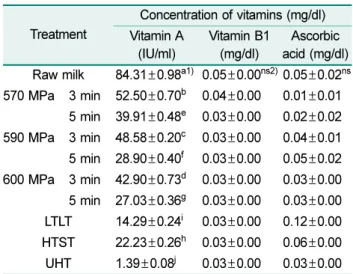
서는 HPP 처리우유의잔존비타민 A의경우압력이높아
질수록함량이유의적으로감소하고, 같은압력조건에서 3분 보다 5분처리시에함량이유의적으로감소하여압력과시 간의영향을많이받음을알수있었으나, 가열살균의경우
비타민 A 함량의 소실이 HPP 처리보다는 높게 나타났다
(Table 1). 이는 HPP 처리가가열살균처리에비하여우유 의비타민 A의소실을적게일으키는결과로해석된다. 비 타민 B1과비타민 C의경우 HPP 처리시에함량이약하게
줄어듦을알수있었지만검출된함량이매우낮아 HPP 처
리에따른소실정도를파악하기는힘들었다(Table 1).
Table 1. Effect of high pressure treatment of milk at 570 MPa, 590 MPa and 600 MPa for 3 min or 5 min on the concentration of vitamin A, vitamin B1 and ascorbic acid.
Treatment
Concentration of vitamins (mg/dl) Vitamin A
(IU/ml)
Vitamin B1 (mg/dl)
Ascorbic acid (mg/dl) Raw milk 84.31±0.98a1) 0.05±0.00ns2) 0.05±0.02ns 570 MPa 3 min 52.50±0.70b 0.04±0.00 0.01±0.01
5 min 39.91±0.48e 0.03±0.00 0.02±0.02 590 MPa 3 min 48.58±0.20c 0.03±0.00 0.04±0.01 5 min 28.90±0.40f 0.03±0.00 0.05±0.02 600 MPa 3 min 42.90±0.73d 0.03±0.00 0.03±0.00 5 min 27.03±0.36g 0.03±0.00 0.03±0.00 LTLT 14.29±0.24i 0.03±0.00 0.12±0.00 HTST 22.23±0.26h 0.03±0.00 0.06±0.00 UHT 1.39±0.08j 0.03±0.00 0.03±0.00
1)Means in the same column (a-j) bearing different super- scripts are significantly different (p < 0.05).
2)ns; not significantly different.
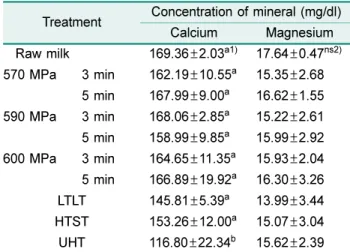
HPP 처리가우유의미네랄함량에미치는영향을알아보 고자우유의대표적미네랄성분인 calcium 및 magnesium 의잔존함량을 HPP 처리후측정하였다. Calcium은처리 한 HPP의모든압력조건에서도거의감소하지않았으며,
magnesium 역시거의유의적인함량의차이를보이지않았
다(Table 2). 본연구결과에서는 HPP 처리시우유의 calcium 함량이거의변하지않고가열살균처리했을시살균온도
가가장높은 UHT 처리우유에서의칼슘함량이가장낮게
나타나, 우유의 calcium은저온살균에의하여영향을거의받
지않는다고알려져있지만고온에서살균시에는 diffusible
calcium 함량이감소하는반면[3, 22], 600 MPa 이하의압력 을처리시에는 ionic calcium의농도가변하지않거나영향 이매우적다고보고된결과와일치하였다[5, 13].
요 약
초고압공정(HPP)은비가열공정중하나로식품중의세
균증식을억제하는방법으로근래들어산업적으로각광받 고있다. 현재우유의살균은대부분가열살균법에의존하고 있으나, 가열살균은우유의영양소및이화학적특성을변화 시키는단점이있다. 따라서본연구에서는초고압처리가 우유의미생물학적및이화학적특성에미치는영향을알아 보았다. 우유를 15oC에서 600 MPa의압력조건으로 3분간처 리했을시일반세균및유산균의수는 2-3 Log CFU/ml 수 준으로감소하였으며, 대장균군은 HPP 처리후 4oC에서 15일
저장기간중에검출되지않았다. HPP 처리에따른유단백
의변성을알아보고자유단백의전기영동패턴을분석한결
과, HPP 처리우유가가열살균우유에비하여단백질변성
도가낮게나타났다. 또한 HPP 처리우유의경우비타민및
무기질의함량변화는상대적으로낮았으나, protease, lipase 및 alkaline phsophatase와같은우유효소는불활성화시키 는특징을나타내었다. 이러한결과는 HPP가우유의영양 소파괴및이화학적특성을변화시키지않으면서우유의미 생물제어에사용될수있음을제시한다.
References
1. Beran M, Klubal R, Molik P, Strohalm J, Urban M, Klaudyova AA, et al. 2009. Influence of high-hydrostatic pressure on tryp- tic and chymotryptic hydrolysis of milk proteins. High Press.
Res. 29: 23-27.
2. Bu G, Luo Y, Chen F, Liu K, Zhu T. 2013. Milk processing as a tool to reduce cow’s milk allergenicity: a mini-review. Dairy Sci. Technol. 93: 211-223.
3. Buchheim W, Schrader K, Morr CV, Frede E. 1996. Effects of high pressure on the protein, lipid and mineral phase of milk.
In Heat Treatments and Alternative Methods 9602: 202-213.
4. Buffa M, Trujillo AJ, Guamis B. 2001. Changes in textural, microstructure, and colour characteristics during ripening of cheeses made from raw, pasteurised or high-pressure-treated goats’ milk. Int. Dairy J. 11: 927-934.
5. de la Fuente MA, Olano A, Casal V, Juárez M. 1999. Effects of high pressure and heat treatment on the mineral balance of goats’ milk. J. Dairy Res. 66: 65-72.
6. Gupta A, Roy I, Khare SK, Gupta MN. 2005. Purification and characterization of a solvent stable protease from Pseudomo- nas aeruginosa PseA. J. Chromatogr. A. 1069: 155-161.
7. Gutleben W, Tuan ND, Stoiber H, Dierich MP, Sarcletti M, Zemann A. 2001. Capillary electrophoretic separation of pro- tease inhibitors used in human immunodeficiency virus ther- apy. J. Chromatogr. A. 922: 313-320.
8. He H, Adams RM, Farkas DF, Morrissey MT. 2006. Use of high-pressure processing for oyster shucking and shelf-life extension. J. Food Sci. 67: 640-645.
9. Hite BH. 1899. The effects of pressure in the preservation of milk. West Virginia Agric. Exp. Sta. Bull. 58: 15-35.
10. Huppertz T, Smiddy MA, Upadhyay VK, Kelly AL. 2006. High- pressure-induced changes in bovine milk: a review. Int. J.
Dairy Technol. 59: 58-66.
11. Iametti S, Transidico P, Bonomi F, Vecchio G, Pittia P, Rovere P, et al. 1997. Molecular modifications of β-lactoglobulin upon exposure to high pressure. J. Agric. Food Chem. 45: 23-29.
12. Isolauri E, Turjanmaa K. 1996. Combined skin prick and patch testing enhances identification of food allergy in infants with atopic dermatitis. J. Allergy Clin. Immunol. 97: 9-15.
13. Johnston DE, Austin BA, Murphy RJ. 1992. Effects of high hydrostatic pressure on milk. Milchwissenschaft 47: 760-763.
Table 2. Effect of high pressure treatment of milk at 570 MPa, 590 MPa and 600 MPa for 3 min or 5 min on the concentration of calcium and magnesium.
Treatment Concentration of mineral (mg/dl)
Calcium Magnesium
Raw milk 169.36±2.03a1) 17.64±0.47ns2) 570 MPa 3 min 162.19±10.55a 15.35±2.68
5 min 167.99±9.00a 16.62±1.55 590 MPa 3 min 168.06±2.85a 15.22±2.61 5 min 158.99±9.85a 15.99±2.92 600 MPa 3 min 164.65±11.35a 15.93±2.04 5 min 166.89±19.92a 16.30±3.26 LTLT 145.81±5.39a 13.99±3.44 HTST 153.26±12.00a 15.07±3.04 UHT 116.80±22.34b 15.62±2.39
1)Means in the same column (a-b) bearing different super- scripts are significantly different (p < 0.05).
2)ns; not significantly different.
14. Kim HY, Kim SH, Choi MJ, Min SG, Kwak HS. 2008. The effect of high pressure-low temperature treatment on physico- chemical properties in milk. J. Dairy Sci. 91: 4176-4182.
15. Kussendrager KD, van Hooijdonk AC. 2000. Lactoperoxidase:
physico-chemical properties, occurrence, mechanism of action and applications. Br. J. Nutr. 84: S19-25.
16. López-Expósito I, Chicón R, Belloque J, López-Fandiño R, Berin MC. 2012. In vivo methods for testing allergenicity show that high hydrostatic pressure hydrolysates of β-lactoglobulin are immunologically inert. J. Dairy Sci. 95: 541-548.
17. López-Fandiño R, Carrascosa AV, Olano A. 1996. The effects of high pressure on whey protein denaturation and cheese- making properties of raw milk. J. Dairy Sci. 79: 929-936.
18. Nitsche R. 2011. Milk protein analysis with the Agilent 2100 Bioanalyzer and the Agilent Protein 80 kit. Germany: Agilent Technologies, Inc.
19. Park SY, Kim JY, Bae JH, Hou CT, Kim HR. 2013. Optimiza- tion of culture conditions for production of a novel cold-active lipase from Pichia lynferdii NRRL Y-7723. J. Agric. Food Chem. 61: 882-886.
20. Rademacher B, Pfeiffer B, Kessler HG. 1998. Inactivation of microorganisms and enzymes in pressure-treated raw milk.
pp. 145-151. Isaacs NS (ed.), High Pressure Food Science, Bioscience and Chemistry, The Royal Society of Chemistry, Cambridge.
21. Raynal-Ljutovaca K, Parkb YW, Gaucheronc F, Bouhallab S.
2007. Heat stability and enzymatic modifications of goat and sheep milk. Small Rumin. Res. 68: 207-220.
22. Schrader K, Buchheim W, Morr CV. 1997. High pressure effects on the colloidal calcium phosphate and the structural integrity of micellar casein in milk. Part 1. High pressure disso- lution of colloidal calcium phosphate in heated milk systems.
Nahrung. 41: 133-138.
23. Sharma S, Kumar P, Betzel C, Singh TP. 2001. Structure and function of proteins involved in milk allergies. J. Chromatogr.
B. Biomed Sci. Appl. 756: 183-187.
24. Smelt JM. 1998. Recent advances in the microbiology of high pressure processing. Trends Food Sci. Technol. 9: 152-158.
25. Trujillo AJ, Capellas M, Saldo J, Gervilla R, Guamis B. 2002.
Applications of high-hydrostatic pressure on milk and dairy products: a review. Innov. Food Sci. Emerg. 3: 295-307.
26. UN FAO. 2011. Food Outlook: Global Market Analysis. Rome, Italy.