Original Article
Received: Jul 11, 2017; Revised: Sep 5, 2017; Accepted: Sep 20, 2017; Published online Nov 16, 2017 Correspondence to: Yong-Woon Kim https://orcid.org/0000-0003-2868-9690
Department of Physiology, Yeungnam University College of Medicine, 170 Hyeonchung-ro, Nam-gu, Daegu 42415, Korea.
Tel: +82-53-640-6922, Fax: +82-53-651-3651, E-mail: [email protected]
*These authors contributed equally to this work as co-first authors.
Copyright © 2018 Korean Society for Sexual Medicine and Andrology
This is an Open Access article distributed under the terms of the Creative Commons Attribution Non-Commercial License (http://creativecommons.
org/licenses/by-nc/4.0) which permits unrestricted non-commercial use, distribution, and reproduction in any medium, provided the original work is properly cited.
Udenafil, a Phosphodiesterase 5 Inhibitor, Reduces Body Weight in High-Fat-Fed Mice
Seong Yul Ryu1,*, Yoon-Jung Choi2,*, So-Young Park2, Jong-Yeon Kim2, Yong-Dae Kim3, Yong-Woon Kim2
1Department of Internal Medicine, Keimyung University School of Medicine, Departments of 2Physiology and 3Otolaryngology, Yeungnam University College of Medicine, Daegu, Korea
Purpose: High-fat (HF) feeding induces hypothalamic leptin resistance via the activation of toll-like receptor 4 (TLR4). TLR4 deficiency confers resistance to diet-induced obesity. Udenafil, an anti-impotence drug, inhibits TLR4 in airway epithelial cells in vitro. In this study, we evaluated whether udenafil suppressed the hypothalamic expression of TLR4 and reduced body weight.
Materials and Methods: The hypothalamic expression of TLR4, phosphodiesterase 5 (PDE5), nuclear factor-κB (NF-κB), and myeloid differentiation primary response gene 88 (Myd88) was analyzed by real-time polymerase chain reaction after treating mice for 2 days with udenafil (0, 12, 120, or 600 μg/d). Furthermore, the hypothalamic expression of TLR4, pro-opiomelanocortin (POMC), and neuropeptide Y (NPY) was analyzed after 9 days’ treatment with udenafil and/or leptin. We also measured body weight and food intake following 9 days of udenafil and/or leptin treatment in control- and HF-fed mice.
Results: Udenafil suppressed hypothalamic TLR4 mRNA expression dose-dependently. The changes were associated with decreased PDE5, NF-κB, and Myd88 expression. Udenafil treatment for 9 days reduced body weight and caloric intake in HF-fed mice. This may have been associated with the suppression of NPY expression that was elevated by HF feeding. POMC expression was not affected by udenafil. However, udenafil did not augment the effects of leptin on the reduction of body weight and caloric intake in HF-fed mice.
Conclusions: These results suggested that udenafil reduced body weight by suppressing hypothalamic TLR4 mRNA expression in HF-fed mice and the combination effect of udenafil and leptin was additive rather than synergistic.
Key Words: Body weight; Hypothalamus; Leptin; Toll-like receptors; Udenafil
INTRODUCTION
Obesity is associated with various metabolic con- ditions, including hypertension, diabetes, dyslipidemia, and atherosclerosis, and is considered to be a growing
public health concern [1]. One of the main causes of obe- sity is leptin resistance, which is associated with hypo- thalamic inflammation [2]. It is well-known that a high-fat (HF) diet induces hypothalamic inflammation in rodents and that the intracerebroventricular administration of satu-
https://doi.org/10.5534/wjmh.17028
rated fatty acids elevates the expression of inflammatory cytokine in the hypothalamus [3]. Furthermore, the sup- pression of hypothalamic inflammation with a specific in- hibitor reduces appetite and body weight in experimental animals treated with an HF diet [4].
Toll-like receptors (TLRs) initiate host defense mecha- nisms in response to microbial products, DNA, and RNA [5,6]. Activated TLRs trigger an intracellular signaling pathway to produce inflammatory cytokines, such as in- terleukin-1β, tumor necrosis factor-α, and interleukin-6 [7,8]. Moreover, TLR4 is involved in the pathogenesis of obesity [4] and provides a link between fat and in- flammation [9]. Intracerebroventricular treatment with TLR4 antiserum for 7 days reduces the expression of hypo- thalamic inflammatory cytokines and normalized leptin resistance [10]. Treatment with polyunsaturated fatty acids attenuates inflammation [11], suppresses HF diet-induced activation of TLR4, and prevents gains in body weight [12].
Thus, we hypothesized that suppression of TLR4 in the hy- pothalamus would promote weight reduction.
Park et al [13] reported that udenafil, a phosphodiester- ase 5 (PDE5) inhibitor prescribed for erectile dysfunction, suppressed TLR4 in human airway epithelial cells. A 14-year prospective study identified obesity as a risk factor for erectile dysfunction [14] and a 12-week HF diet de- creased erectile function in rats [15]. Moreover, weight re- duction with bariatric surgery improved erectile dysfunc- tion significantly in obese men [16]. Recently, Moon et al [17] reported that daily administration of udenafil (75 mg/d) for 6 months improved erectile dysfunction in a randomized placebo-controlled clinical trial. Thus, it is possible that the suppressive effect of udenafil on TLR4 in- duced body weight reduction in obese conditions, and the reduction in body weight caused by udenafil, would be beneficial for improving erectile dysfunction, espe- cially in obese men receiving long-term, daily treatment.
However, the anti-obesity effects of udenafil have not yet been reported.
The purposes of the current investigation were to de- termine whether udenafil suppressed the hypothalamic expression of TLR4 mRNA and reduced body weight in HF-fed mice.
MATERIALS AND METHODS
1. Animal care
Male C57BL/6N mice (body weights: 18∼20 g) and Sprague-Dawley rats (body weights: 280∼300 g) were purchased from Jung-Ang Experimental Animals (Seoul, Korea). The animals were housed in individual cages with a 12-hour light/dark cycle (7:00 a.m. to 7:00 p.m.).
2. Ethics statement
Animals were cared for in accordance with the Guide to the Care and Use of Experimental Animals provided by the Yeungnam University Medical Center. The experimental protocol for this study was approved by the Ethics Committee of Yeungnam University.
3. Experimental design
1) Experiment 1 (direct injection)
To evaluate whether the expression of TLR4 was sup- pressed directly in the hypothalamus by udenafil (Zydena®; Dong-A Pharmaceutical Company, Seoul, Korea), we analyzed TLR4 mRNA expression 1 hour after intracerebroventricular injection. Udenafil (500 μg in 10 μL) or saline were infused over 5 minutes into the lateral ventricle of rats as described previously [18]. Briefly, a brain infusion cannula was placed into the lateral ventricle using a stereotaxic instrument under anesthesia with 8 mg/kg xylazine hydrochloride and 90 mg/kg ketamine.
The coordinates were 1.3 mm posterior to the bregma, 1.9 mm lateral to the midsagittal suture, and a depth of 4.0 mm. The rat hypothalamus was excised 1 hour after the in- fusion and TLR4 mRNA expression was analyzed.
2) Experiment 2 (2-day treatment)
To evaluate udenafil-induced suppression of TLR4 mRNA, we used 24 control diet mice and divided them randomly and evenly into 4 groups. Udenafil was ad- ministered orally using gavage feeding needles at dosages of 0, 12, 120, or 600 μg/d for 2 consecutive days [18]. The dosages were determined according to a previous phar- macokinetic study for udenafil that showed significant changes at a dosage of 20 mg/kg/d for rats, which is analo- gous to ∼600 μg/d for mice [19]. Then, the hypothal- amus was excised and mRNA expression of TLR4, PDE5,
www.wjmh.org
myeloid differentiation primary response gene 88 (Myd88), and nuclear factor-κB (NF-κB) were analyzed using real-time polymerase chain reaction (PCR).
3) Experiment 3 (9-day treatment)
To evaluate whether udenafil decreased body weight, we administered udenafil (500 μg/d, orally, once per day) or saline for 9 days to control- and HF-fed mice. Fifty-six mice were divided randomly into control and HF diet groups. The diets used in this study were HF with 60% of the calories from fat (HFD60%cal) and AIN-93G as the control diet. The HFD60%cal diet contained protein and carbohydrate (each at 20% of total calories) and was sup- plemented with vitamins (1%) and minerals (3.5%). The energy composition of the AIN-93G diet was 64%, 20%, and 16% carbohydrate, protein, and fat, respectively. The diets were purchased from Feedlab Korea (Seoul, Korea).
These diets were fed to the mice for 8 weeks, a widely used protocol for the induction of obesity, leptin resist- ance, and various metabolic derangements in rodents [10]. Control- and HF-fed mice were divided into 4 groups; vehicle-, udenafil-, leptin-, and udenafil plus lep- tin-treated (n=7 in each group). Leptin (1 mg/kg/d, intra- peritoneally) was administered in combination with ude- nafil or saline for 9 days to determine whether udenafil po- tentiated leptin sensitivity. Body weights and daily caloric intake were determined every morning. After 9 days of treatment, the mice were anesthetized with an intra- peritoneal injection of tiletamine and zolazepam (25 mg/kg body weight, ZoletilⓇ; Virbac, Carros, France).
Blood was collected through the abdominal aorta with a heparin-coated syringe and then the plasma was separated by centrifugation at 4°C. The hypothalamus was excised and the expression of TLR4, pro-opiomelanocortin (POMC), and neuropeptide Y (NPY) mRNA was measured. Visceral fat mass (retroperitoneal and epi- didymal white adipose tissue) was excised and weighed.
4. Real-time polymerase chain reaction
Total RNA was obtained from the hypothalamus by us- ing Trizol reagent (Bio Science Technology, Daejeon, Korea). cDNA was synthesized using 1 μg total RNA with oligo-(dT) primers and Prime RT Premix (Genet Bio,
Nonsan, Korea). Real-time PCR was performed with dupli- cated samples in a LightCycler (Roche, Mannheim, Germany) as described previously [20]. The following pri- mers were used: for mouse TLR4, (m)TLR4, 5’-AAC TAT TAC TGT CAA CGA CTT ACA GTT T-3’ (forward) and 5’-GCT TGG TCT TGA ATG AAG TCA-3’ (reverse); for rat TLR4, (r)TLR4, 5’-TCT ACG TGA AAA TCC CCA AGT-3’
(forward) and 5’-ATT CAT GGA GCC TAA TTC CC-3’
(reverse); for mouse NF-κB, 5’-CAG CTA CGG CGG CCT TCT-3’ (forward) and 5’-CTT TTG CGC TTC TCT TCA ATC C-3’ (reverse); for PDE5, 5’-TCA TCT TCT GTG GCT TGG G-3’ (forward) and 5’-ATG GTA AGA CAG GAC CTC TAA TGT-3’ (reverse); for MyD88, 5’-GCC CCA ATG ATA TCG AGT TT-3’ (forward) and 5’-TCT GTT CTA GTT GCC GGA TC-3’ (reverse); for GAPDH, 5’-AAC GGC ACA GTC AAG GCC-3’ (forward) and 5’-CGC TCC TGG AAG ATG GTG AT-3’ (reverse). These primers were designed by Primer Express software ver. 2.0 (Applied Biosystems, Foster City, CA, USA).
5. Data analysis
All results are expressed as mean±standard error.
One-way analysis of variance was used to compare dose- dependent changes and the values among experimental groups. Post-hoc comparisons were performed using Duncan’s test. Statistical comparisons between control and HF-fed mice were evaluated using Student’s t-test.
Statistical analyses were performed using SPSS software ver. 12 (SPSS Inc., Chicago, IL, USA). Values of p<0.05 were considered statistically significant.
RESULTS
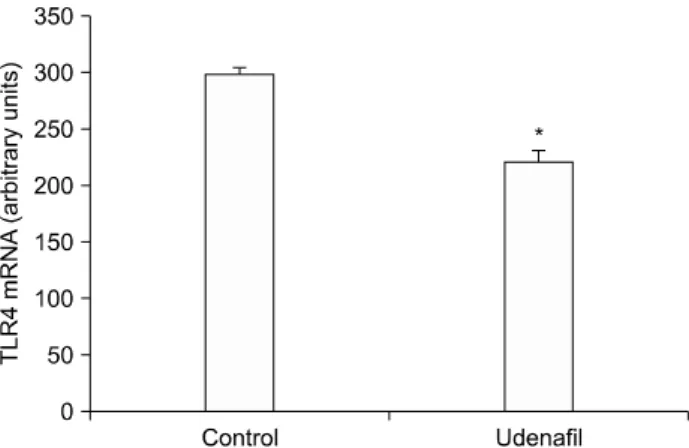
To determine whether udenafil suppressed the ex- pression of TLR4 mRNA in the hypothalamus directly, we injected it into the lateral ventricle of rats. Udenafil sig- nificantly reduced the expression of hypothalamic TLR4 mRNA (p<0.05) (Fig. 1).
Oral treatment with udenafil for 2 days also suppressed the level of hypothalamic TLR4 mRNA in mice in a dose-dependent manner. This was accompanied by the suppression of PDE5, Myd88, and NF-κB mRNA in the hypothalamus (Fig. 2). PDE5 is the target molecule of ude- nafil, and Myd88 and NF-κB are signaling molecules for
Fig. 1. The effect of udenafil on toll-like receptor 4 (TLR4) mRNA expression in the hypothalamus. Udenafil (500 μg) was dissolved in 10 μL saline. Udenafil or an equal volume of saline were injected into the lateral ventricle in rats. Data are expressed as mean±standard error of 3 experimental rats. *p<0.05 vs.
control.
Fig. 2. The effects of different dosages (0, 12, 120, 600 μg) of udenafil on the expression of toll-like receptor 4 (TLR4) (A), phosphodiesterase 5 (PD5E) (B), myeloid differentiation primary response gene 88 (Myd88) (C), and nuclear factor-κB (NF-κB) (D) mRNA in the hypothalamus in mice. Udenafil was administered via gavage for 2 consecutive days. Data are expressed as mean±standard error of 6 mice in each experimental group. Values that do not share a common superscript letters are significantly different at p<0.05.
TLR4 activation.
Obesity was induced by 8 weeks of HF feeding com- pared to control diet mice. The characteristics of HF-fed mice were increased body weight and visceral fat mass, and elevated plasma concentrations of leptin and total cholesterol compared to control diet mice (p<0.05) (Table 1).
Nine days’ treatment with udenafil reduced body weight (p<0.01), visceral fat mass (p<0.05), cumulative caloric intake (p<0.01), and plasma leptin concentration (p<0.05) in HF-fed mice compared with vehicle-treated mice. Udenafil did not induce any statistically significant changes in body weight, visceral fat mass, or caloric intake in mice fed the control diet. Leptin treatment decreased
www.wjmh.org
cumulative caloric intake (p<0.05) and visceral fat mass (p<0.05) in mice fed the control diet; however, there were no specific effects in HF-fed mice. Combined treat- ment with udenafil and leptin decreased body weight, vis- ceral fat mass, and caloric intake in both control diet and HF-fed mice compared to vehicle-treated mice. More- over, the combined treatment suppressed the plasma con- centrations of leptin (p<0.01), glucose (p<0.05), and to- tal cholesterol (p<0.05) in HF-fed mice. However, the combined effects of leptin and udenafil were additive, rather than synergistic (Table 1).
After 9-day treatment with vehicle, udenafil, and/or lep- tin, the hypothalamus was excised and the expression of TLR4, POMC, and NPY mRNA was analyzed. Hypothalamic TLR4 mRNA expression appeared to be elevated in HF-fed mice compared with mice fed the control diet; however, there were no significant differences among the ex- perimental groups because of the relatively large standard error found in the results. Although hypothalamic POMC mRNA levels showed a tendency to decrease in HF-fed mice, this difference was also not significant. Hypothalamic NPY mRNA expression was elevated in HF-diet mice com- pared with mice fed the control diet. This elevation was suppressed by udenafil and leptin treatment in both control diet- and HF-fed mice (Fig. 3).
DISCUSSION
In the present study, we demonstrated that udenafil dose-dependently suppressed TLR4 mRNA expression in the hypothalamus and that the 9-day treatment of udenafil reduced body weight and visceral fat in HF-fed mice.
Hypothalamic inflammation is an important causative factor in the induction of obesity [2], and the reversal of hy- pothalamic inflammation restores body weight homeo- stasis [4]. During hypothalamic inflammation, TLR4 per- forms a critical role in initiating the inflammatory response [21]. Thus, we hypothesized that suppression of TLR4 would reduce body weight in obese conditions. In the pres- ent study, HF-fed mice showed elevated TLR4 mRNA ex- pression in the hypothalamus, which was consistent with previous findings [3,12]. When saturated fatty acids or bac- terial lipopolysaccharides bind to TLR4, intracellular sig- naling through Myd88 and NF-κB results in the secretion Table 1.Changes in physical and biochemical parameters following treatment of mice with udenafil and/or leptin for 9 days Control dietHigh-fat diet Udenafil––++––++ Leptin–+–+–+–+ Body weight (g) Initial32.4±1.1732.4±0.8632.4±0.8432.4±0.6236.9±0.98*36.9±1.0136.9±0.8336.9±0.80 Final31.4±1.1329.8±0.6530.0±0.7829.3±0.8236.1±0.8335.4±1.0133.1±0.9232.6±0.54 Difference1.1±0.30a 2.6±1.22a,b 2.4±0.44a,b 3.1±0.86b 0.9±0.26a 1.5±0.27a 3.8±0.41b 4.3±0.42b Cumulative caloric intake for 9 days (kcal)90.0±5.49a 70.6±1.95b 87.0±1.00a 77.3±3.29b 103.1±0.55a, *96.6±0.69a 82.5±2.48b 80.0±3.45b Visceral fat (g) 2.0±0.14a 1.6±0.04b 1.7±0.13a,b 1.5±0.10b 2.8±0.08a, *2.7±0.13a 2.4±0.14b 2.4±0.08b Plasma biochemical Leptin (ng/mL)10.4±3.225.9±1.717.7±1.964.2±1.5820.5±2.24a, *20.2±2.21a 13.0±1.69b 12.6±0.91b Glucose (mg/dL)282±21.8251±21.3266±16.7252±12.7318±22.9a 320±18.2a 279±13.3a,b 264±14.4b T-cholesterol (mg/dL)164±10.1158±3.1163±8.1148±5.9205±6.21a, *199±6.7a 191±6.3a 180±7.9b Values are expressed as mean±standard error of 7 mice per group. *p<0.05 vs. vehicle treated control mice.a,b There were no significant differences between the same characteristics at p<0.05 within control or high-fat-fed mice.
Fig. 3. Hypothalamic mRNA levels of toll-like receptor 4 (TLR4) (A), pro-opiomelanocortin (POMC) (B), and neuropeptide Y (NPY) (C) after treatment with udenafil and/or leptin for 9 days. The mRNA levels were analyzed using real-time polymerase chain reaction. A-: AIN-93G diet, H-:
high-fat diet with 60% of the calories from fat, CON: control, LEP: leptin, UDE: udenafil. Data are expressed as mean±
standard error of 7 mice in each experimental group. *p<
0.05, vs. A-control. Values that do not share a common superscript letters are significantly different at p<0.05 in the control- or high-fat-fed mice.
of several pro-inflammatory cytokines [7,8,21]. We dem- onstrated that oral treatment with udenafil suppressed the hypothalamic expression of TLR4, which was accom- panied by the suppression of Myd88 and NF-κB ex- pression in a dose-dependent manner in mice.
It is well-known that obesity is frequently associated with erectile dysfunction. Anti-impotence drugs dilate penile blood vessels through elevation of the vasodilator, NO, via PDE5 inhibition [22]. Recently, it was reported that PDE5 inhibitors exerted anti-inflammatory effects [23]. Moreover, Varma et al [24] reported that chronic ad- ministration of tadalafil, a PDE5 inhibitor, improved meta- bolic parameters, such as fasting blood glucose and trigly- ceride levels, and reduced body weight; however, these changes were not statistically significant. No previous studies have evaluated how PDE5 inhibition was linked to
the suppression of TLR4 or Myd88. The results of our cur- rent study confirmed the udenafil-induced suppression of TLR4, which was consistent with the results obtained by Park et al [13].
In the present study, we demonstrated that udenafil treatment for 9 days reduced body weight, visceral fat mass, and appetite in HF-fed mice, which was associated with a reduction in plasma leptin concentration. However, udenafil did not change body weight, caloric intake, or visceral fat mass significantly in mice fed the control diet.
The present results are consistent with those obtained by Ayala et al [25], who showed that treatment with sildenafil for 12 weeks reduced the body weight of HF-fed mice by preventing diet-induced energy imbalance and insulin resistance. Taken together, the weight loss effect of udena- fil in HF-fed mice seems to result from normalization of
www.wjmh.org
pathologic derangements induced by HF-feeding, as ude- nafil did not change body weight significantly in con- trol-diet mice.
Treatment with 20 mg/kg/d udenafil for 4 weeks did not cause any specific toxicity to rats [19]. Our study used ude- nafil at approximately 13 mg/kg/d and also did not reveal any specific side effects of the chronic treatment. In a hu- man study, Moon et al [17] administered 75 mg/kg/d of udenafil for 24 weeks and demonstrated an improvement in erectile function. Although the rate of adverse drug re- actions was 17.9% in those patients, the reactions were mild and the patients recovered without additional treatment. Recent clinical trials have reported that daily treatment with PDE5 inhibitors allows a more sponta- neous sexual life, shows excellent efficacy and safety, and requires a lower dosage than on-demand administration [26,27]. Thus, the body weight reduction caused by ude- nafil in obese conditions demonstrated in the present study would be helpful for improving erectile dysfunction in obese men receiving the drug chronically.
Many mechanistic studies on the role of TLR4 in the in- duction of obesity have involved experiments in gene- modified animals, in which the chemical compounds were required to affect TLR4 mRNA expression. We demon- strated hypothalamic udenafil-induced TLR4 suppression and observed an anti-obesity effect of udenafil in HF-fed obese mice. We expected that the combination of udenafil and leptin would exert a synergistic effect on body weight changes in HF-fed mice by improving leptin resistance;
however, we only observed an additive effect.
In the hypothalamus, appetite is regulated mainly by a balance between the activities of orexigenic NPY-produc- ing neurons and anorexigenic POMC-producing neurons [28]. Activation of POMC neurons by leptin suppresses ap- petite, whereas stimulation of NPY neurons increases food intake [29]. In the present study, HF-fed mice exhibited a relative suppression of POMC and elevation of NPY com- pared with mice fed the control diet, which was consistent with our previous study [18]. Interestingly, treatment with udenafil did not affect POMC mRNA expression, whereas udenafil suppressed NPY mRNA expression markedly in HF-fed mice. These effects may be associated with the sup- pression of caloric intake in HF-fed mice treated with ude- nafil, or the combined treatment of udenafil and leptin
(Fig. 3). Although there are no specific reports supporting the transport of udenafil through the blood-brain barrier directly, Shim et al [30] suggested that this may occur.
Their research demonstrated that daily treatment with udenafil appeared to improve cognition, depression and erectile function in patients with erectile dysfunction.
One limitation of this study was the absence of clarity around the mechanisms of the suppressive effect of udena- fil on TLR4. Specifically, whether the inhibition occurred directly or secondarily via the inhibition of PDE5 is not known. Further studies are necessary to elucidate the mechanism of action of udenafil in the hypothalamus.
Another limitation is that the factors that would affect the differences have not been controlled for statistically.
CONCLUSIONS
The results of this study showed that udenafil sup- pressed TLR4 mRNA expression in the hypothalamus dose-dependently, and this was accompanied by the sup- pression of Myd88 and NF-κB expression. Nine-day treatment with udenafil reduced body weight and appetite in HF-fed mice, which was associated with the sup- pression of hypothalamic TLR4 and NPY levels. However, the effect of the combination of udenafil and leptin was ad- ditive rather than synergistic.
Disclosure
The authors have no potential conflicts of interest to disclose.
Author Contribution
Study design: Ryu SY, Choi YJ, Park SY, Kim YW. Data collection and analysis: Ryu SY, Choi YJ, Kim YD, Kim YW. Writing: Park SY, Kim YW. Review and revision of the manuscript: Kim JY, Kim YD, Park SY, Kim YW. Manuscript approval: all authors.
ORCID
Seong Yul Ryu, https://orcid.org/0000-0002-6023-8550 Yoon-Jung Choi, https://orcid.org/0000-0003-0737-5131 So-Young Park, https://orcid.org/0000-0002-6018-0440 Jong-Yeon Kim, https://orcid.org/0000-0002-1481-7615 Yong-Dae Kim, https://orcid.org/0000-0003-0501-966X Yong-Woon Kim, https://orcid.org/0000-0003-2868-9690
REFERENCES
1. Mozumdar A, Liguori G. Persistent increase of prevalence of metabolic syndrome among U.S. adults: NHANES III to NHANES 1999-2006. Diabetes Care 2011;34:216-9.
2. Wisse BE, Schwartz MW. Does hypothalamic inflammation cause obesity? Cell Metab 2009;10:241-2.
3. Milanski M, Degasperi G, Coope A, Morari J, Denis R, Cintra DE, et al. Saturated fatty acids produce an in- flammatory response predominantly through the activation of TLR4 signaling in hypothalamus: implications for the pathogenesis of obesity. J Neurosci 2009;29:359-70.
4. De Souza CT, Araujo EP, Bordin S, Ashimine R, Zollner RL, Boschero AC, et al. Consumption of a fat-rich diet activates a proinflammatory response and induces insulin resistance in the hypothalamus. Endocrinology 2005;146:4192-9.
5. Medzhitov R, Janeway C Jr. The Toll receptor family and microbial recognition. Trends Microbiol 2000;8:452-6.
6. Aderem A. Role of Toll-like receptors in inflammatory re- sponse in macrophages. Crit Care Med 2001;29:S16-8.
7. Poulain-Godefroy O, Le Bacquer O, Plancq P, Lecoeur C, Pattou F, Frühbeck G, et al. Inflammatory role of Toll-like receptors in human and murine adipose tissue. Mediators Inflamm 2010. doi: 10.1155/2010/823486.
8. Scholtes VP, Versteeg D, de Vries JP, Hoefer IE, Schoneveld AH, Stella PR, et al. Toll-like receptor 2 and 4 stimulation elicits an enhanced inflammatory response in human obese patients with atherosclerosis. Clin Sci (Lond) 2011;121:
205-14.
9. Shi H, Kokoeva MV, Inouye K, Tzameli I, Yin H, Flier JS.
TLR4 links innate immunity and fatty acid-induced insulin resistance. J Clin Invest 2006;116:3015-25.
10. Milanski M, Arruda AP, Coope A, Ignacio-Souza LM, Nunez CE, Roman EA, et al. Inhibition of hypothalamic in- flammation reverses diet-induced insulin resistance in the liver. Diabetes 2012;61:1455-62.
11. Siriwardhana N, Kalupahana NS, Fletcher S, Xin W, Claycombe KJ, Quignard-Boulange A, et al. n-3 and n-6 pol- yunsaturated fatty acids differentially regulate adipose an- giotensinogen and other inflammatory adipokines in part via NF-κB-dependent mechanisms. J Nutr Biochem 2012;23:
1661-7.
12. Liu HQ, Qiu Y, Mu Y, Zhang XJ, Liu L, Hou XH, et al. A high ratio of dietary n-3/n-6 polyunsaturated fatty acids im- proves obesity-linked inflammation and insulin resistance through suppressing activation of TLR4 in SD rats. Nutr Res 2013;33:849-58.
13. Park NK, Choi YS, Lee JH, Kim HS, Kim JK, Ahn JH, et al.
Effect of udenafil on MUC5B expression in human airway epithelial cells. Korean J Otorhinolaryngol-Head Neck Surg 2013;56:501-5.
14. Bacon CG, Mittleman MA, Kawachi I, Giovannucci E, Glasser DB, Rimm EB. A prospective study of risk factors for erectile dysfunction. J Urol 2006;176:217-21.
15. Yu JY, Kang KK, Yoo M. Erectile potentials of a new phos- phodiesterase type 5 inhibitor, DA-8159, in diet-induced obese rats. Asian J Androl 2006;8:325-9.
16. Aleid M, Muneer A, Renshaw S, George J, Jenkinson AD, Adamo M, et al. Early effect of bariatric surgery on urogen- ital function in morbidly obese men. J Sex Med 2017;14:
205-14.
17. Moon KH, Ko YH, Kim SW, Moon du G, Kim JJ, Park NC, et al. Efficacy of once-daily administration of udenafil for 24 weeks on erectile dysfunction: results from a randomized multicenter placebo-controlled clinical trial. J Sex Med 2015;12:1194-201.
18. Kim YW, Kim JY, Park YH, Park SY, Won KC, Choi KH, et al. Metformin restores leptin sensitivity in high-fat-fed obese rats with leptin resistance. Diabetes 2006;55:716-24.
19. Shim HJ, Kim YC, Jang JM, Park KJ, Kim DH, Kang KK, et al.
Subacute toxicities and toxicokinetics of DA-8159, a new phosphodiesterase type V inhibitor, after single and 4-week repeated oral administration in rats. Biopharm Drug Dispos 2003;24:409-18.
20. Kim DS, Cha HN, Jo HJ, Song IH, Baek SH, Dan JM, et al.
TLR2 deficiency attenuates skeletal muscle atrophy in mice.
Biochem Biophys Res Commun 2015;459:534-40.
21. Rocha DM, Caldas AP, Oliveira LL, Bressan J, Hermsdorff HH. Saturated fatty acids trigger TLR4-mediated inflamma- tory response. Atherosclerosis 2016;244:211-5.
22. Sharma R. Novel phosphodiesterase-5 inhibitors: current in- dications and future directions. Indian J Med Sci 2007;61:
667-79.
23. Handa P, Tateya S, Rizzo NO, Cheng AM, Morgan- Stevenson V, Han CY, et al. Reduced vascular nitric ox- ide-cGMP signaling contributes to adipose tissue inflam- mation during high-fat feeding. Arterioscler Thromb Vasc Biol 2011;31:2827-35.
24. Varma A, Das A, Hoke NN, Durrant DE, Salloum FN, Kukreja RC. Anti-inflammatory and cardioprotective effects of tadalafil in diabetic mice. PLoS One 2012;7:e45243.
25. Ayala JE, Bracy DP, Julien BM, Rottman JN, Fueger PT, Wasserman DH. Chronic treatment with sildenafil improves energy balance and insulin action in high fat-fed conscious mice. Diabetes 2007;56:1025-33.
26. Kim ED, Seftel AD, Goldfischer ER, Ni X, Burns PR. A return to normal erectile function with tadalafil once daily after an incomplete response to as-needed PDE5 inhibitor therapy. J Sex Med 2014;11:820-30.
27. Burns PR, Rosen RC, Dunn M, Baygani SK, Perelman MA.
Treatment satisfaction of men and partners following switch from on-demand phosphodiesterase type 5 inhibitor therapy to tadalafil 5 mg once daily. J Sex Med 2015;12:720-7.
28. Schwartz MW, Woods SC, Porte D Jr, Seeley RJ, Baskin DG.
Central nervous system control of food intake. Nature 2000;
404:661-71.
29. Harrold JA. Hypothalamic control of energy balance. Curr Drug Targets 2004;5:207-19.
30. Shim YS, Pae CU, Cho KJ, Kim SW, Kim JC, Koh JS. Effects
www.wjmh.org of daily low-dose treatment with phosphodiesterase type 5
inhibitor on cognition, depression, somatization and erectile function in patients with erectile dysfunction: a double-
blind, placebo-controlled study. Int J Impot Res 2014;26:
76-80.