Review Article
Received: Jun 18, 2016; Revised: Jul 18, 2016; Accepted: Aug 8, 2016 Correspondence to: Tom F Lue
Department of Urology, Urology Faculty Practice, University of California San Francisco, 400 Parnassus Ave, Suite A610, San Francisco, CA 94131, USA.
Tel: +1-415-353-7369, Fax: +1-415-353-2480, E-mail: [email protected] Copyright © 2016 Korean Society for Sexual Medicine and Andrology
This is an Open Access article distributed under the terms of the Creative Commons Attribution Non-Commercial License (http://creativecommons.
org/licenses/by-nc/4.0) which permits unrestricted non-commercial use, distribution, and reproduction in any medium, provided the original work is properly cited.
The Current Status of Stem-Cell Therapy in Erectile Dysfunction:
A Review
Amanda B Reed-Maldonado, Tom F Lue
Department of Urology, University of California San Francisco, CA, USA
Stem cells are undifferentiated cells that are capable of renewal and repair of tissue due to their capacity for division and differentiation. The purpose of this review is to describe recent advances in the use of stem cell (SC) therapy for male erectile dysfunction (ED). We performed a MEDLINE database search of all relevant articles regarding the use of SCs for ED. We present a concise summary of the scientific principles behind the usage of SC for ED. We discuss the different types of SCs, delivery methods, current pre-clinical literature, and published clinical trials. Four clinical trials employing SC for ED have been publi- shed. These articles are summarized in this review. All four report improvements in ED after SC therapy. SC therapy remains under investigation for the treatment of ED. It is reassuring that clinical trials thus far have reported positive effects on erectile function and few adverse events. Safety and methodical concerns about SC acquisition, preparation and delivery remain and require continued investigation prior to wide-spread application of these methods.
Key Words: Erectile dysfunction; Stem cells
INTRODUCTION
Erectile dysfunction (ED) is defined as the inability to at- tain or maintain a penile erection satisfactory for sexual in- tercourse [1]. ED is a prevalent health problem that seri- ously impacts the quality of life of men and their partners [2]. Ultimately, approximately 50% of men between the ages of 40 and 70 years have some degree of ED [3]. The majority of ED patients can now be treated satisfactorily with phosphodiesterase type-5 inhibitors (PDE5is), such as sildenafil, vardenafil, tadalafil, and avanafil [4]. However, PDE5is can cause a variety of side effects that make them
unsuitable for some patients, and they are contraindicated in patients who also take nitrates because of the danger of synergistic hypotensive effects [5]. Several other manage- ment options exist for ED, including lifestyle mod- ifications and pharmacotherapeutic strategies such as in- traurethral alprostadil, intracorporal injection therapy, vacuum erection devices, and surgery, including penile revascularization and penile prosthesis implantation. Despite the efficacy of these modalities, limitations to their use ex- ist, such as intolerance to side effects, cost limitations, and unsatisfactory outcomes [6]. With the exceptions of life- style modification and revascularization procedures, these
https://doi.org/10.5534/wjmh.2016.34.3.155
methods merely treat the manifestations of ED, offering symptomatic relief rather than a cure for the underlying disease process. The pressing need to develop a curative treatment for ED has stimulated interest in utilizing stem- cell therapy in ED patients [7].
RATIONALE FOR USING STEM-CELL THERAPY
The corpora cavernosa are composed of a lattice of si- nusoids lined by a single layer of endothelial cells (ECs) and are surrounded by multiple layers of circular and lon- gitudinal cavernous smooth muscle cells (CSMCs). In the flaccid state, CSMCs are contracted and maintain a small amount of blood flow into and out of the sinusoids. With stimulation, nitric oxide (NO) is released from terminal fi- bers of the cavernous nerves (CNs) and enters the CSMCs, elevating the level of cyclic guanosine monophosphate (cGMP) and resulting in CSMC relaxation, which allows blood to rush in and engorge the sinusoids. Maintenance of erection is thought to result from additional NO release from sinusoidal ECs. Further sinusoidal engorgement leads to compression of the venules between the trabecu- lae and the tunica albuginea, resulting in occlusion of ve- nous outflow and full erection [8]. Detumescence occurs when cGMP is degraded by type 5 phosphodiesterase, leading to contraction of the CSMCs with subsequently decreased inflow and a reduction in the size of the sinus- oidal spaces, allowing more venous outflow through the subtunical venules [9].
Mechanically, the key components of erection are the ECs, the CSMCs, and the neuronal NO synthase-positive nerves of the CN [10]. In various disease states, these com- ponents or interactions of these components are altered, leading to ED. After radical prostatectomy, the CN can be damaged [11]. The short-term consequence is neurogenic ED, which may be reversible. The long-term consequences include diminished NO production, atrophy of CSMCs, and CSMC apoptosis, leading to penile fibrosis and per- manent ED [12,13]. Radiation-based therapies are thought to cause ED via the same type of mechanism [14]. In dia- betes mellitus, high blood glucose can cause dysfunction and reduction in the CN, EC, and CSMC content [15,16].
In hyperlipidemia, cavernous NO levels are decreased,
and the subsequent impairment of CN and EC function is well documented [17], but whether or not structural changes take place is not as certain [16].
Stem cells are believed to be able to differentiate into various cell types, including ECs, smooth muscle cells (SMCs), Schwann cells, and neurons [18]. Consequently, the concept of employing stem-cell therapy for ED was ini- tially based on the hypothesis that transplantation of stem cells into the penis might replenish depleted EC or CSMC content [10]. An additional hypothesis was that trans- planted stem cells might encourage the regeneration of the host’s own ECs and ESMCs or might restore proper in- teractions between ECs and SMCs through a paracrine effect. Based on studies of ED and other conditions, this seems to be the main mechanism of stem cell action [19].
ROLE OF STEM CELLS IN THE TREATMENT OF ERECTILE DYSFUNCTION
Over the past few years, considerable excitement has developed about the potential use of stem cell-based therapies in medicine in general and in the specialty of ur- ology in particular. The treatment of ED has received a tre- mendous amount of publicity, as it is becoming an in- creasingly recognized global public health problem [20].
Nonetheless, stem-cell therapy has been in use since the 1990s in other fields for conditions such as acute and chronic graft-versus-host-disease to enhance engraftment in patients receiving allogeneic hematopoietic stem cell transplantation [21]. The anti-inflammatory, restorative, and immunomodulatory qualities of stem cells are cur- rently being exploited clinically to treat hematologic dis- eases [22-24]; malignancies [25]; cardiovascular disease [26]; neurologic diseases such as amyotrophic lateral scle- rosis [27-29], Parkinson disease [30], and stroke [31]; auto- immune diseases such as multiple sclerosis [31,32] and systemic lupus erythematosus [33]; as well as refractory wounds [34], spinal cord injuries [35], and cartilage de- fects [36]. It makes sense that the field of urology would al- so benefit from the utilization of this type of approach for acute and chronic urologic illnesses.
Many preclinical studies have explored the utility of stem cells, often referred to in studies as regenerative cells, for ED in animal models. A recent article by Soebadi et al
www.wjmh.org
[7] published in 2016 summarized all of these studies.
These authors described the many preclinical trials that have provided data on the utilization of both bone marrow stem cells and adipose-derived stem cells (ADSCs) for ED.
Human data on stem-cell therapy for ED are finally emerg- ing approximately 10 years after the first reports on animal models. So far, 4 clinical trials in patients with ED have been published, and these trials are summarized below.
Most authors have utilized an animal model simulating either an acute iatrogenic trauma to the neurovascular bundle, as in the result of radical prostatectomy, or a chronic disease state such as aging, diabetes mellitus, or hyperlipidemia. In acute ED models, the mechanism of ac- tion of stem cells is presumed to be by paracrine action [37-39]. In contrast, in chronic ED, the theoretical method of stem cell action is postulated to be both engraftment and cellular differentiation [7]. However, the exact mech- anism of action of stem cells in chronic ED remains un- certain [40].
CLASSIFICATION OF STEM CELLS
Stem cells are undifferentiated cells that are capable of self-renewal and differentiation [18]. Stem cells are classi- fied according to their potential for differentiation [6].
Their capacity for division, differentiation, and tissue re- generation is highly dependent on the surrounding envi- ronment, or niche [41]. The niche is a microenvironment that supports stem cells in their quiescent state and pro- motes stem cell self-renewal or tissue regeneration when tissue damage occurs [41]. Niche cells are classified as epi- thelial or stromal depending on their location and prox- imity to the stem cells. Niche properties, including prox- imity to the bloodstream, the presence of certain cytokines and growth factors, low oxygen tension, and other physi- ochemical properties allow optimal interaction among stem cells, their neighboring stromal or epithelial cells, and the extracellular matrix [41]. The stem cell niche is of- ten present in the perivascular space, allowing direct ac- cess to the bloodstream when damaged tissues need stem cells for regeneration.
Totipotent stem cells have the highest potential for dif- ferentiation and can differentiate into any tissue type origi- nating from the ectoderm, mesoderm, or endoderm [42].
The zygote and morula daughter cells are examples of toti- potent stem cells [43]. Pluripotent stem cells can differ- entiate into cells from the 3 different germ cell layers and gonadal ridge, but not into extraembryonic tissues.
Embryonic stem cells (ESCs), which are derived from the inner cell mass of the blastocyst, are an example of pluri- potent stem cells [44,45].
Multipotent stem cells, such as hematopoietic, mesen- chymal, and neural stem cells, are capable of self-renewal and can differentiate into organ-specific cell types; they are isolated from the developing germ layer or from devel- oped adult organs [42]. Unipotent stem cells can give rise to only one distinct cell type, such as epithelial cells; these cells have a limited capacity for self-renewal and labeling then as stem cells has been debated [46]. Ethical concerns regarding the use of ESCs have arisen due to the need to destroy embryos to isolate such cells. This has shifted in- terest to other cell types, such as adult stem cells, as an al- ternative stem cell source [47]. Induced pluripotent stem cells are cells that have been manipulated in the labo- ratory to express genes that are normally present in ESCs.
As such, these cells can differentiate into cells of all organs and tissues [6]. They can be generated from somatic cells by overexpression of ESC-specific transcription factors [48,49]. These cells share characteristics with ESCs, al- though the differences between them have not been fully elucidated [50].
TYPES OF STEM CELLS USED IN ERECTILE DYSFUNCTION
The use of pluripotent ESCs in ED research has been limited due to ethical concerns. Only the study of Bochinski et al [37] investigated the outcome of intra- cavernosal and major pelvic ganglion injection of neural ESCs in a rat model of neurogenic ED induced by cav- ernosal nerve injury. These authors demonstrated im- proved erectile function with significantly higher intra- cavernosal pressures than were found in the control group. Immunohistochemical staining also revealed dif- ferences in the quality of the nitric oxide synthase-contain- ing nerve fibers. Neurofilament staining was significantly better in the experimental groups injected with neural ESCs. No further studies utilizing ESCs have been published.
METHODS OF DELIVERY
Different routes have been suggested for the delivery of stem cells, and research continues to assess the most effec- tive route of instillation. Some studies have involved the direct injection of cells into the organ of concern [51-53].
Other studies have investigated intraperitoneal or intra- venous injections of stem cells [21]. Studies have shown that less than 1% of stem cells infused via the intravenous route actually reach the target tissue, and those that do reach the target tissue dissipate after a few days [54]. In spite of the low level of actual engraftment, stem cells ex- ert clinically relevant influence through paracrine effects, triggering endogenous mechanisms of regeneration, rath- er than transdifferentiation into different cell types [21].
Stem cells promote the propagation and differentiation of resident progenitor cells and encourage the recovery of in- jured tissue via the production of antiapoptotic and proan- giogenic factors [55-57]. A developing body of evidence also indicates that stem cells have immunomodulatory characteristics and immunoprivileged properties [58], and can modulate a wide range of target cells within the im- mune system [54].
In preclinical studies, the intravenous injection of ADSCs has been shown to lead to improvements in erec- tile function [59]. The intracorporal injection of stem cells for ED treatment has also been common in preclinical studies, as it is both straightforward and logical [6]. The re- generative effect of stem cells is achieved by either secret- ing growth factors locally via a paracrine mechanism or by migration to the major pelvic ganglia [60]. Direct injection into the major pelvic ganglia has not been methodically studied due to the inherent challenges involved in the in- jection process [37,61]. Periprostatic injection, with or without a concurrent intracorporal injection, has also been attempted [62-64]. Intraperitoneal infusion of stem cells was less efficacious than intracorporal injection in improving erectile function in a CN injury mouse model, though both groups did show improvement from baseline values [65,66].
PRECLINICAL TRIALS
Many preclinical trials have been performed to inves-
tigate the safety, efficacy, and mechanisms of stem-cell therapy for ED in animal models. A recent article by Soebadi et al [7] published in 2016 summarized these studies. As stated by those authors, these preclinical trials have provided ample data on the utilization of both bone marrow stem cells and ADSCs for ED. Almost all of the studies reported improved erectile function in various ani- mal models of CN injury, vascular insufficiency, diabetes mellitus, hyperlipidemia, and aging.
It is important to note that preclinical studies have also raised concerns about the effects of stem cells on the growth of malignancies. One paper described the effects of transplantation of ADSCs on grafted prostate tumors in athymic mice. The average size of the tumors in the treated mice was larger than in the control group, and ADSCs were identified inside of the tumors of ADSC-treated mice.
Capillary density was twice as high in the tumors of the ADSC-treated mice as in the control mice. The authors concluded that prostate cancer cells recruited ADSC via the CXCL12/CXCR4 axis and that ADSCs helped tumor growth by increasing tumor vascularity, which was medi- ated by fibroblast growth factor 2 [55]. Concerns about the possible promotion of malignant growth remain para- mount as studies exploring the utilization of stem cells for benign human diseases progress.
CLINICAL TRIALS
Human data on stem-cell therapy for ED are finally emerging approximately 10 years after the first reports on animal models. To date, 4 published human clinical trials have employed stem cells in patients with ED, and these trials are summarized below.
In 2010, Bahk et al [53] in Korea reported a single-blind study on the effect of intracavernosal injections of um- bilical cord stem cells in 7 men (mean age, 69.5 years;
range, 57∼87 years) with type 2 diabetes-related ED. The men had been diabetic for a mean of 29.4 years (range, 12∼
52 years) prior to the study and were already scheduled for penile prostheses. The authors injected 1.5×10⁷ human umbilical cord blood stem cells into the bilateral corpora cavernosa after placing a clamp at the base of the penis;
the clamp was removed after 30 minutes. The 3 men in the control group were injected with normal saline in a similar
www.wjmh.org
fashion. The authors assessed outcomes utilizing the inter- national index of erectile function-5 (IIEF-5), the Sexual Encounter Profile, Global Assessment Question, and an erection diary at 9 months, and the patients were followed for a total of 11 months. The controls reported no changes in erectile function after injection. In the experimental group, by 2 months after treatment, 6 of 7 patients re- ported the return of morning erections, which was main- tained for at least 3 months. Six patients reported in- creased penile hardness. With the addition of 100 mg of sildenafil, 2 patients were able to achieve erection ad- equate for coitus, and this effect was retained at the fifth month. By the ninth month, one of these patients reported the inability to penetrate even with the addition of the oral agent. Three of the 7 patients agreed that stem-cell therapy had some effect on ED, although it was insufficient. Five of the 7 patients regarded stem-cell therapy as effective for ED when combined with a PDE5i. The authors also re- ported improvements in blood glucose levels after treat- ment with stem cells, suggesting that the stem cells had a systemic effect in addition to a local effect. No serious ad- verse effects were reported.
In 2016, Yiou et al [51] from France reported the results of a 1-year, nonrandomized dose-escalation, phase I-II pi- lot trial of the intracavernous injection of bone marrow mononuclear cells in post-prostatectomy patients with vasculogenic ED. This study enrolled 12 men (aged 45∼
70 years old; mean age, 63.6 years) with penile arterial in- sufficiency and/or venous occlusive dysfunction at 6 months to 3 years after prostatectomy for localized pros- tate cancer, and administered 1 of 4 escalating doses of treatment (2×10⁷, 2×10⁸, 1×99, or 2×10⁹ stem cells).
The effects of treatment on erectile function and penile vascular parameters were assessed using the IIEF-15 and Erection Hardness Scale (EHS) questionnaires and by col- or duplex Doppler ultrasound. Endothelial function was assessed using the penile NO release test by measuring the percentage of post-occlusive changes in the cav- ernosal artery diameter. At 6 months, EHS and Doppler ul- trasound parameters had significantly improved in pa- tients receiving higher doses and were more pronounced in combination with pharmacotherapy; patients also re- ported significant improvement in the intercourse sat- isfaction and erectile function domains of the IIEF-15.
Significantly greater improvements in spontaneous erec- tions were reported with higher doses. Overall, 9 of 12 pa- tients reported successful intercourse with vaginal pene- tration when using medication. Clinical benefits were as- sociated with improvements in peak systolic velocity (at 6 months, this parameter improved to normal in 7 of the 11 patients) and percent penile NO release test (at 6 months, 8 of the 11 patients were in the normal range, versus 2 of 11 at baseline), and these benefits were sustained after 1 year. No serious adverse side effects were reported.
In 2016, Haahr et al [52] from Denmark reported on the safety and potential effect of a single intracavernous in- jection of autologous ADSCs in 17 men (aged 46∼69 years; median age, 63) with severe, refractory, post-prosta- tectomy ED resulting from surgery 5∼18 months prior to enrollment. This was a 6-month, prospective, open-label, phase I single-arm study. Erectile function was assessed by IIEF-5 scores. The men received between 8.4×10⁶ and 37.2×10⁶ ADSCs immediately after cell isolation from liposuction. Eight of the 17 men recovered erectile func- tion with the ability to accomplish sexual intercourse.
Their IIEF-5 scores continued to improve over the course of the 6-month study in continent participants. The EHS re- sults had significantly improved at 6 months, but no change was noted at 1 month and at 3 months. Of note, positive effects of treatment were absent in incontinent men, who reported IIEF-5 scores and EHS scores at 1, 3, and 6 months that did not significantly differ from those at the time of inclusion into the study. No serious adverse events were reported.
In 2016, Levy et al [67] reported on the feasibility and ef- ficacy of managing ED with placental matrix-derived stem cells. The authors injected 8 patients with placental ma- trix-derived stem cells and followed them for 6 months with Doppler parameters and the IIEF questionnaire. At 6 months, the peak systolic velocity was found to have im- proved to a statistically significant extent, from 25.5∼
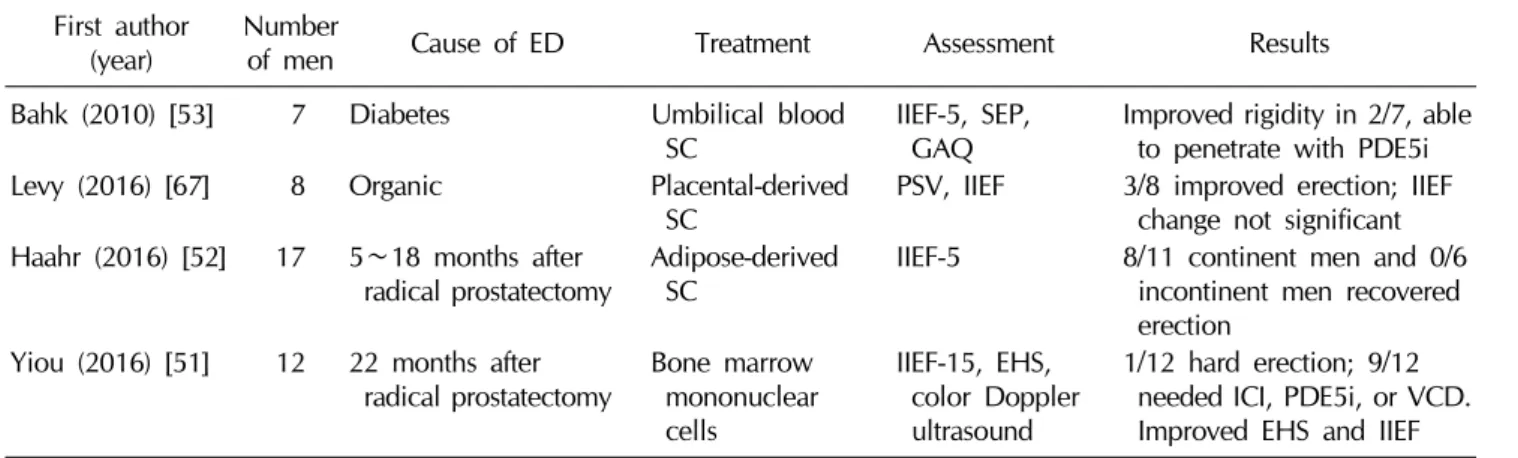
56.5 cm/s at 3 months to 50.7∼73.9 cm/s. Changes in end-diastolic velocity and IIEF scores were not statistically significant. At a 2-month follow-up, 2 patients were able to have erections using PDE5is. At a 3-month follow-up, 3 patients could attain erections with pharmacologic assis- tance from PDE5is, whereas previously they could not (Table 1).
Table 1. Summary of the 4 published clinical trials on stem-cell therapy for ED First author
(year) Number
of men Cause of ED Treatment Assessment Results
Bahk (2010) [53] 7 Diabetes Umbilical blood
SC IIEF-5, SEP,
GAQ Improved rigidity in 2/7, able to penetrate with PDE5i
Levy (2016) [67] 8 Organic Placental-derived
SC PSV, IIEF 3/8 improved erection; IIEF
change not significant Haahr (2016) [52] 17 5∼18 months after
radical prostatectomy Adipose-derived
SC IIEF-5 8/11 continent men and 0/6
incontinent men recovered erection
Yiou (2016) [51] 12 22 months after
radical prostatectomy Bone marrow mononuclear cells
IIEF-15, EHS, color Doppler ultrasound
1/12 hard erection; 9/12 needed ICI, PDE5i, or VCD.
Improved EHS and IIEF ED: erectile dysfunction, SC: stem cell, IIEF: international index of erectile function, SEP: Sexual Encounter Profile, GAQ:
Global Assessment Question, PSV: peak systolic velocity, EHS: erectile hardness score, PDE5i: phosphodiesterase type 5 inhibitor, ICI: intracavernous injection, VCD: vacuum constriction device.
A review by Casiraghi et al [21] included data from trials across a wide range of specialties, including hematology, oncology, cardiology, neurology, and orthopedics, among others. The safety data from clinical trials incorporating more than 700 patients receiving autologous or third-party bone marrow or adipose-tissue derived mesenchymal stem/stromal cells does not suggest that serious adverse events are a clinically important issue [21].
IMMUNOCOMPATIBILITY
Autologous stem cell transplantation is the least im- munogenic type of stem cell transplantation. However, a surgical procedure is required for the harvest of ADSCs (liposuction) and bone marrow stem cells (bone marrow biopsy), and the procedure itself may impact the outcome of stem-cell treatment. More recent preclinical studies have increasingly utilized allogeneic and xenogeneic stem cells transplants as a substitute for autologous stem cells. Allogeneic and xenogeneic stem cells do not incite an immune response, as they do not possess T-cell co- stimulatory molecules [68].
FUTURE DIRECTIONS
Stem-cell therapy is rapidly developing into a viable treatment option for ED patients. With ample preclinical data, 4 published clinical trials, and multiple ongoing clin-
ical trials, it seems that both clinicians and patients are ea- ger to embrace this cutting-edge technology. Despite this overwhelming enthusiasm, several critical questions re- main to be answered before the widespread application of these complex techniques. First and foremost, the mode of action still needs to be determined and the safety of the treatment established. Next, the most efficacious delivery method has yet to be ascertained, although intracorporal injection seems to be the route of choice based on the clin- ical trials that have so far been published [69,70].
Additionally, the ideal timing, type, and dosage of stem cell for treatment still needs to be established, incorporat- ing such considerations as type (adipose-derived, bone marrow, adipose-derived stromal vascular fraction, etc.), source (allogeneic versus autologous), ease of isolation and culture, risk, efficacy, and cost. Finally, long-term sur- veillance studies are needed to determine the possible ad- verse effects of stem cell treatment on cell growth and to determine the consequences of the secretome on coex- istent subclinical conditions.
ON THE HORIZON
As scientists and clinicians, we must always continue to contemplate the next step in treatment for our patients. On the horizon for the treatment of ED is low-intensity pulsed ultrasound (LIPUS), a non-invasive method of upregulat- ing endogenous mesenchymal stem cells [71]. Studies
www.wjmh.org
have shown that LIPUS stimulates cell proliferation through activation of integrin receptors and the Rho/
ROCK/Src/ERK signaling pathway [72], and by promoting the multilineage differentiation of mesenchymal stem/pro- genitor cell lines through the ROCK-Cot/Tpl2-MEK-ERK signaling pathway [73]. Additionally, low-energy shock wave therapy (LESWT)-induced endogenous progenitor cell recruitment and Schwann cell activation was asso- ciated with angiogenesis, tissue regeneration, and nerve generation in a rat model of pelvic neurovascular injury [74].
In human cardiovascular patients, LIPUS has demon- strated an angiogenesis-promoting effect believed to in- volve upregulation of vascular endothelial growth factor.
Additionally, LESWT has been shown to markedly im- prove erectile function in patients with organic ED [75]
through downregulating receptors for advanced glycation end products [76] and the recruitment of endogenous mes- enchymal stem cells [77]. As an indication of the wide- spread enthusiasm it has received from urologists, LESWT has already been discussed in the first-line therapy section (Section 3.5.3; page 24) of the European Association of Urology Sexual Dysfunction Guidelines [78], but has not yet been recommended, as further studies to define the mechanism of action and the best treatment protocol have yet to be carried out.
By utilizing these non-invasive methods, if we are suc- cessful, we will be able to potentially mitigate or eliminate the safety and methodological concerns about stem cell acquisition, preparation, and delivery that were discussed above. As with stem-cell therapy, the underlying mecha- nisms of therapeutic ultrasound and the biological effects it has on the human body remain to be investigated, and well-designed rigorous studies are needed to further de- fine the mechanism of action, safety profile, and efficacy of treatment.
CONFLICT OF INTEREST
No potential conflict of interest relevant to this article was reported.
REFERENCES
1. NIH releases consensus statement on impotence. Am Fam Physician 1993;48:147-50.
2. Litwin MS, Nied RJ, Dhanani N. Health-related quality of life in men with erectile dysfunction. J Gen Intern Med 1998;13:159-66.
3. Feldman HA, Goldstein I, Hatzichristou DG, Krane RJ, McKinlay JB. Impotence and its medical and psychosocial correlates: results of the Massachusetts Male Aging Study. J Urol 1994;151:54-61.
4. Lue TF, Lee KL. Pharmacotherapy for erectile dysfunction.
Chin Med J (Engl) 2000;113:291-8.
5. Dorsey P, Keel C, Klavens M, Hellstrom WJ. Phosphodie- sterase type 5 (PDE5) inhibitors for the treatment of erectile dysfunction. Expert Opin Pharmacother 2010;11:1109-22.
6. Alwaal A, Hussein AA, Lin CS, Lue TF. Prospects of stem cell treatment in benign urological diseases. Korean J Urol 2015;56:257-65.
7. Soebadi MA, Moris L, Castiglione F, Weyne E, Albersen M.
Advances in stem cell research for the treatment of male sexual dysfunctions. Curr Opin Urol 2016;26:129-39.
8. Lue TF. Erectile dysfunction. N Engl J Med 2000;342:1802-13.
9. Prieto D. Physiological regulation of penile arteries and veins. Int J Impot Res 2008;20:17-29.
10. Lin CS, Xin ZC, Wang Z, Deng C, Huang YC, Lin G, et al.
Stem cell therapy for erectile dysfunction: a critical review.
Stem Cells Dev 2012;21:343-51.
11. Mulhall JP, Bella AJ, Briganti A, McCullough A, Brock G.
Erectile function rehabilitation in the radical prostatectomy patient. J Sex Med 2010;7:1687-98.
12. Iacono F, Giannella R, Somma P, Manno G, Fusco F, Mirone V. Histological alterations in cavernous tissue after radical prostatectomy. J Urol 2005;173:1673-6.
13. Fode M, Ohl DA, Ralph D, Sønksen J. Penile rehabilitation after radical prostatectomy: what the evidence really says.
BJU Int 2013;112:998-1008.
14. Carrier S, Hricak H, Lee SS, Baba K, Morgan DM, Nunes L, et al. Radiation-induced decrease in nitric oxide synthase-- containing nerves in the rat penis. Radiology 1995;195:
95-9.
15. Dashwood MR, Crump A, Shi-Wen X, Loesch A. Identificati- on of neuronal nitric oxide synthase (nNOS) in human pe- nis: a potential role of reduced neuronally-derived nitric ox- ide in erectile dysfunction. Curr Pharm Biotechnol 2011;12:
1316-21.
16. Gratzke C, Angulo J, Chitaley K, Dai YT, Kim NN, Paick JS, et al. Anatomy, physiology, and pathophysiology of erectile dysfunction. J Sex Med 2010;7:445-75.
17. Huang YC, Ning H, Shindel AW, Fandel TM, Lin G, Harraz AM, et al. The effect of intracavernous injection of adipose tissue-derived stem cells on hyperlipidemia-associated erec- tile dysfunction in a rat model. J Sex Med 2010;7:1391-400.
18. Lin CS, Xin ZC, Deng CH, Ning H, Lin G, Lue TF. Recent advances in andrology-related stem cell research. Asian J
Androl 2008;10:171-5.
19. Lin CS. Advances in stem cell therapy for the lower urinary tract. World J Stem Cells 2010;2:1-4.
20. Khera M, Albersen M, Mulhall JP. Mesenchymal stem cell therapy for the treatment of erectile dysfunction. J Sex Med 2015;12:1105-6.
21. Casiraghi F, Remuzzi G, Abbate M, Perico N. Multipotent mesenchymal stromal cell therapy and risk of malignancies.
Stem Cell Rev 2013;9:65-79.
22. Arima N, Nakamura F, Fukunaga A, Hirata H, Machida H, Kouno S, et al. Single intra-arterial injection of mesenchymal stromal cells for treatment of steroid-refractory acute graft- versus-host disease: a pilot study. Cytotherapy 2010;12:
265-8.
23. Le Blanc K, Frassoni F, Ball L, Locatelli F, Roelofs H, Lewis I, et al. Mesenchymal stem cells for treatment of steroid-re- sistant, severe, acute graft-versus-host disease: a phase II study. Lancet 2008;371:1579-86.
24. Ball LM, Bernardo ME, Roelofs H, van Tol MJ, Contoli B, Zwaginga JJ, et al. Multiple infusions of mesenchymal stro- mal cells induce sustained remission in children with ste- roid-refractory, grade III-IV acute graft-versus-host disease.
Br J Haematol 2013;163:501-9.
25. Koç ON, Gerson SL, Cooper BW, Dyhouse SM, Haynesworth SE, Caplan AI, et al. Rapid hematopoietic recovery after co- infusion of autologous-blood stem cells and culture-ex- panded marrow mesenchymal stem cells in advanced breast cancer patients receiving high-dose chemotherapy. J Clin Oncol 2000;18:307-16.
26. Chen S, Liu Z, Tian N, Zhang J, Yei F, Duan B, et al. Intra- coronary transplantation of autologous bone marrow mesen- chymal stem cells for ischemic cardiomyopathy due to iso- lated chronic occluded left anterior descending artery. J Invasive Cardiol 2006;18:552-6.
27. Mazzini L, Mareschi K, Ferrero I, Miglioretti M, Stecco A, Servo S, et al. Mesenchymal stromal cell transplantation in amyotrophic lateral sclerosis: a long-term safety study.
Cytotherapy 2012;14:56-60.
28. Mazzini L, Mareschi K, Ferrero I, Vassallo E, Oliveri G, Boccaletti R, et al. Autologous mesenchymal stem cells:
clinical applications in amyotrophic lateral sclerosis. Neurol Res 2006;28:523-6.
29. Mazzini L, Mareschi K, Ferrero I, Vassallo E, Oliveri G, Nasuelli N, et al. Stem cell treatment in Amyotrophic Lateral Sclerosis. J Neurol Sci 2008;265:78-83.
30. Venkataramana NK, Kumar SK, Balaraju S, Radhakrishnan RC, Bansal A, Dixit A, et al. Open-labeled study of unilat- eral autologous bone-marrow-derived mesenchymal stem cell transplantation in Parkinson's disease. Transl Res 2010;
155:62-70.
31. Bang OY, Lee JS, Lee PH, Lee G. Autologous mesenchymal stem cell transplantation in stroke patients. Ann Neurol 2005;57:874-82.
32. Lee JS, Hong JM, Moon GJ, Lee PH, Ahn YH, Bang OY. A long-term follow-up study of intravenous autologous mesen-
chymal stem cell transplantation in patients with ischemic stroke. Stem Cells 2010;28:1099-106.
33. Sun L, Akiyama K, Zhang H, Yamaza T, Hou Y, Zhao S, et al. Mesenchymal stem cell transplantation reverses multi- organ dysfunction in systemic lupus erythematosus mice and humans. Stem Cells 2009;27:1421-32.
34. Dash NR, Dash SN, Routray P, Mohapatra S, Mohapatra PC.
Targeting nonhealing ulcers of lower extremity in human through autologous bone marrow-derived mesenchymal stem cells. Rejuvenation Res 2009;12:359-66.
35. Pal R, Venkataramana NK, Bansal A, Balaraju S, Jan M, Chandra R, et al. Ex vivo-expanded autologous bone mar- row-derived mesenchymal stromal cells in human spinal cord injury/paraplegia: a pilot clinical study. Cytotherapy 2009;11:897-911.
36. Wakitani S, Okabe T, Horibe S, Mitsuoka T, Saito M, Koyama T, et al. Safety of autologous bone marrow-derived mesen- chymal stem cell transplantation for cartilage repair in 41 patients with 45 joints followed for up to 11 years and 5 months. J Tissue Eng Regen Med 2011;5:146-50.
37. Bochinski D, Lin GT, Nunes L, Carrion R, Rahman N, Lin CS, et al. The effect of neural embryonic stem cell therapy in a rat model of cavernosal nerve injury. BJU Int 2004;94:
904-9.
38. Kendirci M, Trost L, Bakondi B, Whitney MJ, Hellstrom WJ, Spees JL. Transplantation of nonhematopoietic adult bone marrow stem/progenitor cells isolated by p75 nerve growth factor receptor into the penis rescues erectile function in a rat model of cavernous nerve injury. J Urol 2010;184:
1560-6.
39. Zhang H, Yang R, Wang Z, Lin G, Lue TF, Lin CS. Adipose tissue-derived stem cells secrete CXCL5 cytokine with neu- rotrophic effects on cavernous nerve regeneration. J Sex Med 2011;8:437-46.
40. Albersen M, Lin CS, Lue T. Stem-cell therapy for erectile dysfunction. Arab J Urol 2013;11:237-44.
41. Kiefer JC. Primer and interviews: the dynamic stem cell niche. Dev Dyn 2011;240:737-43.
42. Becker C, Jakse G. Stem cells for regeneration of urological structures. Eur Urol 2007;51:1217-28.
43. Keller G. Embryonic stem cell differentiation: emergence of a new era in biology and medicine. Genes Dev 2005;19:
1129-55.
44. Evans MJ, Kaufman MH. Establishment in culture of pluri- potential cells from mouse embryos. Nature 1981;292:154-6.
45. Strong TD, Gebska MA, Champion HC, Burnett AL, Bivalacqua TJ. Stem and endothelial progenitor cells in erection biology. Int J Impot Res 2008;20:243-54.
46. Yamzon J, Perin L, Koh CJ. Current status of tissue engineer- ing in pediatric urology. Curr Opin Urol 2008;18:404-7.
47. Yamzon JL, Kokorowski P, Koh CJ. Stem cells and tissue en- gineering applications of the genitourinary tract. Pediatr Res 2008;63:472-7.
48. Yao L, Yu X, Hui N, Liu S. Application of iPS in assisted re- productive technology: sperm from somatic cells? Stem Cell
www.wjmh.org Rev 2011;7:714-21.
49. Takahashi K, Tanabe K, Ohnuki M, Narita M, Ichisaka T, Tomoda K, et al. Induction of pluripotent stem cells from adult human fibroblasts by defined factors. Cell 2007;131:
861-72.
50. Chin MH, Mason MJ, Xie W, Volinia S, Singer M, Peterson C, et al. Induced pluripotent stem cells and embryonic stem cells are distinguished by gene expression signatures. Cell Stem Cell 2009;5:111-23.
51. Yiou R, Hamidou L, Birebent B, Bitari D, Lecorvoisier P, Contremoulins I, et al. Safety of intracavernous bone mar- row-mononuclear cells for postradical prostatectomy erec- tile dysfunction: an open dose-escalation pilot study. Eur Urol 2016;69:988-91.
52. Haahr MK, Jensen CH, Toyserkani NM, Andersen DC, Damkier P, Sørensen JA, et al. Safety and potential effect of a single intracavernous injection of autologous adipose- de- rived regenerative cells in patients with erectile dysfunction following radical prostatectomy: an open-label phase I clin- ical trial. EBioMedicine 2016;5:204-10.
53. Bahk JY, Jung JH, Han H, Min SK, Lee YS. Treatment of dia- betic impotence with umbilical cord blood stem cell intra- cavernosal transplant: preliminary report of 7 cases. Exp Clin Transplant 2010;8:150-60.
54. Uccelli A, Moretta L, Pistoia V. Mesenchymal stem cells in health and disease. Nat Rev Immunol 2008;8:726-36.
55. Lin G, Yang R, Banie L, Wang G, Ning H, Li LC, et al.
Effects of transplantation of adipose tissue-derived stem cells on prostate tumor. Prostate 2010;70:1066-73.
56. Pittenger MF, Mackay AM, Beck SC, Jaiswal RK, Douglas R, Mosca JD, et al. Multilineage potential of adult human mes- enchymal stem cells. Science 1999;284:143-7.
57. Prockop DJ. “Stemness” does not explain the repair of many tissues by mesenchymal stem/multipotent stromal cells (MSCs). Clin Pharmacol Ther 2007;82:241-3.
58. Reddy BY, Xu DS, Hantash BM. Mesenchymal stem cells as immunomodulator therapies for immune-mediated systemic dermatoses. Stem Cells Dev 2012;21:352-62.
59. Qiu X, Villalta J, Ferretti L, Fandel TM, Albersen M, Lin G, et al. Effects of intravenous injection of adipose-derived stem cells in a rat model of radiation therapy-induced erec- tile dysfunction. J Sex Med 2012;9:1834-41.
60. Lin CS, Xin Z, Dai J, Huang YC, Lue TF. Stem-cell therapy for erectile dysfunction. Expert Opin Biol Ther 2013;13:
1585-97.
61. Kim SJ, Choi SW, Hur KJ, Park SH, Sung YC, Ha YS, et al.
Synergistic effect of mesenchymal stem cells infected with recombinant adenovirus expressing human BDNF on erec- tile function in a rat model of cavernous nerve injury.
Korean J Urol 2012;53:726-32.
62. Choi WY, Jeon HG, Chung Y, Lim JJ, Shin DH, Kim JM, et al. Isolation and characterization of novel, highly pro- liferative human CD34/CD73-double-positive testis-derived stem cells for cell therapy. Stem Cells Dev 2013;22:2158- 73.
63. You D, Jang MJ, Lee J, Jeong IG, Kim HS, Moon KH, et al.
Periprostatic implantation of human bone marrow-derived mesenchymal stem cells potentiates recovery of erectile function by intracavernosal injection in a rat model of cav- ernous nerve injury. Urology 2013;81:104-10.
64. You D, Jang MJ, Lee J, Suh N, Jeong IG, Sohn DW, et al.
Comparative analysis of periprostatic implantation and intra- cavernosal injection of human adipose tissue-derived stem cells for erectile function recovery in a rat model of cav- ernous nerve injury. Prostate 2013;73:278-86.
65. Ryu JK, Kim DH, Song KM, Ryu DS, Kim SN, Shin DH, et al. Intracavernous delivery of clonal mesenchymal stem cells rescues erectile function in the streptozotocin-induced diabetic mouse. Andrology 2016;4:172-84.
66. Ryu JK, Kim DH, Song KM, Yi T, Suh JK, Song SU. Intracav- ernous delivery of clonal mesenchymal stem cells restores erectile function in a mouse model of cavernous nerve injury. J Sex Med 2014;11:411-23.
67. Levy JA, Marchand M, Iorio L, Cassini W, Zahalsky MP.
Determining the feasibility of managing erectile dysfunc- tion in humans with placental-derived stem cells. J Am Osteopath Assoc 2016;116:e1-5.
68. Lin CS, Lin G, Lue TF. Allogeneic and xenogeneic trans- plantation of adipose-derived stem cells in immunocom- petent recipients without immunosuppressants. Stem Cells Dev 2012;21:2770-8.
69. Fandel TM, Albersen M, Lin G, Qiu X, Ning H, Banie L, et al. Recruitment of intracavernously injected adipose-derived stem cells to the major pelvic ganglion improves erectile function in a rat model of cavernous nerve injury. Eur Urol 2012;61:201-10.
70. Takayanagi A, Sasaki M, Kataoka-Sasaki Y, Kobayashi K, Matsuda Y, Oka S, et al. Intravenous preload of mesen- chymal stem cells rescues erectile function in a rat model of cavernous nerve injury. J Sex Med 2015;12:1713-21.
71. Xin Z, Lin G, Lei H, Lue TF, Guo Y. Clinical applications of low-intensity pulsed ultrasound and its potential role in urology. Transl Androl Urol 2016;5:255-66.
72. Zhou S, Schmelz A, Seufferlein T, Li Y, Zhao J, Bachem MG. Molecular mechanisms of low intensity pulsed ultra- sound in human skin fibroblasts. J Biol Chem 2004;279:
54463-9.
73. Kusuyama J, Bandow K, Shamoto M, Kakimoto K, Ohnishi T, Matsuguchi T. Low intensity pulsed ultrasound (LIPUS) influences the multilineage differentiation of mesenchymal stem and progenitor cell lines through ROCK-Cot/Tpl2-MEK- ERK signaling pathway. J Biol Chem 2014;289:10330-44.
74. Li H, Matheu MP, Sun F, Wang L, Sanford MT, Ning H, et al. Low-energy shock wave therapy ameliorates erectile dys- function in a pelvic neurovascular injuries rat model. J Sex Med 2016;13:22-32.
75. Vardi Y, Appel B, Jacob G, Massarwi O, Gruenwald I. Can low-intensity extracorporeal shockwave therapy improve erectile function? A 6-month follow-up pilot study in pa- tients with organic erectile dysfunction. Eur Urol 2010;58:
243-8.
76. Liu J, Zhou F, Li GY, Wang L, Li HX, Bai GY, et al.
Evaluation of the effect of different doses of low energy shock wave therapy on the erectile function of streptozoto- cin (STZ)-induced diabetic rats. Int J Mol Sci 2013;14:
10661-73.
77. Qiu X, Lin G, Xin Z, Ferretti L, Zhang H, Lue TF, et al.
Effects of low-energy shockwave therapy on the erectile function and tissue of a diabetic rat model. J Sex Med 2013;
10:738-46.
78. Hatzimouratidis K, Eardley I, Giuliano F, Hatzichristou D, Moncada I, Salonia A, et al. EAU guidelines on penile curvature. Eur Urol 2012;62:543-52.