Received: Sep 17, 2019 Revised: Oct 23, 2019 Accepted: Nov 15, 2019 Published online Dec 17, 2019 Correspondence to: Gianmartin Cito https://orcid.org/0000-0001-7526-4025
Department of Urology, Careggi Hospital, University of Florence, Largo Brambilla, 3, 50134 Florence, Italy.
Tel: +39-0557949203, Fax: +39-0557949046, E-mail: [email protected]
*These authors contributed equally to this study as co-first authors.
Copyright © 2021 Korean Society for Sexual Medicine and Andrology
Hepatitis B Surface Antigen Seropositive Men in Serodiscordant Couples: Effects on the Assisted Reproductive Outcomes
Gianmartin Cito1,* , Maria Elisabetta Coccia2,* , Rossella Fucci2 , Rita Picone2 , Andrea Cocci1 , Maurizio Sessa3 , Francesco Sessa1 , Francesca Rizzello2 , Elisabetta Micelli4 , Michele Trotta5 , Laura Badolato2 , Riccardo Campi1 , Luciana Criscuoli2 , Sergio Serni1 , Marco Carini1 , Alessandro Natali1
1Department of Urology, Careggi Hospital, University of Florence, 2Assisted Reproductive Technology Centre, Careggi Hospital, University of Florence, Florence, 3Campania Pharmacovigilance and Pharmacoepidemiology Regional Centre, Department of Experimental Medicine, University of Campania “L. Vanvitelli”, Naples, 4Department of Gynecology and Obstetrics, St. Claire Hospital, University of Pisa, Pisa,
5Department of Critical Care Medicine and Surgery, Infectious Disease Unit, Careggi Hospital, University of Florence, Florence, Italy
Purpose:
Purpose: To evaluate the influence of hepatitis B virus (HBV) infection in men of serodiscordant couples on the reproductive outcomes.
Materials and Methods:
Materials and Methods: A total of 134 infertile couples were included in this retrospective single-center cohort study. Sixty-six couples had hepatitis B surface antigen (HBsAg)-seropositive men and seronegative partners, while 68 couples were controls with both seronegative men and women. Overall, 134 fresh in-vitro fertilization (IVF)/intracytoplasmic sperm injection (ICSI) treatments were performed. As the main outcome measures, on the day of the fresh IVF/ICSI cycle, we assessed seminal pa- rameters Before and after sperm preparation techniques. Two-pronuclear (2PN) fertilization, 1-2-3PN fertilization, cleavage, miscarriage, pregnancy and live birth rates were collected.
Results:
Results: No significant differences were found between groups in terms of oocytes retrieved, oocytes injected and embryos obtained (p=0.64, p=0.97, and p=0.40, respectively). The 2PN fertilization rate (FR) was comparable among groups (p=0.51).
The 1-2-3PN FR was significantly lower in the HBsAg group than in the control group (66.6% vs. 69.7%, respectively). The clinical pregnancy per cycle, implantation, miscarriage and live birth rate were comparable between the HBsAg group and the control group. The median sperm concentration/ml and total sperm count, measured at baseline and after sperm prepara- tion, was comparable between groups (p>0.05). There was a trend toward significant lower progressive motility (35.0% vs.
55.0%; p<0.05) in the HBsAg group at baseline and after sperm preparation (p<0.05).
Conclusions:
Conclusions: HBV infected men have the same chance to became father, compared to seronegative patients.
Keywords:
Keywords: Anti-hepatitis B antigens; Hepatitis B virus; Infection; Intracytoplasmic sperm injections; In Vitro fertilization; Male infertility
This is an Open Access article distributed under the terms of the Creative Commons Attribution Non-Commercial License (http://creativecommons.org/licenses/by-nc/4.0) which permits unrestricted non-commercial use, distribution, and reproduction in any medium, provided the original work is properly cited.
pISSN: 2287-4208 / eISSN: 2287-4690 World J Mens Health 2021 Jan 39(1): 99-106 https://doi.org/10.5534/wjmh.190121
INTRODUCTION
Hepatitis B virus (HBV) is considered one of the most widespread blood-borne infections, interesting about two billion people in their life [1]. Usually, HBV disease, described as the evidence of serum hepatitis B surface antigen (HBsAg) [2], leads to hepatitis, cirrhosis and hepatocellular carcinoma [3]. Nevertheless, HBV has been detected in several organs, including kidney, parotid glands, ovaries [4] and testes [5], as well as in seminal fluid [6].
Since it has been demonstrated that HBV could raise chromosomal instability in spermatozoa [7], causing damage of sperm viability and normal morphology [8], the correlation between HBV infection and male fertil- ity should be considered a remarkable current issue. In this respect, a growing amount of HBV-infected men with a history of couple infertility resort to assisted reproductive technologies (ARTs), such as in-vitro fer- tilization (IVF)/intracytoplasmic sperm injection (ICSI) treatments. Moreover, the probability of viral trans- mission to the woman or fetus, clinical or embryologi- cal issues and cross-infection of other virus-free gam- etes or embryos raised concerns. In fact, HBV infection can result in vertical transmission to the newborn by inserting sperm and mixing into the genome of the embryo [9].
In this scenario, some studies stated that HBV mRNA was identified in the embryos of HBV-infected fathers, implying the transcription and replication of HBV genes [10,11]. Nevertheless, while previous au- thors showed significantly lower pregnancy rate (PR) in HBV discordant couples likened to age-matched controls [12], other ones detected higher pregnancy, live birth and implantation rates (IRs) in HBV group [13].
On these bases, a general consensus about the influ- ence of the disease on final reproductive findings in seropositive couples lacked.
Therefore, the purpose of the study is to evaluate the influence of HBV men infection on IVF/ICSI outcomes, in a cohort of consecutive serodiscordant couples (SDCs).
MATERIALS AND METHODS
1. Patients selection
From January 2011 to August 2018, a retrospective single-center cohort study of infertile couples refer- ring to our ARTs Centre, for the first ART treatment,
was carried out. Inclusion criteria were: 1) male age range between 18 and 45 years and female age range between 18 and 40 years; 2) HBV-SDCs, in which the men was HBsAg seropositive and the women seronega- tive. When the patients presented with positive HBsAg measured in the serum via enzyme immunoassay for at least 6 months were defined as chronic HBV carri- ers. Exclusion criteria were: 1) the presence of abnor- mal liver function or chronic hepatitis; 2) clinical pre- sentation of azoospermia or severe criptozoospermia; 3) cycles with donor’s semen or chromosomal aberrations;
4) couples who were seropositive for hepatitis immuno- deficiency virus (HIV) and/or hepatitis C virus (HCV).
Additional exclusion criteria were: 1) positive history of parotitis; 2) antiviral therapy during the study period.
2. Cause of couple infertility and laboratory assessment
The cause of couple infertility was categorized into 5 groups: 1) tubal factor; 2) endometriosis; 3) male factor;
4) unexplained; 5) mixed. Controls included both men and women who were negative for serum HBsAg, hep- atitis B surface antibody (HBsAb), hepatitis B e anti- gen, hepatitis B e antibody, and hepatitis B c antibody (HBcAb). Control couples were also matched for age, ART approach used (IVF or ICSI) and cause of infertil- ity.
Both partners were evaluated by an interdisciplin- ary specialized fertility team. On the second day of the cycle, all women underwent endocrinology assess- ment, comprising follicle stimulating hormone (FSH), luteinizing hormone, estradiol, anti-mullerian hormone, thyroid-stimulating hormone, prolactin. All men were examined for a complete physical and andrological vis- it. Baseline features, including male and female’s age, were collected. A dedicated infectious disease special- ist screened both male and female for HIV 1/2, HCV antibody, HbsAg, HbsAb, HBcAb, Treponema Palli- dum Hemagglutination and Veneral Disease Research Laboratories, Ab anti-Clamidya Trachomatis and Ab anticytomegalovirus.
All the men enrolled performed semen analysis, evaluated according to the 2010 World Health Organi- zation (WHO) recommendations. At the time of fresh IVF/ICSI treatment, we measured seminal charac- teristics, as follow: volume, pH, total sperm count/mL, total sperm concentration, viability, progressive motil- ity (PR), non-PR and normal morphology. After sperm
capacitation, we analysed total sperm count/mL and motility.
3. Sperm preparation techniques
Semen samples were obtained by masturbation after 2 to 7 days of sexual abstinence and collected into ster- ile plastic containers. After liquefaction in the incuba- tor set at 37°C for 30 minutes, ejaculates were analyzed and classified (WHO, 2010). Semen samples from HBV- infected men were processed under sterile conditions using the density gradient centrifugation method with 95%, 70% and 50% gradient layers (PureSperm®100;
Nidacon Mölndal, Sweden); heated in the incubator set at 37°C for 30 minutes. Removing the supernatant at each step before the pellet transfer helped to mini- mize any viral transmission. Subsequently, 1 mL of 95% gradient, 1 mL of 70% gradient, and 1 mL of 50%
gradient were gently overlaid in a tube: finally, 1 mL of the sperm was gently overlaid on the 50% gradient and centrifuged at 300×g for 20 minutes. The super- natant was carefully aspirated and discarded using a sterile Pasteur pipette for each tube. The pellet was moved into a new conical tube, re-suspended in 2.5 mL of sperm medium (Flushing; Origio, CooperSurgi- cal Fertility & Genomic Solutions, Måløv, Denmark) and centrifuged again at 250×g for 10 minutes. After centrifugation, the supernatant was discarded using a disposable sterile Pasteur pipette and was re-suspended in 1 mL of sperm medium (Fert; Origio, CooperSurgical Fertility & Genomic Solutions).
Sperm count and motility assessment were then per- formed on the washed pellet under sterile conditions.
This pellet was stored for later use in the ART proce- dure.
4. Ovarian stimulation protocol and assisted reproductive technology treatment
Treatment individualization is based on ovarian response prediction, based on the Anti-Müllerian hor- mone and antral follicle count. The initial prescrip- tion of recombinant FSH was 225 to 375 IU (Gonal- F; Merck, Geneve, Switzerland), depending on age and baseline blood FSH measure. Follicular growing was monitored and the FSH dosage was adjusted based on the follicular response. When follicles ≥14 appeared, gonadotropin-releasing hormone antagonist was used.
Follicular development was checked through frequent ultrasounds to choose the more appropriate phase
of oocytes recovery. When at least two follicles had developed a maximal diameter of 17 to 18 mm, an ad- ministration of 250 μg recombinant human chorionic gonadotropin (HCG; Ovitrelle; Merck) was subcutane- ously administered. Transvaginal oocyte recovery was performed approximately 36 hours later. All oocytes picked by HBV SDCs were accepted for IVF or ICSI treatment, according to seminal parameters. The in- cubation of injected oocytes was done in 20 µL drops.
All the zygotes were valued 16 to 18 hours by ICSI to confirm the presence of two distinct pronuclei (2PN).
Then, all the embryos were evaluated on days 2, 3, and 5 of the progress with an inverted microscope.
5. Assisted reproductive technologies outcome measures
IVF/ICSI results, as well as 2PN fertilization rate (FR), 1-2-3PN FR, and cleavage rate (CR) were re- corded. Total and normal oocyte FR was obtained by total number of fertilized oocytes (1-2-3 PN) and 2PN fertilized oocytes by the number of injected oocytes, respectively. The CR was considered by the number of embryos obtained by the number of 2PN fertilized oocytes. The luteal phase was maintained by a daily administration of 50 mg intramuscularly of natural progesterone (Prontogest; Amsa, Rome, Italy), since the day of oocytes retrieval. Embryo transfer was performed on day 3 to 5 after IVF/ICSI procedure, us- ing a Wallace catheter (©COOK Medical Incorporated, Bloomington, IN, USA). Supernumerary embryos are frozen, according to our laboratory policy. After 14 days, the HCG test was done. The IR was expressed as the number of gestational sacs per embryo transferred.
Clinical PR per cycle was calculated by cycles with HCG levels above 50 mU/L and confirmed by trans- vaginal ultrasounds revealing an intrauterine gesta- tional sac with a heartbeat at around 5 to 6 weeks of gestation. Pregnancy loss before 20 weeks of gestation and all biochemical pregnancies were contemplated as miscarriages. Live birth rate was defined as the per- centage of all cycles that lead to live births.
6. Ethical statement and statistical analysis
All procedural protocols were permitted by the Insti- tutional Review Board (IRB) of University of Florence, Careggi Hospital (IRB No. CS/1158/04.1). All couples provided written informed consent before the start of ART treatment.
Non-parametric continuous variables, count, and pro- portion distributions were compared between groups applying the non-parametric unpaired Wilcoxon rank- sum test with continuity correction or the Fisher exact test. The G*Power program was used to calculate the sample size needed for the abovementioned statistical tests. In particular, the asymptotic relative efficiency method was used to estimate the power for the Wilcox- on rank-sum test. Analyses based on an intention-to- treat approach and considered a statistically significant level of p<0.05 (2-sided). Data analysis was performed using R ver. 3.3.0 (R Development Core Team) and data management was performed using SAS statistical soft- ware ver. 9.4 (SAS Institute Inc., Cary, NC, USA).
RESULTS
This retrospective cohort study included 134 infertile
couples: 66 couples had HBsAg-seropositive men and 68 were controls. Overall, 134 fresh ART treatments were performed: 95 ICSI cycles and 39 IVF cycles. In the HBsAg group, 17 couples had IVF, while 49 had ICSI.
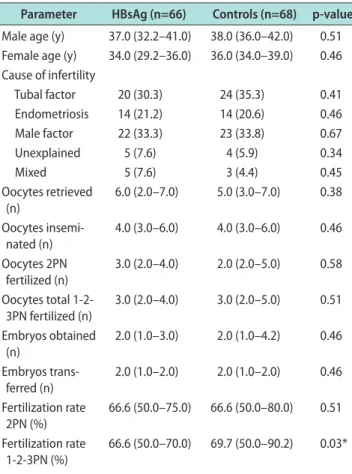
In the control group, 22 couples had IVF and 46 had ICSI. Demographic and laboratory data of the HBsAg- positive patients and controls are presented in Table 1.
Patients’ baseline characteristics did not significantly vary between the HBV-positive and HBV-negative groups. Overall, the cause of couple infertility was:
tubal factor (32.8%), endometriosis (20.9%), male factor (33.6%), unexplained (6.7%), mixed (6.0%). No significant differences were found between groups in terms of oo- cytes retrieved, oocytes injected and embryos obtained (p=0.64, p=0.97 and p=0.40, respectively). 2PN FR was comparable among groups (p=0.51). As shown in Fig. 1, total FR and CR were significantly lower in the HB- sAg group than in the control group (p=0.03; p<0.001, respectively). Women in the two groups were trans- ferred with similar number of embryos (median=2.0;
interquartile range=1.0–2.0). Pregnancy outcomes are depicted in Table 2. The clinical pregnancy per cycle, implantation, miscarriage and live birth rate were comparable between the HBsAg group and the control group. As shown in Fig. 2, the clinical PR was not sta- tistically different between groups after adjusting for confounding variables (odds ratio=1.28, 95% confidence interval=0.57–2.95, p=0.56).
The live births, summing singleton and twin preg- nancies, for couples with HBsAg-positive man and con- trols were respectively 16 and 19.
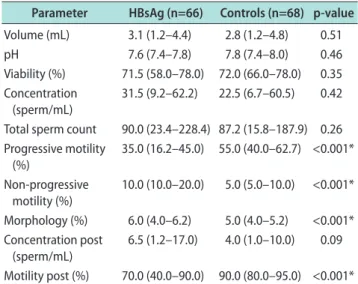
Seminal characteristics of the two groups at baseline and after sperm preparation techniques are summa- rized in Table 3. The median sperm concentration/ml and total sperm count, measured at baseline and after sperm preparation, was comparable between groups, suggesting that sperm production was not affected by the HBV infection (p>0.05). There was a trend toward significant lower PR (35.0% vs. 55.0%; p<0.05) in the HBsAg group at baseline. Equally, total motility re- mained significantly lower after sperm preparation in the HBsAg group (p<0.05).
DISCUSSION
Most of the available evidences evaluating the role of HBV infection on fertility derive from areas in which the virus is endemic [1].
Table 1. Demographic and laboratory data of HBsAg-positive pa- tients and controls
Parameter HBsAg (n=66) Controls (n=68) p-value Male age (y) 37.0 (32.2–41.0) 38.0 (36.0–42.0) 0.51 Female age (y) 34.0 (29.2–36.0) 36.0 (34.0–39.0) 0.46 Cause of infertility
Tubal factor 20 (30.3) 24 (35.3) 0.41 Endometriosis 14 (21.2) 14 (20.6) 0.46 Male factor 22 (33.3) 23 (33.8) 0.67
Unexplained 5 (7.6) 4 (5.9) 0.34
Mixed 5 (7.6) 3 (4.4) 0.45
Oocytes retrieved (n)
6.0 (2.0–7.0) 5.0 (3.0–7.0) 0.38 Oocytes insemi-
nated (n)
4.0 (3.0–6.0) 4.0 (3.0–6.0) 0.46 Oocytes 2PN
fertilized (n)
3.0 (2.0–4.0) 2.0 (2.0–5.0) 0.58 Oocytes total 1-2-
3PN fertilized (n)
3.0 (2.0–4.0) 3.0 (2.0–5.0) 0.51 Embryos obtained
(n)
2.0 (1.0–3.0) 2.0 (1.0–4.2) 0.46 Embryos trans-
ferred (n)
2.0 (1.0–2.0) 2.0 (1.0–2.0) 0.46 Fertilization rate
2PN (%) 66.6 (50.0–75.0) 66.6 (50.0–80.0) 0.51 Fertilization rate
1-2-3PN (%) 66.6 (50.0–70.0) 69.7 (50.0–90.2) 0.03*
Cleavage rate (%) 100.0 (52.5–100.0) 100.0 (100.0–100.0) <0.001*
Values are presented as median (interquartile range) or number (%).
HBsAg: hepatitis B surface antigen, PN: pronuclear.
*Statistical significance (p<0.05).
In our center, screening for HBV before the ART program is a relevant part of our enrolment schedule.
Consequently, there is no ethical motivation to refuse ART treatments in HBsAg seropositive men, albeit in zones little endemic for HBV disease.
The rationale of our research is the knowledge that HBV has the capacity of penetrating the blood-testis barrier and integrating into human sperm chromo- somes [2]. In this way, the virus could induce muta- genic effects, which could affect the embryological and clinical outcomes of pregnancy. In this scenario, the
influence of men HBV infection on fertility represents an important topic, since any anomalies from germ cells could affect assisted reproductive outcomes, like fertilization, implantation, and pregnancy. However, since very conflicting results exist in literature, this work aimed to clarify this issue as much as possible, to achieve a general consensus.
Previous clinical retrospective studies analyzed the implication of viral infection on the seminal param- eters, but none of them reached a common conclusion.
Some researchers detected that, when compared with the control group, HBV seropositive men had lower sperm motility and total sperm count, as well as poor morphology [14,15].
However, in our study sperm concentration/mL and total sperm count appear similar between groups, also after sperm preparation, suggesting that the viral in- fection not influence spermatogenesis. Equally, semen volume and normal sperm morphology of HBsAg group were comparable with controls, in line with other stud-
0.0 15
10
5
1.0
Frequency(n)
Fertilization rate 3PN (%) 0
0.2 0.4 0.6 0.8 0.0 15
10
5
1.0
Frequency(n)
Fertilization rate 3PN (%) 0
0.2 0.4 0.6 0.8 0.0
35
30
25
20
15
10
5
2.0
Frequency(n)
Cleavage (%) 0
0.5 1.0 1.5 0.0
50
40
30
20
10
1.0
Frequency(n)
Cleavage (%) 0
0.2 0.4 0.6 0.8
Cases Controls Cases Controls
0.0 50
40
30
20
10
1.0
Frequency(n)
Pregnancy (%) 0
0.2 0.4 0.6 0.8 0.0 40
30
20
10
1.0
Frequency(n)
Pregnancy (%) 0
0.2 0.4 0.6 0.8
Cases Controls
Fig. 1. Comparison of (1-2-3 pronuclear [PN]) fertilization, cleavage, and pregnancy rates among groups.
Table 2. Pregnancy outcomes
Variable HBsAg Controls p-value
Implantation rate 20/58 (34.5) 25/99 (25.3) 0.78 Pregnancy rate per cycle 17/66 (25.8) 21/68 (30.9) 0.56 Miscarriage rate per cycle 3/17 (17.6) 7/21 (33.3) 0.32 Live birth rate per cycle 14/66 (21.2) 13/68 (19.1) 0.83 Values are presented as number/total number (%).
ies that highlighted how sperm quality may not be compromised in HBV patients [16,17].
Nevertheless, according to previous studies, it was confirmed a significant trend toward reduced sperm motility in HBV infected men. Indeed, other authors showed that HBsAg decreased sperm motility, gen- erating the loss of sperm mitochondrial membrane potential [18]. On these bases, we can confirm previ- ous theories that HBV also could produce chromosome aberrations, leading to hereditary defects in germinal cells [7]. This result could be one reason for lower total fertilization and CRs in couples with men partners be- ing HBV-seropositive.
Of note, our primary outcome was to assess if the men viral infection could determine a real deteriora- tion of the assisted reproductive outcomes. In this con- text, few previous studies focused on couples with only men infected, but the results remain controversial.
Firstly, Zhao et al [19] demonstrated that couples with HBV husbands had similar FR, CR, and rate of good embryo quality compared with controls [20]. Subse-
quently, another study showed that HBV infected men had a higher risk of having a low FR during IVF, in- dicating that HBV had a deleterious effect on IVF out- comes [14]. Pirwany et al [12] observed lower implanta- tion and PRs in HBV-positive individuals, compared to a healthy control group. The researchers recognized the limitation of the small sample size and they supposed that the extra precautions and handling techniques of the potential infective samples in the HBV group might have caused lower PRs linked to the controls. In contrast, Lam et al [13] described higher implantation and PRs in the HBV-seropositive group compared to those in the HBV-negative group. A more recent larger sample-size study observed that fertilization, implanta- tion, and clinical PRs were significantly lower in HBV seropositive patients rather than seronegative [15].
Our results demonstrated that paternal HBV infec- tion was related to significantly lower rates of total fertilization and cleavage. Nevertheless, no significant differences were found in the rates of implantation, clinical pregnancy, miscarriage and live birth between the HBsAg and control groups.
Therefore, one possible reason for the similar rates of pregnancy between the two groups was that other female factors, such as the endometrial receptivity, might play a key role. In this context, to reduce all pos- sible confounding factors, we selected women with age
<40 years, according to literature suggesting that in patients >or =42 years old a decline in clinical pregnan- cies, live births, as well as an increase of spontaneous abortions was found [21].
But yet, only one study considered the reproductive outcomes using the oocyte donation model, to reduce all possible bias related to women. Indeed, Bu et al [17], stated that couples with HBV seropositive husbands had similar seminal parameters, rates of fertilization, cleavage, implantation, and pregnancy, compared to their controls, suggesting that the infection has little impact on IVF outcomes.
Furthermore, we included in the study only men un- der the age of 45 years, according to previous studies
0 Variable
Pregnancy Miscarriage Live_birth
OR 1.28 2.39 0.88
95% CI low 0.57 0.52 0.34
95% CI high 2.95 15.00 2.23
p-value 0.56 0.32 0.83
15 Estimation
1.28 2.39 0.88
[0.57, 2.95]
[0.52, 15.00]
[0.34, 2.23]
5 10
Fig. 2. Comparison of pregnancy, miscarriage and live birth rates among groups, after adjusting for confounding variables. OR: odds ratio, CI: con- fidence interval.
Table 3. Seminal characteristics at baseline and after sperm prepara- tion techniques
Parameter HBsAg (n=66) Controls (n=68) p-value Volume (mL) 3.1 (1.2–4.4) 2.8 (1.2–4.8) 0.51
pH 7.6 (7.4–7.8) 7.8 (7.4–8.0) 0.46
Viability (%) 71.5 (58.0–78.0) 72.0 (66.0–78.0) 0.35 Concentration
(sperm/mL) 31.5 (9.2–62.2) 22.5 (6.7–60.5) 0.42 Total sperm count 90.0 (23.4–228.4) 87.2 (15.8–187.9) 0.26 Progressive motility
(%)
35.0 (16.2–45.0) 55.0 (40.0–62.7) <0.001*
Non-progressive motility (%)
10.0 (10.0–20.0) 5.0 (5.0–10.0) <0.001*
Morphology (%) 6.0 (4.0–6.2) 5.0 (4.0–5.2) <0.001*
Concentration post
(sperm/mL) 6.5 (1.2–17.0) 4.0 (1.0–10.0) 0.09 Motility post (%) 70.0 (40.0–90.0) 90.0 (80.0–95.0) <0.001*
Values are presented as median (interquartile range).
HBsAg: hepatitis B surface antigen.
*Statistical significance (p<0.05).
suggesting that IVF outcomes decrease with advancing paternal age [22].
Nevertheless, our work had some strengths and limitations. First of all, the retrospective nature of the study represents an important limitation; secondly, although previous studies involved very small study cohorts, the sample size of our study population re- mains small and lacks of statistical power. Moreover, the variations in oocyte quality and other factors from women’s side were not well controlled, although pa- tients of the two groups are matched for age, cause of infertility, and controlled ovarian stimulation protocol.
Unfortunately, we were unable to consider only couples addressed to the ovum donation program, because of few patients discovered in our databank. Furthermore, prospective studies consisting of a large number of subjects are needed to get a clearer conclusion on this issue.
CONCLUSIONS
HBV infection proved to be able to affect fertiliza- tion and CRs in couples with HBsAg-positive men and negative women. However, clinical pregnancy out- comes, including implantation, pregnancy, miscarriage and live births rate were not influenced. In this setting, HBV infected men have the same chance to become father, compared to seronegative patients. Further pro- spective studies with larger sample size are needed to better understand the precise mechanisms of action of HBV infection on male fertility and reproductive out- comes.
Conflict of Interest
The authors have nothing to disclose.
Author Contribution
Conceptualization: GC, MEC, RF. Data curation: GC, RF, RP, AC. Formal analysis: RP, RF, MS, FS, FR, EM, MT, LB, RC.
Supervision: MEC, SS, MC, AN. Validation: SS, MC, AN, LC.
Visualization: SS, MC, AN. Writing – original draft: GC, MEC.
Writing – review & editing: AC, AN.
Data Sharing Statement
The data required to reproduce these findings cannot be
shared at this time due to technical and time limitations.
REFERENCES
1. Ocama P, Opio CK, Lee WM. Hepatitis B virus infection: cur- rent status. Am J Med 2005;118:1413.
2. Huang JM, Huang TH, Qiu HY, Fang XW, Zhuang TG, Qiu JW. Studies on the integration of hepatitis B virus DNA se- quence in human sperm chromosomes. Asian J Androl 2002;
4:209-12.
3. Shi L, Liu S, Zhao W, Zhou H, Ren W, Shi J. Hepatitis B virus infection reduces fertilization ability during in vitro fertiliza- tion and embryo transfer. J Med Virol 2014;86:1099-104.
4. Ye F, Yue Y, Li S, Chen T, Bai G, Liu M, et al. Presence of HBsAg, HBcAg, and HBVDNA in ovary and ovum of the patients with chronic hepatitis B virus infection. Am J Obstet Gynecol 2006;194:387-92.
5. Hadchouel M, Scotto J, Huret JL, Molinie C, Villa E, Degos F, et al. Presence of HBV DNA in spermatozoa: a possible vertical transmission of HBV via the germ line. J Med Virol 1985;16:61-6.
6. Qian WP, Tan YQ, Chen Y, Peng Y, Li Z, Lu GX, et al. Rapid quantification of semen hepatitis B virus DNA by real-time polymerase chain reaction. World J Gastroenterol 2005;11:
5385-9.
7. Huang JM, Huang TH, Qiu HY, Fang XW, Zhuang TG, Liu HX, et al. Effects of hepatitis B virus infection on human sperm chromosomes. World J Gastroenterol 2003;9:736-40.
8. Lorusso F, Palmisano M, Chironna M, Vacca M, Masciandaro P, Bassi E, et al. Impact of chronic viral diseases on semen pa- rameters. Andrologia 2010;42:121-6.
9. Hu XL, Zhou XP, Qian YL, Wu GY, Ye YH, Zhu YM. The presence and expression of the hepatitis B virus in human oo- cytes and embryos. Hum Reprod 2011;26:1860-7.
10. Ye F, Liu Y, Jin Y, Shi J, Yang X, Liu X, et al. The effect of hepa- titis B virus infected embryos on pregnancy outcome. Eur J Obstet Gynecol Reprod Biol 2014;172:10-4.
11. Kong Y, Liu Y, Liu X, Li N, Zhu Z, Zhang A, et al. Relation- ship between the mechanism of hepatitis B virus father-infant transmission and pregnancy outcome. Arch Gynecol Obstet 2017;295:253-7.
12. Pirwany IR, Phillips S, Kelly S, Buckett W, Tan SL. Reproduc- tive performance of couples discordant for hepatitis B and C following IVF treatment. J Assist Reprod Genet 2004;21:157- 61.
13. Lam KD, Bacchetti P, Abbasi F, Ayala CE, Loeb SM, Shah V, et al. Comparison of surrogate and direct measurement of insu- lin resistance in chronic hepatitis C virus infection: impact of
obesity and ethnicity. Hepatology 2010;52:38-46.
14. Oger P, Yazbeck C, Gervais A, Dorphin B, Gout C, Jacquesson L, et al. Adverse effects of hepatitis B virus on sperm motility and fertilization ability during IVF. Reprod Biomed Online 2011;23:207-12.
15. Zhou XP, Hu XL, Zhu YM, Qu F, Sun SJ, Qian YL. Compari- son of semen quality and outcome of assisted reproductive techniques in Chinese men with and without hepatitis B.
Asian J Androl 2011;13:465-9.
16. Moretti E, Federico MG, Giannerini V, Collodel G. Sperm ultrastructure and meiotic segregation in a group of patients with chronic hepatitis B and C. Andrologia 2008;40:286-91.
17. Bu Z, Kong H, Li J, Wang F, Guo Y, Su Y, et al. Effect of male hepatitis B virus infection on outcomes of in vitro fertilization and embryo transfer treatment: insights from couples under- going oocyte donation. Int J Clin Exp Med 2014;7:1860-6.
18. Zhou XL, Sun PN, Huang TH, Xie QD, Kang XJ, Liu LM. Ef- fects of hepatitis B virus S protein on human sperm function.
Hum Reprod 2009;24:1575-83.
19. Zhao EY, Chen SL, Sun L, Yin MN, Xiong XS, Song J, et al.
[Influence of chronic HBV infection in the husband on the outcome of IVF-ET treatment]. Nan Fang Yi Ke Da Xue Xue Bao 2007;27:1827-9.
20. Cito G, Coccia ME, Fucci R, Picone R, Cocci A, Russo GI, et al. Influence of male human immunodeficiency virus (HIV) and hepatitis C virus (HCV) infection on the reproductive outcomes in serodiscordant couples: a case-control study. An- drology 2019;7:852-8.
21. Hourvitz A, Machtinger R, Maman E, Baum M, Dor J, Levron J. Assisted reproduction in women over 40 years of age: how old is too old? Reprod Biomed Online 2009;19:599-603.
22. Cito G, Coccia ME, Picone R, Cocci A, Russo GI, Garaffa G, et al. Impact of advanced paternal age on the intracytoplasmic sperm injection (ICSI) outcomes in donor egg cycles. Transl Androl Urol 2019;8:S22-30.
![Fig. 1. Comparison of (1-2-3 pronuclear [PN]) fertilization, cleavage, and pregnancy rates among groups.](https://thumb-ap.123doks.com/thumbv2/123dokinfo/5408845.220800/5.892.90.568.110.761/fig-comparison-pronuclear-fertilization-cleavage-pregnancy-rates-groups.webp)