372 https://doi.org/10.9713/kcer.2019.57.3.372
PISSN 0304-128X, EISSN 2233-9558
Reusing the Liquid Fraction Generated from Leaching and Wet Torrefaction of Empty Fruit Bunch
Jae-Won Lee*,†, Jun-Ho Choi*, Hyeon-Soo Im**, Min Um* and Hyoung-Woo Lee*
*Department of Wood Science and Engineering, College of Agriculture & Life Sciences, Chonnam National University, 77, Yongbong-ro, Buk-gu, Gwangju, 61186, Korea
**Power Generation Laboratory, Fuel & Combustion Group, KEPCO Research Institute, 105, Munji-ro, Yuseong-gu, Daejeon, 34065, Korea (Received 6 October 2018; Received in revised form 23 February 2019; accepted 10 April 2019)
Abstract − Leaching (60oC, 5 min) and wet torrefaction (200oC, 5 min) of empty fruit bunch (EFB) were carried out to improve the fuel properties; each liquid fraction was reused for leaching and wet torrefaction, respectively. In the leaching process, potassium was effectively removed because the leaching solution contained 707.5 ppm potassium.
Inorganic compounds were accumulated in the leaching solution by increasing the reuse cycle of leaching solution. The major component of the leached biomass did not differ significantly from the raw material (p-value < 0.05). Inorganic compounds in the biomass were more effectively removed by sequential leaching and wet torrefaction (61.1%) than by only the leaching process (50.1%) at the beginning of the liquid fraction reuse. In the sequential leaching and wet torrefaction, the main hydrolysate component was xylose (2.36~4.17 g/L). This implied that hemicellulose was degraded during wet torrefaction. As in the leaching process, potassium was effectively removed and the concentration was accumulated by increasing the reuse cycle of wet torrefaction hydrolysates. There was no significant change in the chemical composition of wet torrefied biomass, which implied that fuel properties of biomass were constantly maintained by the reuse (four times) of the liquid fraction generated from leaching and wet torrefaction.
Key words: Empty fruit bunch, Leaching, Wet torrefaction, Ash, Inorganic compounds
1. Introduction
Global energy demand is growing rapidly and fossil fuels are still considered as a major energy resource. However, the use of fossil fuels is causing global warming and environmental problems; thus, renewable energy is required as an alternative energy source.
As the Renewable Portfolio Standard (RPS) system is being implemented in South Korea, the use of renewable energy is increasing rapidly.
Renewable energy obtained from waste biomass accounts for more than 60% of the domestic renewable energy usage [1]. Therefore, biomass-solid refuse fuel (BIO-SRF) produced from biomass, such as agricultural waste, herbaceous waste, and waste paper, has attracted attention. However, biomass has a complex structure, low energy density, high water content, low heating value, and hydrophilic properties;
thus, it has several disadvantages for use as a fuel [2]. In particular, waste biomass contains relatively higher moisture content and inorganic compounds than that of other biomass. Therefore, there are problems in slagging, fouling, equipment corrosion and harmful substances emissions during the combustion process. The melting point of ash is lowered when inorganic compounds, such as sodium, potassium, and silica are present in a relatively high concentration in the biomass [3,4].
As a result, slagging and fouling increase during combustion. Therefore, a suitable pretreatment of waste biomass is required to overcome these disadvantages for using waste biomass as a fuel [5,6].
Leaching is a method to remove inorganic compounds from biomass, which removes impurities from the biomass surface. In particular, water-soluble alkali metals and chlorine are easily removed during leaching, and it reduces the ash content. Water is used as a solvent in the leaching process; thus, the process can be applied to biomass containing high moisture content. Several leaching methods have been introduced, such as using natural rain, acid catalysts, and hot water [7-9]. The removal efficiency of inorganic compounds during leaching processes differs depending on the biomass owing to differences in the composition of inorganic compounds [4]. Some inorganic compounds can be removed in a relatively short time but are difficult to completely remove. Depending on the leaching conditions, organic matter can be removed with inorganic compounds. Therefore, it is important to investigate the optimal leaching conditions for the biomass [10].
Various pretreatments have been suggested to improve fuel properties, among which thermal pretreatment is the most widely used [11-13]. After thermal pretreatment, fuel properties such as energy density, calorific value, grindability, and hydrophobicity are improved [5,14]. Torrefaction is a thermal pretreatment that can be divided into dry and wet types. Dry torrefaction is carried out in the range of 200- 300oC with dried biomass for less than 1 h in an inert atmosphere [15].
Therefore, biomass should be dried before dry torrefaction. Wet
†To whom correspondence should be addressed.
E-mail: [email protected]
This is an Open-Access article distributed under the terms of the Creative Com- mons Attribution Non-Commercial License (http://creativecommons.org/licenses/by- nc/3.0) which permits unrestricted non-commercial use, distribution, and reproduc- tion in any medium, provided the original work is properly cited.
Korean Chem. Eng. Res., Vol. 57, No. 3, June, 2019 torrefaction is performed at a relatively low temperature (180~260oC)
owing to the use of water as a solvent [14,16]. It is not necessary to dry the biomass before pretreatment and some inorganic compounds are removed during wet torrefaction [16].
However, a large amount of water is used for leaching and wet torrefaction processes; thus for economic reasons, post treatment for used water should be considered. In this study, sequential leaching and wet torrefaction of empty fruit bunch (EFB) were carried out to improve the fuel properties. The possibility of reusing the liquid fraction (leaching solution and hydrolysate of wet torrefaction) generated from each process was investigated.
2. Materials and Methods
2-1. Biomass
Empty fruit bunch (EFB) was used in this study, which was kindly provided by the Drying Engineering Inc. (Gwang-ju, Korea). The biomass was milled to a particle size of < 5 mm and air dried to < 10%
of moisture content before leaching and wet torrefaction.
2-2. Leaching and wet torrefaction
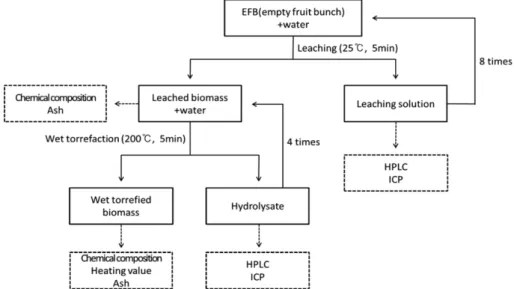
The biomass and distilled water were mixed with a 1:10 ratio (w/w), and leaching was performed in a 500 mL flask at 25oC for 5 min with stirring (150 rpm). After leaching, the solution was filtered and reused for a new leaching process. To reuse the leaching solution, the biomass was soaked in leaching solution with a 1:10 ratio (w/w), and leaching was performed under the same conditions as above. The process was repeated eight times.
The leached biomass was subsequently subjected to wet torrefaction.
The process was carried out in an EMS reactor (EMV-HT/HP 600, EMS TECH, Korea) at 200oC for 5 min with stirring (150 rpm). The operating pressure of wet torrefaction was 16.8 psi at 200oC. The ratio of biomass over distilled water was 1:8 (w/w) (25g biomass (dry weight):200 mL distilled water). After wet torrefaction, the reactor was submerged in an ice bath for cooling. The hydrolysate was separated
by filtration, and the collected hydrolysate was reused for new wet torrefaction. The process was repeated four times. A schematic of the overall experimental process is shown in Fig. 1.
2-3. Analysis of liquid fraction generated from leaching and wet torrefaction
The monosaccharide (glucose and xylose) and other degradation products (acetic acid and furfural) were determined by HPLC (Waters e2695 system, Alliance, USA) equipped with an Aminex 87H column (300 × 7.8 mm, BIO-RAD) and refractive index detector (Waters 2414, USA). An amount of 5 mM H2SO4 was used as the mobile phase and the analysis was carried out for 55 min with a 0.6 mL/min flow rate. Inorganic compounds were measured by ICP-OES (Inductively Coupled Plasma-Optical Emission Spectrometer, OPTIMA 7300 DV, PerkinElmer, USA).
2-4. Analysis of solid fraction generated from leaching and wet torrefaction
The chemical compositions of biomass were determined according to the NREL standard analytical method (Laboratory Analytical Procedure-Determination of structural carbohydrates and lignin in biomass) [17].
The ash content in the biomass was measured using a modified TAPPI Standard Method (T211-om-02). The inorganic compounds of the ash were determined under the same conditions as above. The biomass heating value was determined using an automatic isoperibol calorimeter (6400, Parr, USA).
2-5. Statistical analysis
Significant differences were confirmed between the samples using a two-way analysis of variance (ANOVA) at a significance level of p-value < 0.05. The data were analyzed using SPSS software (Version 23, SPSS Inc., USA). A further analysis was carried out by Duncan’s multiple range test, where a significant difference was observed between the treatments.
Fig. 1. Schematic diagram of this study.
3. Results and Discussion
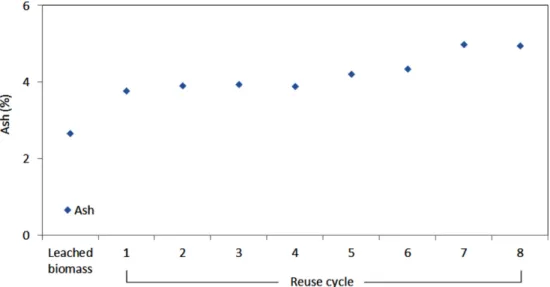
3-1. Properties of biomass fraction obtained by EFB leaching Alkali metals and chlorine bound in water-soluble salts are easily removed by leaching processes, which reduce the ash in biomass and alter the ash chemistry [10]. Therefore, an improvement of biomass fuel properties could be expected through leaching. The change of ash content in the leached biomass depending on the reuse cycle of the leaching solution is shown in Fig. 2. The ash content of the raw material was 5.4%, which decreased by 2.66% after leaching, which corresponded a reduction of 49%. During the leaching solution reuse, the ash content was similar until the fourth time, whereas the content was slightly increased until the eighth time. Finally, the ash content in the leached biomass was 4.5%. This was owing to the adsorption inorganic compounds on the biomass surface. Therefore, the leaching solution reuse is considered to be possible up to four times based on the ash content in the biomass. The ash content should be kept below a certain level owing to the negative effect on the combustion process, because alkali metals in biomass affect slagging and fouling [18].
Based on the ash content depending on the reuse cycle of leaching solution, the chemical composition of biomass was analyzed and the results are shown in Fig. 3. After the leaching process, the major chemical components of biomass (glucan, xylan, and lignin) did not differ from the raw material. Statistical analysis (at p-value < 0.05) confirmed that the leaching solution reuse did not affect the change of major chemical components of biomass. In addition, there was no
difference on the degradation rate of biomass between before and after leaching. Therefore, the leaching solution could be reused four times based on ash content and chemical composition of biomass.
3-2. Properties of liquid fraction generated by EFB leaching The chemical composition and pH of the liquid fraction generated from EFB leaching depending on the reuse cycle of leaching solution are shown in Table 1. Water soluble monosaccharide concentrations (glucose and xylose) steadily increased with increasing reuse cycles of the leaching solution. This is owing to monosaccharide accumulation during the leaching solution reuse. The monosaccharide concentration was relatively higher that of other biomass, such as wood. In particular, the xylose concentration was high as 6.06 g/L after the leaching
Fig. 2. Change of ash content in biomass on reusing leaching solution.
Fig. 3. Chemical compositions of leached biomass on reusing leaching solution.
Table 1. Chemical compositions and pH of liquid fraction generated from biomass leaching Reuse cycle
Original 1 2 3 4 5 6 7 8
Glucose 0.04 (0.00) 0.04 (0.00) 0.07 (0.01) 0.14 (0.02) 0.21 (0.01) 0.26 (0.04) 0.38 (0.09) 0.45 (0.10) 0.57 (0.08) Xylose ND ND 0.65 (0.08) 1.30 (0.08) 2.32 (0.05) 3.14 (0.08) 4.29 (0.05) 5.41 (0.07) 6.06 (0.10) pH 6.01 (0.01) 6.01 (0.01) 4.60 (0.01) 4.54 (0.04) 4.50 (0.3) 4.44 (0.00) 4.43 (0.11) 4.44 (0.12) 4.45 (0.04) The parentheses contain the standard deviation with the analysis repeated three times.
ND is not detectable.
Korean Chem. Eng. Res., Vol. 57, No. 3, June, 2019 solution was reused eight times. This was not owing to hemicellulose
degradation because leaching was carried out at 25oC for 5 min.
Therefore, the leaching process did not affect the biomass weight degradation during the leaching solution reuse. The pH value decreased slightly with increasing reuse cycles of the leaching solution, and the value was similar after the leaching solution was reused five times.
This was owing to the accumulation of organic acid generated from the biomass surface.
Inorganic compounds in the leaching solution are shown in Fig. 4.
Few heavy metals were detected in all leaching solutions. Potassium was effectively removed by the leaching process, and was accumulated with the increasing reuse cycle of the leaching solution. The ash fusion temperature is changed by the potassium concentration during combustion [3,19]. The temperature decreased when the potassium concentration was low in biomass. Other elements (phosphate, calcium, and magnesium etc.) were slightly removed by the leaching process.
However, the removal of silicon was ineffective by the leaching process owing to its insolubility. Therefore, limited silicon was detected in all leaching solution. This was in agreement with the results of other studies [19-21].
3-3. Properties of biomass fraction obtained by EFB wet torre- faction
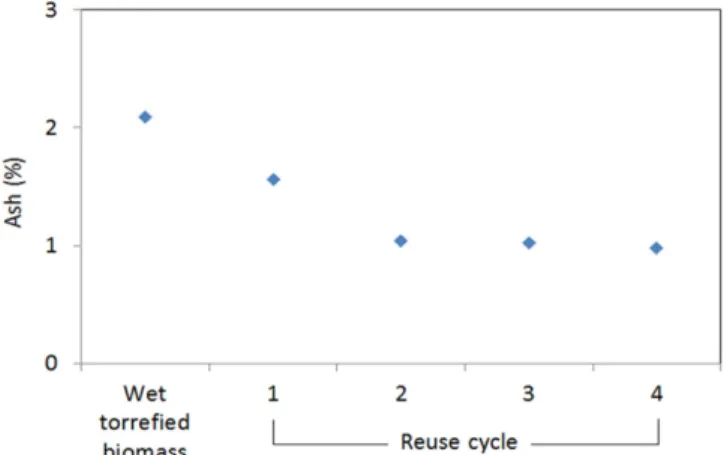
The change of degradation rate and ash content in biomass during wet torrefaction are shown in Fig. 5. The degradation rate was 30%
by wet torrefaction, which decreased slightly to 25% by hydrolysate reuse. This is owing to inorganic compound accumulation in hydrolysate, which lowers the hyrolysate acidity during wet torrefaction. The ash content was 2.2% in wet torrefied biomass, which was lower than that of leached biomass. This was owing to the high reaction temperature of wet torrefaction. The removal efficiency of inorganic compounds was affected by the reaction temperature, and the efficiency increased with increasing the reaction temperature. In addition, the ash content decreased slightly by increasing the hydrolysate reuse cycles. The biomass heating value increased with sequential leaching and wet torrefaction (Table 2), and increased slightly with increasing hydrolysate
reuse cycles. However, there was no significant change between treated biomass.
The chemical compositions of biomass are shown in Fig. 6. Most hemicellulose (xylan) was removed by wet torrefaction than that of the raw material. This is a typical characteristic of wet torrefaction, where hemicellulose is easily hydrolyzed compared to cellulose and lignin [22]. However, cellulose and lignin content increased relatively by removal of hemicellulose. After hydrolysate reuse, the differences of major chemical constituents in biomass were not significant. Therefore, it was confirmed that hydrolysate generated from wet torrefaction could be reused up to four times maintaining uniform biomass Fig. 4. Inorganic compounds in leaching solution on reusing leaching
solution. Fig. 5. Change of ash content in biomass on reusing hydrolysate of
wet torrefaction.
Table 2. Mass yield and heating value of biomass in reuse cycle of hydrolysate generated from wet torrefaction
Reuse cycle Mass yield (%) Heating value (kcal/kg)*
Raw material 100
Original 69.76 4618 (12.07)
1 73.23 4661 (14.02)
2 73.45 4698 (3.73)
3 73.89 4752 (12.19)
4 75.22 4711 (1.99)
The parentheses contain the standard deviation with the analysis repeated three times.
*High heating value
Fig. 6. Chemical compositions of wet torrefied biomass on reusing hydrolysate of wet torrefaction.
chemical component. Regarding fuel properties, there was no significant difference between treated biomass (Table 2).
3-4. Properties of hydrolysate fraction obtained by EFB wet torrefaction
The leached biomass was used for wet torrefaction, and hydrolysate was reused for wet torrefaction. The chemical compositions of hydrolysate are shown in Table 3. Monosaccharide and degradation products were detected in hydrolysate during hydrolysate reuse, and the concentrations increased with increasing reuse cycles. However, the xylose concentration decreased after the fourth hydrolysate reuse owing to its further degradation. Therefore, the formic acid concentration increased slightly. The pH value decreased with increasing hydrolysate reuse cycle owing to organic acid accumulation in the hydrolysate.
Therefore, the hydrolysis efficiency of wet torrefaction increased slightly during hydrolysate reuse. However, this did not affect the change of biomass chemical composition (Fig. 6). The changes of inorganic compound concentrations in the hydrolysate are shown in Fig. 7. Potassium, magnesium, and calcium were effectively removed, whereas silicon and iron were less easily extracted by wet torrefaction. The inorganic compound concentrations increased with increasing hydrolysate reuse cycles. Limited extraction of silicon, titanium, iron, and aluminum has been reported under wet torrefaction [23,24]. The results were similar to that of the leaching solution reuse (Fig. 4). In summary, the reuse of wet torrefaction hydrolysate is considered to be possible up to four times to provide constant fuel properties.
4. Conclusions
The fuel properties of treated biomass (sequential leaching and wet torrefaction) and the possible reuse of the liquid fraction generated in each process were investigated. The heating value was significantly enhanced and the ash content decreased. In particular, potassium removal for the inorganic compounds was effective with leaching and wet torrefaction. Organic and inorganic compounds in liquid fractions were slightly increased with increasing reuse cycles of the liquid fraction (leaching solution and hydrolysate of wet torrefaction);
however, did not dramatically affect the biomass chemical composition.
Considering the biomass chemical composition and fuel characteristics, the possibility of reusing the liquid fraction generated from leaching and wet torrefaction was confirmed.
Acknowledgment
This work was supported by Korea Electric Power Corporation (KEPCO) by funded by project (No. R17GA02).
References
1. KESIS, “Production of New & Renewable Energy by Region (toe),” Korea Energy Statistics Information System. Ulsan, Korea (2018).
2. Deng, L., Zhang, T. and Che, D., “Effect Water Washing on Fuel Properties, Pyrolysis and Combustion Characteristics, and Ash Fusibility of Biomass,” Fuel Process. Technol., 106, 712-720(2013).
3. Nielsen, H. P., Baxter, L. L., Sclippab, G., Morey, C., Frandsen, F. J. and Dam-johnsen, K., “Deposition of Potassium Saltes on Heat Transfer in Straw-fired Boilers: a Pilot-scale Study,” Fuel, 79, 131-139(2000).
4. Ma, T., Fan, C., Hao, L., Li, S., Song, W. and Lin, W., “Fusion Characterization of Biomass Ash,” Thermochim. Acta, 638, 1-9 (2016).
5. Smith, A. M., Singh, S. and Ross, A. B., “Fate of Inorganic Material During Hydrothermal Carbonization of Biomass: Influ- ence of Feedstock on Combustion Behavior of Hydrochar,”
Fuel, 169, 135-145(2016).
6. Bach, Q. V. and Skreiberg, Ø., “Upgrading Biomass Fuels via wet Torrefaction: A Review and Comparison with dry Torrefac- tion,” J. Renew. Sustain. Energy, 54, 665-677(2016).
7. Chin, K. L., H’ng, P. S., Paridah, M. T., Szymona, K., Maminski, M., Lee, S. H., Lum, W. C., Nurliyana, M. Y., Chow, M. J. and Go, W. Z., “Reducing Ash Related Operation Problems of Fast Fig. 7. Inorganic compounds in hydrolysate on reusing hydrolysate
of wet torrefaction.
Table 3. Concentration of sugars and degradation products in hydrolysate depending on reuse cycle of wet torrefaction hydrolysate (unit: g/L)
Reuse cycle Glucose Xylose Arabinose Formic acid Acetic acid Furfural pH
Original 0.11 (0.01) 1.07 (0.08) 0.25 (0.01) 0.74 (0.02) 1.53 (0.10) 0.56 (0.04) 3.98 (0.04)
1 0.16 (0.01) 3.54 (0.12) 0.26 (0.04) 0.83 (0.08) 3.67 (0.07) 2.95 (0.09) 3.77 (0.06)
2 0.23 (0.03) 3.47 (0.09) 0.25 (0.03) 1.35 (0.10) 5.76 (0.09) 5.17 (0.10) 3.69 (0.02)
3 0.20 (0.02) 4.17 (0.08) 0.25 (0.03) 2.08 (0.08) 5.61 (0.07) 5.29 (0.06) 3.58 (0.10)
4 0.26 (0.02) 2.36 (0.04) 0.26 (0.01) 2.10 (0.09) 8.59 (0.12) 5.17 (0.05) 3.47 (0.03)
The parentheses contain the standard deviation with the analysis repeated three times.
Korean Chem. Eng. Res., Vol. 57, No. 3, June, 2019 Growing Timber Species and Oil Palm Biomass for Combus-
tion Applications Using Leaching Techniques,” Energy, 90, 622- 630(2015).
8. Persson, H., Kantarelis, E., Evangelopoulos, P. and Yang, W.,
“Wood-derived Acid Leaching of Biomass for Enhanced Produc- tion of Sugars and Sugar Derivatives During Pyrolysis: Influence of Acidity and Treatment Time,” J. Anal. Appl. Pyrolysis, 127, 329-334(2017).
9. Zhang, S., Su, Y., Zhu, S., Zhang, H. and Liu, X., “Effects of Torrefaction and Organic-acid Leaching Pretreatment on the Pyrolysis Behavior of Rice Husk,” Energy, 149, 804-813(2018).
10. Yu, C., Wang, L., Anderson, S. N., VanderGheynst, J. S., Upadhyaya, S. K. and Jenkins, B. M., “Influence of Leaching Pretreatment on Fuel Properties of Biomass,” Fuel Process Technol., 128, 43- 53(2014).
11. Zheng, A., Zhao, Z., Chang, S., Huang, Z., Zhao, K., Wei, G. and Li, H., “Comparison of the Effect of Wet and Dry Torrefaction on Chemical Structure and Pyrolysis Behavior of Corncobs,”
Biomass Bioenergy, 176, 15-22(2015).
12. Na, B., Kim, Y., Lim, W., Lee, S., Lee, H. and Lee, J., “Torrefac- tion of Oil Palm Mesocarp Fiber and Their Effect on Pelletiz- ing,” Biomass Bioenergy, 52, 159-165(2013).
13. Ho, S., Zhang, C., Chen, W. and Chang, J., “Characterization of Biomass Waste Torrefaction Under Conventional and Microwave Heating,” Bioresour. Technol., 264, 7-16(2018).
14. Lynam, J. G., Coronella, C. J., Yan, W., Reza, M. T. and Vasquez, V. R., “Acetic Acid and Lithium Chloride Effects on Hydrothermal Carbonization of Lignocellulosic Biomass,” Bioresour. Technol., 102, 6192-6199(2011).
15. Lee, S. and Lee, J., “Optimization of Biomass Torrefaction Condi- tions by the Gain and Loss Method and Regression Model Anal- ysis,” Bioresour. Technol., 172, 438-443(2014).
16. Kambo, H. S. and Dutta, A., “Comparative Evaluation of Torre- faction and Hydrothermal Carbonization of Lignocellulosic Bio-
mass for the Production of Solid Biofuel,” Energy Conv. Manag., 105, 746-755(2015).
17. Sluiter, A., Hames, B., Ruiz, R., Scarlate, C., Sluiter, J., Temple- ton, D. and Crocker, D., “Laboratory Analytical Procedure No.
TP-510-42618,” NREL, Goden, CO(2012).
18. Saddawi, A., Jones, J. M., Williams, A. and Coeur, C., “Commod- ity Fuels from Biomass Through Pretreatment and Torrefaction:
Effects of Mineral Content on Torrefied Fuel Characteristics and Quality,” Energy Fuels, 26, 6466-6474(2012).
19. Thy, P., Grundvig, S., Jenkins, B. M., Shiraki, R. and Lesher, C. E.,
“Analytical Controlled Losses of Potassium from Straw Ashes,”
Energy Fuels, 19, 2571-2575(2005).
20. Tonn, B., Thumm, U., Lewandowski, I. and Claupein, W., “Leach- ing of Biomass from Semi-natural Grasslands-Effects on Chemical Composition and Ash High-temperature Behavior,” Biomass Bioen- ergy, 36, 390-403(2012).
21. Supancic, K., Obernberger, I., Kienzl, N. and Arich A., “Con- version and Leaching Characteristics of Biomass Ashes During Outdoor Storage-Results of Laboratory Tests,” Biomass Bioen- ergy, 61, 211-226(2014).
22. Novianti, S., Nurdiawati, A., Zaini, I. N., Prawisudha, P., Sumida, H. and Yoshikawa, K., “Low-potassium Fuel Production from Empty Fruit Bunches by Hydrothermal Treatment Processing and Water Leaching,” Energy Procedia, 75, 584-589(2015).
23. Nurdiawati, A., Novianti, S., Zaini, I.N., Nakhshinieva, B., Sum- ida, H., Takahashi, F. and Yoshikawa, K., “Evaluation of Hydrother- mal Treatment of Empty Fruit Bunch for Solid Fuel and Liquid Organic Fertilizer co-production,” Energy Procedia, 79, 226-232 (2015).
24. Mäkelä, M., Fullana, A. and Yoshikawa, K., “Ash Behavior During Hydrothermal Treatment for Solid Fuel Applications. Part 1:
Overview of Different Feedstock,” Energy Conv. Manag., 121, 402-408(2016).