J Appl Biol Chem (2016) 59(1), 5−7 http://dx.doi.org/10.3839/jabc.2016.002
Online ISSN 2234-7941 Print ISSN 1976-0442
Original Article: Biochemistry/Molecular Biology
Isolation and Identification of Major Component from Roots of Potentilla chinensis
Hae Soo Jung · Hyoung Shik Kim · Jeong Hun Lee · Seo Jin Moh · Jin Hui Yeo · Gi won Park · Sang Hyun Moh*
딱지꽃(Potentilla chinensis) 뿌리 추출물의 주요성분 분리동정
정해수 · 김형식 · 이정훈 · 모서진 · 여진희 · 박기원 · 모상현*
Received: 1 October 2015 / Accepted: 8 October 2015 / Published Online: 31 March 2016
© The Korean Society for Applied Biological Chemistry 2016
Abstract One of oriental medicinal plants, Potentilla chinensis, has been used for anti-inflammation, hemostatic, decryption, and antipyretic. Especially, a root of Potentilla chinensis was used as important material for oriental medication. Although several kinds of bioactive component of Potentilla chinensis extract from stems and leaves were identified, the major component of Potentilla chinensis from roots is not well established. In this study, the root of Potentilla chinensis was extracted in different solvent system and analyzed by high performance liquid chromatography (HPLC).
According to HPLC analysis, a major component was isolated and its physicochemical properties were evaluated by mass spectrometry and nuclear magnetic resonance. Based on these results, isolated compound was identified as 2,3,8-Tri- O-methylellagic acid. And quantification of 2,3,8-Tri- O-methylellagic acid with different extraction solvent system was performed for industrial application.
Keywords high performance liquid chromatography · mass spectrometry · nuclear magnetic resonance · root of potentilla chinensis
서 론
장미과에 속하는 딱지꽃(Potentilla chinensis)은 산야의 양지에 자라는 다년초로 위릉채로도 알려져 있다(Mesicek과 Sojak, 1993). 노란 꽃이 피며 높이가 30−60 cm로 자라며 근육통, 지 혈, 해독, 해열 등에 효능을 가진다. 딱지꽃의 전초와 뿌리는 다 량의 flavonoid를 함유하고 saponin, kaempferol, cyanidin, catechin 등이 포함되어 있다(Shen 등, 2006; Wang 등, 2006; Xue와 Yang, 2008). 또한 딱지꽃에 들어있는 polyphenol 물질들은 티 푸스막대균, 적리막대균, 포도알균에 대한 살균작용이 있고 항 염증작용, 모세혈관 강화작용이 있다고 알려져 있으며, 딱지꽃 전초는 지혈제, 진통진정제, 염증약으로 쓰이고 있다(Jung 등, 2012; Wei 등, 2013; Lin 등 2014).
최근 약초식물의 관심이 높아지면서 약초식물의 유효성분에 대한 관심이 높다. 딱지꽃도 그 중 하나로 많은 관심을 받고 있 으나 딱지꽃의 유효성분에 대한 연구는 미비한 실정이다(Kang 등, 2013). 특히, 딱지꽃의 뿌리를 제외한 부분의 추출물에 대 한 연구가 진행된 적 있으나 뿌리 추출물에 대한 연구는 거의 이루어지지 않았다(Tomczyk와 Latte, 2009).
따라서, 본 연구는 강원도 정선의 고랭지에서 자생하는 딱지 꽃의 뿌리를 다양한 용매를 사용하여 추출하여 유효성분의 차 이를 비교 분석 하였고, 그 중 주요성분이 가장 많이 추출되는 용매인 methanol을 사용하여 딱지꽃의 뿌리를 추출하였다. 추출 물 속의 주요 성분을 high performance liquid chromatography (HPLC)를 이용하여 분리정제 후 mass spectroscopy 및 nuclear H. S. Jung · H. S. Kim · J. H. Lee · S. H. Moh
Anti-aging Research Institute of BIO-FD&C Co.,Ltd, Smart valley A-510, 30, Songdomirae-ro, Yeonsu-gu, Incheon 21990, Republic of Korea S. J. Moh
Innoplant Agricultural Union Corp. 991, Worasan-ro, Geumgok-myeon, Jinju-si, Gyeongnam 52839, Republic of Korea
J. H. Yeo . G. Park
Jeongseon Agricultural Technology & Extension Center 146-5, Songseok- gil, Bukpyeong-myeon, Jeongseon-gun, Gangwon 26103, Republic of Korea
*Corresponding author (S. J. Moh: [email protected])
This is an Open Access article distributed under the terms of the Creative Commons Attribution Non-Commercial License (http://creativecommons.
org/licenses/by-nc/3.0/) which permits unrestricted non-commercial use, distribution, and reproduction in any medium, provided the original work is properly cited.
6 J Appl Biol Chem (2016) 59(1), 5−7
magnetic resonance (NMR)를 통해 주요 물질을 동정하였다. 또 한, 추후 딱지꽃 뿌리 추출물의 산업적 이용을 위해 동정된 주 요물질이 용매 별로 얼마나 추출되는지 확인하였다.
재료 및 방법
실험재료. 본 실험에 사용된 딱지꽃은 정선 배서영농조합과 진 주 영농조합법인 이노플랜트 두 곳에서 수급하여 사용하였다.
시약 및 기기. 딱지꽃의 HPLC 분석은 waters 1525µ binary HPLC pump, waters 996 photodiode array detector를 사용하 였고, 사용된 컬럼은 gemini C18 (5µm, 4.6×250nm, phenomenex, Madrid Avenue Torrance, CA, USA) column을 사용하였다.
그리고 주요성분을 분리정시에는 waters 600E system, waters 484 detector, phenomenex C18 (5µm, 20.2×300 mm) column 을 사용하였다. NMR 분석은 Bruker사의 400 MHz NMR을 사 용하였다. 그리고 Mass 분석은 MALDI-TOF (Matrix Assisted Laser Desorption Ionization-Time of Flight)를 이용하였으며 Perseptive Biosystem 사의 Voyager-De STR의 모델을 사용하 였으며 matrix로 α-cyano-4-hydroxycinnamic acid를 사용하였다.
딱지꽃 뿌리 추출 방법. 추출을 위하여 딱지꽃 시료를 60oC에 서 2일 동안 건조하였고, 각각 정제수(2 L), 메탄올(2 L), 아세트 산에틸(2 L), 헥산(2 L)을 사용하여 추출하였다. 추출 시 농도는 2 g/L로 추출한 후, 여과하여 그 액을 실험에 사용하였다.
딱지꽃 추출물의 HPLC 분석 및 정제. 딱지꽃 뿌리 추출물을 추출용매에 따른 주요성분을 HPLC로 분석하였다. 분석 조건은 0.1% 삼불화아세트산(trifluoroacetic acid, TFA)를 포함한 정제 수(용매A)와 아세토나이트릴(용매B)를 사용하였고 1 mL/min (분 석시) 혹은 5 mL/min (분리동정시) 유속으로 254 nm 파장에서 분석하였다.
NMR (Nuclear Magnetic Resonance) 분석. 정제된 딱지꽃
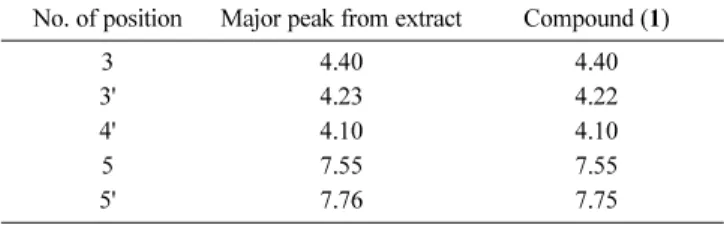
뿌리 추출물 주요 피크를 동결건조 시킨 후 연한 노란색의 파 우더를 확보한 다음 CDCl3에 녹여 분석을 수행하였다. 화합물 (1) (400 MHz NMR, CDCl3) δ 4.40 (s, 3H), 4.22 (s, 3H), 4.10 (s, 3H), 7.55 (s, 1H), 7.75 (s, 1H)
Mass spectrometry 분석. 정제된 딱지꽃 뿌리 추출물 주요 피 크를 동결건조 시킨 후 연한 노란색의 파우더를 확보한 다음 메탄올에 녹인 후 α-cyano-4-hydroxycinnamic acid와 섞고 MALDI-TOF MS를 이용하여 분석을 수행하였다. 화합물 (1) MALDI-TOF MS calcd for C17H12O8 [M+H]+=345.8, found 345.8.
결과 및 고찰
딱지꽃 뿌리 추출물의 HPLC 분석. 딱지꽃 뿌리에서 용매별 추 출물의 주요 성분 차이를 비교하기 위하여 HPLC를 이용하여 분석하였다. 그 결과 아세트산에틸과 헥산 을 이용하여 추출한 추출물과 달리 정제수, 메탄올, 부탄올에서 추출된 추출물에서 일정한 주요 피크(22.2 분)를 확인할 수 있었다(Fig. 1). 본 연 구에서는 정제수 및 알코올류 용매에서 주요하게 추출되는 주 요성분(retention time: 22.2분)을 분리 동정하였다.
NMR 및 MALDI-TOF MS를 통한 딱지꽃 뿌리추출물의 주요 피크 구조 분석. HPLC를 통해 정제된 딱지꽃 뿌리추출물의 22.2분 주요 피크를 1H NMR 분석을 수행하였다. 그 결과 δ 4.10, 4.23, 4.40 ppm에서 단일선과 7.51, 7.76 ppm에서 단일선 의 수소 피크를 확인하였다. 1H NMR 분석에서 확인된 4.10, 4.23, 4.40 ppm의 단일선은 3개의 메톡시(-OCH3)기의 피크로 예 상하였고, 7.51, 7.76 ppm의 singlet은 방향족 고리의 수소피크 로 예상되었다. 이러한 결과를 토대로 문헌상에 확인된 딱지꽃 성분 중 가장 유사한 NMR 결과를 가진 물질이 2,3,8-tri-O- methylellagic acid (1)임을 확인 할 수 있었다(Kim, 1989). 이
Fig. 1 HPLC analysis of extract of Potentilla chinensis roots (arrow: major peak).
J Appl Biol Chem (2016) 59(1), 5−7 7
를 확인하기 위해 시중 구입 가능한 2,3,8-Tri-O-methylellagic acid (1)를 구입하여 동일한 조건으로 1H NMR data를 확인한 결과 비슷한 결과를 확인하였다(Table 1).
추가적으로 분리된 주요물질의 분자량을 MALDI-TOF MS를 이용하여 분석 함으로써 화합물 (1)과 동일한 물질인지 확인하 였다. 그 결과 분자량 [M+H]+=345.8를 확인함으로써 화합물 (1)의 분자량과 일치함을 알 수 있었다.
위 결과들을 바탕으로 딱지꽃의 뿌리에서 추출된 주요 물질 이 2,3,8-Tri-O-methylellagic acid (1)임을 확인하였다(Fig. 2).
문헌 화합물 (1)은 주로 항균작용을 물질로 알려져 있음을 확 인하였다(Ndukwe와 Zhao, 2007).
딱지꽃 뿌리에서 용매별 추출물의 2,3,8-tri-O-methylellagic acid (1) 함량 분석. 용매에 따른 딱지꽃 뿌리추출물에서의 화 합물 (1)의 함량을 분석하기 위해 시중 구입 가능한 화합물 (1) 을 100, 200, 300 ppm 농도로 제조 후 HPLC를 이용하여 표 준곡선(standard curve)를 만들었다. 이를 이용하여 각 용매별로 추출된 화합물 (1) 양을 정량한 결과 메탄올 643.5 ppm, 정제수 319.0 ppm, 부탄올 153.1 ppm, 아세트산에틸 2.8 ppm, 헥산 0 ppm으로 확인되었다. 이 결과를 바탕으로 화합물 (1)은 뿌리에 서 메탄올을 이용하여 추출 시 가장 많은 양이 추출된다는 것 을 알 수 있다(Table 2).
본 연구에서는 그 동안 연구가 미비했던 딱지꽃의 뿌리의 추 출물의 주요성분을 2,3,8-Tri-O-methylellagic acid로 분리동정 하
였다. 화합물 (1)은 문헌 조사결과 항균활성에 중요한 역할을 미치는 물질임이 알려져 있었다. 또한 산업적응용을 위해 용매 별로 화합물 (1)의 추출양을 정량함에 따라 메탄올이 최적의 추 출용매임을 확인하였다.
초 록
딱지꽃(Potentilla chinensis)은 약초식물의 하나로 항염, 지혈, 해 독 그리고 해열 등의 효과가 알려져 있다. 특히 딱지꽃의 뿌리 는 약제로써 중요한 가치를 지니고 있다. 그러나 기존에 딱지 꽃의 줄기나 잎에 대한 유효성분에 대한 연구가 시도된 반면 딱지꽃의 뿌리의 주요성분을 분석한 사례가 없었다. 따라서 본 연구는 딱지꽃의 뿌리를 다양한 용매별로 추출하고 주요한 물 질을 분리정제 하였다. 분리 정제된 물질을 NMR과 mass 분석 을 통하여 물질을 동정하였고 그 결과 주요성분이 화합물 (1) 임을 확인하였다. 또한, 동정된 물질의 산업적 응용을 위해 딱 지꽃 뿌리에서 용매별로 화합물 (1) 추출양을 정량하였다.
Keywords 딱지꽃 뿌리 추출물·액체크로마토 그래피·질량 분석기·핵자기공명기
감사의 글 본 연구는 농림축산식품부 농림축산식품기술료사업에 의해 이 루어짐(국문 과제명: 고랭지 자생 딱지꽃을 활용한 기능성 제품 개발)
References
Jung CH, Choi JK, Yang Y, Koh HJ, Heo P, Yoon KJ et al. (2012) A botulinum neurotoxin-like function of Potentilla chinensis extract that inhibits neuronal SNARE complex formation, membrane fusion, neuroexocytosis, and muscle contraction. Pharm Biol 50, 1157−67.
Kang CH, Han SH, and So JS (2013) Anti-Inflammatory Effect of Chloroform Extract from Potentilla chinensis. KSBB Journal 28, 13−7.
Kim HS (1989) Components of Potentilla Species. J Pharm Soc Kor 33, 377−
9.
Lin X, Zhang S, Huang R, Tan S, Liang S, Wu X et al. (2014) Protective effect of tormentic acid from Potentilla chinensis against lipopolysaccharide/
Dgalactosamine induced fulminant hepatic failure in mice. Int Immunopharmacol 19, 365−72.
Mesicek J and Sojak J (1993) Annotated Chromosome-numbers of Selected Asiatic Potentilla Species. Folia Geobotanica & Phytotaxonomica 28, 437−46.
Ndukwe GI and Zhao Y (2007) Pharmacological activity of 2,3,8-tri-O- methyl ellagic acid isolated from the stem bark of Irvingia gabonensis.
Afr J Biothenol 6, 1910−2.
Shen Y, Wang QH, Lin HW, Shu W, Zhou JB, and Li ZY (2006) Study on chemical constituents of Potentilla chinensis Ser. Zhong Yao Cai 29, 237−9.
Tomczyk M and Latte KP (2009) Potentilla-A review of its phytochemical and pharmacological profile. J Ethnopharmacol 122, 184−204.
Wang QH, Li ZY, Shen Y, Lin HW, Shu W, and Zhou JB (2006) Studies on triterpenoids from Potentilla chinensis. Zhongguo Zhong Yao Za Zhi 31, 1434−6.
Wei J, Huang Q, Huang R, Chen Y, Lv S, Wei L et al. (2013) Asiatic acid from Potentilla chinensis attenuate ethanol-induced hepatic injury via suppression of oxidative stress and Kupffer cell activation. Biol Pharm Bull 36, 1980−9.
Xue HJ and Yang XK (2008) Common volatiles are major attractants for neonate larvae of the specialist flea beetle Altica koreana.
Naturwissenschaften 95, 639−45 Table 1 1H NMR data (400 MHz, CDCl3) of major component from
Potentilla chinensis roots extract and 2,3,8-Tri-O-methylellagic acid (1) No. of position Major peak from extract Compound (1)
3 4.40 4.40
3' 4.23 4.22
4' 4.10 4.10
5 7.55 7.55
5' 7.76 7.75
Fig. 2 Structure of 2,3,8-Tri-O-methylellagic acid (1) Table 2 Quantification of 2,3,8-Tri-O-methylellagic acid (1) with different extraction solvent system from Potentilla chinensis roots
Extraction solvent Compound (1) (ppm)
Methanol 643.5
DW 319.0
Butanol 153.1
Ethylacetate 2.8
Hexane 0