Printed in the Republic of Korea
http://dx.doi.org/10.5012/jkcs.2015.59.5.429
Stability and Electronic Properties of the Adsorption of Molecular Hydrogen on Metal-containing Single-walled Carbon Nanotubes
Michael Mananghaya†,‡,§
†De La Salle University, 2401 Taft Avenue, 0922 Manila, Philippines
‡DLSU STC Laguna Boulevard, LTI Spine Road Barangays Biñan and Malamig, Biñan City, Laguna, Philippines
§Analysis of Nanomaterials (ANA), Division IX, National Research Council of the Philippines, General Santos Ave, Taguig, 1631 Metro Manila, Philippines. E-mail: [email protected]
(Received March 24, 2015; Accepted August 31, 2015)
ABSTRACT. The binding ability and hydrogen storage capacity of nitrogen doped carbon nanotube with divacancy (4ND- CNxNT) that is decorated with transition metals was investigated based on density functional theory calculations. Results indi- cate that scandium shows an ideal reversible hydrogen binding capability with promising system-weight efficiency compared with other transition metals when functionalized with 4ND-CNxNT. The (Sc/4ND)10-CNxNT can store up to 50H2 molecules, corresponding to a maximum gravimetric density of 5.8 wt%. Detailed structural stability and electronic properties were reported as hydrogen molecules were absorbed. It takes about 0.16 eV/H2 to add one H2 molecule, which assures reversible storage of H2 molecules under ambient conditions.
Key words: Binding energy, Density functional theory, Porphyrin defects, Scandium, Single-walled carbon nanotubes
INTRODUCTION
Developing appropriate storage media is important for practical application of hydrogen energy. Hydrogen has long been debated as a clean, abundant and efficient energy carrier. Carbon nanotubes (CNT) have attracted much inter- est due to their many exceptional properties,1−20 for example high surface area and abundant pore volume. Unfortu- nately, it was demonstrated before that the hydrogen stor- age capacity of porous CNT at ambient temperature is no more than 1 wt %.18−20 The interaction of H2 and CNTs is van der Waals (vdW) in nature and a high hydrogen adsorption capacity of 4 wt % can be achieved at very low tempera- tures20 and so pristine CNTs are not the most appropriate.
As an earth-abundant element, nitrogen is widely used for hydrogen storage with its chemical hydrides and non- structural forms.10−20 The nitrogen atoms incorporated in porphyrin-like (4ND)9,10 vacancy structures can alter the chemical and physical properties of CNT. The 4ND vacancy is characterized by a four-nitrogen divacancy formed by removing two C atom among hexagons and replacing the four surrounding C atoms with 4 N atoms. The CNT with 4ND are seen as well as a poor hydrogen storage medium, although they are light-weight and hold the capability to bind with metal atoms.
The transition metals (TMs) dispersed materials have been considered recently for large hydrogen storing capac-
ity20 with respect to release temperature the TM-H2 binding energy and ratio look very promising.18 The 4ND defects in N-doped nanostructures enhances the reactivity and immobilization of TM.18,20 The TM has the ability to hold a certain number of hydrogens in molecular form; theoreti- cal simulations of hydrogen adsorption by metal adsorbed nitrogen CNT were reported recently.15−17 For the hydrogen storage materials, TM atoms are important components due to their strong attraction to hydrogen molecules.19–20 The TMs are considered as an ideal binder metal in nano- materials since it holds great advantages in hydrogen storage, which has been concluded.16 The outstanding performances in hydrogen storage of TM-decorated nanostructures have been widely reported.19,20 Previous computations on hydro- gen storage16,17 focuses on the appropriate TM adsorbent for CNT surface, addressing adsorption stability and the increase in hydrogen storage capacity. So which kind of TM atom/s would be the best absorbent for Nitrogen doped Carbon Nanotube with divacancy (4ND-CNxNT) as a hydro- gen storage material? Here we perform density functional theory (DFT) calculations on the binding capability of dif- ferent 3d-block transition metal atom decorated 4ND- CNxNT. Lastly, the possibility that such decorated N-con- taining CNT behave as an ideal H2-storage material was evaluated in detail by gradually increasing the number of H2 molecules to produce the greatest number of H2 adsorp- tion preferentially at room temperature.
430 Michael Mananghaya
COMPUTATIONAL
The 4ND-CNxNT was constructed as depicted in Fig. 1.
DFT calculations are carried out by the Dmol3 code avail- able from Accelrys.21 The generalized gradient-corrected Perdew-Burke-Ernzerhof (PBE/GGA) functional,22 along with a double numerical basis set including p-polarization function (DNP), is employed for the geometry optimization and property calculations. The DFT semi-core pseudo-poten- tials (DSPPs) was applied to efficiently manage the core elec- tron of the TMs. The dispersion-corrected DFT (DFT-D) scheme is used to describe the vdW interaction. The incor- poration of DFT-D scheme further improves the accuracy in evaluating weak interactions. The Monkhorst-Pack scheme23 was used in the Brillouin zone with 1x1x5 special k-points for all geometry optimizations with the Broyden-Fletcher- Goldfarb-Shanno (BFGS) algorithm with convergence threshold values specified as 1 × 10⁻⁵ Ha for energies, 2 × 10⁻³ Ha/Å for gradient, 5 × 10⁻³ Å for displacement and self- consistent-field (SCF) convergence tolerance set to 1 × 10⁻⁶ Ha.
RESULTS AND DISCUSSIONS
Experimentally produced CNTs has an average diam- eter of around a nanometer, theoretically calculated diam- eter close to one nm can be considered; obviously dictated by the need of drastically reducing the computational effort in such a large unit cell. The single-walled (10,0) zigzag CNT was chosen motivated by the small periodicity of the zigzag nanotubes compare to chiral ones not to mention that the system is correspondingly small, which should
justify the choice, as seen later on the discussion of the results. All CNT geometries were optimized at the same level of theory, including C114N4 as a reference with a diameter of 7.83 Å and length of 12.78 Å. The bond lengths calculated for the C-C is around 1.423-1.453 Å, respec- tively. The typical (sp3)C-C(sp3) bond length is 1.54 Å. The structure with porphyrin-like defect functionalized with TM (Sc) can be observed as shown in figure 1; C-N bond lengths of nanotube are ~1.384-1.400 Å. The C-N bond lengths of 4ND doping are smaller compared to the C-N bond length for amines that is 1.479 Å due to the two missing C atom. The Nitrogen and TM impurities in CNT produce local strains as expected.
Hirshfeld population analysis shows that charge of the order 0.116 e on each of the 4 N atoms of 4ND-CNxNT, hence this site can act as a strong oxidizing agent for TMs due to its reactivity. As TM atom is adsorbed on the CNxNT, the TM adsorption is preferred on the divacancy because of its higher reactivity than other sites. 16, 20, 24-31 The bind- ing energy (Eb) of an individual TM on the 4ND-CNxNT was defined as:
Eb=E(4ND-CNxNT)+E(TM)-E(TM/4ND-CNxNT) (1) where E denotes the total energy of the optimized system in the bracket. All Eb>0 corresponds to a stable, optimized configuration and indicates bonding ranging from 3.495 (Zn) to 8.765 (Sc) eV. The TM/4ND-CNxNT complexes are stable and offer a higher binding energy than their cor- responding crystalline cohesive energies (Ecoh). To avoid the metal adatoms forming cluster on the CNT, the metal species should meet the fundamental requirement that the binding energies are higher than their Ecoh.19,28 The Sc, Ti,
Figure 1. Optimized geometry of 4ND-CNxNT functionalized with TM in this case Scandium. Gray color depicts Carbon atoms;
blue is Nitrogen, and white is Sc.
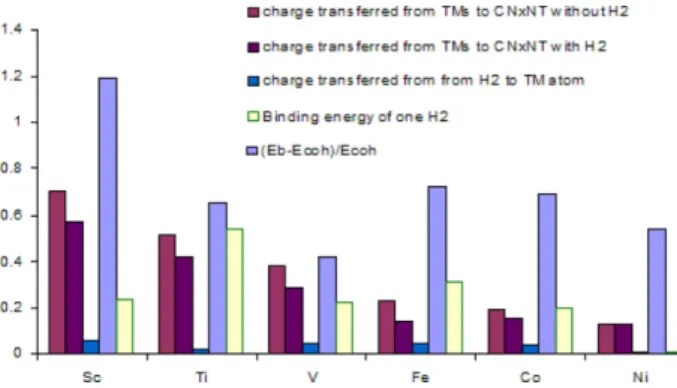
Figure 2. Charge transferred from TMs to the (10,0) CNxNT (a) without H2 adsorbed, (b) with one H2 adsorbed; (c) charge trans- ferred from H2 to TM atom and (d) the binding energy of one H2
attached to the TM, all in terms of electron volts (eV). Lastly, (e) the difference between Eb and Ecoh with respect to Ecoh expressed in unit less ratio.
V, Fe, Co and Ni show higher binding energies than their cohesive energies as calculated through the ratio between the difference of Eb and Ecoh with respect to Ecoh, (Eb - Ecoh)/
Ecoh as presented in Fig. 2. The average binding energies of Sc, Ti, V, Fe, Co and Ni are 8.765, 8.256, 7.80, 7.397, 7.598 and 7.089 eV respectively. Thus, the TMs mentioned could be used as good adsorbates to decorate 4ND-CNxNT.
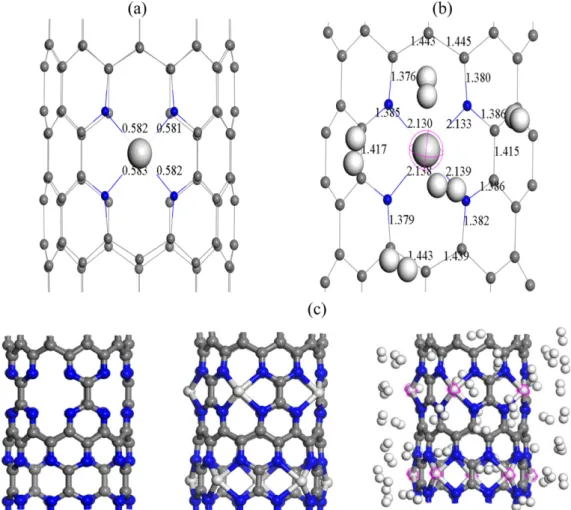
The strong interaction that exists between p orbitals of N atoms and the d orbitals of various TMs accounts to hybridization with high binding energies. Mayor bond order analysis on single TM-decorated CNxCNT was per- formed, as shown in Fig. 3(a) for Sc. It was found out that different binding conformations on 4ND vacancy struc- ture reveal that Sc (3d14s2) covalently bonds with all the surrounding nitrogen atoms due to its valence electrons.
Covalent bond exists also for Ti: 3d24s2, V: 3d34s2, Fe:
3d64s2, Co: 3d74s2, Ni: 3d84s2 with a bond order value larger than 0.5. The average TM–N distances of the opti-
mized TM/4ND-CNxNT system range from 1.923 (Ni) to 2.144 (Sc) Å. The TM-decorated complexes distort slightly and project out of the CNT substrate although it does not affect the geometric structure of a CNT significantly. The cal- culated charge transfer using Hirshfeld population analysis shows that the charges transferred from TMs to the (10,0) 4ND-CNxNT ranges from 0.127 e (Ni) to 0.704 e (Sc) with- out a hydrogen molecule adsorbed. The partially cationic character of the TMs results due to the charge transfer, and thus facilitating the adsorption of hydrogen gas.20,31
As one H2 molecule is adsorbed on the TM/4ND-CNxNT system, the H-H bond length is elongated from 0.752 Å of a free H2 to as high as 0.828 Å (for Ti). The optimized TM- H2 bond length is found to range from 1.630 (Fe) to 3.143 (Ni) Å. The average adsorption energy (Eads) was used to evaluate the H2 adsorption capability of the TM-decorated 4ND-CNxNT. The Eads are calculated based on the following formula
Figure 3. Optimized geometrical parameters of (a) Sc-decorated (10,0) CNTs with Mayor bond order analysis (b) Sc/4ND-CNxNT con- taining five H2 molecules (c) system with 10 porphyrin defect (left) functionalized with 10 Sc atoms (middle) where fifty hydrogen mol- ecules (right) are adsorbed. Gray depicts carbon, blue is nitrogen, white is hydrogen and Sc.
432 Michael Mananghaya
Eads = ETM/4ND-CNxNT + EH2− ETM/4ND-CNxNT + H2 (2) where ETM/4ND-CNxNT+H2, ETM/4ND-CNxNT and EH2 are the total energies of the TM-decorated 4ND-CNxNT with one H2 molecule, Sc-decorated 4ND-CNxNT and H2 molecule adsorbed, respectively. For efficient hydrogen storage at ambient conditions, the ideal adsorption energy should be in the range of 0.16-0.42 eV/H220,30 intermediate between physisorption and chemisorptions for realizable reversible adsorption and desorption. Among the candidates, only Sc, V, Fe and Co complies with the ideal adsorption energy requirement as shown in Fig. 2. The Adsorption energy of Ni, which is 0.013, eV falls below the range while Ti at 0.536 eV is well above the threshold excluding them from the list of candidates. Depending on the TM incorporated 0.004e (Ni) to 0.059e (Sc) electron are transferred from H2 to TM atom and the entire TM atoms still carry a positive charge (CTM-H2), indicating that eventually more H2 mol- ecules can be brought up. According to the well-known 18- electron rule, the upper limit number of adsorbed hydro- gen molecules (Nmax) is determined by the valence elec- trons that is participating in the covalent bonds. For metal- decorated 4ND-CNxNT, the 18-electron rule can be defined as
2Nmax= 18 − nv (TM) − nv (4ND− CNxNT) (3) where nv(TM) represents the valence electron number of the metal element, which is 3 for Sc, 5 for V, 8 for Fe and 9 for Co, nv (4ND-CNxNT) represents the electrons con- tributed by 4ND-CNxNT which is 4 due to the 4 N atoms.
The Nmax is calculated to be 5.5, 4.5, 3, 2.5 for Sc, V, Fe and Co respectively, which demonstrates that the single Sc-decorated 4ND-CNxNT can store up to 5 H2 mole- cules. Obviously Fe and Co/4ND-CNxNT system are inef- fective as a hydrogen storage medium. Interestingly V can store up to 4 H2 molecules. After the adsorption for the first H2 the Sc still carries a positive charge of 0.573 e and V at 0.29 e, indicating that more H2 molecules can be taken up. Based from previous discussions with respect to (a) best dispersability -highest ratio between the difference of Eb and Ecoh with respect to Ecoh, (Eb - Ecoh) / Ecoh = 1.19; (b) biggest charge transferred from TMs to the (10,0) CNxNT with 4ND defect of 0.704 e. An (c) ideal adsorption energy per H2, 0.239 eV (0.279 eV with vdW correction) for revers- ible adsorption and desorption. The (d) largest charge transferred from one H2 adsorbed to TM atom of 0.573 e (0.567 with vdW correction), not to mention that since (e) Sc is the lightest transition metal it can potentially achieve the benchmark required for system-weight efficiency. There-
fore, Sc is the transition metal of choice in designing advanced composite material for hydrogen adsorption.
The optimized Sc-H and Sc-N distances are found to be 2.324 and 2.144 Å on the average, respectively. The con- secutive adsorption energy (ΔE) gained by successive addi- tions of H2 molecules was used to assess the reversibility for storage of H2 molecules. The ΔE is calculated based on the rule that
ΔE = ESc/4ND-CNxNT+(n-1)H2+ EnH2− ESc/4ND-CNxNT+nH2 (4) where ESc/4ND-CNxNT+nH2and ESc/4ND-CNxNT+(n-1)H2are the total energies of Sc-decorated 4ND-CNxNT with n and n-1 H2
molecules, respectively. The GGA predicted that the Sc atom can absorb up to n=5 H2 as shown in Fig. 2(b). Cor- respondingly, the calculated ΔE based on GGA-PBE cal- culations are summarized in Table 1 with the entire ΔE larger than 0.16 eV/H2, with vdW incorporated our sim- ulations confirm that the reversible adsorption of H2 mol- ecules can reach a maximum of 5. For H2 adsorption on Sc, the first H2 molecule exhibits larger adsorption energy with respect to the following H2 molecules adsorbed. The addition of the second to fifth H2 gains energies within 0.166-0.194 eV per H2 and changes the charge transferred from the Scandium to the CNT from 0.549 to 0.520 in which they are adsorbed around the first H2, as shown in Fig. 3(b).
The analysis of the Sc-H2 distance reveals that the first added H2 molecule keeps a close distance to the Sc atom (2.371 Å). Particularly, affected by the four surrounding H2 molecules, the first H2 molecule of 5 H2 molecules adsorbed will be nearer to the Scandium atom. Most impor- tantly, the H-H distances are increased slightly from 0.752 Å due to the charge transfer from the H2 molecules to the Sc/
4ND-CNxNT yet all the adsorbed H2 remain molecular. The adsorption of H2 molecules was studied further on a 10Sc functionalized to a CNxNT with ten 4ND defects. The 5H2 was placed on each of the ten Sc atoms and the starting con- Table 1. The consecutive adsorption energy (ΔE) gained by suc- cessive additions of H2 molecules, charge transferred from Sc to the (10,0) CNxNT in the presence of nH2 (CSc-H2) and average H-H distance (DH2)
n ΔE (eV) CSc-H2 (e) DH2 (Å)
0 − 0.704 (0.704*) −
1 0.239 (0.279*) 0.573 (0.567*) 0.766 2 0.117 (0.194*) 0.549 (0.549*) 0.758 3 0.101 (0.166*) 0.527 (0.523*) 0.757 4 0.115 (0.167*) 0.539 (0.527*) 0.755 5 0.118 (0.172*) 0.525 (0.520*) 0.755
*Incorporated with vdW correction, the structural parameter such as bond lengths are not affected with the correction.
figuration for geometry optimization is taken by attaching 50H2 around the 10 Sc atoms above the 10 defects and the resulting optimized structure shown in Fig. 3(c). The hydrogen atoms attached all remained molecular. The aver- age hydrogen adsorption energy is 0.16 eV per H2 calculated using GGA-PBE functional. In addition, a calculation using LDA-PWC was also carried out and average hydrogen adsorption energy is in good agreement within the adsorp- tion requirement of hydrogen storage at room tempera- ture of 0.20~0.70 eV/ H2.26−31
CONCLUSION
The 4ND defects in SWCNT enhanced the chemical functionalization of Sc, Ti, V, Fe, Co and Ni considerably to overcome clustering over the metal decorated nanotube.
Scandium as the lightest transition metal has an ideal adsorp- tion energy per H2 within 0.166-0.279 eV for reversible adsorption and desorption. A maximum of five H2 mole- cules can attach with the Sc with ΔE=0.172 eV/H2. More- over, a total of fifty H2 where attached in the (Sc/4ND)10- CNXNT system possessing a 5.8 wt% in the scope of the requirement as proposed by the DOE with the adsorption requirement of hydrogen storage at room temperature that is preferred at the LDA and GGA level.
Acknowledgments. Publication cost of this paper was supported by the Korean Chemical Society.
REFERENCES
1. Ye, Y.; Ahn, C. C.; Witham, C.; Fultz, B.; Liu, J.; Rinzler, A. G. et al., App. Phys. Lett. 2005, 74, 2307.
2. Sudan, P.; Züttel, A.; Mauron, P.; Emmenegger, C.; Wenger, P.; Schlapbach, L. Carbon, 2003, 41, 2377.
3. Henwood, D.; Carey, J. D. Phys. Rev. B., 2007, 75, 245413.
4. Tibbetts, G. G.; Meisner, G. P.; Olk, C. H. Carbon, 2001, 39, 2291.
5. Mananghaya, M. J. Mol. Liq.2015, Article in Press.
6. Mananghaya, M.; Rodulfo, E.; Santos, G. N.; Villagracia, A. R. J. Nanotechnol. 2012, 2012, 780815.
7. Terrones, M.; Terrones, H.; Grobert, N. et al., App. Phys.
Lett. 1999, 75, 3932.
8. Czerw, R.; Terrones, M.; Charlier, J. C. et al., Nano Lett.
2001, 1, 457.
9. Terrones, M.; Ajayan, P. M.; Banhart, F. et al., App. Phys.
A 2002, 74, 355.
10. Golberg, D.; Dorozhkin, P. S.; Bando, Y. et al., App. Phys. A 2003, 76, 499.
11. Villalpando-Páez, F.; Romero, A. H.; Mu˜noz-Sandoval, E.;
Martínez, L. M.; Terrones, H.; Terrones, M. Chem. Phys.
Lett. 2004, 386, 137.
12. Suenaga, K.; Johansson, M. P.; Hellgren, N. et al., Chem.
Phys. Lett. 1999, 300, 695.
13. Lim, S. H.; Elim, H. I.; Gao, X. Y. et al., Phys. Rev. B 2006, 73, 045402.
14. Droppa, R.; Ribeiro, C. T. M.; Zanatta, A. R.; Dos Santos, M. C.; Alvarez, F. Phys. Rev. B 2004, 69, 045405.
15. Villalpando-Paez, F.; Zamudio, A.; Elias, A. L. et al., Chem.
Phys. Lett. 2006, 424, 345.
16. Yu, S. S.; Wen, Q. B.; Zheng, W. T.; Jiang, Q. Nanotech- nology, 2007, 18, 165702.
17. Qiao, L.; Zheng, W. T.; Xu, H.; Zhang, L.; Jiang, Q. J.
Chem. Phys. 2007, 126, 164702.
18. Park, N.; Hong, S.; Kim, G.; Jhi, S. H. J. Am. Chem. Soc.
2007, 129, 8999.
19. Sun, Q.; Wang, Q.; Jena, P.; Kawazoe, Y. J. Am. Chem.
Soc. 2005, 129, 14582.
20. Mananghaya, M. Int. J. Hydr. En. 2015, 40, 9352.
21. Delley, B. J. Chem. Phys. 1990, 92, 508.
22. Perdew, J. P.; Burke, K.; Ernzerhof, M. Phys. Rev. Lett.
1996, 77, 3865.
23. Monkhorst, H. J.; Pack, J. D. Phys Rev B 1976, 13, 5188.
24. Choi, H. C.; Bae, S. Y.; Park, J. et al., App. Phys. Lett.
2004, 85, 5742.
25. Terrones, M.; Kamalakaran, R.; Seeger, T.; Ruhle, M.
Chem. Commun. 2000, 23, 2335.
26. Zhao, J.; Ding, Y.; Wang, X. G.; Cai, Q.; Wang, X. G. Dia.
Rel. Mat., 2011, 20, 36.
27. Mananghaya, M. Bull. Korean Chem. Soc. 2014, 35, 253.
28. Mananghaya, M.; Rodulfo, E.; Santos, G. N.; Villagracia, A. R. J. Nanomater. 2012, 2012, 104891.
29. Mananghaya, M. J. Korean Chem. Soc. 2012, 56, 34.
30. Mananghaya, M. J. Chem. Sci. 2014, 126, 1737.
31. Mananghaya, M. J. Chem. Sci. 2015, 127, 751.
32. Mananghaya, M. J. Korean Chem. Soc. 2015, 59, 1.