• 검색 결과가 없습니다.

An Endobronchial Inflammatory Myofibroblastic Tumor Treated by Modified Left One-stoma-type Carinoplasty

N/A
N/A
Protected

Academic year: 2021

Share "An Endobronchial Inflammatory Myofibroblastic Tumor Treated by Modified Left One-stoma-type Carinoplasty"

Copied!
4
0
0

로드 중.... (전체 텍스트 보기)

전체 글

(1)

Korean J Thorac Cardiovasc Surg 2012;45:263-266 □ Case Report □ http://dx.doi.org/10.5090/kjtcs.2012.45.4.263 ISSN: 2233-601X (Print) ISSN: 2093-6516 (Online)

− 263 −

Department of Thoracic and Cardiovascular Surgery, Kosin University Gospel Hospital, Kosin University College of Medicine Received: October 13, 2011, Revised: December 6, 2011, Accepted: December 7, 2011

Corresponding author: Sung Dal Park, Department of Thoracic and Cardiovascular Surgery, Kosin University Gospel Hospital, Kosin University College of Medicine, 34 Amnam-dong, Seo-gu, Busan 602-702, Korea

(Tel) 82-51-990-6466 (Fax) 82-51-990-3066 (E-mail) [email protected]

C

The Korean Society for Thoracic and Cardiovascular Surgery. 2012. All right reserved.

CC
This is an open access article distributed under the terms of the Creative Commons Attribution Non-Commercial License (http://creative- commons.org/licenses/by-nc/3.0) which permits unrestricted non-commercial use, distribution, and reproduction in any medium, provided the original work is properly cited.

An Endobronchial Inflammatory Myofibroblastic Tumor Treated by Modified Left One-stoma-type Carinoplasty

Jong In Kim, M.D., Sung Dal Park, M.D., Ki Nyun Kim, M.D., Hae Young Lee, M.D.

Endobronchial inflammatory myofibroblastic tumor is a rare primary lung disease. A 39-year-old woman with dysp- nea and a productive cough underwent complete surgical resection of a small-sized inflammatory myofibroblastic tu- mor that invaded the left main bronchus and the carina with lung-saving modified left one-stoma-type carinoplasty.

We report this case with a review of literature.

Key words: 1. Tumor, benign 2. Bronchial neoplasms 3. Carina

4. Bronchoplasty

CASE REPORT

A 39-year-old female patient was referred to us for surgical treatment. She was a non-smoker but had undergone medical treatment for pulmonary tuberculosis for several years and was receiving ventilator care until just before her transfer from the local medical clinic. At that time, she complained of a moderate degree of dyspnea and a cough with purulent spu- tum despite extubation. Vital signs and an electrocardiogram were within normal limits but we could auscultate rhonchi and wheezing in the left lung field by physical examination.

Routine blood tests were unremarkable with the exception of hypokalemia of 2.7 mEq/L and mild hypoxemia of PaO

2

68 mmHg.

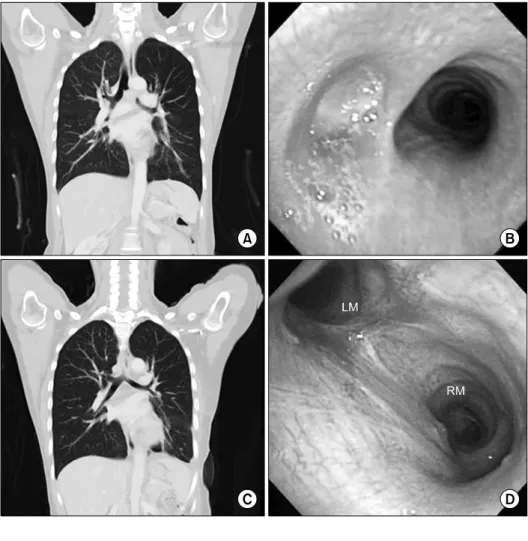
Computed tomography (CT) showed an endobronchial mass-like lesion obstructing the left main bronchus, stretching from the carina to 2 cm distal with segmental atelectasis and extraluminal invasion to subcarinal area (Fig. 1A). A bron-

choscopic finding revealed a yellowish endobronchial mass obstructing the proximal portion of the left main bronchus (Fig. 1B).

We planned segmental resection of the tumor containing left main bronchus which was followed by bronchoplasty us- ing end to end anastomosis. The operation was accomplished through a left posterolateral thoracotomy via the 4th inter- costal space. The most proximal left main brochus was trans- ected from carina for safe margin according to preoperative bronchoscopic finding, but unexpectedly the tumor was found to be grossly invading part of the carina extraluminally. We performed a complete tumor resection including part of the carina and the left main bronchus, followed by modified left one-stoma-type carinoplasty (Fig. 2) with tension free anasto- mosis by U-shaped pericardial incision below the left inferior pulmonary vein and reinforcement of the anastomotic site with the mediastinal fat pad.

In the macroscopic pathologic findings, a yellowish mass,

(2)

Jong In Kim, et al

− 264 −

Fig. 1. (A) Preoperative chest com- puted tomography (CT) scan shows an endobronchial mass obstructing the left main bronchus, and extra- luminally invading subcarinal area.

(B) Upon bronchoscopy, a endobron- chial mass obstructing the left main bronchus is noted. (C) Postoperative chest CT scan shows good patency of the airway. (D) Bronchoscopy sh- ows luminal patency at the anasto- motic site without narrowing at 6 months after operation. LM, left main bronchus; RM, right main bronchus.

Fig. 2. Schema of modified left one-stoma-type carinoplasty; resection of the proximal left main bronchus and part of the carina followed by partial closure of the upper portion of stoma and end to side anasto- mosis between the remnant distal portion of the left main bronchus and stoma of the carina.

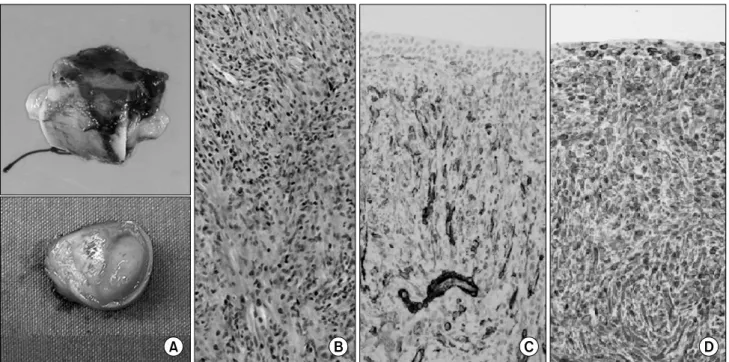
2.5×1×1 cm in size and almost completely obstructing the lu- men of the left main bronchus with focal extraluminal in- vasion to the carina was noted (Fig. 3A). Microscopically, we noted a fusiform nucleus with abundant fibrous matrix, in- filtration of lymphocytes and plasma cells (Fig. 3B). Tumor involved whole layer of bronchial wall and resection margins were free from tumor. A definitive pathological diagnosis of inflammatory pseudotumor was made according to im-

munohistochemical staining for actin (+), vimentin (+), S-100 (+, partial), and C-kit (−) (Fig. 3C, D).

A small amount of air leakage persisted until the 10th

postoperative day but ceased spontaneously. The luminal pa-

tency was good without recurrence or stenosis through 10

months after surgery according to CT scans and broncho-

scopy (Fig. 1C, D).

(3)

An Endobronchial Tumor Treated by Modified Left One-stoma-type Carinoplasty

− 265 −

Fig. 3. (A) Gross finding of resected endobronchial mass. (B) Microscopic findings showing abundant spindle cells and inflammatory cells (H&E, ×200). (C) Immunostaining for smooth muscle actin (×400) and (D) vimentin (×400) is diffusely strongly positive on the neoplastic cells.

DISCUSSION

Inflammatory myofibroblastic tumors are also known as plasma cell granulomas, inflammatory pseudotumors, xantho- mathous pseudotumors, fibrous histiocytomas, and mast cell granulomas. The main pathologic characteristic is spindle cell proliferation with a fibroinflammatory appearance. These tu- mors can develop in any part of the body but are most com- monly found in the thorax; however, they rarely manifest as primary lung tumors, with an incidence of only 0.04% to 1%

[1,2].

The cause of inflammatory myofibroblastic tumors is not completely understood, but several theories suggest that these lesions represent past inflammatory tissue reactions [3] and possibly immune-related lesions due to recent viral infections such as Epstein-Barr virus and human herpes virus-8. Howev- er, neoplastic disease is generally accepted as the cause based on the adjacent tissue invasion, metastasis, recurrence and molecular genetic evidence [2,4].

Inflammatory myofibroblastic tumors occur preferentially at a younger age, with an average reported onset of 37.9 years,

and in men (22 in 28 cases, 81.5%). The clinical manifes- tation is most commonly a cough and is often accompanied by dyspnea, sputum, hemoptysis, low fever, and chest pain.

An asymptomatic patient often may present with an incidental mass in radiologic images.

The most common site of origin is the intrapulmonary pa- renchyma, but endobronchial and bronchial lesions are rela- tively uncommon [5]. The histopathologic diagnosis before surgery is difficult because the lesion contains abundant in- flammatory tissue [1], and differential diagnosis from other primary pulmonary tumors is also difficult because the radio- logic findings are most commonly reported as a solitary well-demarcated tumor with or without calcification, cav- itation or multinodular densities. In addition, when the tumor size is very large, pneumonia or atelectasis induced by the secondary mass effect is apt to be misdiagnosed [6].

Complete surgical resection is an essential therapeutic modal- ity because incomplete tumor removal affects recurrence and prognosis [2,7].

In the operative technique, we performed resection of the

proximal left main bronchus and part of the carina containing

(4)

Jong In Kim, et al

− 266 − the extraluminally invaded endobronchial mass. Because of size discrepancy between large oval-shaped proximal stoma and the distal portion of the left main bronchus, we accom- plished partial repair of the upper portion of stoma using sev- eral stitches of interrupted 4-0 Vicryl (Ethicon Inc., Johnson and Johnson company, Somerville, NJ, USA) suture and then end to side anastomosis between the remnant distal portion of the left main bronchus and stoma of the carina (modified one-stoma-type carinoplasty) [8] (Fig. 2). We applied the hi- lar release technique by U-shaped pericardial incision below the left inferior pulmonary ligament for tension free anastomosis.

Modified one-stoma-type carinoplasty could make surgeons avoid an aggressive carinal resection for lung-saving and showed a good result without luminal narrowing.

There is much debate about the therapeutic effectiveness of radiotherapy, chemotherapy, and corticosteroid therapy when complete resection is not tolerable. In general, complete re- section results in a better prognosis [2,7], but a few delayed recurrence after surgical resection implies the need for long-term follow-up.

Here we reported a rare case of endobronchial myofibro- blastic tumor invading carina, even the access to the carina from left side is troublesome because of the anatomy of the aortic arch and narrow surgical field, we successfully treated

by complete resection with lung-saving modified left one-sto- ma-type carinoplasty.

REFERENCES

1. Sakurai H, Hasegawa T, Watanabe S, Suzuki K, Asamura H, Tsuchiya R. Inflammatory myofibroblastic tumor of the lung. Eur J Cardiothorac Surg 2004;25:155-9.

2. Cerfolio RJ, Allen MS, Nascimento AG, et al. Inflammatory pseudotumors of the lung. Ann Thorac Surg 1999;67:933-6.

3. Matsubara O, Tan-Liu NS, Kenney RM, Mark EJ. Inflam- matory pseudotumors of the lung: progression from organiz- ing pneumonia to fibrous histiocytoma or to plasma cell granuloma in 32 cases. Hum Pathol 1988;19:807-14.

4. Biselli R, Ferlini C, Fattorossi A, Boldrini R, Bosman C.

Inflammatory myofibroblastic tumor (inflammatory pseudotu- mor): DNA flow cytometric analysis of nine pediatric cases.

Cancer 1996;77:778-84.

5. Kim JH, Cho JH, Park MS, et al. Pulmonary inflammatory pseudotumor: a report of 28 cases. Korean J Intern Med 2002;17:252-8.

6. Copin MC, Gosselin BH, Ribet ME. Plasma cell granuloma of the lung: difficulties in diagnosis and prognosis. Ann Thorac Surg 1996;61:1477-82.

7. Mondello B, Lentini S, Barone M, et al. Surgical manage- ment of pulmonary inflammatory pseudotumors: a single center experience. J Cardiothorac Surg 2011;6:18.

8. Maeda M, Nakamoto K, Tsubota N, Okada T, Katsura H.

Operative approaches for left-sided carinoplasty. Ann Tho-

rac Surg 1993;56:441-5.

수치

Fig. 1. (A) Preoperative chest com- com-puted tomography (CT) scan shows  an endobronchial mass obstructing  the left main bronchus, and  extra-luminally invading subcarinal area
Fig. 3. (A) Gross finding of resected endobronchial mass. (B) Microscopic findings showing abundant spindle cells and inflammatory cells  (H&E, ×200)

참조

관련 문서