| Abstract |
1)PURPOSE: This study examined the factors related to school-based activity performance in school-aged children with spastic cerebral palsy (CP).
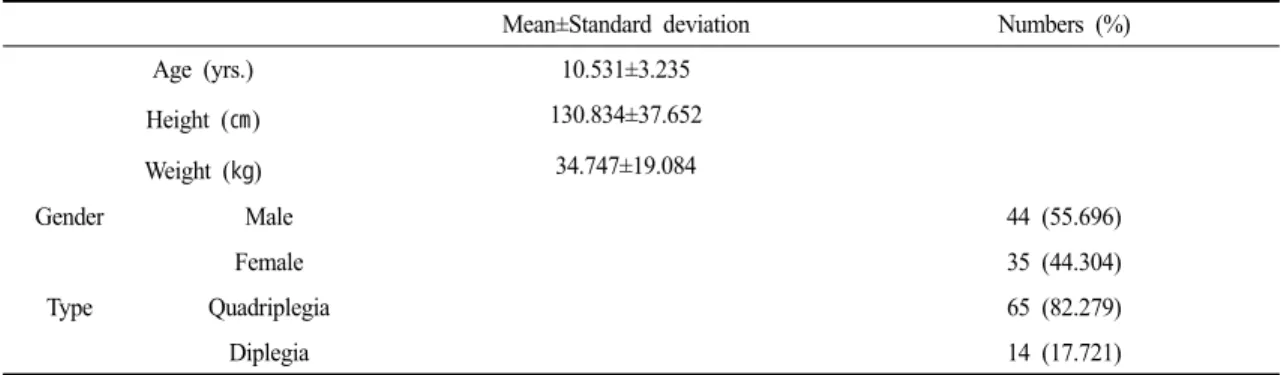
METHODS: The Gross Motor Function Systems (GMFCS), Manual Ability Classification System (MACS), Communication Function Classification System (CFCS) as functional classifications, and the physical activity performance of the School Function Assessment (SFA) were measured in 79 children with spastic CP to assess the student’s performance of specific school-related functional activities.
RESULTS: All the function classification systems were correlated significantly with the physical activity
†Corresponding Author : Won-Ho Kim
[email protected], https://orcid.org/0000-0002-8984-8328 This is an Open Access article distributed under the terms of the Creative Commons Attribution Non-Commercial License (http://creativecommons.org/licenses/by-nc/3.0) which permits unrestricted non-commercial use, distribution, and reproduction in any medium, provided the original work is properly cited.
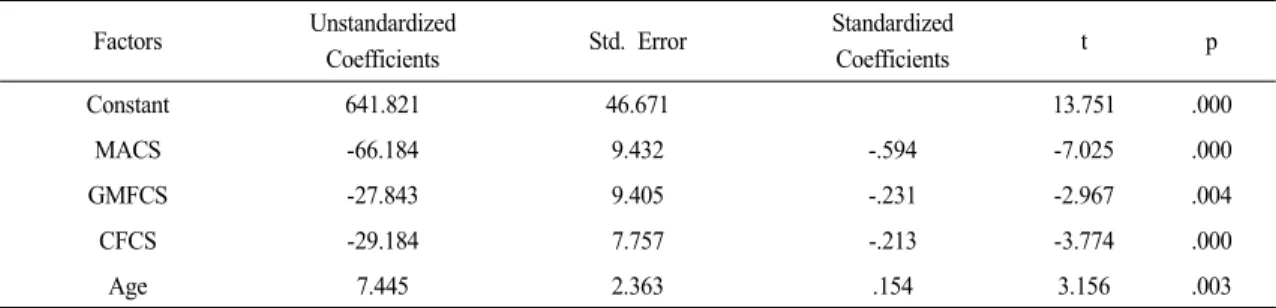
performance of the SFA (r s =-.47 to -.80) (p<.05). The MACS (β=-.59), GMFCS (β=-.23), CFCS (β=-.21), and age (β
=-.15) in order were predictors of the physical activity performance of the SFA (84.8%)(p<.05).
CONCLUSION: These functional classification systems can be used to predict the school-based activity performance in school-aged children with CP. In addition, they can contribute to the selection of areas for intensive interventions to improve the school-based activity performance.
Key Words: Cerebral palsy, Functional classification systems, School function assessment
Ⅰ . 서 론
뇌성마비는 비대칭 자세 및 반사, 비정상적 근육긴 장도 등 ]을 보이면서 원활한 움직임을 수행하지 못하고 더 나아가 또래에 맞는 활동이나 사회참여에 제한을 받는 만성적인 상태이다[1,2]. 따라서 사회구성원으로 서 역할을 수행할 수 있도록 하기 위해 다양한 형태의 치료와 교육이 지속적 필요하다.
Research Article Open Access
경직성 뇌성마비가 있는 학령기 아동의 학교기반 신체 활동수행력에 영향을 주는 요인