http://dx.doi.org/10.46670/JSST.2020.29.6.369 pISSN 1225-5475/eISSN 2093-7563
Position-Selective Metal Oxide Nanostructures using Atomic Thin Carbon Layer for Hydrogen Gas Sensors
Hak Ki Yu
+Abstract
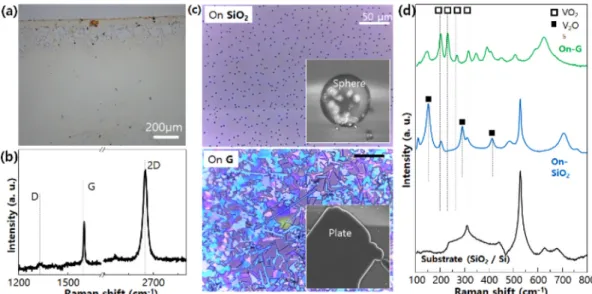
A hydrogen sensor was fabricated by utilizing a bundle of metal oxide nanostructures whose growth positions were selectively con- trolled by utilizing graphene, which is a carbon of atomic-unit thickness. To verify the reducing ability of graphene, it was confirmed that the multi-composition metal oxide V
2O
5was converted into VO
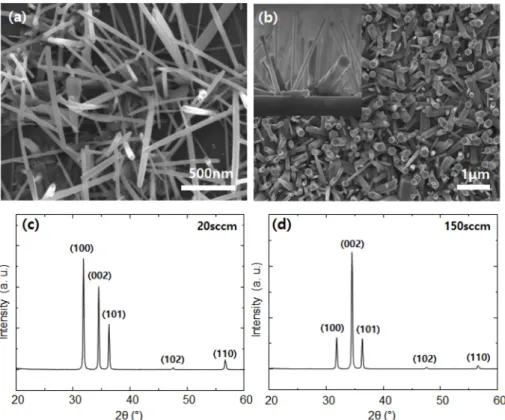
2on the graphene surface. Because of the role of graphene as a reducing catalyst, it was confirmed that ZnO and MoO
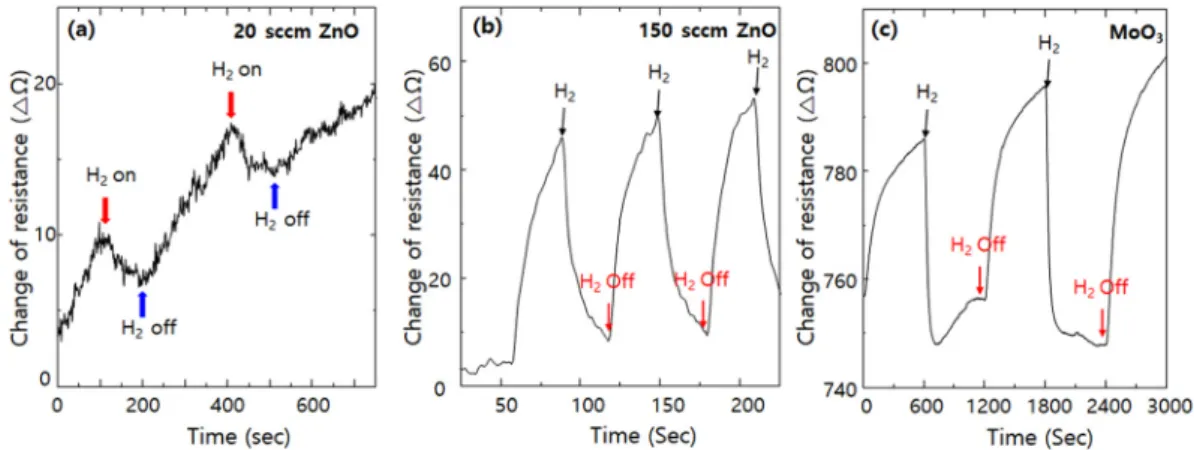
3nanostructures were grown at high density only on the graphene surface. The fabricated gas sensor showed excellent sensitivity.
Keywords: Metal oxide, Position selective growth, Atomic carbon layer, Hydrogen sensors
1. INTRODUCTION
The increased social/public interest in hydrogen as a future energy source has led to increasing demands for its safe use [1].
When hydrogen reaches a concentration of ≥4% in the atmosphere, it reacts with oxygen and explodes; hence, the accurate monitoring of gaseous hydrogen in real time is very important. An optical-based sensor is mainly required for concentrations ≥4%, whereas at low ppb-level concentrations, an electronic sensor capable of detecting trace amounts is used [2,3].
In other words, the overall management of hydrogen concentration requires the simultaneous use of two types of sensors.
To detect very low concentrations of hydrogen, numerous studies have been conducted on an electronic sensor that utilizes the change in the resistance of a metal oxide (MO
x) semiconductor. Hydrogen removes the OH group adsorbed on the metal oxide and increases the electron concentration on the surface, which increases the electrical conductivity of n-type oxide semiconductors; the opposite is true for p-type semiconductors [4]. To increase the sensitivity of such a gas sensor, it is necessary to increase the surface area. Thus, research has been conducted to
fabricate various metal oxide nanostructures for application in hydrogen sensors [5-8]. In general, for a nanostructured hydrogen sensor, a unit device is fabricated by forming an electrode after separating the synthesized nanostructure. If the detection device is fabricated using a single nanorod, the complex fabrication process (such as e-beam lithography) leads to lower productivity and higher processing costs. An alternative method is to synthesize a bundle of connected nanostructures to form an electrode, and then fabricating the sensor with high sensitivity.
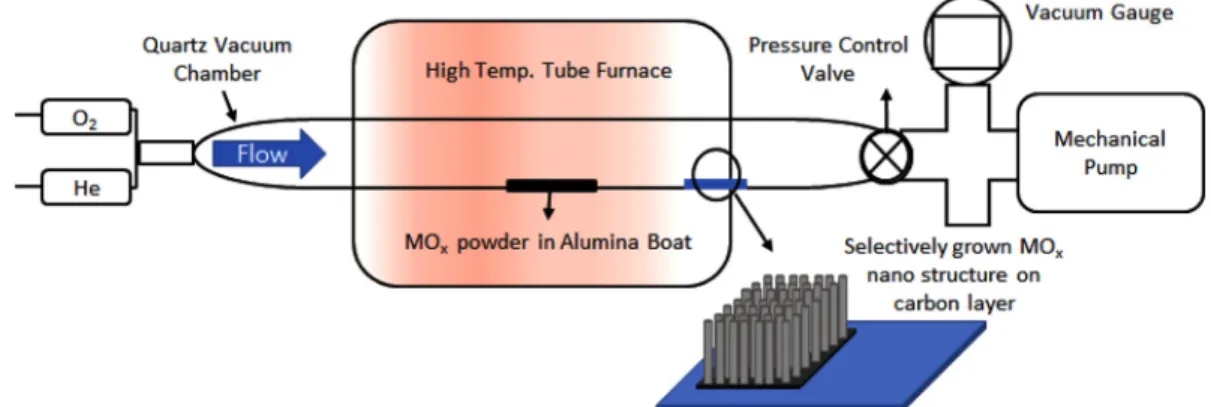
To apply such a bundle of nanostructures to a sensor, it is very important to have technology that can selectively grow nanostructures in a desired area. In this study, an atomic-unit-thick carbon layer (graphene) was used as a catalyst to control the growth position of these nanostructures. Carbon is a material with high reducing power, and the synthesis of nanostructures can be controlled by the following positional growth mechanism. The simplified chemical reaction formula is as follows:
C
(Carbon
)+ MO x (Powder) → CO
2(gas
)+ Metal
(gas
)Metal
(gas
)+ O
2(gas
)→ MO x
(nanostructure
)(on graphene)
To realize this idea experimentally, we focused on ZnO (n-type, T melt = 1975
oC) and MoO
3(n-type, T melt = 795
oC) catalysts. The MO
xnanostructures, which are automatically connected to each other owing to high-density nucleation on the graphene layer, are directly applied as gas sensors, specifically for hydrogen molecules.
1
Department of Materials Science and Engineering & Department of Energy Systems Research, Ajou University, Suwon, 16499, Republic of Korea
+