Background and Purpose Few studies have investigated the relationship between the spe- cific functional factors potentially associated with functional level and stroke recurrence. We conducted a study of patients with noncardioembolic ischemic stroke (NCIS) to determine the functional factors affecting recurrence within the first year.
Methods In total, 568 first-ever NCIS patients (age=65.1±17.4 years, mean±SD) were ana- lyzed in a multicenter, prospective cohort study registered from August 2012. Demographic characteristics, past medical history, comorbidities, laboratory data, stroke features in neuro- imaging, acute treatments, and medications at discharge were assessed. Functional factors re- flecting gross functional impairment, ambulatory function, motor function, activities of daily living, cognition, language ability, swallowing function, mood, and quality of life were compre- hensively evaluated in face-to-face assessments using standardized tools at the time of discharge.
Results The cumulative incidence of stroke recurrence in NCIS was 6.0% (n=34) at 1 year.
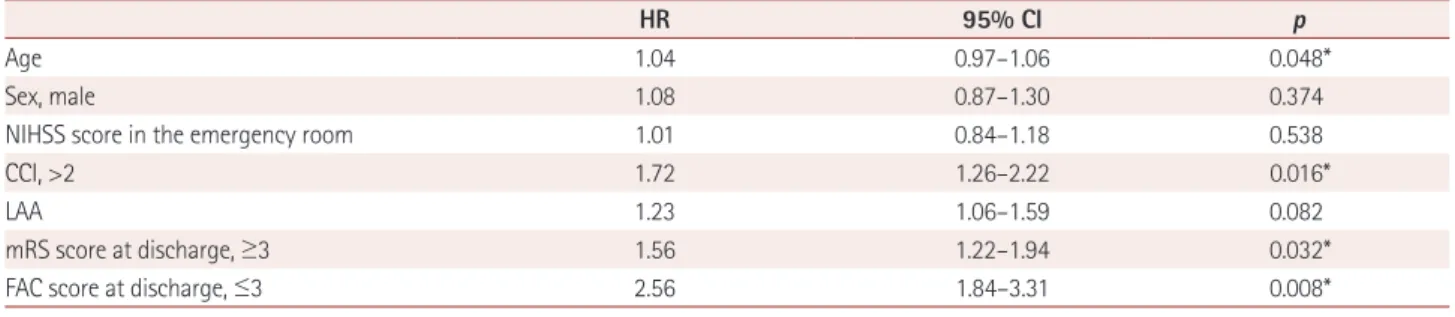
The period from admission to discharge was 34.4±7.0 days. The independent predictors of stroke recurrence within 1 year in multivariate Cox proportional-hazards regression analyses were 1) age [per-year hazard ratio (HR)=1.04, 95% confidence interval (CI)=0.97–1.06, p=0.048], 2) Charlson Comorbidity Index higher than 2 (HR=1.72, 95% CI=1.26–2.22, p=
0.016), 3) modified Rankin Scale score of 3 or more at discharge (HR=1.56, 95% CI=1.22–1.94, p=0.032), and 4) Functional Ambulation Category of 3 or less at discharge (HR=2.56, 95% CI=
1.84–3.31, p=0.008).
Conclusions In addition to patient age, moderate-to-severe functional impairment requiring the help of others (especially for ambulation) at the time of discharge and the severity of comor- bidity were independent predictors of stroke recurrence within 1 year of the first NCIS.
Key Words comorbidity, disability evaluation, function, recurrence, stroke.
Impact of Functional Status on Noncardioembolic Ischemic Stroke Recurrence Within 1 Year: The Korean Stroke Cohort for Functioning and Rehabilitation Study
INTRODUCTION
Compared to first-ever stroke, recurrent stroke is responsible for greater disability, with more- severe physical, psychological, and social impairments.1 Previous community-based stud- ies have revealed that 8–12% of stroke patients experience recurrence within 1 year after an initial stroke.1-3 Risk factors for stroke recurrence include prior stroke, hypertension, heart failure, diabetes, hyperlipidemia, metabolic syndrome, and poor lifestyle,4-7 and these factors have been extensively investigated for secondary stroke prevention. Stroke subtype, neuro- imaging findings, and several blood markers are also well-recognized risk factors for recur- rence, but these factors cannot be modified.8,9
While the current approach to secondary prevention primarily focuses on controlling these Min-Su Kima, Min Cheol Jooa
Min Kyun Sohnb, Jongmin Leec Deog Young Kimd, Sam-Gyu Leee Yong-Il Shinf, Soo-Yeon Kimf Gyung-Jae Ohg, Yang-Soo Leeh Eun Young Hani, Junhee Hanj Jeonghoon Ahnk, Won Hyuk Changl Yun-Hee Kiml
a Department of Rehabilitation Medicine, Wonkwang University School of Medicine and Institute of Wonkwang Medical Science, Iksan, Korea
b Department of Rehabilitation Medicine, School of Medicine, Chungnam National University, Daejeon, Korea
c Department of Rehabilitation Medicine, Konkuk University School of Medicine, Seoul, Korea
d Department and Research Institute of Rehabilitation Medicine, Yonsei University College of Medicine, Seoul, Korea
e Department of Physical and Rehabilitation Medicine, Chonnam National University Medical School, Gwangju, Korea
f Department of Rehabilitation Medicine, Pusan National University School of Medicine, Pusan National University
Yangsan Hospital, Yangsan, Korea
g Department of Preventive Medicine, Wonkwang University School of Medicine, Iksan, Korea
h Department of Rehabilitation Medicine, Kyungpook National University School of Medicine, Kyungpook National University Hospital, Daegu, Korea
i Department of Rehabilitation Medicine, Jeju National University Hospital, Jeju National University School of Medicine, Jeju, Korea
j Department of Statistics, Hallym University, Chuncheon, Korea
k Department of Health Convergence, Ewha Womans University, Seoul, Korea
l Department of Physical and Rehabilitation Medicine, Sungkyunkwan University School of Medicine, Seoul, Korea
pISSN 1738-6586 / eISSN 2005-5013 / J Clin Neurol 2019;15(1):54-61 / https://doi.org/10.3988/jcn.2019.15.1.54
Received April 26, 2018 Revised August 20, 2018 Accepted August 21, 2018 Correspondence Yun-Hee Kim, MD, PhD Department of Physical and Rehabilitation Medicine, Sungkyunkwan University School of Medicine, 81 Irwon-ro, Gangnam-gu, Seoul 06351, Korea Tel +82-2-3410-2824
Fax +82-2-3410-0388 E-mail [email protected] Min Cheol Joo, MD, PhD
Department of Rehabilitation Medicine, Wonkwang University School of Medicine and Institute of Wonkwang Medical Science, 895 Muwang-ro, Iksan 54538, Korea
Tel +82-63-859-1610 Fax +82-63-843-1385 E-mail [email protected]
cc This is an Open Access article distributed under the terms of the Creative Commons Attribution Non-Com- mercial License (https://creativecommons.org/licenses/by-nc/4.0) which permits unrestricted non-commercial use, distribution, and reproduction in any medium, provided the original work is properly cited.
JCN
Open Access ORIGINAL ARTICLEKim MS et al.
JCN
risk factors, there has been unsatisfactory progress in pre- venting recurrence. Functional status and rehabilitation are also recently identified factors that are significant for recur- rence.10,11 Functional status refers to the ability of an individual to perform the normal daily activities required to meet basic needs, fulfill usual roles, and maintain health and well-be- ing.12,13 Functional status subsumes related concepts of inter- est; functional capacity and functional performance.12 While functional capacity represents the capacity of an individual to perform daily activities in the physical, psychological, social, and spiritual domains of life, functional performance refers to the activities that people actually participate in during the course of their daily lives.12 Functional impairment means the loss of functional status, and it was used in the restricted sense of activity limitation in the present study.14 For example, Park and Ovbiagele11 reported stepwise relationships between in- creasing disability and risk of recurrent stroke that contrasted with the outcomes in patients with no disability. Impaired physical activity is a major risk factor for stroke occurrence, and exercise is recommended to prevent stroke and cardiovas- cular events.15 In addition, early functional recovery after stroke can enable survivors to increase their active physical ac- tivity and thereby ultimately reduce the probability of stroke recurrence.
However, there has been little research into the potential associations of specific functional indicators with functional impairment and stroke recurrence. It is especially necessary to establish an appropriate rehabilitation strategy to prevent recurrence. Therefore, we conducted a prospective observa- tional study of patients with noncardioembolic ischemic stroke (NCIS) to determine functional indicators that affect recurrence within the first year.
METHODS
Patient selection
This study was based on the Korean Stroke Cohort for Func- tioning and Rehabilitation (KOSCO) report.16 The study pro- tocols were approved by the ethics committee of each hospital.
The study objectives, design, and risks/benefits were explained to the patients, and written informed consent was obtained upon hospitalization. The study protocols were approved by the ethics committee of each hospital (IRB No. WKUH-1515).
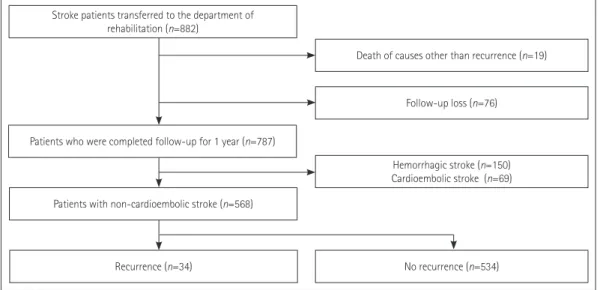
This study enrolled 882 first-ever NCIS patients transferred to a department of rehabilitation after being treated for acute stroke (Fig. 1). Trial of Org 10,172 in Acute Stroke Treatment (TOAST) criteria were used to detect NCIS.17 These ischemic stroke subtypes were determined by stroke neurologists at each participating hospital based on neuroimaging findings, medical history, and use of medication. The patients were dis- charged from the participating hospitals after undergoing inpatient rehabilitation for approximately 3 weeks. Patients who died (n=19) due to causes other than stroke recurrence or were lost to follow-up (n=76) during the 1-year analysis pe- riod were excluded. The causes of death of these patients were as follows: pneumonia (n=11), cardiac event (n=3), cancer (n=
2), traffic accident (n=2), and liver cirrhosis (n=1). Among the 787 patients who completed follow-up, hemorrhagic (n=
150) and cardioembolic ischemic stroke (n=69) patients were excluded. Therefore, 568 patients with NCIS were finally se- lected for this study.
Demographic and clinical assessments
A complete data survey of all patients was conducted based on a review of medical records. Items including demographic data, cerebrovascular risk factors, and family/social history were
Stroke patients transferred to the department of rehabilitation (n=882)
Patients who were completed follow-up for 1 year (n=787)
Patients with non-cardioembolic stroke (n=568)
Recurrence (n=34)
Death of causes other than recurrence (n=19)
Follow-up loss (n=76)
No recurrence (n=534) Hemorrhagic stroke (n=150) Cardioembolic stroke (n=69)
Fig. 1. Patient selection flowchart.
Functional Risk Factors for Stroke Recurrence
JCN
surveyed using standardized, structured questionnaires. The National Institutes of Health Stroke Scale (NIHSS) was used to evaluate the severity of neurological deficits in the emergency room. Comorbidities were assessed using the Charlson Co- morbidity Index (CCI), which contains 19 categories of co- morbidity and predicts the mortality of patients who may have a range of comorbid conditions.18-20 Because higher CCIs in- dicate greater comorbidities, we divided the patients into two groups based on a CCI of 2 points, and analyzed the risk of re- currence separately in these groups.18 Laboratory data, stroke features, acute treatments, and medications commonly pre- scribed at discharge were assessed.
Functional status evaluation
Comprehensive face-to-face functional evaluations were per- formed at discharge. All evaluations were conducted by re- search assistants who were sufficiently trained and rigorously tested. The functional status in terms of the level of depen- dency, ambulation, motor function, activities of daily living, cognition, language ability, swallowing function, mood, and health-related quality of life were evaluated extensively at dis- charge after receiving stroke rehabilitation using the follow- ing standardized tools: modified Rankin Scale (mRS),21 Func- tional Ambulation Category (FAC),22 Fugl-Meyer Assessment (FMA),23 Functional Independence Measure (FIM),24 Korean version of the Mini Mental State Examination (K-MMSE),25 Korean version of the Frenchay Aphasia Screening Test (K- FAST),26 American Speech-Language-Hearing Association National Outcome Measurement System Swallowing Scale (ASHA-NOMS),27 Geriatric Depression Scale–Short Form (GDS-SF),28 and EuroQoL-5 Dimensions (EQ-5D),29 respec- tively (Supplementary Table 1 in the online-only Data Supple- ment).
Several functional indicators were analyzed after dichoto- mization according to the degree of dependence or severity in order to establish possible rehabilitation strategies in the future. For example, a mRS score of 3 or more indicates that the patient has moderate-to-severe functional impairment, and a FAC score of 3 or less means that the patient requires man- ual contact with another person during ambulation on level surfaces. The FMA motor score was divided into two groups according to the severity: mild (>79) and moderate to severe (0–79).23 The FIM ranges from 18 to 126 points and is a com- mon tool used for assessing the ability to perform the activi- ties of daily living.24 These assessments were performed in the present study based on dividing the level of dependence on others into two groups: mild (>90) and moderate to severe (18–90).24 The K-MMSE score was analyzed by dividing the patients into two groups, with scores of 0–23 points indicat- ing moderate-to-severe cognitive impairment and scores of
more than 23 points indicating mild cognitive dysfunction.25 The ASHA-NOMS scores were also analyzed by dividing pa- tients into two groups corresponding to normal (7 points) and abnormal (≤6 points) swallowing function.
Identification of stroke recurrence within 1 year Detailed information about stroke recurrence was collected at 3 months, 6 months, and 1 year after stroke onset. All pa- tients were approached for follow-up assessments using a two- step approach.16 We first regularly obtained follow-up infor- mation via telephone interviews with the patients themselves or their caregivers. All of the survivors were subsequently in- vited to visit the outpatient clinics of the hospitals where they were first admitted to complete a battery of functional assess- ments, structured self-administered questionnaires, and face- to-face interviews. If patients were not able to return for the fol- low-up assessments, research assistants visited the patients at their homes to perform these same evaluations. Stroke re- currence was confirmed based on the medical records of each participating hospital whenever the patients themselves or their caregivers reported recurrence during these follow-up initiatives.
Statistical analysis
We used univariate Cox proportional-hazards regression to identify differences in baseline characteristics between patients with and without recurrence. Hazard ratios (HRs) and 95%
confidence intervals (CIs) were calculated using the univari- ate Cox proportional-hazards model. We also determined the risk of subsequent stroke recurrence in relation to each vari- able by using multivariate Cox proportional-hazards regres- sion analysis. A backward conditional procedure was per- formed using p>0.10 in the likelihood ratio test for exclusion.
The regression model included the time to recurrent stroke as the response, and clinical/functional predictors of recur- rence with a univariate probability value of p<0.1 as an inde- pendent variable. Because sex and the initial NIHSS score measured in the emergency room are well-known factors in- volved in stroke recurrence,30-32 these factors were additionally included and analyzed in the final model. The Kaplan-Meier method was used to evaluate the distribution of time to events according to the characteristics derived from the multivariate Cox proportional-hazards regression analysis. Intergroup comparisons were performed using the log-rank test. A prob- ability value of p<0.05 was considered significant. All analyses were performed using SPSS statistical software (version 22.0;
IBM Corp., Armonk, NY, USA).
Kim MS et al.
JCN
Table 1. Clinical characteristics of the patients and HRs from the univariate Cox proportional-hazards regression analyses for stroke recurrence Recurrence: yes (n=34, %) Recurrence: no (n=534, %) HR (95% CI) p Baseline characteristics
Age, years 70.3±13.0 63.7±19.4 1.04 (0.97–1.06) 0.016*
Sex, male 60 58 1.21 (0.67–1.82) 0.309
BMI, kg/m2 23.1±3.1 23.5±3.4 0.96 (0.90–1.02) 0.209
Marital status, married 79 78 1.17 (0.45–2.02) 0.470
Education, ≥high school 48 49 1.00 (0.38–1.62) 0.992
Family history 11 9 1.48 (0.98–2.12) 0.169
Smoking 57 53 1.06 (0.82–1.35) 0.771
Alcohol 65 62 1.11 (0.74–1.55) 0.582
CCI, >2 27 15 2.20 (1.30–3.24) 0.008*
Past medical history
Hypertension 61 58 1.05 (0.46–1.67) 0.781
Diabetes mellitus 30 29 1.34 (0.40–2.33) 0.134
Ischemic heart disease 8 7 1.20 (0.52–1.73) 0.596
Atrial fibrillation 8 6 1.80 (1.02–3.03) 0.060*
Hyperlipidemia 13 10 1.73 (1.12–2.88) 0.055*
Initial neurological deficits in the emergency room
NIHSS score 8.6±6.2 9.5±6.9 1.01 (0.74–1.52) 0.325
Laboratory data on admission
Fasting glucose, mg/dL 101±16 104±18 1.00 (0.89–1.11) 0.681
Total cholesterol, mg/dL 176±41 178±44 0.99 (0.95–1.05) 0.325
LDL-C, mg/dL 105±32 108±36 1.00 (0.89–1.09) 0.483
HDL-C, mg/dL 45±13 46±17 0.98 (0.90–1.06) 0.889
Triglycerides, mg/dL 124±76 121±78 1.00 (0.88–1.12) 0.450
Creatinine, mg/dL 0.9±0.6 1.0±0.6 0.94 (0.90–1.00) 0.699
Homocysteine, µmol/L 10.7±17.5 9.2±10.6 1.01 (0.86–1.16) 0.812
Stroke features
Lesion side, left 50 46 0.83 (0.39–1.69) 0.296
Location, brain stem 30 30 1.07 (0.68–1.52) 0.729
Subtypes
LAA 81 77 2.19 (1.33–3.42) 0.028*
Small-vessel occlusion 18 21 1.02 (0.60–1.45) 0.113
Others 1 2
Acute-phase therapies
IV tPA 5 6 0.85 (0.49–1.16) 0.712
IA tPA 5 4 1.46 (0.68–2.32) 0.224
IV heparin 9 10 1.18 (0.63–1.94) 0.328
Antiplatelet 81 80 1.44 (1.02–1.82) 0.123
Medications at discharge
Antiplatelet 71 76 0.84 (0.45–1.26) 0.443
Anticoagulation 10 10 0.99 (0.82–1.19) 0.220
Antihypertensive 47 41 1.26 (0.94–1.66) 0.199
Antidiabetic 24 19 1.08 (0.79–1.28) 0.748
Antilipid 73 68 1.20 (0.93–1.63) 0.347
Noncategoric data are expressed as mean±SD values. Categoric data are expressed as percentage values.
*p<0.10.
BMI: body mass index, CCI: Charlson Comorbidity Index, CI: confidence interval, HDL-C: high-density lipoprotein cholesterol, HR: hazard ratio, IA: intra- arterial, IV: intravenous, LAA: large-artery atherosclerosis, LDL-C: low-density lipoprotein cholesterol, NIHSS: National Institutes of Health Stroke Scale, tPA: tissue plasminogen activator.
Functional Risk Factors for Stroke Recurrence
JCN
RESULTS
This study analyzed 568 patients (age=65.1±17.4 years, mean±
SD; 318 males and 250 females), of which 34 patients expe- rienced recurrent stroke during the 1-year observation period, giving a recurrence rate following NCIS of 6.0% (34/568).
Four patients died due to stroke recurrence. The period to dis- charge after stroke onset was 34.4±7.0 days, and we identi- fied that NCIS was caused by large-artery atherosclerosis in 446 (79%) patients, small-vessel occlusion in 108 (19%) patients, and another cause in 14 (2%) patients.
Univariate analyses
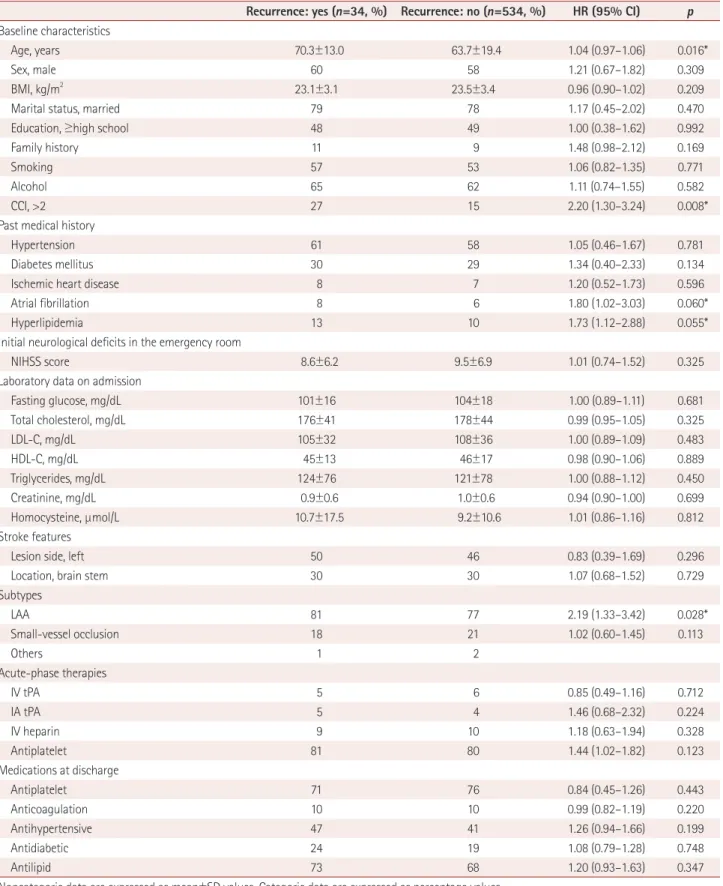
The clinical characteristics, laboratory data, stroke features, and medications prescribed at discharge are presented in Ta- ble 1. Age (HR=1.04, 95% CI=0.97–1.06, p=0.016), a CCI higher than 2 (HR=2.20, 95% CI=1.30–3.24, p=0.008), atrial fibrillation (HR=1.80, 95% CI=1.02–3.03, p=0.060), hyperlip- idemia (HR=1.73, 95% CI=1.12–2.88, p=0.055), and large-ar- tery atherosclerosis (HR=2.19, 95% CI=1.33–3.42, p=0.028)
were significantly associated with stroke recurrence.
Table 2 presents the results for the functional factors asso- ciated with the risk of stroke recurrence. The period to dis- charge after stroke onset was 34.8±6.8 days in the patients with recurrent stroke and 34.2±7.0 days in those who were recurrence-free during the 1-year analysis period. Significant associations with the risk of stroke recurrence were found for an mRS score of 3 or more (HR=1.85, 95% CI=1.28–2.54, p=
0.010), an FAC score of 3 or less (HR=3.89, 95% CI=2.32–5.65, p<0.001), and an FMA motor score of 79 or less (HR=1.46, 95% CI=1.02–1.90, p=0.048).
Multivariate analyses
A subsequent analysis was performed of all significant vari- ables after the univariate analyses. As indicated in Table 3, the independent predictors of stroke recurrence within 1 year after onset in the multivariate Cox proportional-hazards regression analysis were 1) patient age (per-year HR=1.04, 95% CI=0.97–1.06, p=0.048), 2) CCI higher than 2 (HR=
1.72, 95% CI=1.26–2.22, p=0.016), 3) mRS score of 3 or more Table 2. Functional status assessed at discharge and the results of the univariate Cox proportional-hazards regression analysis
Functional indicator Recurrence: yes (n=34, %) Recurrence: no (n=534, %) HR (95% CI) p
mRS score, ≥3 42 35 1.85 (1.28–2.54) 0.010*
FAC score, ≤3 47 34 3.89 (2.32–5.65) <0.001*
FMA motor score, 0–79 48 42 1.46 (1.02-1.90) 0.048*
FIM, 18–90 50 46 1.34 (0.94–1.74) 0.126
K-MMSE score, 0–23 49 51 1.12 (0.86–1.40) 0.233
K-FAST score 6.1±1.7 6.2±1.6 1.04 (0.80–1.28) 0.421
ASHA-NOMS score, ≤6 32 29 0.78 (0.29–1.33) 0.250
GDS-SF score 2.6±1.6 2.2±1.5 0.99 (0.80–1.19) 0.407
EQ-5D score 0.65±0.37 0.60±0.35 1.01 (0.98–1.04) 0.207
Period to discharge, days 34.8±6.8 34.2±7.0 0.93 (0.84–1.04) 0.124
Noncategoric data are expressed as mean±SD values. Categoric data are expressed as percentage values.
*p<0.10.
ASHA-NOMS: American Speech-Language-Hearing Association National Outcome Measurement System Swallowing Scale, CI: confidence interval, EQ-5D: EuroQoL-5 Dimensions, FAC: Functional Ambulation Category, FIM: Functional Independence Measure, FMA: Fugl-Meyer Assessment, GDS-SF:
Geriatric Depression Scale-Short Form, HR: hazard ratio, K-FAST: Korean version of the Frenchay Aphasia Screening Test, K-MMSE: Korean version of the Mini Mental State Examination, mRS: modified Rankin Scale.
Table 3. Results of multivariate Cox proportional-hazards regression analyses for stroke recurrence
HR 95% CI p
Age 1.04 0.97–1.06 0.048*
Sex, male 1.08 0.87–1.30 0.374
NIHSS score in the emergency room 1.01 0.84–1.18 0.538
CCI, >2 1.72 1.26–2.22 0.016*
LAA 1.23 1.06–1.59 0.082
mRS score at discharge, ≥3 1.56 1.22–1.94 0.032*
FAC score at discharge, ≤3 2.56 1.84–3.31 0.008*
*p<0.05.
CCI: Charlson Comorbidity Index, CI: confidence interval, FAC: Functional Ambulation Category, HR: hazard ratio, LAA: large-artery atherosclerosis, mRS: modified Rankin Scale, NIHSS: National Institutes of Health Stroke Scale.
Kim MS et al.
JCN
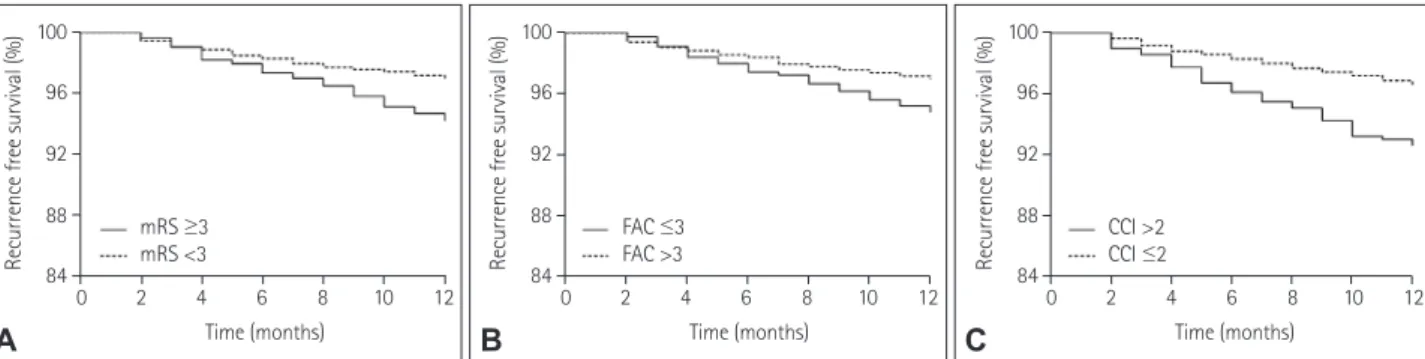
(HR=1.56, 95% CI=1.22–1.94, p=0.032), and 4) FAC score of 3 or less (HR=2.56, 95% CI=1.84–3.31, p=0.008). According to the Kaplan-Meier analysis, there were significant differences in recurrence-free survival between patients with mRS score
≥3 and mRS score <3 at discharge (p=0.034, log-rank test), and between patients with FAC score ≤3 and FAC score >3 at discharge (p=0.016, log-rank test) (Fig. 2). In addition, the recurrence-free survival period was significantly shorter for patients with CCI >2 than for those with CCI ≤2 (p=0.028, log-rank test).
DISCUSSION
The present study found that functional impairment (espe- cially ambulatory function) at discharge, age, and the severity of comorbidities were independent predictors of recurrence within 1 year after the onset of NCIS. The results of this study imply that applying other interventions to promote function—
in addition to previously developed medical treatments for secondary stroke prevention—may reduce the probability of stroke recurrence.
The functional status based on the mRS score after simpli- fication into two categories (no or slight functional impair- ment and moderate-to-severe functional impairment) was a strong indicator of recurrence. It was previously shown that functional impairment at approximately 1 month poststroke is related to long-term functional outcome,21 and the present results are similar to those reported previously.11,33 It was re- ported that compared to no/slight functional impairment (mRS score ≤2), moderate functional impairment (mRS score=3) after a recent NCIS was independently associated with an al- most 1.5-fold higher risk of recurrent stroke within 2 years.11 The mRS did not indicate impairment of any specific func- tional domains, since it is an index of the overall dependence according to the severity of gross functional impairment.34 However, the previous study did not precisely consider what functional deficits were underlying these findings. Instead,
reactive depression arising from clearly more-disabling con- sequences, and vitamin D deficiency due to limited mobility and decreased sunlight exposure were thought to be the fac- tors underlying the low mRS scores and stroke recurrence.11
In contrast, our present comprehensive analysis of overall functional indicators has confirmed that ambulatory func- tion is a critical factor for stroke recurrence. Those patients who needed help from others or were not able to walk at all (FAC score ≤3) were approximately 2.5-fold more likely to experience recurrence than those who did not have such defi- cits. The underlying mechanisms linking ambulatory func- tion and stroke recurrence remain unclear, but they can be in- ferred from several reports. Kono et al.35 reported that physical activity quantified based on the step count during ambula- tion was an independent predictor of the recurrence of vascu- lar events (68% for stroke and 32% for coronary heart dis- ease) in stroke survivors. It is widely known that lifestyle modifications for secondary stroke prevention significantly reduce the probability of stroke recurrence and other vascu- lar events, and physical activity also tends to be associated with stroke recurrence.7,36,37 Another study found that walking itself enhanced endogenous fibrinolysis by increasing tissue plas- minogen activator and decreasing the activity of plasminogen activator inhibitor PAI-1 in stroke patients.38 Moreover, Cheng et al.10 discovered that rehabilitation during the first year af- ter stroke was significantly associated with a lower incidence of recurrent stroke and all-cause mortality. Therefore, a reha- bilitation strategy that focuses on the recovery of ambulatory function should be strongly considered to prevent recurrence.
Comorbidity was also a strong predisposing factor for re- currence in patients with NCIS. Although there has been lit- tle research into the relevance of comorbidities to stroke re- currence, a few possible mechanisms can be considered. It is known that the CCI is a strong predictor of both mortality and stroke occurrence.18,39 A previous comparison of very severe comorbidity with no comorbidity found ischemic stroke in- creased both the 30-day and 5-year mortality rates by approx-
100 96 92 88 84
100 96 92 88 84
100 96 92 88
Recurrence free survival (%) Recurrence free survival (%) Recurrence free survival (%) 84
0 2 4 6 8 10 12 0 2 4 6 8 10 12 0 2 4 6 8 10 12
Time (months) Time (months) Time (months)
mRS ≥3
mRS <3 FAC ≤3
FAC >3 CCI >2
CCI ≤2
A B C
Fig. 2. Differences in the recurrence-free survival according to the Kaplan-Meier analysis. Significant differences in recurrence-free survival rate were found for the mRS score (A), the FAC score at discharge (B), and the CCI (C). CCI: Charlson Comorbidity Index, FAC: Functional Ambulatory Cate- gory, mRS: modified Rankin Scale.
Functional Risk Factors for Stroke Recurrence
JCN
imately 2.5-fold.18 Comorbidity is also an important factor in poststroke functional recovery.40 Insufficient rehabilita- tion therapies and repeated hospitalization due to multiple comorbidities contribute to poor functional outcomes.41 Poor functional recovery in patients with multiple comorbidities cause decreased physical activity and deconditioning,42,43 which lead to arterial stiffness, increased atherosclerosis, and fail- ure to control other stroke risk factors.43,44 These processes were therefore considered to increase the probability of stroke recurrence.
Several limitations of the present study should be consid- ered when interpreting its findings. We confirmed stroke re- currence after calling the patients themselves or their caregivers by telephone at each time point. Although the research assis- tants visited the homes of the patients after establishing phone contact, a limitation was the difficulty of determining recur- rence if the patients or caregivers could not be reached by telephone. Furthermore, a larger number of recurrent stroke patients may be missed by our protocol compared with a methodology utilizing a nationwide stroke registry to identify recurrence. The functional data at discharge of the patients who were not followed up are summarized in Supplementary Table 1 (in the online-only Data Supplement). We thought that patients with greater functional impairment due to neu- rological deficits were more likely to be lost to follow-up, but there were no differences in functional status. We consider it most likely that these patients stopped participating in the research intentionally during the follow-up for personal rea- sons. The degree of compliance with the protocol of this study was not investigated, and so the factors influencing compli- ance should be analyzed in a future study. Although the 76 patients who were lost to follow-up within 1 year accounted for a small proportion of the overall population, their exclu- sion may have influenced the results. In addition, informa- tion on adherence to medications for secondary prevention and good health-related behaviors was not collected during the follow-up. In Korea, medication prescriptions for second- ary prevention and educating about health-related behaviors are mainly the responsibility of neurologists. However, the re- searchers visiting the present patients received regular training about medications and habitual education. They also taught the patients to comply with taking their medications and follow their instructions for behavioral changes during every visit.
However, the actual compliance with these activities was not investigated in this study.
In conclusion, moderate-to-severe functional impairment at the time of discharge requiring the help of others (espe- cially for ambulation) and the severity of comorbidity in ad- dition to age were confirmed to be independent risk factors for stroke recurrence within 1 year of onset in patients with
NCIS. Additional treatments focused on the recovery of am- bulatory function may be a good strategy for preventing stroke recurrence.
Supplementary Materials
The online-only Data Supplement is available with this arti- cle at https://doi.org/10.3988/jcn.2019.15.1.54.
Conflicts of Interest
The authors have no financial conflicts of interest.
Acknowledgements
This study was supported by the Research Program funded by the Korea Centers for Disease Control and Prevention (2016E-33003-02), Korea.
REFERENCES
1. Elkind MS. Outcomes after stroke: risk of recurrent ischemic stroke and other events. Am J Med 2009;122(4 Suppl 2):S7-S13.
2. Kuwashiro T, Sugimori H, Ago T, Kamouchi M, Kitazono T; FSR In- vestigators. Risk factors predisposing to stroke recurrence within one year of non-cardioembolic stroke onset: the Fukuoka Stroke Regis- try. Cerebrovasc Dis 2012;33:141-149.
3. Hillen T, Coshall C, Tilling K, Rudd AG, McGovern R, Wolfe CD;
South London Stroke Register. Cause of stroke recurrence is multi- factorial: patterns, risk factors, and outcomes of stroke recurrence in the south London stroke register. Stroke 2003;34:1457-1463.
4. Callaly E, Ni Chroinin D, Hannon N, Marnane M, Akijian L, Shee- han O, et al. Rates, predictors, and outcomes of early and late recur- rence after stroke: the North Dublin Population Stroke Study. Stroke 2016;47:244-246.
5. Andersen SD, Gorst-Rasmussen A, Lip GY, Bach FW, Larsen TB. Re- current stroke: the value of the CHA2DS2VASc score and the essen stroke risk score in a nationwide stroke cohort. Stroke 2015;46:2491- 2497.
6. Furie KL, Kasner SE, Adams RJ, Albers GW, Bush RL, Fagan SC, et al. Guidelines for the prevention of stroke in patients with stroke or transient ischemic attack: a guideline for healthcare professionals from the American Heart Association/American Stroke Association.
Stroke 2011;42:227-276.
7. Kono Y, Yamada S, Kamisaka K, Araki A, Fujioka Y, Yasui K, et al.
Recurrence risk after noncardioembolic mild ischemic stroke in a Japanese population. Cerebrovasc Dis 2011;31:365-372.
8. Elkind MS, Luna JM, McClure LA, Zhang Y, Coffey CS, Roldan A, et al. C-reactive protein as a prognostic marker after lacunar stroke: lev- els of inflammatory markers in the treatment of stroke study. Stroke 2014;45:707-716.
9. Kim GM, Park KY, Avery R, Helenius J, Rost N, Rosand J, et al. Ex- tensive leukoaraiosis is associated with high early risk of recurrence after ischemic stroke. Stroke 2014;45:479-485.
10. Cheng YY, Shu JH, Hsu HC, Liang Y, Chang ST, Kao CL, et al. The impact of rehabilitation frequencies in the first year after stroke on the risk of recurrent stroke and mortality. J Stroke Cerebrovasc Dis 2017;
26:2755-2762.
11. Park JH, Ovbiagele B. Relationship of functional disability after a re- cent stroke with recurrent stroke risk. Eur J Neurol 2016;23:361-367.
12. Leidy NK. Functional status and the forward progress of merry-go- rounds: toward a coherent analytical framework. Nurs Res 1994;43:
196-202.
13. Wilson IB, Cleary PD. Linking clinical variables with health-related quality of life. A conceptual model of patient outcomes. JAMA 1995;
273:59-65.
Kim MS et al.
JCN
14. Ustün B, Kennedy C. What is “functional impairment?” Disentan- gling disability from clinical significance. World Psychiatry 2009;8:
82-85.
15. Saunders DH, Greig CA, Mead GE. Physical activity and exercise after stroke: review of multiple meaningful benefits. Stroke 2014;45:3742- 3747.
16. Chang WH, Sohn MK, Lee J, Kim DY, Lee SG, Shin YI, et al. Korean stroke cohort for functioning and rehabilitation (KOSCO): study ra- tionale and protocol of a multi-centre prospective cohort study. BMC Neurol 2015;15:42.
17. Adams HP Jr, Bendixen BH, Kappelle LJ, Biller J, Love BB, Gordon DL, et al. Classification of subtype of acute ischemic stroke. Defini- tions for use in a multicenter clinical trial. TOAST. Trial of Org 10172 in acute stroke treatment. Stroke 1993;24:35-41.
18. Schmidt M, Jacobsen JB, Johnsen SP, Bøtker HE, Sørensen HT. Eigh- teen-year trends in stroke mortality and the prognostic influence of comorbidity. Neurology 2014;82:340-350.
19. Chang WH, Sohn MK, Lee J, Kim DY, Lee SG, Shin YI, et al. Predic- tors of functional level and quality of life at 6 months after a first-ever stroke: the KOSCO study. J Neurol 2016;263:1166-1177.
20. Fried L, Bernardini J, Piraino B. Charlson comorbidity index as a predictor of outcomes in incident peritoneal dialysis patients. Am J Kidney Dis 2001;37:337-342.
21. Ovbiagele B, Lyden PD, Saver JL; VISTA Collaborators. Disability sta- tus at 1 month is a reliable proxy for final ischemic stroke outcome.
Neurology 2010;75:688-692.
22. Mehrholz J, Wagner K, Rutte K, Meissner D, Pohl M. Predictive valid- ity and responsiveness of the functional ambulation category in hemi- paretic patients after stroke. Arch Phys Med Rehabil 2007;88:1314- 1319.
23. Duncan PW, Goldstein LB, Horner RD, Landsman PB, Samsa GP, Matchar DB. Similar motor recovery of upper and lower extremities after stroke. Stroke 1994;25:1181-1188.
24. Ancheta J, Husband M, Law D, Reding M. Initial functional indepen- dence measure score and interval post stroke help assess outcome, length of hospitalization, and quality of care. Neurorehabil Neural Re- pair 2000;14:127-134.
25. Mungas D. In-office mental status testing: a practical guide. Geriat- rics 1991;46:54-58, 63, 66.
26. Enderby P, Crow E. Frenchay aphasia screening test: validity and com- parability. Disabil Rehabil 1996;18:238-240.
27. Kim J, Oh BM, Lee GJ, Lee SA, Chun SW, Han TR. Clinical factors associated with severity of post-stroke dysphagia. Brain Neurorehabil 2011;4:116-120.
28. Roger PR, Johnson-Greene D. Comparison of assessment measures for post-stroke depression. Clin Neuropsychol 2009;23:780-793.
29. Golicki D, Niewada M, Buczek J, Karlińska A, Kobayashi A, Janssen MF, et al. Validity of EQ-5D-5L in stroke. Qual Life Res 2015;24:845- 30. Toni D, Di Angelantonio E, Di Mascio MT, Vinisko R, Bath PM; PRo-850.
FESS Study Group. Types of stroke recurrence in patients with isch- emic stroke: a substudy from the PRoFESS trial. Int J Stroke 2014;9:
873-878.
31. Omori T, Kawagoe M, Moriyama M, Yasuda T, Ito Y, Hyakuta T, et al.
Multifactorial analysis of factors affecting recurrence of stroke in Ja- pan. Asia Pac J Public Health 2015;27:NP333-NP340.
32. Zhang C, Zhao X, Wang C, Liu L, Ding Y, Akbary F, et al. Prediction factors of recurrent ischemic events in one year after minor stroke.
PLoS One 2015;10:e0120105.
33. Magalhães R, Abreu P, Correia M, Whiteley W, Silva MC, Sander- cock P. Functional status three months after the first ischemic stroke is associated with long-term outcome: data from a community-based cohort. Cerebrovasc Dis 2014;38:46-54.
34. de Haan R, Limburg M, Bossuyt P, van der Meulen J, Aaronson N.
The clinical meaning of Rankin ‘handicap’ grades after stroke. Stroke 1995;26:2027-2030.
35. Kono Y, Kawajiri H, Kamisaka K, Kamiya K, Akao K, Asai C, et al.
Predictive impact of daily physical activity on new vascular events in patients with mild ischemic stroke. Int J Stroke 2015;10:219-223.
36. Ovbiagele B, Saver JL, Fredieu A, Suzuki S, Selco S, Rajajee V, et al.
In-hospital initiation of secondary stroke prevention therapies yields high rates of adherence at follow-up. Stroke 2004;35:2879-2883.
37. Kono Y, Yamada S, Yamaguchi J, Hagiwara Y, Iritani N, Ishida S, et al.
Secondary prevention of new vascular events with lifestyle interven- tion in patients with noncardioembolic mild ischemic stroke: a single- center randomized controlled trial. Cerebrovasc Dis 2013;36:88-97.
38. Ivey FM, Womack CJ, Kulaputana O, Dobrovolny CL, Wiley LA, Macko RF. A single bout of walking exercise enhances endogenous fibrinolysis in stroke patients. Med Sci Sports Exerc 2003;35:193-198.
39. Tang J, Wan JY, Bailey JE. Performance of comorbidity measures to predict stroke and death in a community-dwelling, hypertensive Med- icaid population. Stroke 2008;39:1938-1944.
40. Tessier A, Finch L, Daskalopoulou SS, Mayo NE. Validation of the Charlson comorbidity index for predicting functional outcome of stroke. Arch Phys Med Rehabil 2008;89:1276-1283.
41. Yeh HJ, Huang N, Chou YJ, Cheng SP, Lee WK, Lai CC, et al. Older age, low socioeconomic status, and multiple comorbidities lower the probability of receiving inpatient rehabilitation half a year after stroke.
Arch Phys Med Rehabil 2017;98:707-715.
42. Kyu HH, Bachman VF, Alexander LT, Mumford JE, Afshin A, Estep K, et al. Physical activity and risk of breast cancer, colon cancer, diabetes, ischemic heart disease, and ischemic stroke events: systematic review and dose-response meta-analysis for the Global Burden of Disease Study 2013. BMJ 2016;354:i3857.
43. Howard VJ, McDonnell MN. Physical activity in primary stroke pre- vention: just do it! Stroke 2015;46:1735-1739.
44. Tang A, Eng JJ, Brasher PM, Madden KM, Mohammadi A, Kras- sioukov AV, et al. Physical activity correlates with arterial stiffness in community-dwelling individuals with stroke. J Stroke Cerebrovasc Dis 2014;23:259-266.