Copyright ⓒ 2018 by Korean Society for Surgery of the Hand, Korean Society for Microsurgery, and Korean Society for Surgery of the Peripheral Nerve. All Rights reserved.
This is an Open Access article distributed under the terms of the Creative Commons Attribution Non-Commercial License (http://creativecommons.org/licenses/by-nc/4.0/) which permits unrestricted non-commercial use, distribution, and reproduction in any medium, provided the original work is properly cited.
INTRODUCTION
Extension block (EB) Kirschner wire (K-wire) fixation is a convenient technique and the most commonly used
operative procedure for treating bony mallet finger1-7. However, there are some problems associated with the accuracy of reduction and stability of fixation. Several authors have reported various modified EB techniques Hand and
Microsurgery
골성 추지 신전제한 K 강선 고정술 시행 후 정복소실
김병성
1ㆍ노재휘
2ㆍ정기진
3ㆍ윤건희
1ㆍ박은석
1ㆍ박성용
41순천향대학교 부천병원 정형외과, 2순천향대학교 서울병원 정형외과, 3순천향대학교 천안병원 정형외과, 4서귀포의료원 정형외과
Reduction Loss after Extension Block Kirschner Wire Fixation for Treatment of Bony Mallet Finger
Byungsung Kim
1, Jae-Hwi Nho
2, Ki Jin Jung
3, Keonhee Yun
1, Eunseok Park
1, Sungyong Park
41Department of Orthopedic Surgery, Soonchunhyang University Bucheon Hospital, Bucheon, Korea
2Department of Orthopedic Surgery, Soonchunhyang University Seoul Hospital, Seoul, Korea
3Department of Orthopedic Surgery, Soonchunhyang University Cheonan Hospital, Cheonan, Korea
4Department of Orthopedic Surgery, Seogwipo Medical Center, Seogwipo, Korea
Purpose: We investigated occurrence of reduction loss after extension block (EB) Kirschner wire fixation or additional interfragmentary fixation (AIF) and clinical results including extension lag of the distal interphalangeal joint for treating bony mallet finger.
Methods: Forty-six patients were included with a mean follow-up of 28 months (range, 12-54 months). Twenty-seven patients were treated with EB K-wire fixation (Group A) while 19 patients were treated with AIF (Group B). We checked radiologic factors, such as amount of articular involvement, volar subluxation, mallet fragment angle, reduction loss, range of motion including extension lag, and functional outcomes using Crawford’s criteria.
Results: Reduction loss occurred in eight patients (17%). Differences in mean extension lag, age, preoperative volar subluxation and mallet fragment angle between patients with reduction loss and those with reduction maintaining were significant. However, there were no significant differences in gender, hand dominance, amount of articular involvement, AIF, or further flexion between reduction loss and reduction maintaining. As for patterns of displacement, there was a sig- nificant relationship between gap or step-off and extension lag. Using Crawford’s evaluation criteria, functional outcomes were excellent in 31, good in 10, fair in 3, and poor in 2 patients.
Conclusion: Reduction loss should be careful in older age, smaller mallet fragment angle and preoperative volar subluxation.
Key Words: Mallet finger, Extension block, Additional interfragmentary fixation, Reduction loss
Received July 24, 2018, Revised [1] August 28, 2018, [2] September 3, 2018, [3] September 14, 2018, Accepted September 17, 2018 Corresponding author: Sungyong Park
Department of Orthopedic Surgery, Seogwipo Medical Center, 47 Jangsu-ro, Seogwipo 63585, Korea TEL: +82-64-730-3416, FAX: +82-64-733-4320, E-mail: [email protected]
Original Article
including additional fixation to reduce the gap between distal phalanx and dorsal fragment1,6,8,9.
Although anatomic reduction is achieved immediate postoperatively, reduction loss can occasionally occur until bony union. The gap between the distal phalanx and dorsal fragment may be associated with extension lag10. Residual displacement immediately postoperatively has been reported to be a prognostic factor11. However, to our knowledge, reduction loss after treatment of bony mal- let finger has not been reported yet. Reduction loss also leads to malunion which may cause extension lag of the distal interphalangeal (DIP) joint, although remodeling of DIP joint may occur.
For this reason, we analyzed the relationship between reduction loss and extension lag of the DIP joint. In this study, we investigated occurrence of reduction loss after EB K-wire fixation or additional interfragmentary fixa- tion (AIF) for the treatment of bony mallet finger and evaluated clinical results including extension lag of the DIP joint.
The first hypothesis of this study was that reduction loss after EB K-wire fixation for bony mallet finger would increase extension lag. The second hypothesis was that AIF would effectively prevent reduction loss in the treatment of bony mallet finger.
MATERIALS AND METHODS
This study was approved by the Institutional Review Board of our hospital. This retrospective study was per- formed from November 2004 to June 2014. Patients with bony mallet finger deformity were treated by modified EB K-wire fixation. The inclusion criteria of modified EB K-wire fixation were: (1) a dorsal intra-articular fracture fragment involving more than one-third of the base of the distal phalanx, (2) volar subluxation of the DIP joint, or (3) step-off of >1 mm between the dorsal fragment and distal phalanx with an extension DIP splint. Seventy patients were eligible for this criteria. Patients with os- teoarthritic change of the DIP joint (n=1), neglected mal- let finger deformity (n=2) (untreated cases more than 8 weeks after injury) and less than 1 year follow-up (n=21)
were excluded. So 46 patients were included among 70 patients excluding 24 patients. All patients were assessed for reduction loss. Radiographic images were taken im- mediately after surgery and at 2, 4, 6, and 8 weeks, and then every 6 months after union. Images were reviewed by two different orthopedic surgeons. All patients were assessed for extension lag at 3 months postoperatively and at the last follow-up.
Forty-six (66%) of 70 patients with a minimum follow- up of 1 year were included. The mean follow-up was 28 months (range, 12-54 months) excluding 21 patients because of follow-up loss. Twenty-seven patients were treated with EB K-wire fixation (Group A) while 19 patients were treated with AIF (Group B). We inserted additional interfragmentary K-wire to improve quality of reduction when the reduction was not satisfactory or to increase stability when bony fragment seemed to be un- stable despite EB K-wire fixation. There were 29 males and 15 females with a mean age of 29 years (range, 17- 53 years). The mean time from injury to surgery was 16 days (range, 4-48 days). When the reduction was delayed more than 4 weeks, we inserted 23-G needle into the frac- ture gap to remove hematoma and freshen the fracture site.
Thirty-two patients had right-sided injury and 14 had left-sided injury. The most common mechanism for injury was fall (26 patients), followed by volleyball (9 patients), basketball (5 patients), traffic accident (4 pa- tients), and soccer (2 patients). The ring finger was the most commonly affected (17 patients), followed by the small finger (11 patients), index finger (11 patients), and long finger (7 patients).
All patients were assessed with respect to the time to radiological union, residual pain using visual analogue scale, and range of motion at the DIP joint recorded with a goniometer. Functional outcomes were assessed us- ing Crawford’s criteria12. Extension lag was defined as a
>10° limitation of DIP active extension. We classified the pattern of displacement between the distal phalanx and dorsal fragment on a true lateral radiograph into step-off, gap, and rotation irrespective of existence of reduction loss. Step-off was defined as displacement of more than
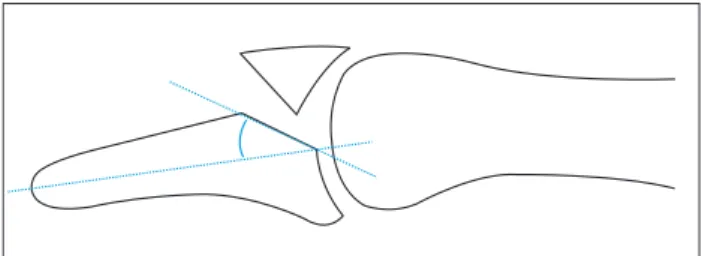
1 mm in the longitudinal direction. A gap was defined as displacement of more than 1 mm in the anteroposterior direction. Rotation was defined as rotation of more than 10° of the dorsal fragment (Fig. 1). Reduction loss was defined as change of step-off more than 1 mm, gap dis- placement more than 1 mm, and rotation more than 10°
between the distal phalanx and dorsal fragment on a true lateral radiograph comparing radiograph immediate post- operatively with the radiograph at the time of detecting reduction loss before bony union occurred. In addition, we checked preoperative mallet fragment angle. The mal- let fragment angle was defined as an acute angle between the axis of the distal phalanx and the fracture line (Fig. 2).
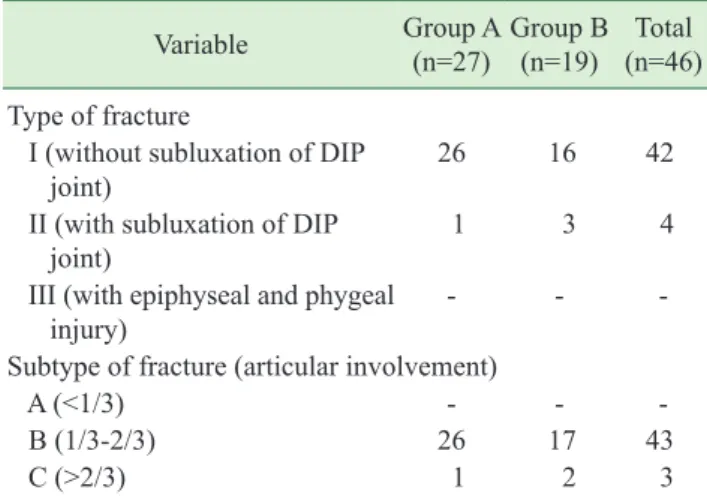
Preoperative volar subluxation was defined as more than 2 mm of the distal phalanx volar cortex margin than the middle phalanx one. The Wehbé and Schneider13 clas- sification was used to analyze radiological fracture type (Table 1).
The procedure was generally performed under digital block anesthesia with lateral radiography using image intensifier control. Closed manipulation was achieved by compression of the dorsal fragment with surgeon’s index finger and thumb with DIP flexion and joint congruity was evaluated with DIP extension. When the joint con- gruity was unsatisfactory, hematoma was removed using a 23-G needle inserted from dorsum of distal phalanx into the fracture gap. Then the fracture site was freshened by swiveling the needle tip mediolaterally within the fracture site with care not to injure the middle phalanx head (Fig.
3). After satisfactory joint congruity was achieved, a 1.4- mm K-wire was inserted obliquely from the dorsal neck of the middle phalanx to the volar side of the middle pha- lanx to prevent dorsal displacement of dorsal fragment.
A second K-wire was inserted obliquely from the radial side of the distal phalanx to the ulnar side of the middle phalanx while maintaining slightly dorsal translation and extension of the DIP joint. For Group B patients, a 0.9 or 1.1-mm K-wire was additionally inserted from the dorsal fracture fragment to the volar cortex of the distal pha- lanx perpendicular to the fracture surface with care not to make fracture of the fragment itself (Fig. 4). Regular dressing and pin care were encouraged and the DIP joint was immobilized using a U-shaped aluminum splint for 6 weeks. Wires were removed in the outpatient clinic at 6 weeks postoperatively with verification of radiologi- cal union. After removal of pins, active exercise of the DIP joint was then initiated with a removable night DIP extension aluminum splint for an additional two weeks to prevent further extension lag. Independent t-test were used to compare continuous variables between groups.
Chi-square test were used to compare categorical value between groups or pattern of displacement.
RESULTS
Mean radiographic bone union was 6.2 weeks (range, 5-7 weeks) based on callus between fragments. There
A B C
Fig. 1. (A) Step-off was defined as more than 1 mm of displacement in the longitudinal direction. (B) Gap was defined as more than 1 mm of displacement in the anteroposterior direction. (C) Rotation was defined as more than 10 degrees in rotation of the dorsal fragment.
Fig. 2. Mallet fragment angle was defined as acute angle between an axis of distal phalanx and a line of fracture.
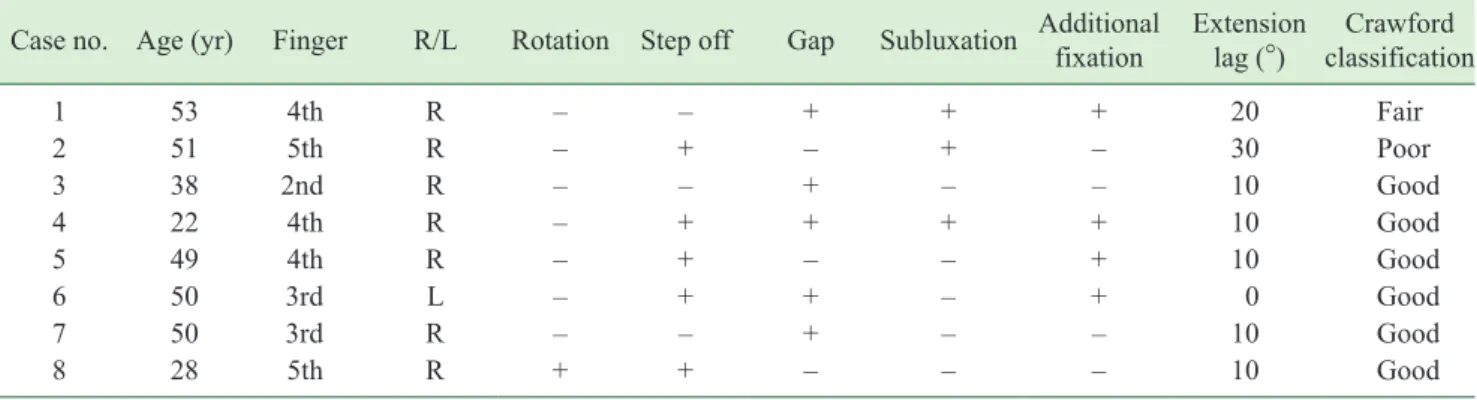
was no statistically significant difference in age, sex, joint involvement, or time to surgery between the two groups (Table 2). The average articular surface involvement was 47.4% (10%-70%). Reduction loss occurred in 8 (17%) of 46 patients within postoperative 4 weeks (range, 2-4 weeks) (Table 3). Differences in mean extension lag, age, and mallet fragment angle between patients with reduc- tion loss and those with reduction maintaining were sig- nificant according to the independent t-test (all p<0.05, Table 4).
Four out of 46 patients had preoperative volar sublux- ation (more than 2 mm) of the distal phalanx. Three of these four patients with preoperative subluxation had re- duction loss (p<0.05). However there were no significant difference in gender, hand dominance, AIF, or further flexion between reduction loss and reduction maintaining (all p>0.05, Table 4).
Fig. 3. Intraoperative fluoroscopic image showing that hematoma was removed using 23-G needle when the reduction was unsatisfactory.
Satisfactory reduction was then achieved.
A B
Fig. 4. (A) Patients of Group A were treated using modified extension block K-wire fixation alone. (B) Group B patients were treated by additional interfrag- mentary fixation.
Table 1. Wehbe and Schneider’s classification
Variable Group A
(n=27) Group B (n=19) Total
(n=46) Type of fracture
I (without subluxation of DIP
joint) 26 16 42
II (with subluxation of DIP
joint) 1 3 4
III (with epiphyseal and phygeal
injury) - - -
Subtype of fracture (articular involvement)
A (<1/3) - - -
B (1/3-2/3) 26 17 43
C (>2/3) 1 2 3
Group A: patients were treated with extension block, Group B: patients were treated with additional interfragmentary flexion, DIP: distal interphalangeal.
Patients with reduction loss showed displacement pat- terns of gap only (n=3), step-off only (n=2), and com- bined (n=3) (Fig. 5, 6). For patterns of displacement, there was a significant relationship between gap (n=5) or step-off (n=5) and extension lag more than 10° (both p<0.05). However, there was no significant relationship between rotation (n=1) and extension lag more than 10°
(p>0.05).
The extensor lag of the DIP joint at the last follow- up was 4.3°±9.3° (Group A, 5.3°±12.4° vs. Group B, 3.3°±6.2°, p>0.05). Further flexion of the DIP joint was 78.3°±15.1° (Group A, 79.3°±15.3° vs. Group B, 77.3°±14.9°, p>0.05). There was no statistically signifi- cant difference between the two groups.
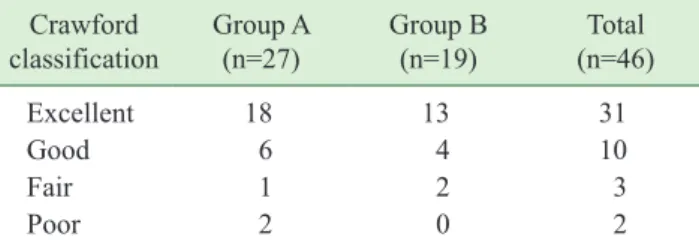
Using Crawford’s evaluation criteria, functional out- comes were excellent in 31 patients (Group A, 18; Group B, 13), good in 10 patients (Group A, 6; Group B, 4), fair in 3 patients (Group A, 1; Group B, 2), and poor in 2 pa- Table 2. Independent t-test and chi-square test comparing
different factors between Group A and B Group A
(n=27) Group B
(n=19) p-value
Mean age (yr) 26.3 29.8 0.280
Gender (male:female) (n) 9:6 11:4 0.350
Joint involvement (%) 53.3 50 0.239
Dominant hand (%) 86.7 60 0.215
Involved finger
(2nd:3rd:4th:5th) (n) 3:3:5:4 3:2:7:3 0.879
Duration (d) 15 17 0.901
Follow-up (mo) 28.2 28.7 0.659
Extension lag (°) 5.3 3.3 0.823
Further flexion (°) 79.3 77.3 0.518
Complications (n) 0 1 (pin site infection)
Group A: patients were treated with Extension block, Group B: patients were treated with additional interfragmentary flexion.
Table 3. Details of the 8 patients with reduction loss
Case no. Age (yr) Finger R/L Rotation Step off Gap Subluxation Additionalfixation Extension
lag (°) Crawford classification
1 53 4th R – – + + + 20 Fair
2 51 5th R – + – + – 30 Poor
3 38 2nd R – – + – – 10 Good
4 22 4th R – + + + + 10 Good
5 49 4th R – + – – + 10 Good
6 50 3rd L – + + – + 0 Good
7 50 3rd R – – + – – 10 Good
8 28 5th R + + – – – 10 Good
R: right, L: left.
Table 4. Independent t-test and chi-square test comparing different factors between patients groups
Reduction loss (n=8) Reduction maintain (n=38) p-value
Age (yr)* 42.6 28.3 0.001
Gender (male:female) 8:0 29:9 0.114
Joint involvement (%)* 47.5 52.6 0.239
Dominant: non dominant hand 7:1 26:12 0.153
Mallet fragment angle (°) 43.2±7.9 49.7±10.8 0.038
Additional interfragmentary fixation (+:–) 4:4 3:35 0.065
Volar subluxation (>2 mm) (+:–) 3:1 1:37 0.004
Extension lag (°) 12.5±8.9 2.3±8.2 0.015
Further flexion (°) 77.5±7.1 78.5±15.6 0.810
Values are presented as number only or mean±standard deviation.
*Values are presented as mean only.
tients (Group A, 2; Group B, 0) (Table 5). Residual pain using visual analogue scale was 0.8 (0-2). There were no nail deformities, persistent pain, or DIP arthritis in any patient. One case of a pin-site infection was treated suc- cessfully with oral antibiotics and local wound care.
DISCUSSION
We evaluated a cohort of eight patients with reduc- tion loss after modified EB K-wire fixation for treatment of bony mallet finger. Seven of these eight patients had extension lag of >10°. We also identified several factors related to reduction loss such as age, volar subluxation, and mallet fragment angle previously reported to be a Fig. 5. (A) Lateral radiograph showing a displaced mallet fracture with joint subluxation in a 22-year-old man (case number 4).
(B) A postoperative radiograph showing subtle volar subluxation. (C) The 6-month follow-up radiograph showing a reduction loss with both gap and step off, resulting in volarly subluxation of distal phalanx. At the final follow-up, extension lag of the injured distal interphalangeal joint remained.
A B C
A B C
Fig. 6. (A) Lateral radiograph showing a displaced mallet fracture in a 49-year-old man (case number 5). (B) A postoperative radiograph showing an anatomic reduction. (C) The 6-month follow-up radiograph showing a reduction loss with step off. At the final follow-up, extension lag of the injured distal interphalangeal joint remained.
prognostic factor for EB technique11. In contrast, AIF was not effective for preventing reduction loss.
It is important to restore joint surface by accurate reduction because it is closely related to functional out- come3,14,15. In this study, we focused on the relationship between reduction loss and extension lag. If reduction loss occurs until bony union, extension lag could be an- ticipated at the final follow-up. This is critical for postop- erative management.
At the final follow-up, extensor lag in patients with reduction loss differed significantly from that in patients with reduction maintaining. This supports our hypothesis that reduction loss after EB K-wire fixation for bony mal- let finger can affect extension lag.
We confirmed that extension lag was dependent on the final reduction quality such as step-off or gap. However, rotation in the sagittal plane did not affect extension lag.
Reduction loss caused by fragment rotation is rather re- lated to articular incongruity which fortunately has high remodeling potential3. It is mainly caused by rotation of the dorsal fragment, not by rotation of the distal phalanx.
On the other hand, the occurrence of step-off or gap was dependent upon displacement of both the dorsal frag- ment and distal phalanx. The reason for reduction loss is currently unclear. Single transfixing K-wire across DIP might not be sufficient to prevent sagittal or rotational movement from bending or loosening of the pin. These findings suggest that effort should be made to maintain reduction of the distal phalanx to the middle phalanx (which is dependent solely upon transfixing a single K- wire) and the dorsal fragment.
It is difficult to verify the quality of reduction in EB K-wire because it involves an indirect reduction under an image intensifier16. Several authors have described additional percutaneous procedures to increase stability of the fragment5. However, potential disadvantages of ad- ditional pin fixation should be considered. For example, it is difficult to locate the exact insertional entry point. In addition, there is potential for further soft tissue injury16. Enhancement of functional outcome related to additional pin fixation was not found in this study.
Reduction loss did not affect further flexion in our study. Further flexion is rather dependent on early mo- bilization of the DIP joint because extensor tendon ad- hesion hinders DIP joint motion6. As the number of pin tracks increases, adhesion points are added which may prevent tendon excursion3. Therefore, additional K-wires may diminish the potential advantage of fragment stabil- ity because additional K-wires could not provide enough strength to allow early DIP motion.
The limitations of this study are as follows. First, it was retrospective in design without a control group. Although standardization of the degree of injury may be difficult, a prospective randomized study is warranted. Second, age and injury mechanism could affect extension lag accord- ing to Kim and Lee17. In our study, 3 of 38 patients with- out reduction loss were identified to have extension lag at the last follow-up. This means that other factors might influence extension lag. Further studies are needed.
Last, reduction loss proportion in this study seems to be relatively high. We cannot exclude possibility that imme- diate postoperative incomplete reduction such as subtle volar subluxation (Fig. 5) or immediate postoperative less rigid DIP fixation (Fig. 4) would result in reduction loss. Some modification such as two small EB K-wires or additional intrafocal pinning techniques may improve reduction quality if immediate anatomic reduction could not be achieved3,18.
One case of a pin-site infection occurred in this study.
Burying the tips of all pins under the skin would be help- ful to prevent infection or other pin-related complications according to Shin et al.19.
Table 5. Clinical results Crawford
classification Group A
(n=27) Group B
(n=19) Total
(n=46)
Excellent 18 13 31
Good 6 4 10
Fair 1 2 3
Poor 2 0 2
Group A: patients were treated with Extension block, Group B: patients were treated with additional interfragmentary flexion.
CONCLUSION
Although accurate reduction was initially achieved, reduction loss after EB K-wire fixation for the treatment of bony mallet finger occasionally occurred, leading to extension lag. Reduction loss should be careful in older age, smaller mallet fragment angle and preoperative volar subluxation.
CONFLICTS OF INTEREST
The authors have nothing to disclose.
REFERENCES
1. Tetik C, Gudemez E. Modification of the extension block kirschner wire technique for mallet fractures. Clin Orthop Relat Res. 2002;(404):284-90.
2. Pegoli L, Toh S, Arai K, Fukuda A, Nishikawa S, Vallejo IG. The Ishiguro extension block technique for the treat- ment of mallet finger fracture: indications and clinical results. J Hand Surg Br. 2003;28:15-7.
3. Lee YH, Kim JY, Chung MS, Baek GH, Gong HS, Lee SK. Two extension block kirschner wire technique for mallet finger fractures. J Bone Joint Sur Br. 2009;91:1478- 81.
4. Jörgsholm P, Björkman A, Emmeluth C, Björkman- Burtscher IM. Extension block pinning of mallet fractures.
Scand J Plast Reconstr Surg Hand Surg. 2010;44:54-8.
5. Hofmeister EP, Mazurek MT, Shin AY, Bishop AT. Exten- sion block pinning for large mallet fractures. J Hand Surg Am. 2003;28:453-9.
6. Bendre AA, Hartigan BJ, Kalainov DM. Mallet finger. J Am Acad Orthop Surg. 2005;13:336-44.
7. Ishiguro T, Itoh Y, Yabe Y, Hashizume N. Extension block with kirschner wire for fracture dislocation of the distal interphalangeal joint. Tech Hand Up Extrem Surg.
1997;1:95-102.
8. Theivendran K, Mahon A, Rajaratnam V. A novel hook plate fixation technique for the treatment of mallet frac- tures. Ann Plast Surg. 2007;58:112-5.
9. Lucchina S, Badia A, Dornean V, Fusetti C. Unstable mallet fractures: a comparison between three differ- ent techniques in a multicenter study. Chin J Traumatol.
2010;13:195-200.
10. Schweitzer TP, Rayan GM. The terminal tendon of the digital extensor mechanism: part II, kinematic study. J Hand Surg Am. 2004;29:903-8.
11. Hahn SB, Park GH, Choi YR, Kang HJ, Lee JK. Prognos- tic factors of the extension block technique for the bony mallet finger. J Korean Orthop Assoc. 2010;45:127-32.
12. Crawford GP. The molded polythene splint for mallet fin- ger deformities. J Hand Surg Am. 1984;9:231-7.
13. Wehbé MA, Schneider LH. Mallet fractures. J Bone Joint Surg Am. 1984;66:658-69.
14. Husain SN, Dietz JF, Kalainov DM, Lautenschlager EP.
A biomechanical study of distal interphalangeal joint subluxation after mallet fracture injury. J Hand Surg Am.
2008;33:26-30.
15. Pike J, Mulpuri K, Metzger M, Ng G, Wells N, Goetz T.
Blinded, prospective, randomized clinical trial compar- ing volar, dorsal, and custom thermoplastic splinting in treatment of acute mallet finger. J Hand Surg Am.
2010;35:580-8.
16. Segmueller HE. Mallet finger injuries. J Hand Surg Am.
2010;35:693; author reply 693-4.
17. Kim JY, Lee SH. Factors related to distal interphalangeal joint extension loss after extension block pinning of mal- let finger fractures. J Hand Surg Am. 2016;41:414-9.
18. Chung DW, Lee JH. Anatomic reduction of mallet frac- tures using extension block and additional intrafocal pin- ning techniques. Clin Orthop Surg. 2012;4:72-6.
19. Shin SH, Lee YS, Kang JW, Kang W, Chung YG. Tips under the skin: a simple modification of extension block pinning for mallet fractures. Orthopedics. 2018;41:e299- 302.
골성 추지 신전제한 K 강선 고정술 시행 후 정복소실
김병성
1ㆍ노재휘
2ㆍ정기진
3ㆍ윤건희
1ㆍ박은석
1ㆍ박성용
41순천향대학교 부천병원 정형외과, 2순천향대학교 서울병원 정형외과, 3순천향대학교 천안병원 정형외과, 4서귀포의료원 정형외과
목적: 골성 추지의 치료로 신전 제한 K 강선 고정 또는 추가 골편간 고정 후 발생한 정복 소실과 원위지관절 신전 지연을 포함한 임상적 결과를 분석하였다.
방법: 평균 추시 기간 28개월(12-54개월)의 46명을 대상으로 하였고, 27명은 신전 제한 K 강선 고정(A군)으로, 19 명은 추가 골편 간 고정(B군)으로 치료하였다. 관절면 침범 정도, 전방아탈구, 추지 골편각, 정복 소실, 관절운동 범 위, Crawford 기준을 이용한 기능적 결과를 평가하였다.
결과: 정복 소실은 8예(17%)에서 발생하였다. 신전 제한 정도, 연령, 술 전 전방아탈구 및 추지 골편각은 정복 소실 여부에 따른 차이가 유의하였으나 성별, 우세 수, 관절면 침범 정도 및 추가 골편 간 고정은 정복 소실 여부에 따른 차이가 유의하지 않았다. 전위 양상은 골편 틈 또는 계단 변형은 신전 제한과 상관관계가 있었다. Crawford 기준 상 우수 31, 양호 10, 보통 3, 그리고 불량이 2예였다.
결론: 고령, 적은 추지 골편각, 술 전 전방아탈구가 있는 경우는 정복 소실에 대한 주의가 필요하다.
색인단어: 추지, 신전 제한, 추가 골편간 고정, 정복 소실
접수일 2018년 7월 24일 수정일 1차: 2018년 8월 28일, 2차: 2018년 9월 3일, 3차: 2018년 9월 14일 게재확정일 2018년 9월 17일 교신저자 박성용
63585, 제주도 서귀포시 장수로 47, 서귀포의료원 정형외과
TEL 064-730-3416 FAX 064-733-4320 E-mail [email protected]