© 2011 The Korean Academy of Medical Sciences.
This is an Open Access article distributed under the terms of the Creative Commons Attribution Non-Commercial License (http://creativecommons.org/licenses/by-nc/3.0) which permits unrestricted non-commercial use, distribution, and reproduction in any medium, provided the original work is properly cited.
pISSN 1011-8934 eISSN 1598-6357
Association of Alcohol Consumption with the Risk of Ocular Trauma
This study was conducted to evaluate the influence of alcohol consumption on the risk of ocular trauma. We retrospectively reviewed the medical records of 1,024 patients who visited emergency department and received ophthalmologic examination from January 1 to December 31, 2009. The patients were divided into 2 groups: those with ocular trauma (n = 494) and those without (n = 530); the influence of alcohol consumption was compared between these 2 groups. In the ocular trauma group, the association of the causes and types of ocular trauma with alcohol consumption was evaluated. One of 530 patients of no trauma group and 117 (23.7%) of 494 patients of trauma group were related with alcohol intake, and the difference was statistically significant (P < 0.001).
Concerning the causes, physical assault was significantly more common in alcohol- associated injury (P < 0.001). Regarding the types of injury, orbital wall fracture and hyphema showed a significant association with alcohol consumption (P < 0.001). Older age and nighttime injury were significantly related to the increased risk of alcohol- associated ocular trauma (P = 0.018 and < 0.001, respectively). In conclusion, alcohol consumption significantly increases the risk of ocular trauma.
Key Words: Alcohols; Alcohol-associated Ocular Trauma; Assault; Ocular Trauma; Eye Injuries
Sang Beom Han, Hee Kyung Yang, Se Joon Woo, Joon Young Hyon, and Jeong-Min Hwang
Department of Ophthalmology, Seoul National University College of Medicine, Seoul National University Bundang Hospital, Seongnam, Korea Received: 26 December 2010
Accepted: 7 March 2011 Address for Correspondence:
Jeong-Min Hwang, MD
Department of Ophthalmology, Seoul National University Bundang Hospital, 166 Gumi-ro, Bundang-gu, Seongnam 463-707, Korea
Tel: +82.31-787-7372, Fax: +82.31-787-4057 E-mail: [email protected]
This study was supported by a grant of the Seoul R&BD Program (ST090841) and the Korea Healthcare technology R&D Project, Ministry for Health, Welfare & Family Affairs, Republic of Korea (A101308).
DOI: 10.3346/jkms.2011.26.5.675 • J Korean Med Sci 2011; 26: 675-678
ORIGINAL ARTICLE
Ophthalmology
INTRODUCTION
Alcohol intake has been shown to potentiate aggressive behav- ior as a psychomotor stimulant (1). Previous studies have dem- onstrated that alcohol consumption increases the risk of both trauma by physical assault and accidental trauma (2, 3). There- fore, alcohol consumption can conceivably increase the risk of ocular trauma. However, to the best of our knowledge, only a few studies have elucidated the impact of alcohol consumption on ocular trauma (4, 5). In Korea, 87.6% of adults are reported to have drunk alcohol, which is much higher compared to USA (64.9%) and Canada (72.3%) (6). Therefore, we believe that the influence of alcohol consumption on ocular trauma should be investigated. The purpose of this study was to evaluate the in- fluence of alcohol consumption on ocular trauma in Korea.
MATERIALS AND METHODS
We retrospectively reviewed the medical records of 1,024 con- secutive patients who presented at the emergency department of Seoul National University Bundang Hospital for ophthalmo- logic examination between January 1, and December 31, 2009.
Among them, the patients with ocular trauma were chosen, and the causes of the injury were studied. In each subject, whether
the patient was in drunken state at the time of ocular trauma or not was documented. In the case of trauma by physical assault, it was also evaluated whether the assailant was in drunken state or not. If the patient or attacker was in an inebriated state, the case was defined as an alcohol-associated injury. Ocular trau- ma due to traffic accident caused by drunken driver was also defined as an alcohol-associated injury. Alcohol consumption was determined by asking to the patients or companions. The influence of alcohol was compared between patients who suf- fered trauma and those who did not using Fisher’s exact test.
Among those who suffered trauma, the association of the causes and types of ocular trauma with alcohol consumption was eval- uated using Pearson’s chi-square test and linear-by-linear asso- ciation, as appropriate. The causes of ocular trauma were re-clas- sified into assault and non-assault, and the association of the cause and alcohol consumption was re-analyzed; the odds ra- tio was calculated using chi-square test. The influence of demo- graphic factors including gender and age, and the time of injury (nighttime [6 pm to 6 am] vs daytime [6 am to 6 pm]) on the risk of alcohol-associated ocular trauma was analyzed using chi- square test, linear-by-linear association and Student’s t-test, as appropriate.
SPSS software for Windows (V15.0; SPSS Inc, Chicago, IL, USA) was used in every statistical analysis. A P value of less than 0.05
Han SB, et al. • Alcohol and Ocular Trauma
676 http://jkms.org DOI: 10.3346/jkms.2011.26.5.675
was considered statistically significant.
Ethics statement
The study protocol was approved by the institutional review board of Seoul National University Bundang Hospital, and the board waived informed consent. This study conformed to the tenets of the Declaration of Helsinki.
RESULTS
The study population comprised 647 (63.2%) male and 377 (36.8%) female patients. The mean age was 34.9 ± 20.5 yr (range, 0-90). Of the 1,024 patients, 494 (48.2%) sustained ocular trau- ma, including 373 (75.5%) male and 121 (24.5%) female patients.
The mean age was 34.2 ± 19.0 yr (range, 11-81).
Of the 494 subjects with ocular trauma, 117 (23.7%) patients had alcohol-associated ocular injuries, while only one (0.2%) of 530 patients with ocular diseases other than ocular trauma was associated with alcohol drinking at presentation (P < 0.001).
There was a significant difference in the causes of ocular trau- ma between groups with and without alcohol-association (P <
0.001, Table 1). Assault was the most common cause (76.1%, 89/
117) of alcohol-associated ocular trauma, whereas it was the least common cause (11.1%, 42/377) of non-alcohol-associated ocular trauma (odds ratio [OR], 25.4; 95% confidence interval [CI]: 14.9-43.2; P < 0.001).
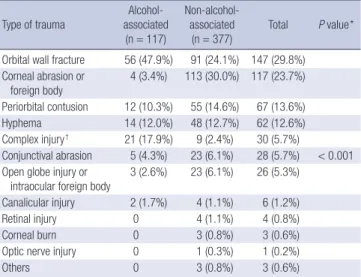
The types of ocular injuries were also different between the alcohol-associated and non-alcohol-associated groups (Table 2). Orbital wall fracture and complex injuries were more com- mon in the alcohol-associated group than the non-alcohol-as- sociated group (47.9% vs 24.1%; 17.9% vs 2.4%), and most of the complex injuries were the combination of orbital wall fracture and hyphema. Among 21 cases of complex injuries associated with alcohol consumption, orbital wall fracture was most fre- quently found (21 cases, 100%), followed by hyphema (19 cases, 90.5%). Details of the types of ocular trauma are summarized in Table 2.
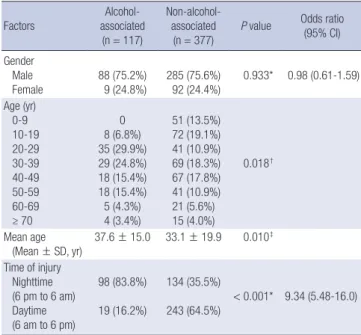
Regarding the demographic factors, no significant difference in the gender ratio was observed between the alcohol-associat-
ed group and the non-alcohol-associated group. However, the mean age was significantly older in the alcohol-associated group than in the non-alcohol-associated group (37.6 ± 15.0 yr vs 33.1
± 19.9 yr, P = 0.010). Linear-by-linear association also demon- strated the significant difference in the age distribution between the two groups (P = 0.018). The significant difference in the time of injury between the two groups was also found. Alcohol-asso- ciated ocular injuries were substantially more common in night- time, whereas non-alcohol-associated ocular injuries occur more frequently in daytime (OR, 9.34; 95% CI: 5.48-16.0; P < 0.001).
Details of the influence of demographic factors and the time of injury on the risk alcohol-associated ocular trauma are summa- rized in Table 3.
DISCUSSION
The known risk factors of ocular trauma include male gender, laborer, rural setting, and lower education level (5, 7-10). There has been a few reports describing the association of alcohol con-
Table 1. Causes of ocular trauma according to the association with alcohol consumption
Causes Alcohol-associated
(n = 117) Non-alcohol-associated
(n = 377) Total
(n = 494) P value Odds ratio (95% CI)
Daily activity Assault
Exercise or outdoor activity Work
Traffic accident
24 (20.5%) 89 (76.1%)
0 0 4 (3.4%)
154 (40.8%) 42 (11.1%) 68 (18.4%) 62 (16.4%) 51 (13.5%)
178 (36.0%) 131 (26.5%) 68 (13.8%) 62 (12.6%) 55 (11.1%)
< 0.001*
Assault Non-assault†
89 (76.1%) 28 (23.9%)
42 (11.1%) 335 (88.9%)
131 (26.5%) 363 (73.5%)
< 0.001‡ 25.4 (14.9-43.2)
*Linear-by-linear association; †The causes of ocular trauma were re-classified into assault and non-assault, and the association of the cause and alcohol consumption was re- analyzed; ‡Chi-square test. CI, Confidence interval.
Table 2. Comparison of the frequencies of different types of ocular trauma with and without alcohol consumption
Type of trauma Alcohol- associated
(n = 117)
Non-alcohol- associated
(n = 377) Total P value*
Orbital wall fracture 56 (47.9%) 91 (24.1%) 147 (29.8%) Corneal abrasion or
foreign body
4 (3.4%) 113 (30.0%) 117 (23.7%) Periorbital contusion 12 (10.3%) 55 (14.6%) 67 (13.6%)
Hyphema 14 (12.0%) 48 (12.7%) 62 (12.6%)
Complex injury† 21 (17.9%) 9 (2.4%) 30 (5.7%)
Conjunctival abrasion 5 (4.3%) 23 (6.1%) 28 (5.7%) < 0.001 Open globe injury or
intraocular foreign body 3 (2.6%) 23 (6.1%) 26 (5.3%) Canalicular injury 2 (1.7%) 4 (1.1%) 6 (1.2%)
Retinal injury 0 4 (1.1%) 4 (0.8%)
Corneal burn 0 3 (0.8%) 3 (0.6%)
Optic nerve injury 0 1 (0.3%) 1 (0.2%)
Others 0 3 (0.8%) 3 (0.6%)
*Linear-by-linear association; †complex injury-includes 29 cases of orbital wall frac- ture combined with hyphema (n = 25), with open globe injury (n = 1), with corneal abrasion (n = 1), with optic nerve injury (n = 1), and with hyphema and retinal damage (n = 1). The remaining one case was a combination of periorbital contusion and hyphema.
Han SB, et al. • Alcohol and Ocular Trauma
http://jkms.org 677
DOI: 10.3346/jkms.2011.26.5.675
sumption with ocular trauma (4, 5). Smith et al. (4) demonstrat- ed that 76.2% of all assaults were alcohol-related in Australian patients. The present study showed the similar result that 67.9%
(89/131) of assaults were related with alcohol, suggesting that increased violence due to alcohol consumption is also an im- portant cause of ocular trauma in Asians (4). Loon et al. (5) re- cently reported that alcohol consumption was associated with a history of having ocular injury. However, a limitation of the study was that they had only investigated a history of alcohol consumption as a lifestyle habit, and the state of inebriation at the time of injury was never documented. Besides, as the au- thors pointed out, alcohol consumption might have been un- derreported because of religious restrictions (5). In the present study, we demonstrated the direct impact of alcohol consump- tion on ocular trauma by investigating the state of inebriation at the time of ocular injury.
In the present study, alcohol-associated injuries were most frequently caused by assault, followed by daily activity. The find- ing is in good agreement with the results of the previous studies that alcohol consumption is more common in assault or inten- tional injury (2, 3). Overall, alcohol consumption was found to be associated with one-fourth of all ocular traumas in Korea, this may be because social drinking is very prevalent in the Ko- rean society (6).
Alcohol-associated injuries are more frequently associated with orbital wall fractures and complex injuries, most of which are a combination of orbital wall fracture and hyphema (Table 2). This finding can be explained by the fact that most cases of physical assault involve blunt trauma inflicted by fist or foot; this is especially true in countries such as Korea where civilians can-
not legally carry guns. Lee et al. (3) revealed that blunt trauma including fracture, bruises, and open wound occurs more fre- quently in alcohol-dependent drinkers, supporting the results of our study. In addition to physical assault because of alcohol consumption, collapse of individuals in an inebriated state or accidents while driving in drunken state can lead to ocular trau- ma. Lee et al. (2) demonstrated that trauma associated with al- cohol consumption was significantly more common in male than female, and in nighttime injuries than daytime injuries, which corresponds well with our results that nighttime is asso- ciated with the increased risk of alcohol-associated ocular trau- ma (Table 3). It is probably due to the difference in the causes of the injury. Alcohol-associated ocular trauma is more frequently related to assault in drunken state, which usually occurs in the nighttime (2, 3). By contrast, non-alcohol-associated ocular trau- ma is more common in injuries related to sports, work or daily activities, which occurs more often in the daytime (Table 1). How- ever, our results show that male gender does not increase the risk of alcohol-associated ocular injury (Table 3). It is conceiv- ably because male gender increases the risk of ocular trauma by non-alcohol-associated injury as well as that by alcohol-as- sociated injury. Male gender is a well-known risk factor of ocu- lar trauma, as men are more frequently exposed to violence and danger in workplace or outdoor activities (11-13). The difference in the age distribution is probably due to the fact that legal drink- ing age is 19 yr old in Korea, thus youngsters under that age have limited chance to be exposed to alcohol. The difference in the proportion of the patients ≤ 19 yr old (6.8% in the alcohol-asso- ciated group vs 32.6% in the non-alcohol-associated group) and the significantly older mean age in the alcohol-associated group (37.6 ± 15.0 yr vs 33.1 ± 19.9 yr) support our assumption (Table 3).
In conclusion, alcohol consumption significantly increases the risk of ocular trauma, especially by violence.
REFERENCES
1. Pihl RO, Peterson JB, Lau MA. A biosocial model of the alcohol-aggres- sion relationship. J Stud Alcohol Suppl 1993; 11: 128-39.
2. Lee EJ, Kim TY, Kim SC, Park HS, Suh GJ, Shin SD, You EY. Effect of alco- hol consumption on the severity of blunt injury. J Korean Soc Emerg Med 2005; 16: 339-45.
3. Lee WK, Kim Y. Drinking pattern and nonfatal injuries of adults in Korea.
J Korean Soc Traumatol 2009; 22: 233-41.
4. Smith AR, O’Hagan SB, Gole GA. Epidemiology of open- and closed-globe trauma presenting to Cairns Base Hospital, Queensland. Clin Experiment Ophthalmol 2006; 34: 252-9.
5. Loon SC, Tay WT, Saw SM, Wang JJ, Wong TY. Prevalence and risk fac- tors of ocular trauma in an urban south-east Asian population: the Sin- gapore Malay Eye Study. Clin Experiment Ophthalmol 2009; 37: 362-7.
6. Kim MJ. Analysis of the medical expense by alcohol attributed diseases. J Korean Alcohol Sci 2003; 4: 136-48.
Table 3. Influence of the demographic factors and the time of injury on the risk of alcohol-associated ocular trauma
Factors
Alcohol- associated
(n = 117)
Non-alcohol- associated
(n = 377) P value Odds ratio (95% CI) Gender
Male Female
88 (75.2%) 9 (24.8%)
285 (75.6%) 92 (24.4%)
0.933* 0.98 (0.61-1.59) Age (yr)
0-9 10-19 20-29 30-39 40-49 50-59 60-69 ≥ 70
0 8 (6.8%) 35 (29.9%) 29 (24.8%) 18 (15.4%) 18 (15.4%) 5 (4.3%) 4 (3.4%)
51 (13.5%) 72 (19.1%) 41 (10.9%) 69 (18.3%) 67 (17.8%) 41 (10.9%) 21 (5.6%) 15 (4.0%)
0.018†
Mean age (Mean ± SD, yr)
37.6 ± 15.0 33.1 ± 19.9 0.010‡ Time of injury
Nighttime (6 pm to 6 am) Daytime (6 am to 6 pm)
98 (83.8%) 19 (16.2%)
134 (35.5%)
243 (64.5%) < 0.001* 9.34 (5.48-16.0)
*Chi-square test; †Linear-by-linear association; ‡Student t-test. CI, Confidence interval.
Han SB, et al. • Alcohol and Ocular Trauma
678 http://jkms.org DOI: 10.3346/jkms.2011.26.5.675
7. Nirmalan PK, Katz J, Tielsch JM, Robin AL, Thulasiraj RD, Krishnadas R, Ramakrishnan R; Aravind Comprehensive Eye Survey. Ocular trauma in a rural south Indian population: the Aravind Comprehensive Eye Sur- vey. Ophthalmology 2004; 111: 1778-81.
8. McCarty CA, Fu CL, Taylor HR. Epidemiology of ocular trauma in Aus- tralia. Ophthalmology 1999; 106: 1847-52.
9. Krishnaiah S, Nirmalan PK, Shamanna BR, Srinivas M, Rao GN, Thom- as R. Ocular trauma in a rural population of southern India: the Andhra Pradesh Eye Disease Study. Ophthalmology 2006; 113: 1159-64.
10. Dandona L, Dandona R, Srinivas M, John RK, McCarty CA, Rao GN.
Ocular trauma in an urban population in southern India: the Andhra Pradesh Eye Disease Study. Clin Experiment Ophthalmol 2000; 28: 350-6.
11. Han SB, Yu HG. Visual outcome after open globe injury and its predic- tive factors in Korea. J Trauma 2010; 69: E66-72.
12. Rahman I, Maino A, Devadason D, Leatherbarrow B. Open globe inju- ries: factors predictive of poor outcome. Eye (Lond) 2006; 20: 1336-41.
13. Schmidt GW, Broman AT, Hindman HB, Grant MP. Vision survival after open globe injury predicted by classification and regression tree analysis.
Ophthalmology 2008; 115: 202-9.
AUTHOR SUMMARY
Association of Alcohol Consumption with the Risk of Ocular Trauma
Sang Beom Han, Hee Kyung Yang, Se Joon Woo, Joon Young Hyon, and Jeong-Min Hwang
We evaluated the influence of alcohol consumption on ocular trauma in Korea. The retrospective study of 1,024 patients (494 patients with ocular trauma and 530 patients without) showed remarkable difference. One of no trauma group and 117 (23.7%) of trauma group were related with alcohol consumption. As a cause of ocular trauma, physical assault was significantly more common in alcohol-associated injury (P < 0.001). Regarding the types of injury, orbital wall fracture and hyphema showed a significant association with alcohol consumption (P < 0.001). Older age and night time injury were significantly related to the increased risk of alcohol-associated ocular trauma (P = 0.018 and < 0.001, respectively).