Smart-textronics Product Development Process by Systematic Participatory Design Method
Sooyeon Leem1, Sang Won Lee2*
1Doctoral Student, Department of Interdisciplinary Program in Studies of Arts, Sungkyunkwan University
2Professor, School of Mechanical Engineering, Sungkyunkwan University
체계적인 사용자 참여형 디자인 방법론을 활용한 스마트 텍스트로닉스 제품 개발 프로세스
임수연1, 이상원2*
1성균관대학교 예술학협동과정 박사과정, 2성균관대학교 기계공학부 교수
Abstract Smart-textronics technology which enables functional textiles has recently been applied in various fields such as smart clothes, smart home and smart health care, and a variety of smart-textronics products have been developed. In this context, the smart-textronics product development process is proposed based on the systematic participatory design method in this paper.
The proposed method consists of two phases: in-depth interviews and analyzing. In the phase of in-depth interviews, participants are asked to create journey maps that include activities, pain points and emotional status and to generate solution ideas with sketches and simple prototypes. In the analyzing phase, design researchers investigate the participants’ journey maps, and create personas by identifying critical characteristics with the behavior pattern analysis. Then, each persona’s needs are linked with value elements of the E3 value framework. Finally, pre-survey was conducted to identify smart-textronics market and a smart sofa design is proceeded as the case study to show the applicability of the proposed method.
Key Words : Human-centered design, Systematic design, Participatory design, Smart-textronics product, Smart sofa
요 약 기능성 섬유를 가능하게 하는 스마트 텍스트로닉스가 최근 스마트 의류, 스마트 홈, 스마트 헬스케어 등 다양한 분야에서 활용되어 다양한 제품이 개발되고 있다. 이러한 관점에서 본 연구에서는 체계적인 참여형 디자인 방법을 기반 으로 한 스마트 텍스트로닉스 제품 개발 프로세스를 제안한다. 프로세스는 심층 인터뷰와 분석의 두가지 단계로 구성되 며 심층 인터뷰 단계에서는 참여자가 사용행위, 행위별 요구조건, 만족도 수준 등을 포함한 사용자 여정맵과 스케치 및 간단한 프로토타입 제작을 통한 아이디어 생성 활동을 수행한다. 이 후 분석 단계에서는 디자인 연구자가 심층 인터 뷰 단계로부터 도출된 결과에 행동 패턴 분석 방법을 적용하여 핵심 특성을 도출하고 이를 기반으로 한 사용자 페르소 나를 생성하고 각 페르소나의 주요 니즈를 E3 가치 체계의 가치요소와 연관시킨다. 본 연구에서는 사전 설문조사를 실시하여 스마트 텍스트로닉스 시장 파악하였으며, 제안된 방법론에 대한 검증을 위해 스마트 홈 분야에서 가장 많은 사용자와의 상호작용을 갖는 소파의 디자인 사례연구를 수행하였다.
주제어 : 인간 중심 디자인, 체계적 디자인, 참여형 디자인, 스마트 텍스트로닉스 제품, 스마트 소파
*This study is supported by the Korea Institute of Industrial Technology [kitech JA-20-0001]; the Gyeongi-Do Technology Development Program [kitech IZ-20-0004].
*Corresponding Author : Sang Won Lee([email protected]) Received September 21, 2020
Accepted January 20, 2021 Revised December 30, 2020
Published January 28, 2021
1. Introduction
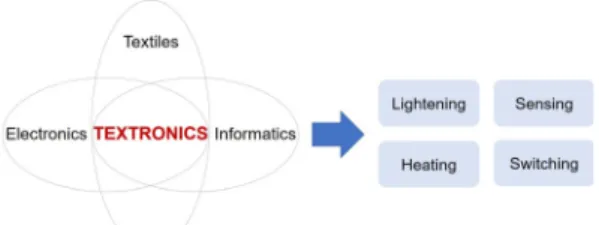
The term of 'smart-textronics' refers to wearable textile that retains the same textures of regular textile but is added with advanced electronics and informatics. Textiles, electronics and informatics are the three disciplines which enable a new interdisciplinary function of smart-textronics [1]. This field is specifically named as textronics and it also includes functions of automatics, automation, and metrology. Specifically, this textronics can be utilized with the sensing system such as chameleon fibers, optical fibers, soft switches, and conductive fibers. The major functions of smart-textronics technology are categorized into lightening, sensing, switching, and heating, which are schematically given in Fig. 1.
Fig. 1. Major functions of smart-textronics technology The smart-textronics technology has been applied to various fields such as safety, healthcare, art, and so on by using the above-mentioned major functions. For example, in case of healthcare, body signals can be collected and processed to monitor human’s health status [2]. In case of safety, sensors integrated in smart textile can locate people’s locations by sending the signals under a life-threatening situation [3]. There have also been various attempts to apply smart-textrocnis in dangerous situations. For example, the wireless communication technology for firefighters was invented using dual-polarized textile antennas which was integrated in garment [4]. For an art application, the famous designer,
Moritz Waldemeyer, used a lightening function of the smart-textronics technology to visualize his works [5].
The smart-textronics technology has also created new markets such as smart clothes, smart home, smart healthcare, and so forth. This technology can be effectively applied to such markets to create customers’ new experiences.
More specifically, it can provide customers’
visual, tactile, and hearing satisfaction. For example, Philips developed luminous textile panels with integrated multi-colored LEDs.
Besides, Desso developed a luminous carpet which was enabled with Philips lighting LED technology. This carpet is used to greet or inform people [6].
As can be inferred from the previous sections, the smart-textronics products usually have a lot of human interaction. Thus, a human-centric approach should be necessary to develop a new smart-textronics product to fully explore users’
needs and requirements [7]. For this reason, this study intends to deeply understand users’ needs and insights through a human-centered design approach [8].
Among many human-centered design methods, a user participatory design method is introduced for a new smart-textronics product development in this research. User participatory design within human-centered design landscape actively involves key stakeholders in the design process [9]. In the participatory design, user needs and preferences are gathered as participants are directly involved in the design process [10-11].
In this paper, the systematic user participatory design method is proposed by composing two phases including the in-depth interviews with participants and the analysis with design researchers. Before starting the actual design process, the survey is conducted with many respondents to explore possible fields of the smart-textronics applications such as smart clothes, smart home and smart healthcare. In this
survey, customers’ levels of ‘awareness’, ‘purchase intention’, and ‘necessity’ for each smart-textronics field are examined, and the results are used to determine a specific target area for the participatory design process.
In the phase of in-depth individual interview, participants are asked to create journey maps that include activities, pain points and emotional status. In each activity, its contextual information can be expressed by the context-based activity model (CBAM) [12]. In addition, the co-design process is carried out by participants for generating ideas with sketches and simple prototypes.
In the analyzing phase, design researchers investigate the participants’ journey maps, and create personas by identifying critical characteristics with the behavior pattern analysis.
Then, each persona’s needs are linked with value elements of the E3 value framework [13].
For the validation case study, a smart sofa design is chosen in the field of smart home. A sofa is a major furniture to have a lot of interactions with users everyday, and it also has many issues to be smartized with the smart-textronics technology.
2. Surveys for Smart-textronics Applications
Since the smart-textronics technology is relatively new for users, the survey was carried out to find out possible applicable products - smart clothes, smart home and smart health care.
The survey respondents were composed of 118 people (38 men and 80 women). Among them, 104 respondents were in their 20s, accounting for 88.1% of the total respondents.
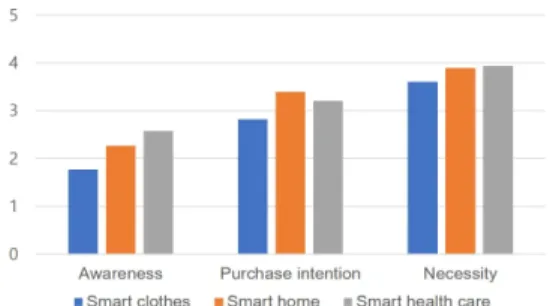
The survey results on users' perspective levels of 'awareness', 'purchase intention' and 'necessity' for each smart-textronics product are
given in Fig. 2. As can be seen in Fig. 2, the 'purchase intention' level for smart home is the highest and the 'necessity' level was also very high. On the other hand, the 'awareness' level was relatively low for the smart home as compared with the smart health care. Therefore, it could be necessary to concentrate in a new product development in the smart home field for a potential market of the smart-textronics technology.
Fig. 2. The survery results of user perspective levels for smart-textronics application fields
Afterwards, the second survey was conducted to discover users' preference for the smart home products. The survey questions were created based on several research works. Lee found that 4 trait values, ‘convenience’, ‘safety’, ‘economic feasibility’, and ‘comfortableness’, significantly affected the smart home user satisfaction [14].
In addition, E3 value framework was also introduced to explore the smart home users' values. The E3 value framework was proposed by Cho et al., and it is composed of economic value, ecological value and experience value [13].
After studying the research works done by Lee and Cho et al., the critical factors to influence the smart home users' preference were sorted out, and they are 'functionality', 'convenience', 'safety', and 'amenity', which are given in Table 1.
In addition, sub-classes of each factor are categorized in Table 1.
The survey questions were created by reflecting the results given in Table 1. The survey
results - the values of analysis of means of each sub-class - are given in Table 2. From Table 2, it was known that 'security', 'manageability', 'usability' and 'durability' had the highest values for each category of the factors. On the other hand, sub-classes of 'aesthetic' and 'symbolic' had relatively low values, which meant that the respondents weighed more on 'must-be' or '1-dimensional' issues than on 'delight' issues based on the Kano model interpretation [15].
Smart home product
Safety Security, Protection, Alert Amenity Manageability, Insulation, Sterilize,
Aesthetic Convenience Practicality, Usability,
Interchangeability, Saving Functionality Durability, Symbolic, Health care Table 1. Influence factors of the smart home users
Following these survey results, the research team was able to build up the big picture of user studies for a new smart home product development. In addition, a systematic participatory design process could be prepared.
Safety
Security 4.38
Protection 4.26
Alert 4.35
Amenity
Manageability 4.28
Insulation 4.17
Sterilize 4.25
Aesthetic 3.75
Convenience
Practicality 4.33
Usability 4.42
Interchangeability 3.81
Saving 4.14
Functionality
Durability 4.30
Symbolic 3.05
Health care 3.75
Table 2. Values of analysis of means of each sub-class of the smart home users' influence factors
3. Systematic user participatory design method and case study
In this section, the systematic user participatory
design method is proposed, and it is composed of 'individual in-depth interview' and 'analyzing'.
In addition, the case study on designing a new sofa with the smart-textronics technology is given.
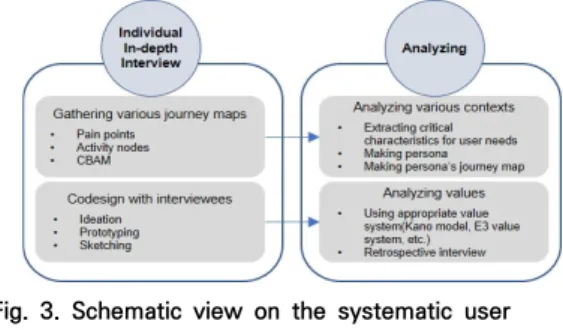
3.1 Systematic user participatory design method The systematic user participatory design method is schematically shown in the Fig. 3.
There are two phases such as individual in-depth interview and analyzing.
Fig. 3. Schematic view on the systematic user participatory design method
In the phase of individual in-depth interview, participants' journey maps are collected by gathering their pain points, activities and contexts for a possible smart-textronics product.
In particular, the context-based activity modeling (CBAM) method is introduced to systematically represent users' activity and associated contexts [12]. Then, the co-design process with interviewees is conducted for them to ideate, prototype and sketch possible solutions. This co-design process could help to uncover users’
latent needs and values [16-18].
In the analyzing phase, critical characteristics of users are extracted and their future personas are then created by analyzing the contextual information. In addition, possible journey maps of the future personas for a smart-textronics product are explored. When analyzing the values, users' needs and wants are linked with the sub-elements of the E3 values and Kano model.
Furthermore, retrospective interviews can be
carried out to supplement researchers’
interpretations.
3.2 Case Study - Smart Sofa Design To validate the proposed systematic user participatory design method, the case study on a smart sofa design was considered in the smart home field. Among many products related to the smart home, a sofa has been chosen since people usually used it and had a lot of interactions with it everyday. It is preferred for a sofa to be properly smartized to provide better experiences to the smart home users.
3.2.1 Individual in-depth interview
In the case study, individual interviews were carried out with seven participants. They were comprised of three office workers, three researchers and one freelancer who are in their late 20s and 30s. Throughout the interviews, their scenarios using the sofa were collected with their pain points, activity nodes, needs and context.
Fig. 4 showed the sample journey map of one participant. As seen in Fig. 4, the participannts’
activities, emotional status, pain points, and needs were included in the journey map. After reviewing the journey maps, it was found that the participants were mostly focused on the ‘relax’
activity when using the sofa. All of the participants have discussed the ‘relaxation’ such as watching TV, chatting with family, and taking a rest after work on the sofa to relieve their physical and mental stresses.
Fig. 4. Sample journey map when using the sofa
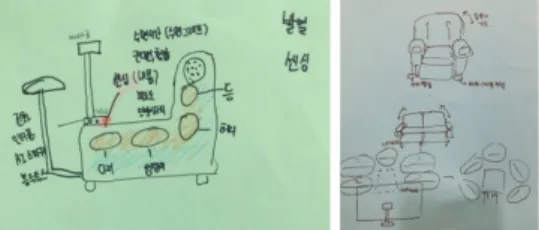
Afterwards, the participants were asked to ideate solutions of a smart sofa by sketching them on blank papers in the co-design process.
The sample sketches are given in Fig. 5. In the sketches, the participants tried to add various smart-textronics functions for the development of a customized smart sofa.
Fig. 5. Sample sketches for an smart sofa
3.2.2 Analyzing
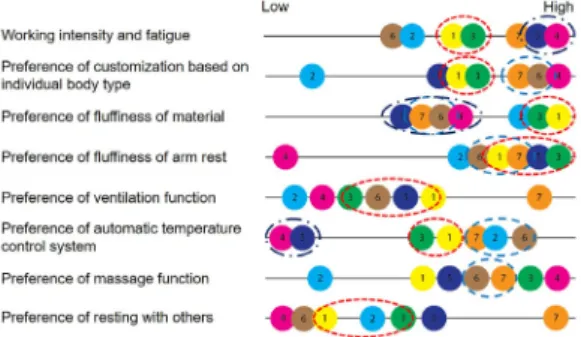
In the phase of analyzing, the behavior pattern analysis was carried out to create personas for the smart sofa. The profiles of seven participants are followed. <1. 28 year-old student researcher, 2. 30 year-old free-lancer, 3. 29 year-old researcher, 4. 29 year-old researcher, 5. 35 year-old worker of a big company, 6. 32 year-old office worker, 7. 33 year-old office worker>
In addition, 8 critical characteristics were identified when using a sofa based on the interviews with the participants. They are as follows. <1. Work intensity and fatigue, 2. Preference of customization based on individual body type, 3. Preference of fluffiness of the material, 4.
Preference of fluffiness of the arm rest, 5.
Preference of ventilation, 6. Preference of automatic temperature control system, 7.
Preference of massage function, 8. Preference of resting with others>
Afterwards, 7 participants were placed according to their relevance levels, from low to high, for each critical characteristic, which is shown in Fig. 6. In Fig. 6, the colored circles represent each participant, and they were collectively grouped together by considering similarity of their relevance levels.
Thus, three personas could be modeled as follows.
<Persona 1 – participants 1 and 3>
People whose working place is also a resting place
<Persona 2 – participants 4 and 5>
People who have extreme fatigue and high degree of work intensity
<Persona 3 – participants 6 and 7>
Office workers who have normal work intensity and a spare time after work
After modeling personas, the participants’
sketches were examined, and possible needs for each persona were explored from them. Then, those explored needs were linked with the E3 value framework for each persona. In Fig. 7, the needs linked with experience value of the E3 value framework are shown. As can be seen in Fig. 7, the sample needs which were categorized into the excellence, convenience and emotional value elements are shown.
Fig. 6. Behavior patterns and grouping of participants when using a sofa
Fig. 7. Sample needs in the experience value elements of the E3 value framework
The value elements to which the needs were categorized can offer in-depth insights to a design team in the early stage of a new smart sofa development. For instance, the excellence, convenience and emotional value elements could be considered first for a new smart sofa design by reflecting the results given in Fig. 7.
After obtaining the results from the analyzing phase, the retrospective interviews of the participants were carried out and they confirmed the results. Therefore, the objective validity on the results was verified.
4. Conclusion
In this paper, the new systematic user participatory design method was proposed for a smart-textronics product development. The smart-textronics products usually have frequent interactions with potential users, and therefore, user participation should be required in the early design process.
In the beginning, the survey was conducted to determine the target field of smart-textronics applications. In this research, the smart home was chosen by considering perspective levels of
‘awareness’, ‘purchase intention’, and ‘necessity’.
The proposed user participatory design method consisted of two phases: individual in-depth interview and analyzing. In the phase of individual in-depth interview, the journey maps including activities, pain points and contexts were collected, and the co-design process was conducted to generate possible ideas with potential user participation. In the analyzing phase, the design researcher conducted the persona modeling based on contextual information and the value proposition by connecting needs and value elements.
For validation, the case study on smart sofa design was conducted by recruiting 7 participants. In the case study, 3 personas were
modeled and more than 30 needs were extracted.
Those needs were mapped to the critical value elements. These needs and value elements were confirmed by the participants during the retrospective interviews. Therefore, the extracted critical value elements could be considered for design of the new sofa where the smart-textronics technology is implemented.
REFERENCES
[1] K. Gniotek & I. Krucinska. (2004). The basic problems of textronics. FIBRES AND TEXTILES IN EASTERN EUROPE, 12(1), 13-16.
[2] T. Linz, C. Kallmayer, R. Aschenbrenner & H. Reichl.
(2006, April). Fully untegrated EKG shirt based on embroidered electrical interconnections with conductive yarn and miniaturized flexible electronics.
In International Workshop on Wearable and Implantable Body Sensor Networks. (pp. 4-26).
Cambridge : IEEE.
[3] F. Axisa, P. M. Schmitt, C. Gehin, G. Delhomme, E.
McAdams & A. Dittmar. (2005). Flexible technologies and smart clothing for citizen medicine, home healthcare, and disease prevention. IEEE Transactions on information technology in biomedicine, 9(3), 325-336.
DOI: 10.1109/TITB.2005.854505
[4] L. Vallozzi, P. Van Torre, C. Hertleer, H. Rogier, M.
Moeneclaey & J. Verhaevert. (2010). Wireless communication for firefighters using dual-polarized textile antennas integrated in their garment. IEEE Transactions on Antennas and Propagation, 58(4), 1357-1368.
[5] S. Oliveira. (2020). MORITZ WALDEMEYER – DESIGN
& LIGHTING DESIGN. MODERN CHANDELIERS.
https://www.modernchandeliers.eu/moritz-waldemeye r-design-lighting-design/
[6] R. Crist. (2015). Walk this way: Philips rolls out LED carpets. CNET.
https://www.cnet.com/news/walk-this-way-philips-ro lls-out-led-carpets/
[7] K. Y. Lin. (2018). A text mining approach to capture user experience for new product development.
International Journal of Industrial Engineering, 25(1), 108-121.
[8] T. Brown & B. Katz. (2011). Change by design. Journal of product innovation management, 28(3), 381-383.
DOI: 10.1111/j.1540-5885.2011.00806.x
[9] E. B. N. Sanders & P. J. Stappers. (2008). Co-creation and the new landscapes of design. Co-design, 4(1),
5-18.
DOI: 10.1080/15710880701875068
[10] T. Vacha, O. Přibyl, M. Lom & M. Bacurova. (2016, May). Involving citizens in smart city projects: Systems engineering meets participation. In 2016 Smart Cities Symposium Prague (SCSP) (pp. 1-6). IEEE.
[11] T. Vacha & V. Kandusova. (2018, May). Making innovation in elderly care possible using participatory design: the smart home-care project in Prague. In 2018 Smart City Symposium Prague (SCSP) (pp. 1-6).
IEEE.
[12] Y. S. Kim, J. W. Maeng & S. W. Lee. (2010).
Product-service systems design with functions and activities: methodological framework and case studies. In Proc. Design & Emotion.
[13] C. K. Cho, Y. S. Kim & W. J. Lee. (2010, October).
Economical, ecological and experience values for product-service systems. In Proc. Design & Emotion Conference.
[14] S. H. Lee. (2015). A Study on Acceptance and User Satisfaction of Smart Home- Focusing on Echo-Boomer Generation -. Doctoral dissertation.
The Graduate School of Seoul Venture University Seoul, Seoul.
[15] Q. Xu, R. J. Jiao, X. Yang, M. Helander, H. M. Khalid
& A. Opperud. (2009). An analytical Kano model for customer need analysis. Design studies, 30(1), 87-110.
DOI: 10.1016/j.destud.2008.07.001
[16] E. B. N. Sanders. (1999). Postdesign and participatory culture. Proceedings of Useful and Critical: The Position of Research in Design. University of Art and Design.
[17] E. B. N. Sanders & C. T. William. (2002). Harnessing people’s creativity: Ideation and expression through visual communication. Focus groups: Supporting effective product development
[18] E. B. N. Sanders & B. Westerlund. (2011, May).
Experiencing, exploring and experimenting in and with co-design spaces. Nordes 2011 - Making Design Matter. Helsinki : Nordes
임 수 연(Sooyeon Leem) [정회원]
․ 2014년 8월 : 성균관대학교 기계공학 부 (공학사)
․ 2016년 8월 : 성균관대학교 예술학협 동과정 (예술학석사)
․ 2016년 9월 ~ 현재 : 성균관대학교 예술학협동과정 (박사과정중)
․ 관심분야 : 인간중심디자인, 공동디자 인
․ E-Mail : [email protected]
이 상 원(Sang Won Lee) [정회원]
․ 1995년 2월 : 서울대학교 기계설계학 과(공학사)
․ 1997년 2월 : 서울대학교 기계설계학 과(공학석사)
․2004년 8월 : (미) Univ. of Michigan, Mechanical Engineering (공학박사)
․2006년 3월 ~ 현재 : 성균관대학교 기 계공학부 교수
․관심분야 : 융합디자인교육, 인간중심디자인, 데이터기반디 자인
․E-Mail : [email protected]