Characteristics of Phthalate Esters-exposed Boar Sperm during Boar Semen Storage
A-Sung Lee
1, Sang-Hee Lee
2, Seunghyung Lee
1* and Boo-Keun Yang
11
College of Animal Life Science, Kangwon National University, Chuncheon 24341, Korea
2
Institute of Animal Resources, Kangwon National University, Chuncheon 24341, Korea Received November 19, 2018 /Revised April 15, 2019 /Accepted April 16, 2019
Phthalate is a chemical endocrine disrupter and interfere with the action of hormones, estrogens, an- drogens and thyroid hormones. It also affect cardiovascular, metabolic, immune and reproductive sys- tem in the human and animals. Curcumin is antioxidant, anti-inflammatory activity and -cancer prop- erties in the human. We studied whether phthalates damage viability, mitochondrial activity and membrane integrity of sperm in boar semen. We also treated curcumin with/without phthalates in the boar semen. Fresh boar semen was treated with phthalates and/or curcumin for examining sperm characteristics. Sperm characteristics, sperm motility, viability, mitochondrial activity, and membrane integrity were determined during storage of boar semen. Sperm motility and viability in dose-depend- ent manner decreased by di-n-butyl phthalate (DBP), mono-n-butyl phthalate (MBP) and di-2-ethyl- hexyl phthalate (DEHP, p<0.05). Phthalates also decreased mitochondrial activity and membrane in- tegrity of sperm (p<0.05). However, sperm motility and viability were higher than untreated-curcumin when DBP, MBP and DEHP treated with a curcumin in boar semen (p<0.05). Mitochondrial activity and membrane integrity of sperm were higher in DBP- and MBP-treated semen with curcumin (p<0.05). In conclusion, phthalates can damage sperm viability and quality during the boar semen stor- age, and curcumin may protect the boar sperms from phthalates during storage term.
Key words : Boar semen, phthalate, spermatozoa
*Corresponding author
*Tel : +82-33-250-8637, Fax : +82-33-259-5572
*E-mail : [email protected]
This is an Open-Access article distributed under the terms of the Creative Commons Attribution Non-Commercial License (http://creativecommons.org/licenses/by-nc/3.0) which permits unrestricted non-commercial use, distribution, and reproduction in any medium, provided the original work is properly cited.
Journal of Life Science 2019 Vol. 29. No. 4. 395~401 DOI : https://doi.org/10.5352/JLS.2019.29.4.395
Introduction
Phthalate esters used for imparting the flexibility and du- rability, when producing plastic products [12, 36]. Di-2-eth- ylhexyl phthalate (DEHP), di-n-butyl phthalate (DBP), di- methyl phthalate (DMP) and mono-n-butyl phthalate (MBP) are phthalate esters. They commonly used in modern life [34, 41]. Briefly, phthalates are used as plasticizers of poly- vinyl chloride materials, dietary supplements, flooring, roof- ing, carpeting, packaging equipment, automotive parts, medical equipment, toys [13].
Moreover, phthalate is an endocrine disrupter, endocrine disruptor is an exogenous substance that causes adverse health effects in an intact organism, or its progeny, or pop- ulation [2, 4, 6, 15, 23, 36]. Endocrine disruptors are chem- icals that can interfere with action of hormones, estrogens,
androgens and thyroid hormones, and affect cardiovascular, metabolic, immune and reproductive system [33]. Especially, it is possible to affect the reproductive system and sexual development [22]. Reduction of testicular weight and semi- niferous tubule atrophy were induced by phthalates in males, and increased DNA damage on sperm [32]. Phthalate also induces premature, breast development, shortened pregnancy in females [32]. Therefore, phthalate exposed- sperm has a harmful influence on characteristics and via- bility of sperm.
Additionally, a curcumin (1,7-bis(4-hydroxy-3-methoxy phenyl)-1,6-heptadiene-3,5-dione) is the yellow substance contained in the curry or turmeric (curcuma longa). In recent studies, it has been shown that curcumin has various bio- logical activities [38]. Curcumin is an antioxidant, which has anti-inflammatory activity and -cancer properties in the hu- man [1, 8, 16, 40]. Oguzturk et al. and Lonare et al. reported that curcumin protects from cadmium and imidacloprid in mice [21, 26]. Also, curcumin eliminated 2,3,7,8-tetracholor- odibenzo-p-dioxin-induced oxidative stress in rat liver [5].
The above results indicate that curcumin is a potential factor
in reproductive function and infertility in pigs. Thus, we
studied whether the phthalate damages sperm viability and
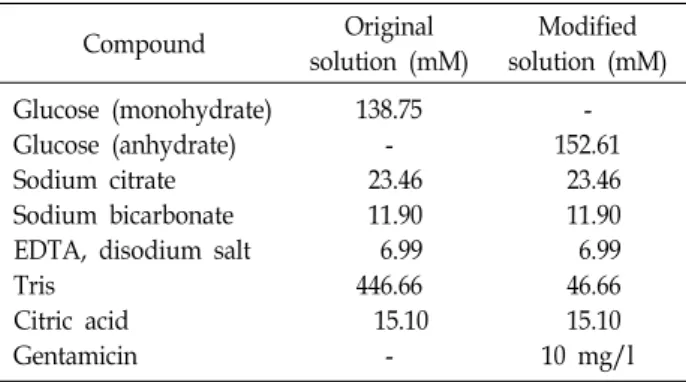
Table 1. Composition of Modena extender
Compound Original
solution (mM)
Modified solution (mM) Glucose (monohydrate)
Glucose (anhydrate) Sodium citrate Sodium bicarbonate EDTA, disodium salt Tris
Citric acid Gentamicin
138.75 - 23.46 11.90 6.99 446.66 15.10
-
- 152.61 23.46 11.90 6.99 46.66 15.10 10 mg/l quality in bore semen, also we have tested curcumin can protect sperm from phthalate.
Material and Methods
Reagents
DBP, DEHP and curcumin were purchased from Sigma- Aldrich (St. Louis, Missouri, USA). MBP was purchased from Tokyo Chemical Company (Chuo-ku, Tokyo, Japan).
Preparation of semen and treatments
Semen was collected from five pigs by gloved-hand tech- nique at the local AI center (Wonju, Kangwon, South Korea).
After collection, semen was diluted to concentration of 1.0×
10
7sperm in 1 ml Modena extender (Table 1). Then semen was transported to the laboratory at 17℃ within 2 hr [9, 20]. The semen was incubated with phthalates (50, 100, and 200 μM) and/or curcumin (5 and 10 μM) for 3, 6, and 9 hr at 37℃. Sperm samples were also treated phthalate (50 μM) with/without curcumin (5 μM) for 3 hr. Then, sperm motility, viability, mitochondria activity and membrane in- tegrity were evaluated (n=5).
Motility and viability of sperm
The motility and viability of spermatozoa were evaluated after treatment with DBP, MBP, DEHP, and/or curcumin for 3, 6, and 9 hr. 20 μl of sperm samples (1.0×10
6/ml) were placed on pre-warmed slide glass, then sperm progressive motility was analyzed using a phase contrast microscope (Nikon Eclipse TE300, Tokyo, Japan). Hoechst 33342 (HO) / propidium iodide (PI) staining method used for measuring sperm viability. 100 μl sample was stained with 10 μl PI (0.5 mg/ml in PBS), and incubated for 5 min at 37℃, and treated 10 μL HO (0.5 mg/ml) for 10 min at 37℃ in the dark. After incubation, 20 μl of sperm sample was placed on slide glass,
and observed under an epifluorescence microscope at 400×
magnification (Ziess Axioskop, Jena, Germany). The fluo- rescence spectra were 460/500 nm for HO, and PI emits at more than 600 nm.
Sperm membrane integrity
The plasma membrane integrity was evaluated using hy- poosmotic swelling test (HOST). 100 μl sperm sample was mixed with 1 ml hypo-osmotic solution (150 mOsm, 7.35 g Na-citrate and 13.51 g fructose in 1 l water), and incubated for 30 min at 37℃. Finally, 20 μl sample was placed on a glass slide, and covered with a cover glass. The swell of sperm tails was observed under a phase contrast microscope at 400× magnification (Nikon Eclipse TE300, Tokyo, Japan).
Mitochondrial activity in sperm
Mitochondrial activity was assessed by Rhodamin123 (R123) staining. Briefly, 3 μl of R123 (0.1 mg/ml) was added in 1 ml sperm sample, and stained for 15 min at 37℃ in dark room. After incubation, the sample was centrifuged at 1,500× g for 5 min, then diluted with 1 ml PBS, and then mixed with 10 μl PI for 10 min. After incubation, 20 μl of sperm sample was placed a slide glass, and covered with a glass coverslip. Samples were evaluated by epifluorescence microscope at 400× magnification (Ziess Axioskop, Jena, Germany). R123 and PI were measured in 490/515 and 545/590 nm, respectively. Mitochondrial activity is deter- mined on the mid-piece region of sperm.
Statistical analysis
The data was analyzed using a Statistical Analysis System software version 9.2 (SAS Institute Inc. USA). Treatment groups were compared for differences using of Duncan’s modified multiple range tests. All values are presented as mean ± the standard effort of the mean (SEM). P-value of 5% was considered significant.
Results
In this study, we treated high concentration of phthalate in the boar semen, since sperm has different cell type of cells in the human. Also low concentration of phthalate did not effect on sperm characteristics.
Dose-dependent effect of phthalate on sperm motility
and viability in boar semen
Table 2. Effect of phthalates on sperm motility
Treatments (μM) Motility (%)
3 hr 6 hr 9 hr
Control
DBP 50
100 200
MBP 50
100 200 DEHP 50
100 200
66.6±3.3
a54.8±3.2
b52.2±2.7
b42.2±3.2
c56.6±2.8
b50.1±2.3
bc43.3±3.3
c51.1±2.6
b40.0±2.3
c33.3±4.4
c51.1±4.2
a44.4±3.7
a32.2±2.2
b28.8±2.3
b44.4±4.1
a41.1±4.2
ab32.2±3.2
b38.3±2.0
b28.8±2.3
c21.1±3.5
c35.5±3.3
a30.0±3.7
a20.0±2.3
b10.5±2.1
c30.5±3.1
ab23.8±3.0
b12.7±1.4
c19.4±1.7
b11.1±1.8
c07.3±1.4
cDBP, Di-n-butyl phthalate; MBP, monobutyl phthalate; DEHP, Di (2-ethylhexyl) phthalate.
a~cValues with different superscripts within same column are significantly different, p<0.05.
Table 3. Effect of phthalates on viability of sperm
Treatments (μM) Viability (%)
3 hr 6 hr 9 hr
Control
DBP 50
100 200
MBP 50
100 200 DEHP 50
100 200
64.0±3.0
a52.6±4.1
b45.4±2.5
bc42.3±1.9
c48.8±6.1
b44.7±1.9
c38.0±0.9
c54.3±3.6
b40.7±0.7
bc37.1±0.9
c48.3±3.3
a39.2±2.6
b35.2±1.6
b33.0±1.6
b42.7±3.5
ab34.3±2.4
bc31.7±2.4
c43.2±4.0
a35.0±2.2
b28.8±1.8
b39.8±1.8
a31.3±2.2
b28.6±1.6
b28.2±1.7
b36.0±2.9
a27.4±1.5
b24.5±1.2
b37.5±3.0
a31.7±2.2
b23.7±1.4
bDBP, Di-n-butyl phthalate; MBP, monobutyl phthalate; DEHP, Di (2-ethylhexyl) phthalate.
a~cValues with different superscripts within same column are significantly different, p<0.05.
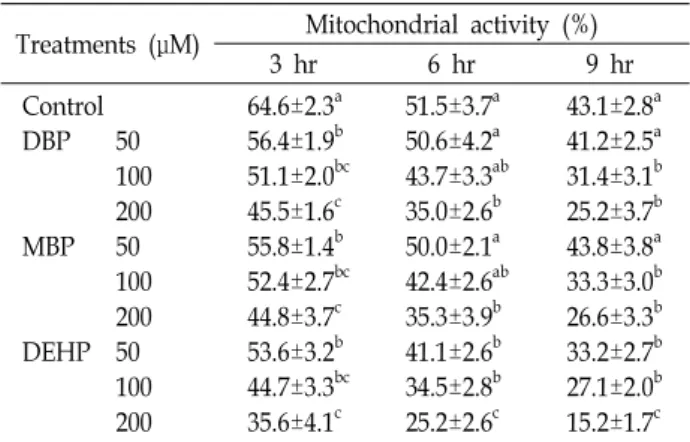
Table 4. Effect of phthalates on sperm mitochondrial activity
Treatments (μM) Mitochondrial activity (%)
3 hr 6 hr 9 hr
Control
DBP 50
100 200
MBP 50
100 200 DEHP 50
100 200
64.6±2.3
a56.4±1.9
b51.1±2.0
bc45.5±1.6
c55.8±1.4
b52.4±2.7
bc44.8±3.7
c53.6±3.2
b44.7±3.3
bc35.6±4.1
c51.5±3.7
a50.6±4.2
a43.7±3.3
ab35.0±2.6
b50.0±2.1
a42.4±2.6
ab35.3±3.9
b41.1±2.6
b34.5±2.8
b25.2±2.6
c43.1±2.8
a41.2±2.5
a31.4±3.1
b25.2±3.7
b43.8±3.8
a33.3±3.0
b26.6±3.3
b33.2±2.7
b27.1±2.0
b15.2±1.7
cDBP, Di-n-butyl phthalate; MBP, monobutyl phthalate; DEHP, Di (2-ethylhexyl) phthalate.
a~cValues with different superscripts within same column are significantly different, p<0.05.
Table 5. Effect of phthalates on membrane integrity of sperm
Treatments (μM) Membrane integrity (%)
3 hr 6 hr 9 hr
Control
DBP 50
100 200
MBP 50
100 200 DEHP 50
100 200
30.4±2.7
a18.8±1.4
b14.8±1.1
b18.7±2.5
b15.0±1.7
b12.8±1.7
b15.0±1.7
b13.5±1.5
b11.2±0.9
b15.8±2.3
b18.7±1.8
a09.4±1.5
b09.7±1.5
b10.6±1.3
b10.4±1.5
b07.5±0.7
b09.3±1.0
b08.1±1.2
b06.2±1.1
b09.3±1.3
b12.8±1.0
a07.3±0.7
b05.4±0.8
b06.5±0.9
b08.7±1.0
b05.1±0.8
b05.5±0.6
b06.4±1.0
b03.4±0.8
b06.1±0.9
bDBP, Di-n-butyl phthalate; MBP, monobutyl phthalate; DEHP, Di (2-ethylhexyl) phthalate.
a~bValues with different superscripts within same column are significantly different, p<0.05.
Phthalate reduced the motility and viability of sperm in a dose-dependent manner (Table 2 and Table 3). 50 μM of DBP, MBP, and DEHP were found to significantly decrease the motility and viability of sperm for 3, 6, and 9 hr (p<0.05).
Thus, we used 50 μM phthalate concentration in the study.
Dose-dependent effect of phthalate on sperm mi- tochondrial activity and membrane integrity in boar se- men
DBP, MBP, and DEHP decreased sperm mitochondrial ac- tivity and membrane integrity in boar semen (Table 4 and Table 5). 50 μM of phthalate significantly inhibited mi- tochondrial activity of sperm at 3, 6, and 9 hr (Table 4, p<0.05). Membrane integrity was decreased by phthalate at all concentrations (50, 100, and 200 μM), and all incubation times (Table 5, p<0.05).
Effect of curcumin, DBP, MBP and DEHP on sperm motility and viability in phthalate-treated semen
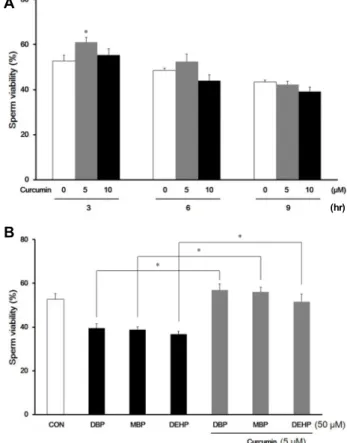
Sperm motility was increased at 5 μM curcumin for 3 and 9 hr (Fig. 1A, p<0.05), but not at higher concentration (10 μM). Viability of sperm was also increased at 5 μM curcumin for 3 hr (Fig. 2A, p<0.05). Therefore, a concentration of 5 μM of curcumin was used in the next experiments. Sperm motility increased in curcumin-treated samples with DBP, MBP and DEHP (Fig. 1B, p<0.05). Sperm viability also was higher in curcumin-treated sperm (Fig. 2B, p<0.05).
Effect of curcumin, DBP, MBP and DEHP on mi- tochondrial activity and membrane integrity in phtha- late-treated semen
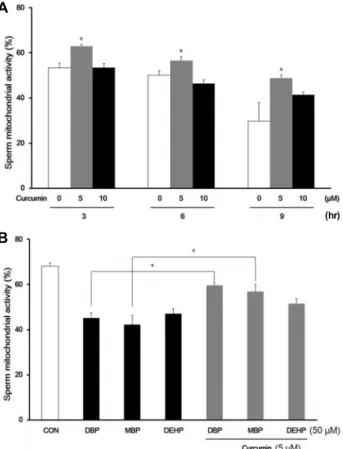
Mitochondrial activity and membrane integrity increased
by curcumin (Fig. 3A and Fig. 4A, p<0.05). The mitochon-
A
B
(hr)
Fig. 1. Effect of DBP, MBP, DEHP (50 μM) and/or curcumin (5 μM) on sperm motility in boar semen. Asterisks in- dicate significant differences compared with phtha- late-treated sperm. Values represented as means ± SEM (p<0.05).
A
B
(hr)
Fig. 2. Effect of DBP, MBP, DEHP (50 μM) and/or curcumin (5 μM) on viability of sperm in boar semen. Asterisks indicate significant differences compared with phtha- late-treated sample. Values represented as means ± SEM (p<0.05).
drial activity and membrane integrity of sperm were higher in phthalate-treated sperm with curcumin (Fig. 3B and Fig.
4B, p<0.05), but DEHP-treated sperm was not affected by curcumin.
Discussion
Phthalate known to induce metabolic dysfunction and ox- idative stress, and reactive oxygen species production by phthalate in the cells is rapidly increased [7, 28]. Also re- active oxygen species formation causes DNA damage, lipid peroxidation, protein denaturation, and apoptosis. More- over, oxidative stress by reactive oxygen species induced the infertility of male [18]. Endocrine disruptors, bisphenol A, methoxychlor, 2, 3, 7, 8-tetrachlorodibenzo-p-dioxin and genistein, are very important play in the infertility of male [27], and chemical or synthetic function has harmful effects in normal hormone mechanisms [36]. Therefore, antioxidant is an important factor for protecting cells from oxidative
damage [11, 25]. Thus, we investigated whether phthalate can damage sperm characteristics as endocrine disruptor.
Sperm motility, viability, membrane integrity and mitochon- drial activity were inhibited by phthalates, suggesting phtha- late is can trigger the infertility of male in mammals, and may play an endocrine disruptor in boar sperm.
In this study, curcumin enhanced sperm characteristics,
motility, viability, mitochondrial activity, and membrane in-
tegrity of boar sperm. We showed time-dependent effects
of curcumin, and found that a low concentration of curcu-
min elevated the quality of sperm, but not a high concen-
tration. Some other studies reported that sperm motility de-
creased by a high concentration of curcumin, indicating cur-
cumin plays a selective immobilizing effect in sperm [25,
29]. Also Tvrada et al. (2015) reported that curcumin could
be beneficial for a complex enhancement of bovine sperma-
tozoa activity and protection against complications resulting
from in vitro culture experiments [39]. Moreover, curcumin
can use a supplementation to medium for boar semen cry-
A
B
(hr)
Fig. 3. Effect of DBP, MBP, DEHP (50 μM) and/or curcumin (5 μM) on mitochondrial activity in boar semen. Asterisks indicate significant differences compared with phtha- late-treated sample (p<0.05).
A
B
(hr)