http://dx.doi.org/10.12925/jkocs.2015.32.2.202
Poly(Dimethylaminoethyl Methacrylate)-Based pH-Responsive Hydrogels Regulate Doxorubicin Release at Acidic Condition
Seung-Hun LeeㆍJin-Oh You
†Department of Engineering Chemistry, Chungbuk National University, Cheongju, 362-763, Republic of Korea
(Received May 2, 2015; Revised May 20, 2015; Accepted May 20, 2015)
Abstract : Stimuli-responsive biomaterials that alter their function through sensing local molecular cues may enable technological advances in the fields of drug delivery, gene delivery, actuators, biosensors, and tissue engineering. In this research, pH-responsive hydrogel which is comprised of dimethylaminoethyl methacylate (DMAEMA) and 2-hydroxyethyl methacrylate (HEMA) was synthesized for the effective delivery of doxorubicin (Dox) to breast cancer cells.
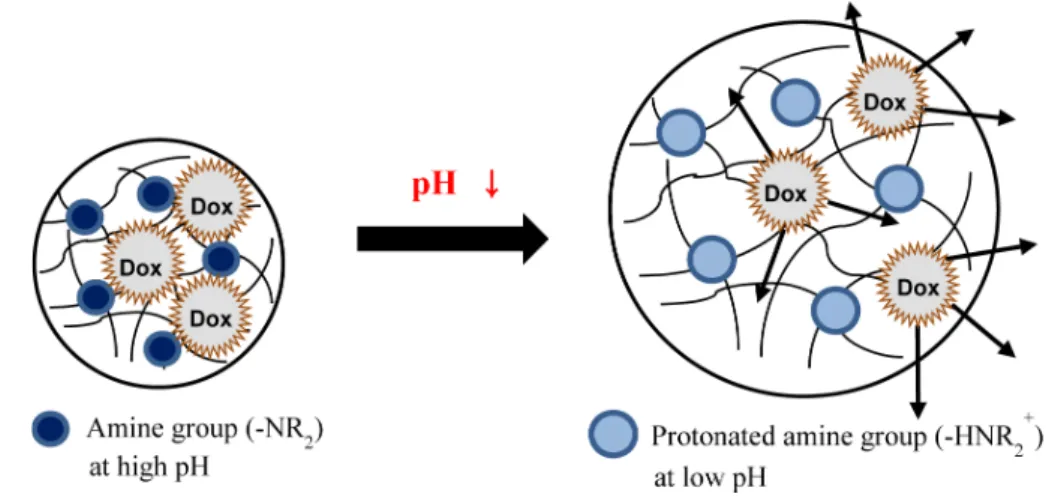
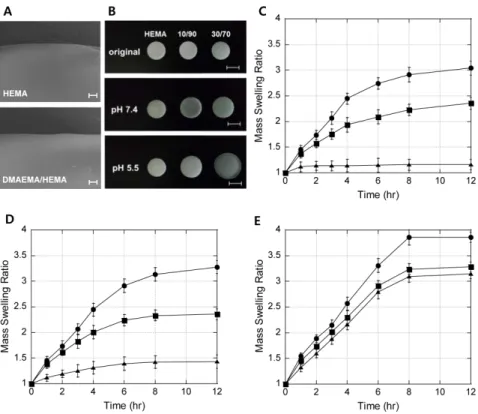
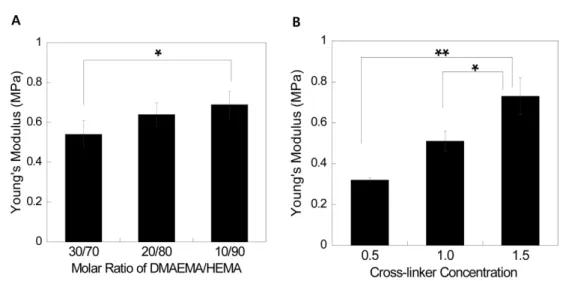
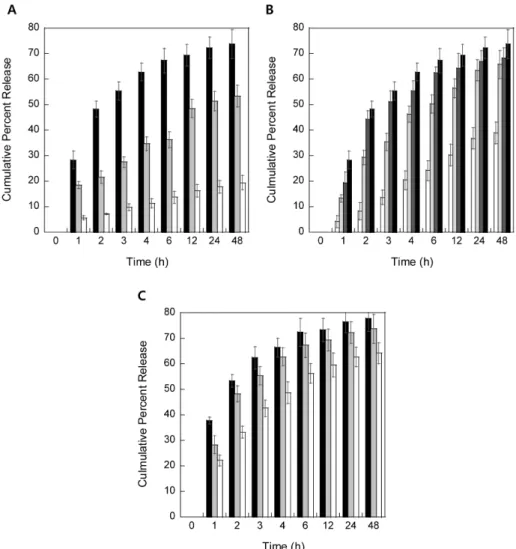
Cancer and tumor tissues show a lower extracellular pH than normal tissues. DMAEMA/HEMA hydrogels showed significant sensitivity by small pH changes and each formulation of hydrogels was examined by scanning electron microscopy, mechanical test, equilibrium mass swelling, controlled Dox release, and cytotoxicity. High swelling ratios and Dox release were obtained at low pH buffer condition, low cross-linker concentration, and high content of DMAEMA. Dox release was accelerated to 67.3% at pH 5.5 for 6-h incubation at 37
oC, while it was limited to 13.8% at pH7.4 at the same time and temperature. Cell toxicity results to breast cancer cells indicate that pH-responsive DMAEMA/HEMA hydrogels may be used as an efficient matrix for anti-cancer drug delivery with various transporting manners. Also, pH-responsive DMAEMA/
HEMA hydrogels may be useful in therapeutic treatment which is required a triggered release at low pH range such as gene delivery, ischemia, and diabetic ketoacidosis.
Keywords : pH-responsive hydrogel, DMAEMA, drug delivery, doxorubicin, cancer therapy
1. Introduction
Polymeric materials that respond to a stimulus such as temperature,[1, 2] pH,[3, 4]
light,[5] electric field,[6] and ionic strength[7]
have been used to fabricate various types of hydrogels for biomedical applications. Among
✝