Printed in the Republic of Korea http://dx.doi.org/10.5012/jkcs.2014.58.1.92
Stimuli-Sensitive Poly(NIPA-co-APA) Hydrogels for the Controlled Release of Keterolac Tromethamine
Yonghyun Kim, V. Ramesh Babu, K. S. V. Krishna Rao†, Jae-Min Lim, T. Daniel Thangadurai‡, and Yong-Ill Lee*
Anastro Laboratory, Department of Chemistry, Changwon National University, Changwon 641-773, Korea.
*E-mail: [email protected]
†Department of Chemistry, Yogi Vemana University, Kadapa-516003, India
‡Department of Nanotechnology, College of Engineering, Sri Ramakrishna Institutions, Coimbatore 641022, India (Received November 25, 2013; Accepted January 3, 2014)
ABSTRCT. The pH sensitive hydrogels composed of N-isopropylacrylamide (NIPA) and acryloyl phenylalanine (APA) were prepared by redox polymerization using N,N'-methylenebisacrylamide (MBA) as a crosslinker. Anti-inflammatory and analge- sic agent, Keterolac Tromethamine (KT), was loaded successfully into poly(NIPA-co-APA) copolymeric hydrogels by swelling equilibrium method. To understand the nature of drug in the polymeric matrix, the newly synthesized drug loaded poly(NIPA- co-APA) copolymeric hydrogels were characterized by using differential scanning calorimetry (DSC) and X-ray diffraction (XRD) techniques. The scanning electron microscopy (SEM) technique result indicates the spherical smooth surface of the hydrogels. The drug (KT) releasing nature of the poly(NIPA-co-APA) hydrogels was studied in pH 1.2 and 7.4. Effects of drug loading, crosslinking agent, pH and the ionic strength of the external medium on swelling of hydrogels were also investigated.
Key words: Hydrogel, Keterolac tromethamine, Controlled Release, Stimuli-responsive
INTRODUCTION
In recent years, the incorporation of amino acids into synthetic polymers has been acknowledged a consider- able interest because it can lead to new biomaterials with a wide range of properties that can be easily modulated by varying the components in the building block of the mac- romolecular backbone during synthesis.1−5 Examples of amino acid-derived organic polymers based on polyacrylates, polyisobutylenes, polyurethanes, polyacetylenes, and hydro- gels have been developed for diverse applications including controlled drug delivery systems, antibacterical activity, affinity based separators, and optobioelectronic devices.6−12 Hydrogels have been an extensive research topic dur- ing last several decades due to their high water content and the possible control over the swelling kinetics make them very attractive for biomedical applications. Owing to their widely variable and adjustable properties, hydrogels based on synthetic polymers have principally been studied as the vehicles for the controlled release of both low-molecular mass drugs and macromolecular drugs including thera- peutic proteins, enzymes, and DNA.13 The gel properties like porosity, swelling behavior, stability, biodegradability, gel strength, and biocompatibility may be tailored for a particular application. A special class of hydrogels, which
are called “intelligent” or “stimuli-responsive” hydrogels, exhibits significant volume change in response to small changes in external stimuli, such as pH, temperature, light, etc. The most interesting pH- and temperature-sensitive “intelligent” hydro- gels have extensively been used in the development of drug delivery systems for pharmaceutical applications.
Poly(N'-isopropylacrylamide) (PNIPA) hydrogel which is an intelligent hydrogel with a lower critical solution temperature (LCST)14−18 can be used for drug delivery systems, bioseparation, and other biotechnology applications.19,20 The volume phase transition of PNIPA matrix at 32oC is narrow and not practical at physiological temperature (37oC).
It is easy to tune the release of drug by temperature- and pH-sensitive systems due to the wide range of physiological pH mean values (2.20 in stomach to 6.80 in intestine).21 The thermosensitivity of hydrogel could be controlled with pH by incorporating the small amount of ionizable groups (such as carboxyl) into PNIPA chains.22
Ketorolac tromethamine (KT, Scheme 1) is a non-ste- roidal anti-inflammatory drug with 4−6 h of biological half- life period. The recommended total daily dose of KT tablets (maximum 40 mg) is significantly lower than KT injec- tion (maximum 120 mg). Dosage should be adjusted for patients 65 years or older, for patients under 50 kg (110 lbs) of body weight and for patients with moderately elevated
serum creatinine. Furthermore, doses of KT injection are not to exceed 60 mg (total dose per day) in these patients.
Therefore, it is necessary to enhance sustain action of drug for longer periods. If KT administrates directly as a con- ventional formulation, it causes gastro intestinal complications including irritation, ulcer, bleeding, and perforation.23,24 Therefore, it is essential to develop a pH sensitive con- trolled drug delivery system to prevent the above problems.
The present communication reports the development of amino acid based pH-sensitive hydrogels for the controlled release of drug KT. Swelling studies as well as drug release studies have been performed at pH 1.2 and 7.4 to meet gastro intestinal conditions.
EXPERIMENTAL
Materials
Ketorolac tromethamine (KT), N-isopropylacrylamide (NIPA), N,N'-methylenebisacrylamide (MBA), ammonium persulfate (APS) were purchased from Aldrich. N,N,N',N'- tetramethylethylenediamine (TEMED) was purchased from Alfa Aesar A Johnson Matthey Company. N-acryloyl-L- phenylalanine (APA) was synthesized by the procedure given in prior art.25
Preparation of Dissolution Media
The buffer solution at pH 1.2 was prepared by taking 50 mL of 0.2 M KCl and 7.8 mL of 0.2 N HCl in vol- umetric flask and diluted to 200 mL with distilled water. The pH 7.4 solution was prepared by taking 50 mL of 0.2 M KH2PO4 and 39.1 mL of 0.2 N NaOH in volumetric flask and diluted to 200 mL with distilled water.26
Scheme 1. Chemical structure of Ketorolac Tromethamine (KT).
Scheme 2. Synthetic scheme of poly(NIPA-co-APA) hydrogel.
Synthesis of Poly(N-isopropyl acrylamide-co-acryloyl phenyl alanine), Poly(NIPA-co-APA), Hydrogels
Poly(NIPA-co-APA) hydrogels were prepared by redox polymerization. NIPA (800 mg), APA (200 mg), and MBA (10 mg) were dissolved in 4 mL of distilled water at room temperature (APA dissolved in equimolar ratio of NaOH).
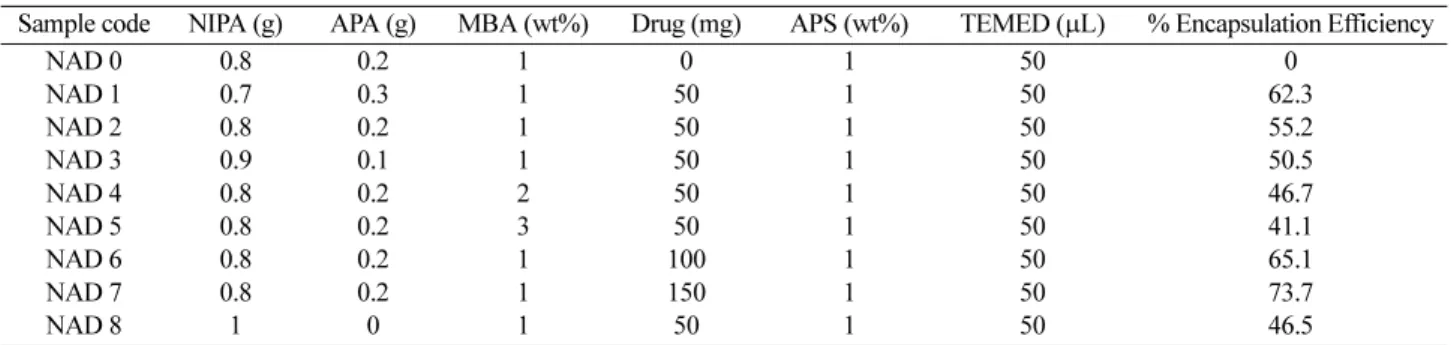
To this homogeneous monomer solution, initiator APS (10 mg) and accelerator TEMED (50μL) were added sequen- tially under continuous stirring. The free-radical crosslinking polymerization was continued for 24 h at 5oC in order to complete the network formation. The reaction mecha- nism for the synthesis of hydrogels has been illustrated in Scheme 2. The synthesized copolymeric hydrogels were taken out and immersed in distilled water for 3 days at room temperature by changing the water every 12 h in order to remove residual unreacted monomers. The resulting “swollen” hydrogels were dried in air for 2 days and then in a vacuum oven at 37oC until attaining a constant weight. The copolymeric hydrogels were pre- pared by varying the ratios of monomers, the amount of crosslinking agent, and the different amount of drug. The pure PNIPA hydrogel without APA was also fabricated under the same condition. All formulations used in this work were given in Table 1.
Swelling Studies
Dynamic swelling of the copolymeric hydrogels pre- pared with three different crosslink densities as well as three different drug loadings was studied at pH 1.2 and 7.4 by mass measurements at 37oC. To perform the swelling experiments, hydrogels were soaked in water and then removed from the swelling bottles at different time inter- vals. The hydrogels were wiped carefully with tissue paper (without pressing hard) to remove the surface-adhered water.
Swelling experiments were repeated thrice for each sam- ple and the average values were used in data analysis. The standard deviations (SD) in all cases were <5%. The per- centage of swelling ratio (% SR) was calculated by the
following equation (1).
(1)
where, Ws is the weight of the swollen gel at time t and Wd
is the dry weight of the gel.
Release Dynamics of the Model Drug
Standard curve of Ketorolac Tromethamine In this procedure, the absorbance of a number of stan- dard solutions with the reference substance encompass- ing the sample concentrations were measured by using the UV–vis Spectrophotometer (Agilent 8453 UV spectropho- tometer) at λmax 324 nm. The calibration graph was con- structed and the concentration of the drug in sample solution was determined from the absorbance of solution. Two cal- ibration graphs were made in pH 1.2 and 7.4 dissolution media, to determine the amount of drug release from the drug-loaded hydrogels.
Loading of the drug in copolymeric networks The loading of the drug onto poly(NIPA-co-APA) hydro- gels was carried out by the swelling equilibrium method.
The poly(NIPA-co-APA) hydrogels were allowed to swell in the drug solution of known concentration for 24 h at 37oC and then dried to obtain the release device.27
Estimation of drug loading and encapsulation The loading efficiency of KT in the copolymeric hydrogel was examined spectrophotometrically. About 10 mg of the drug-loaded hydrogels were placed in 10 mL of buffer solution and stirred vigorously for 48 h to extract drug from the hydrogels. The solution was filtered and assayed by using the UV spectrophotometer at 324 nm. The percentage (%) drug loading and encapsulation efficiency were calcu- lated by Eqs. (2) and (3), respectively, and the data were compiled in Table 1.
%SR Ws×Wd Wd ---
⎝ ⎠
⎛ ⎞ 100×
=
Table 1. Formulation of hydrogels with KT and their encapsulation efficiencies
Sample code NIPA (g) APA (g) MBA (wt%) Drug (mg) APS (wt%) TEMED (µL) % Encapsulation Efficiency NAD 0
NAD 1 NAD 2 NAD 3 NAD 4 NAD 5 NAD 6 NAD 7 NAD 8
0.8 0.7 0.8 0.9 0.8 0.8 0.8 0.8 1
0.2 0.3 0.2 0.1 0.2 0.2 0.2 0.2 0
1 1 1 1 2 3 1 1 1
0 50 50 50 50 50 100 150 50
1 1 1 1 1 1 1 1 1
50 50 50 50 50 50 50 50 50
0 62.3 55.2 50.5 46.7 41.1 65.1 73.7 46.5
% Drug loading =
×100 (2)
% Encapsulation efficiency = ×100 (3)
In vitro release studies
The KT release from the poly(NIPA-co-APA) copoly- meric hydrogels was investigated in dissolution media at pH 1.2 and 7.4 with different percentage of KT loading and different extent of crosslinking. In vitro release exper- iments were performed by using the digital tablet disso- lution test apparatus (Model: VDA-8D, Mumbai, India) at a stirring speed of 100 rpm. The weighed quantities of the samples equivalent to 10 mg of the drug were placed in the basket, which was then immersed in 900 mL dissolution medium maintained at 37oC. A 5 mL of sample aliquot was withdrawn at different time intervals and filtered through a 0.25 µm filter. The dissolution media were then replaced with 5 mL of fresh dissolution media. The KT concen- tration was determined spectrophotometrically at 324 nm.
These measurements were carried out in triplicate for each sample, but average values were considered in data anal- ysis and graphical presentations.
Characterization
Differential scanning calorimetric analysis
Differential scanning calorimetry (DSC) was performed on placebo poly(NIPA-co-APA) hydrogel, drug-loaded poly(NIPA-co-APA) hydrogel, and pristine KT. The ther- mal properties of poly(NIPA-co-APA) copolymeric hydro- gels were evaluated by using TA 5000/SDT 2960 DSC Q10 thermal system (Zurich, Switzerland). About 1−4 mg of sample was heated from 25 to 250oC at the heating rate of 10oC/min under nitrogen atmosphere with keeping the flow rate at 20 mL/min.
X-ray diffractometry (XRD)
The crystallinity of KT after encapsulation was evaluated for placebo poly(NIPA-co-APA) hydrogel, drug-loaded poly (NIPA-co-APA) hydrogel, and pristine KT by using the X-ray diffractometer (X’pert MPD 3040). The uniform size of dried poly(NIPA-co-APA) hydrogel was mounted on a sample holder and XRD patterns were recorded in the angle range of 5−45o at the speed of 5o/min.
Scanning Electron Microscopy (SEM)
SEM images of the poly(NIPA-co-APA) hydrogels were
recorded using a MIRA LMH, H.S. scanning electron microscope (SEM), equipped with Phoenix energy dis- persive analysis of X-rays (EDAX) at the required mag- nification. The micrographs were obtained at 15 kV as operating voltage.
RESULTS AND DISCUSSION
Differential Scanning Calorimetric Study
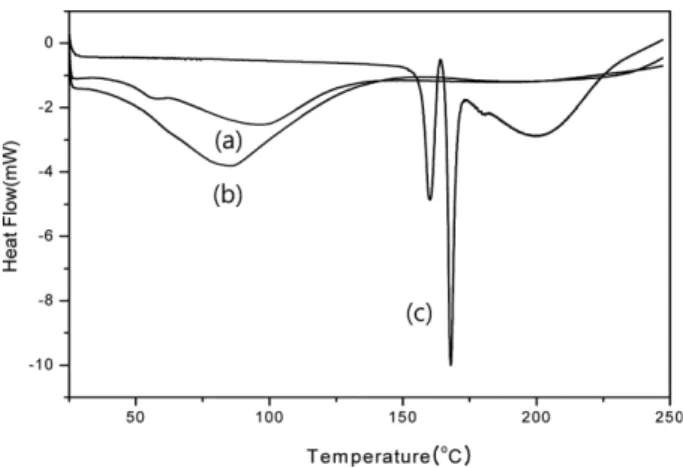
The DSC thermograms of (a) placebo poly(NIPA-co-APA) hydrogels, (b) drug-loaded poly(NIPA-co-APA) hydrogels, and (c) pristine KT are presented in Fig. 1. The crystal- linity of drug and the melting temperature (Tm) of poly- mer were determined. The placebo poly(NIPA-co-APA) hydrogels have shown an endothermic peak at 96oC, indi- cating the melting temperature, whereas the drug-loaded poly(NIPA-co-APA) hydrogels showed an endothermic peak at 85oC. However, a strong exothermic decomposition peak was observed around 172oC for KT, which designates the melting and the decomposition of the drug. It should be noted that this exothermic peak did not appeared in all the drug-loaded hydrogels comfirming an amorphous dis- persion of the drug into the polymer matrix.
X-ray Diffraction Studies
To investigate the crystallinity of the drug in the crosslinked poly(NIPA-co-APA) hydrogels, x-ray diffraction patterns of Placebo poly(NIPA-co-APA) hydrogels, drug-loaded poly(NIPA-co-APA) hydrogels and pristine KT were recorded (Fig. 2a−c). Characteristic intense peaks were observed between 8, 14, 18, and 20o due to crystalline nature of KT (Fig. 2c). However, these peaks were disappeared when KT was loaded in poly(NIPA-co-APA) hydrogels and only
⎝⎛Amount of drug in the P(NIPA-co-APA) hydrogels Amount of P(NIPA-co-APA) hydrogels ⎠⎞
Actual loading Theoretical loading
Figure 1. DSC thermograms of (a) placebo poly(NIPA-co-APA) hydrogels, (b) drug-loaded poly(NIPA-co-APA)hydrogels, and (c) pristine KT.
placebo polymer matrix peaks were observed (Fig. 2a,b).
This result revealed that the KT dispersed well at the molec- ular level in the polymer matrix and crystallinity was not found in the drug-loaded matrices. Moreover, it is very difficult to measure the detection limit due to the amor- phous nature of the loaded drug.
Scanning Electron Microscopy Studies
The SEM micrographs of poly(NIPA-co-APA) hydrogels indicate smooth surface with partial holes which helps the drug release as well as swelling capacity of the hydrogels (Fig. 3).
Swelling Studies
Hydrogels are composed of hydrophilic homopolymer or copolymer networks, which can swell in the presence of water or physiological fluids. Swelling parameters are the most important factors for hydrogel characterization because of fundamental relationship exists between the swelling of a polymer and the nature of the swelling
medium.28,29 Chemical crosslinks (covalent bonds) or phys- ical junctions (e.g., secondary forces, crystallite formation, chain entanglements) provide the hydrogels unique swell- ing behavior and three-dimensional structure.30−32 In order to evaluate the optimum reaction parameters for the syn- thesis of hydrogels, we took the swelling of the hydrogels and the structural integrity maintained by the hydrogels after swelling for 24 h as the criteria. The swelling of the poly(NIPA-co-APA) hydrogels was studied as a function of APA content, in pH value of 1.2 and 7.4, amount of KT and amount of MBA in the polymer matrix.
Effect of N-acryloyl-L-phenylalanine (APA) contents The effect of monomer concentration on the swelling of crosslinked polymers was investigated as a function of APA contents and the results are presented in Fig. 4(a).
The extent of APA is related largely to the swelling equi- librium. It was observed that the % swelling ratios of the hydrogels were increased from 44 to 1652 with increasing the amount of APA from 0 to 300 mg. This is attributed to increase the hydrophilicity of matrix due to the presence of carboxylic as well as amide groups in APA.
Effect of drug loading
The hydrogels were prepared with different KT con- tents from 0 to 150 mg in order to study the entrapment of KT on the polymer network. The swelling was taken in pH 7.4 dissolution media at 37oC. As can be seen in Fig. 4(b), the swelling was increased with increasing KT contents in the composition of hydrogel matrix. Such an increase in swelling of the matrix is mainly due to the incorporation of the acidic nature of KT and formation of matrix between hydrophilic APA and NIPA chains.
Effect of crosslinking agent
The effect of crosslinking agent (MBA) on the swelling of the hydrogel at 37oC was investigated by preparing polymers with different concentration of crosslinking agent (Fig. 4(c)). The extent of crosslinking is dependent upon the amount of crosslinking agent (MBA) used and the swell- ing equilibrium. For instance, % swelling ratio decreased from 1415 to 897 with increasing the amount of MBA from 10 to 30 mg. The denser crosslinking produced by increasing the crosslinker concentration leading to decreased void size in the polymer matrix and thereafter decreases the swelling in the polymer.
Effect of pH
To investigate the effect of pH and ionic strength of the Figure 2. X-ray diffraction patterns of (a) placebo poly(NIPA-
co-APA) hydrogels, (b) drug-loaded poly(NIPA-co-APA) hydro- gels, and (c) pristine KT.
Figure 3. Scanning Electron Microscope image of a pure poly (NIPA-co-APA) hydrogel.
external medium on the swelling of poly(NIPA-co-APA) hydrogels, the swelling experiments were carried out in pH 1.2 and 7.4 (Fig. 4(d)). The % swelling ratio values were found to be much higher at pH 7.4 than at1.2 due to the swell- ing ratio of the hydrogel was limited at pH 1.2 owing to the formation of intermolecular hydrogen bonds. At pH 7.4, the carboxylic acid groups on the hydrogel become ion- ized (–COO–) progressively. In this case, a large swelling force created by the electrostatic repulsion between the ionized acid groups make the hydrogel to be swelled more significantly. The electrostatic attraction between oppo- site charged molecules is an adjustable driving force for structured material construction.
Encapsulation Efficiency (EE %)
In order to explore the percentage of encapsulation effi- ciency (EE %), three different concentrations of KT (1, 2, and 3 wt%) were loaded in the hydrogels. The results reveal that the percentage of encapsulation efficiency increases by increasing the drug concentration (Table 1). It should be noticed that EE % was enhanced with increasing the amount of APA in the copolymeric hydrogels. The copoly- meric hydrogels containing 0, 0.1, 0.2, and 0.3 g of APA, and 1 wt% of KT with 1 wt% of MBA, the EE % were 46.5, 50.5 55.2 and 62.3%, respectively. For hydrogels crosslinked with 1, 2, and 3 wt% of MBA, the EE % are 55.2, 46.7, and 41.1%, respectively. Such a decreasing trend in encapsulation efficiency is resulted from reducing the
free volume spaces within the polymer matrix associated with an increase in crosslinking density and the ridgidty of the copolymeric hydrogels.
In vitro cumulative drug release studies
Drug release kinetics was analyzed by plotting the cumu- lative release values, (Mt/M∞) versus time, where, Mt/M∞ is a fraction of drug released at time ‘t’.
The poly(NIPA-co-APA) copolymeric hydrogels were used to study the release behavior of KT in pH 1.2 and 7.4.
Effect of N-acryloyl-L-phenylalanine (APA) content Effect of APA content in the hydrogel polymers was studied at constant loading of 1 wt% KT. The hydrogels prepared with different amounts of APA showed release trends up to >80% of cumulative release within ~10 h (Fig.
5(a)). A systematic increase in the % cumulative release was observed with increasing the composition of APA. The three-dimensional networks in the hydrogel polymers swelled systematically more with increasing amount of APA, proba- bly due to the ionization of crosslinked chains. Therefore, the relaxation responses of the polymer chains made an increase of dimension of the polymer coil, and further a significant increase in molecular volume of the overall hydrated polymer matrix. Noteworthy, the nature of release profiles remains almost identical for all the matrices con- taining different amount of APA indicating that swelling of APA has a linear relationship with their release profiles.
Figure 4. Effect of (a) N-acryloyl-L-phenylalanine (APA), (b) drug loading, (c) crosslinking agent in distilled water, and (d) pH in different buffer medium, on swelling kinetics of poly(NIPA-co-APA) hydrogels at 37oC.
Effect of drug loading
Fig. 5(b) displays the drug release profiles of drug-loaded hydrogels with different amounts of drug loadings (50, 100, and 150 mg). The effect of drug loading on the release rates was investigated for three formulations, NAD 2, 6, and 7 (Table 1).
It was observed that the drug release rates were slower for the formulations containing lower amount of the drug and vice versa.
The drug in the hydrogels might act as inert filler by occupying the free volume of the swollen hydrogel. This could have created a twisted path for water molecules to permeate, however, the degree of twisting depends upon the volume fraction of the filler.27
Effect of crosslinking agent
Typical plots between % cumulative release data versus time are illustrated in Fig. 5(c) by varying the amounts of MBA (i.e., 1, 2, and 3 wt%) at constant drug loading. The
% cumulative release was relatively large at the lower amount of MBA (1 wt%), compared with those at higher amount of MBA (3 wt%), probably due to the polymeric chains become rigid at higher concentration of MBA owing to the contraction of microvoids.
Effect of pH
The cumulative drug release experiments of poly(NIPA-co- APA) hydrogels were performed in pH 1.2 and 7.4 dissolu- tion media at 37oC. Fig. 5 indicates a considerable increase in the cumulative drug release for all the hydrogels when pH was increased from 1.2 to 7.4. It can be seen that the poly(NIPA-co-APA) hydrogels have shown extensive drug release rates than the pure NIPA hydrogels. However, it should be remarked that there is a drastic difference in the drug release rates of the formulated blend hydrogels in pH 1.2 and 7.4, implying the drug release of the poly(NIPA- co-APA) hydrogels depends upon the nature of the poly- mer matrix as well as pH of the media. For instance, in 24 h, only 70% of drug was released in pH 1.2 (Fig. 5(d)) and 90% was released in pH 7.4. In the case of the hydrolyzed blend polymer, it is likely that there is a complexation of carboxylic acid groups of APA, but there could be a defor- mation of the complex (NH-COO-) formed in pH 1.2.
CONCLUSION
Copolymeric hydrogels, poly(NIPA-co-APA), based on NIPA and APA were prepared by redox polymerization method and characterized by differential scanning calo- Figure 5. Percentage of cumulative drug release of poly(NIPA-
co-APA) hydrogels containing (a) different amount of APA, (b) different amount of KT, and (c) different amount of crosslinking agent in pH 7.4 and (d) in pH 1.2 at 37oC.
rimetry, X-ray diffractometry, and scanning electron micros- copy. All hydrogels swelled slowly in pH 1.2 and 7.4 at 37oC and reached the equilibria within 24 h. The per- centage of swelling ratio of the hydrogels was increased from 44 to 1652 with increasing the amount of APA (from 0 to 300 mg) and the KT contents. Effect of pH on swell- ing kinetic studies revealed that percentage of swelling ratio decreases by decreasing the pH due to the formation of intermolecular hydrogen bonds. The drug KT was dis- persed at the molecular level in the polymer matrix and no crystals were found in the drug-loaded matrices. The amounts of matrix crosslinking agent, drug-loading, and APA con- tent of the matrix influenced the release of KT. The drug release profile was varied (up to 10 h) depending upon the nature of the matrix in gastro intestinal tract (GIT) disease conditions.
Acknowledgments. This work was supported by the research project of Changwon National University (2012- 2014).
REFERENCES
1. Raman, K.; Ramamoorthy, R.; Reddy, B. S. R. React. Funct.
Polym. 2005, 62, 215.
2. Vaidya, A. A.; Lele, B. S.; Kulkarni, M. G.; Mashelkar, R.
A. Biotechnol. Bioeng. 1999, 64, 418
3. Deshmukh, M. V.; Vaidya, A. A.; Kulkarni, M. G.; Rajamo- hanan, P. R.; Ganapathy, S. Polymer 2000, 41, 7951.
4. Puskas, J. E.; Chen, Y.; Dahman, Y.; Padavan, D. J. Polym.
Sci. Part A: Polym. Chem. 2004, 42, 3091.
5. Vyavahare, N.; Kohn, J. J. Polym. Sci. Part A: Polym. Chem.
1994, 32, 1271.
6. Nathan, A.; Zalipsky, S.; Kohn, J. J. Bioact. Compat. Polym.
1994, 9, 239.
7. Lin, H. B.; Sun, W.; Mosher, D. F.; García-Echeverría, C.;
Schaufelberger, K.; Lelkes, P. I.; Cooper, S. L. J. Biomed.
Mater. Res. 1994, 28, 329.
8. Salhi, F.; Lam, J. W. Y.; Cheuk, K. K. L.; Cha, J. A. K.;
Tan, B. Z. Polymer Preprint 2000, 41, 1185.
9. Song, H.; Chu, C. C. J. Appl. Poly. Sci. 2012, 124, 3840.
10. Sato, M.; Mutsumi Inata, M.; Yamaguchi, I. J. Appl. Poly.
Sci. 2012, 126, E298.
11. Angiolini, L.; Caretti, D.; Giorgini, L.; Salatelli, E.; Altomare, A.; Carlini, C.; Solaro, R. Polymer 1998, 39, 6621.
12. Ramesh Babu, V.; Kim, C.; Kim, S.; Ahn, C. Lee, Y. I.
Carbohyd. Polym. 2010, 81, 196.
13. Erbil, C.; Aras, S.; Uyanik, N. J. Polym. Sci. Part A: Polym.
Chem. 1999, 37, 1847.
14. Vesterinen, E.; Dobrodumov, A.; Tenhu, H. Macromole- cules 1997, 30, 1311.
15. Chen, G.; Hoffman, A. S. Nature 1995, 373, 49.
16. Serizawa, T.; Uemura, M.; Kaneko, T.; Akashi, M. J. Polym.
Sci. Part A: Polym. Chem. 2002, 40, 3542.
17. Wang, M.; Fang, Y.; Hu, D. React. Funct. Polym. 2001, 48, 215.
18. Yan, L.; Zhu, Q.; Kenkare, P. U. J. Appl. Poly. Sci. 2000, 78, 1971.
19. Krishna Rao, K. S. V.; Vijaya Kumar, N. B.; Subha, M.
C. S.; Sairam, M.; Aminabhavi, T. M. Carbohyd. Polym.
2006, 66, 333.
20. Cui, Z. F.; Guan, Y. X.; Chen, J. L.; Yao, S. J. J. Appl.
Poly. Sci. 2005, 96, 1734.
21. Grøttum, J. A.; Erikson, U.; Grasdalen, H.; Staurnes, M.
Comparative Biochemistry and Physiology Part A: Molecu- lar & Integrative Physiology 1998, 120, 469.
22. Shin, B. C.; Jhon, M. S.; Lee, H. B.; Yuk, S. H. Eur. Polym.
J. 1998, 34,171.
23. Soppimath, K. S.; Aminabhavi, T. M.; Kulkarni, A. R.;
Rudzinski, W. E. J. Controlled Release 2001, 70, 1.
24. Casolaro, M.; Paccagnini, E.; Mendichi R.; Ito, Y. Mac- romolecules 2005, 38, 2460.
25. Baljit, S. Int. J. Pharm. 2007, 334, 1.
26. Peppas, N. A. Bioavailability and the Pharmacokinetic Con- trol of Drug Response; Wiley: New York, 1980.
27. Pharmacopoeia of India; Controller of publications: Delhi, India, 1985.
28. Dogu, Y.; Okay, O. J. Appl. Poly. Sci. 2006, 99, 37.
29. Gundogan, N.; Melekaslan, D.; Okay, O. J. Appl. Poly. Sci.
2012, 94, 135.
30. Peppas, N. A.; Mikos, A. G. Preparation Methods and Struc- ture of Hydrogels. In Hydrogels in Medicine and Pharmacy;
Peppas, N. A., Ed.; CRC Press: Boca Raton, Florida, 1986;
pp 1−25.
31. Allan, S. H. Adv. Drug Delivery Rev. 2002, 54, 3.
32. Peppas, N. A.; Bures, P.; Leobandung, W.; Ichikawa, H.;
Eur. J. Pharm. Biopharm. 2000, 50, 27.