1. INTRODUCTION
With the unprecedented growth of network technologies and development of advanced devices, Internet-of-Things (IoT), coined by Kevin Ashton [1], becomes one of the most promising future visions. IoT is a paradigm that foresees enormous amounts of interoperable things and heterogenous services in the environment [2-5]. Such an envi- ronment, from the perspective of the businesses, will provide tremendous opportunities in many fields, like household [4] and industries [5]. From the point of view of end-users, it will bring both a great deal of information as well as many
troubles. People have to face the increasing com- plexity of the surrounding environment and master a growing number of interactive abilities, which may cause cognitive load or detrimental to their productivity [6]. Therefore, it is a necessity to es- tablish intelligent mechanisms to assist people in achieving their intention in a simple and effective manner. Although, a growing number of service providers dedicate to developing intelligent hard- ware or software in a specific domain to admit the majority’s need. However, a dynamic choreography of a variety of services across domains is often necessary. Service composition, a concept of en- abling the combination of multiple services span-
A Service Composition using Hierarchical Model in Multiple Service Environment
Jiamei Tang†, Sangwook Kim††
ABSTRACT
Internet-of-Things (IoT) becomes one of the most promising future paradigms, which foresees enormous amounts of interoperable things and heterogeneous services. The goal of IoT is to enable all things connected and brings all kinds information and services to people. However, such a great deal of information may lead to cognitive overload or restrain in productivity of people. Thus, it is a necessity to build intelligent mechanisms to assist people in accessing the information or services they needed in a proactive manner. Most of previous related mechanisms are built on well-defined web services and lack of consideration of constrained resources. This paper suggests a services composition method by adapting a hierarchical model, which is a graph-based model composed of four layers: Context Layer, Event Layer, Service Layer and Device Layer. With a such multi-layer graph, service composition can be achieved by the iteration of layer by layer. Then, to evaluate the effectiveness of this proposed hierarchical model, a real-life emergency response dataset is applied and the experimental results are composed with the general probabilistic method and indicate that the proposed method is help for compositing multiple services while considering given context and constrained resources.
Key words: Multiple Service Environment, Service Composition, Hierarchical Model
※ Corresponding Author : Sangwook Kim, Address:
(702-701) Kyungpook National University 80 Daehak-ro, Buk-gu, Daegu, Korea, TEL : +82-53-940-8881, FAX : +82-53-950-6369, E-mail : [email protected]
Receipt date : Aug. 6, 2015, Approval date : Aug. 11, 2015
†School of Computer Science and Engineering, Kyung- pook National University
(E-mail : [email protected])
††School of Computer Science and Engineering, Kyung- pook National University
※ This research was supported by Next-Generation Information Computing Development Program through the National Research Foundation of Korea (NRF) funded by the Ministry of Science, ICT & Future Planning (No.
2012M3C4A7032185).
ning multiple service providers to achieve a com- mon task, is expected to provide dynamic service solutions with little or no human intervention. In this context, quite a few researchers propose com- position mechanisms for well-defined web serv- ices, which differ from real-world services [7,8].
Some of researches do propose mechanisms focus- ing on real-world services, such as the studies in [9-11]. However, these works do not consider con- textual information and limited resources.
This paper proposed a service composition mechanism using a hierarchical model in multiple services environment, like IoT environment. This service composition mechanism uses contextual information as input, and the output is the combi- nation of a set of predicated relevant services and corresponding optimal actuating devices. More specifically, the hierarchical model is generated ac- cording to the historical usage records and com- posed of four layers: Context Layer, Event Layer, Service Layer, and Device Layer. With the rela- tions in this hierarchical model, service composi- tion is achieved by the iteration of layer by layer.
The contributions of this paper are two-fold: 1) formulate the service composition in the multiple service environment 2) propose a graph-based model for service composition mechanism with considerations of context and constrained devices.
The remainder of this paper is organized as follows: some related works are reviewed and dis- cussed in Section 2. In Section 3, some assump- tions are made and the service composition prob- lem is formulated. Following, in Section 4. The proposed Service Composition Method is illustrated. Then, relevant evaluation is shown in Section 5. Lastly, in Section 6, the conclusion of this work is drawn.
2. RELATED WORKS
In this section, some related backgrounds and studies are reviewed and discussed.
The term of IoT, coined by Kevin Ashton [1], has been identified as a most promising future ver- sion and a great opportunity to many fields [12].
The basic idea of IoT is able to offer connectivity of heterogeneous devices, services and systems and enable their interactions and cooperations to reach common goals. There are three major com- ponents in IoT, hardware, middleware and pre- sentation [13]. Hardware includes a variety of physical things like sensors, actuators and so on.
Middleware refers to the mechanisms handling da- ta storage, computing and analysis. Moreover, pre- sentation provides the visual or interactive inter- faces for different applications. There are many re- searches conducted with respect to each component. As space is limited, this paper does not discuss them individually except service oriented architecture.
Service oriented architecture is one of the popu- lar middleware architectures proposed for IoT era [2]. In SOA, services act as the fundamental ele- ments that have features of self-describing, dis- coverable, manageable and composable. A common SOA-based architecture is proposed in [2], where Object layer refers to the real-world physical things. Object Abstraction layer provides the capa- bility that accessing to the different devices with a common descriptive language. Service manage- ment layer is to create and manage services.
Service Composition layer provides the composited services by combing multiple services to pursuit a common specific goal. Application layer consists all the system’s functionalities which directly in- teract with the end-users. This paper is a mecha- nism in Service Composition layer.
A number of researches concentrated on build- ing self-adaptive and self-adaptive services in the last few years. Service composition is a concept achieving these ideas by enabling the combination of multiple services on demand, which can over- come the isolation of services and lack of con- nections between them. With the swift growth of
the web, service composition on web attracts tre- mendous attentions, such the study in [14].
However, web services differ from services in re- al-world [7,8]. The former are generally well-de- fined and relative static, which are usually de- ployed in resource-rich environment, in contrast, the latter refers to the real-world service which is always operated in highly dynamic environment and limited to constrained resource, such as limited device computing capability, network bandwidth, battery and storage capability. Some researchers did propose service composition mechanisms for real life, such ambient environments, pervasive en- vironments, and ubiquitous environments. For in- stance, Amigo [9] is a mechanism allows users to perform tasks by composing services at a specific time and place, meanwhile it guarantees tasks to meet the request Quality-of-service (QoS). Aura proposed in [10,11] is a user preference based self-optimization and self-healing system for daily tasks, which devotes to finding the best match be- tween a user’s preferences and demands for a spe- cific task and environment capabilities. However, these works don’t consider constantly changing environment and resources-constrained devices.
3. ASSUMPTIONS AND FORMULATION Before narrating the hierarchical model-based service composition mechanism, there are some assumptions are made. In the first place, events happened in the environment can be automatically obtained and described by a set of related context.
Meanwhile, every event corresponds to a set of services running on different devices. Thus, an event can be associated with these services on devices. In the second place, services’ descriptions such as properties, operations, should be readily acquired and maintained by the Service Repository.
Similarly, there is a Device Repository keeps aware of all devices related information, such as capa- bilities, resources, functionalities and status and so on. Moreover, a User Repository masters all the
information and history usage data. In the end, if an event is specified, there is at least one execut- able solution of service composition. The service composition problem is to find the ideal service composition solution which is the most closest to the user’s service needs.
Based on before-mentioned assumptions, this service composition can be formulated. Let
denotes all the services in the Service Repository. is the set of all available devices, which is dynam- ically update and kept in the Device Repository.
represents all the set of possible events in this environment. For each event, it is described using a set of relevant contextual information, that is . For each user, there is a history storage includes all the service usage in the past, which is expressed by
′′′′ ′′′′ ′ ′ ′ ′
, where ′′∈ is an event instance,
′′⊂is the corresponding service set,
′′⊂
is the perform device set and
′ records the corre- spondence between service set and device set.
Hence, in general, this service composition problem can be formulated as follows a four-tuple
′ , where ′ is the input event cap- tured in this environment. Supposing the realistic demanded service set is′, device set is′, and their relations set ′, the objective of this study is to automatically determine the optimal services
′, devices ′ and their mapping relations set
′, which are closest to ′′′ respectively.
4. SERVICE COMPOSITION METHOD In this paper, the service composition process is achieved using a hierarchical model. This model is based on a four-layer graph which containing Context Layer, Event Layer, Service Layer and Device Layer(Shown in Fig. 1.) More specifically, each layer is an weighted undirected graph which
describes internal relations between the same ele- ment type. There are links across different layers, which represents the association strengths be- tween different elements types. This hierarchical model is built utilizing the historical usage records.
Specifically, in Context Layer, each context item is presented as one node, and the edge
between two contextual item reflects their co-oc- currence relations are calculate as equation (1), where the function· is the frequency of oc- currence of variable.
≠ (1)
Nodes in the Event layer refers to events, and edges between them are used to de- scribe the similarity between two events. Edges are measured using equation (2), where · repre- sents the number of elements of a finite set.
∪
∩
≠ (2)
Each service is expressed as one node in Service Layer, and edges between services re- flects the co-occurrence relations between services.
The weights of edges are assigned as equation (3).
≠ (3) As Device Layer, each node represents one in- dividual device. And edges between any devices embodies their co-operation relations, which is measured using equation (4).
≠ (4) After generating these four layers, links be- tween them can be attached. ∀∈∈, the link between them is measured using equation(5).
∈∈(5) Similarly, the links between Event Layer and Service Layer can be generated(Shown in equation (6)).
∈∈ (6) The links between Service Layer and Device Layer not just reflect their association relations, but also reflect their independence relationships, which is calculated as equation (7).
·
∈∈ (7)
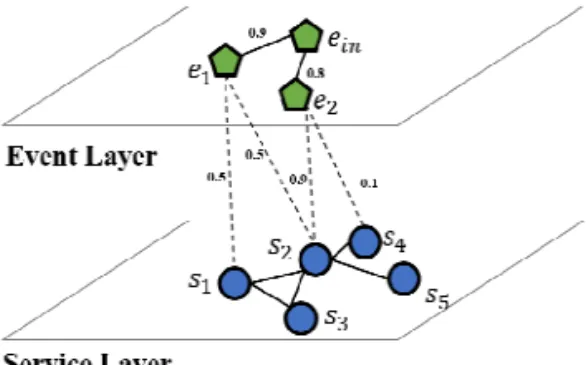
So far, the hierarchical model is constructed, and a service composition process can be achieved as an iterative selection process layer by layer. For example, as shown in Fig. 2, if
and can be calculated as equation (2). Moreover, the , ,
and . It is possible to compute that association strength between
and is × . Similarity,
. For , as there are two links exist and , and
get the maximum values among them, that is . So, the associated serv- Fig. 1. Proposed hierarchical model.
ices are with association strengths of
. Finally, the selection of optimal serv- ices can be depended on the predefined number of selection. For instance, ′if selecting the two most relevant services. Then, according to the optimal services set ′, the optimal devices set
′can be generated and links between them be- comes the mapping relation ′.
5. EVALUATION
To evaluate the effectiveness of this proposed hierarchical model, a real-life emergency response dataset is applied. This database contains 817 valid emergency events, 1348 contextual items and 384 services, which is crawled from “Chinese case knowledge Base of Public Crisis Management”
constructed by PCIM (Public Crisis Information Management) research team [15]. PCIM research team collects crisis events from 2007 to the end of 2014 in China and describes each event using
abstract, description, response, related URL, basic data and relevant video. In this study, abstracts are treated as events and IK-Analyzer [16], a Chinese Word Segmenter tool, is applied to generate lin- guistic segmentations as context. The organ- izations in rescue are treated as services. To meas- ure the performance, three evaluation indicators are applied (Table 1).
In the experiment, three-quarter of database (613 records) are randomly selected and used to generate the hierarchical model. The remainder quarter of dataset (204 records) is applied to eval- uate the performance of this proposed system.
Setting the number of selection to 1 and average precision, average recall and average F1-score of 204 records are calculated and used to evaluate the performance of this model. At the same time, a probability model depends on the conditional prob- ability is constructed and considered as the baseline. The results are shown in Table 2. It shows that the precision, recall and F1-score of baseline is 0.532, 0.337 and 0.352 respectively, and the proposed hierarchical model is 0.650, 0.980 and 0.754. The proposed model exceeded the baseline, which because probability model is much influ- enced by the context noise.
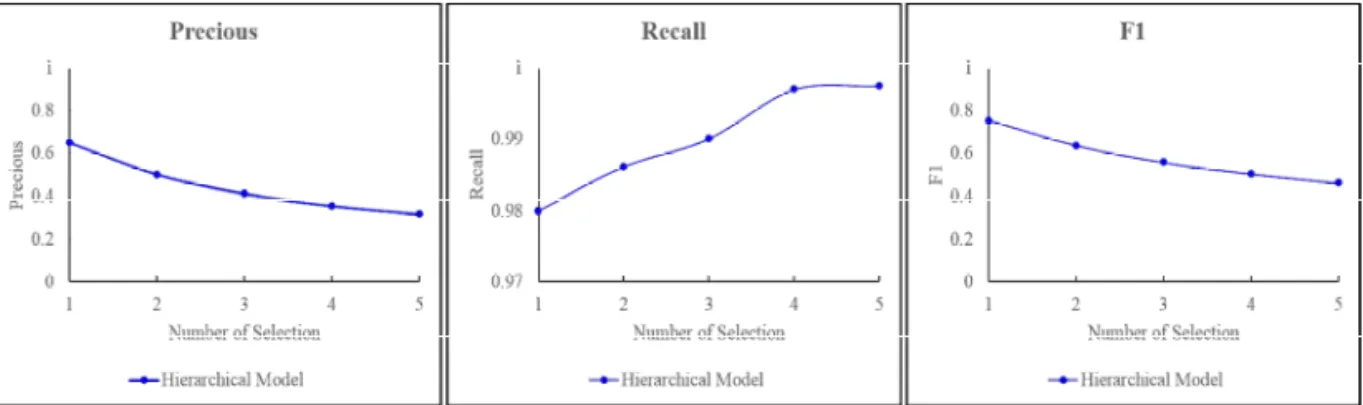
Besides the comparison with probability model, the influence of selection number is evaluated and the results are shown in Fig. 3. From the results, the performance is in decline with the selection number increases, which because that the bigger the number is, the more likely select the irrelevant Fig. 2. An example between Event Layer and Service
Layer.
Table 1. Evaluation indicators
Indicator Description Measurement
The fraction of selected instances that are relevant
′
′∩′
The fraction of relevant instances that are selected ′
′∩′
As precision and recall are always inverse proportional, so
F-score is used to measure the overall accuracy.
× ×
services, thus the precious falls. For recall, the more services selected, it is more likely to contain the services really need.
6. CONCLUSION
This paper formulates the service composition problem in the multiple service environment and proposes a service composition mechanism with a hierarchical model to support a context-based pro- active service composition mechanism. With this model, a service composition problem becomes an iterative graph search problem. This model is not based on well-defined web services but the real world services which limited to limited resource.
The performance of this method is compared with a general probabilistic method using a real-life emergency response dataset. The performances of the hierarchical model exceeds the probabilistic model. The experimental results indicates that this proposed hierarchical model is help for compositing multiple services. In the near future, more varying dataset will be collected and further evaluation will be undertaken.
REFERENCE
[ 1 ] K. Ashton, “That ‘Internet of Things’ Thing,”
RFID J ournal, Vol. 22, No. 7, pp. 97-114, 2009.
[ 2 ] L. Atzori, A. Iera, and G. Morabito, “The Internet of Things: A Survey,” Computer Networks, Vol. 54, No. 15, pp. 2787-2805, 2010.
[ 3 ] D. Lee, and D. Choi, “Implementation of Zigbee-based Publish/Subscribe System for M2M/IoT Services,” J ournal of Korea Multimedia Society, Vol. 17, No.12, pp. 1461- 1472, 2014.
[ 4 ] M. Darianian and M.P. Michael, “Smart Home Mobile RFID-based Internet-of-Things Sys- tems and Services,”Proceedings of Interna- tional Conference on Advanced Computer Theory and Engineering, pp. 116-120, 2008.
[ 5 ] L. Nixon, G. Hench, D. Lambert, A. Filipowska, and E. Simperl, “Future of the Internet of Services for Industry: the ServiceWeb 3.0 Roadmap,” Proceedings of Future Internet Assembly, pp. 23-24, 2009.
[ 6 ] S. De, P. Barnaghi, M. Bauer, and S. Meissner,
“Service Modelling for the Internet of Things,”
P roceedings of Federated Conference on Computer Science and Information Systems, pp. 949-955, 2011.
[ 7 ] Q. Wei and Z. Jin, “Service Discovery for Internet of Things: a Context-awareness Perspective,” Proceedings of the Fourth Table 2. Comparison with Probability Model
Method
Probability Model 0.532 0.337 0.352 Hierarchical Model 0.650 0.980 0.754
Fig. 3. The influence of selected number.
Asia-P acific Symposium on Internetware, ACM, Article No.25, 2012.
[ 8 ] J. Bronsted, K.M. Hansen, and M. Ingstrup,
“Service Composition Issues in Pervasive Computing,“ IEEE Pervasive Computing, Vol. 9, No. 1, pp. 62-70, 2010.
[ 9 ] S.B. Mokhtar, J. Liu, Ni. Georgantas, and V.
Issarny, “QoS-aware Dynamic Service Composition in Ambient Intelligence Environ- ments,” Proceedings of the 20th IEEE/ACM International Conference on Automated Software Engineering, pp. 317-320, 2005.
[10] J.P. Sousa, V. Poladian, D. Garlan, B. Schmerl, and M. Shaw, “Task-based Adaptation for Ubiquitous Computing,” IEEE Transactions on Systems, Man, and Cybernetics, Part C:
Applications and Reviews, Vol. 36, No. 3, pp.
328-340, 2006.
[11] D. Garlan, D.P. Siewiorek, A. Smailagic, and P. Steenkiste, “Project Aura: Toward Distrac- tion-free Pervasive Computing,” IEEE Per- vasive Computing, Vol. 1, No. 2, pp. 22-31, 2002.
[12] The 2014 Gartner Hype Cycle Special Report, http://www.gartner.com/technology/re- search/hype-cycles/ (accessed June, 18, 2015) [13] D. Giusto, A. Iera, G. Morabito, and L. Atzori, The Internet of Things: 20th Tyrrhenian Workshop on Digital Communication, Springer Science + Business Media, New York, USA, 2010.
[14] J. Rao and X. Su, “A Survey of Automated Web Service Composition Methods,” Semantic Web Services and Web P rocess Composi- tion, Vol. 3387, pp. 43-54, 2005.
[15] Chinese Case knowledge Base of Public Crisis Management, http://ccm.lzu.edu.cn/index.jsp (accessed June, 20, 2015)
[16] IK-Analyzer, https://code.google.com/p/ik- analyzer/ (accessed July, 15, 2015)
Jiamei Tang
She received B.S. degree from PLA Information Engineering University, China, in 2006. She received M.S. degree from Kyung- pook National University, in 2010. She is currently complet- ing her Ph.D. in Computer Science and Engineering. She is interested in human computer interaction, social network analysis and Internet-of-Things.
Sangwook Kim
He received B.S. degree from Kyungpook National University, Korea, in 1979. He received M.S.
degree from Seoul National University, Korea, in 1981. He received Ph.D. in Computer Science and Engineering from Seoul National University, Korea, in 1989. He is cur- rently Professor of School of Computer Science and Engineering at Kyungpook National University. He is interested in mobile media systems, media contents, human computer interaction, social network analysis and Internet-of-Things.