논문 2011-48CI-5-14
클러스터 기반 무선 센서 망에서 트래픽 적응적 수면시간 기반 MAC 프로토콜 성능 분석
( Performance Evaluation of Traffic Adaptive Sleep based MAC in Clustered Wireless Sensor Networks )
웅 홍 우*, 소 원 호*** ( Xiong Hongyu and So Wonho )
요 약
본 논문에서는 무선 센서 망을 위한 트래픽 적응적 수면시간 기반 매체 접근 제어 (Traffic Adaptive Sleep based Medium Access Control; TAS-MAC) 프로토콜을 제안한다. 제안 된 프로토콜은 클러스터를 구성하는 센서노드에 적용되며 TDMA를 기본 방식으로 사용한다. 기존에 제시된 LEACH와 BMA-MAC과 같은 전형적인 스케줄링 방식을 사용하지만 입력 데이터가 없거나 주변으로부터 발생되는 이벤트 발생이 없는 긴 침묵시간을 고려한다. 이를 위하여 간단한 트래픽 측정기법을 사용하며 기존 중앙집중식 MAC에서 수행하는 불필요한 스케줄링 시간을 줄임으로서 에너지 소모를 적게 한다. 제안된 프로토콜의 프 레임은 조사(I), 전송(T), 그리고 수면기간(S)로 구성되며 I-기간 동안 필요한 정보를 수집하여 긴 침묵 시간에 대응한 적당한 수면시간을 동적으로 결정한다. 또한 한 노드에서 클러스터 헤드로 전송할 데이터가 하나 이상일 때, T-기간 동안 다중의 데 이터 전송이 가능하도록 TAS-MAC 프로토콜을 개선하여 데이터의 평균 전송 지연을 줄인다. 시뮬레이션을 통하여 에너지 소 비와 전송 지연을 분석하고 기존 방식에 비해 에너지 효율이 향상됨을 보인다. 제안된 방식은 에너지 효율이 증가되면서 지연 이 상대적으로 증가하는데 에너지 감소 요구를 만족시키는 방안도 논의한다.
Abstract
In this paper, a traffic adaptive sleep based medium access control (TAS-MAC) protocol for wireless sensor networks (WSNs) is proposed. The protocol aims for WSNs which consist of clustered sensor nodes and is based on TDMA-like schema. It is a typical schedule based mechanism which is adopted in previous protocols such as LEACH and Bit-Map Assisted MAC. The proposed MAC, however, considers unexpected long silent period in which sensor nodes have no data input and events do not happen in monitoring environment. With the simple traffic measurement, the TAS-MAC eliminates scheduling phases consuming energy in previous centralized approaches. A frame structure of the protocol includes three periods, investigation (I), transmission (T), and sleep-period (S). Through the I-period, TAS-MAC aggregates current traffic information from each end node and dynamically decide the length of sleep period to avoid energy waste in long silent period. In spite of the energy efficiency of this approach, the delay of data might increase. Thus, we propose an advanced version of TAS-MAC as well, each node in cluster sends one or more data packets to cluster head during the T-period of a frame. Through simulation, the performance in terms of energy consumption and transmission delay is evaluated. By comparing to BMA-MAC, the results indicate the proposed protocol is more energy efficient with tolerable expense in latency, especially in variable traffic situation.
Keywords : TAS-MAC, Dynamic Sleep Time, Energy efficiency, Centralized scheduling, WSN
* 정회원, 순천대학교 과학정보융합학과
(Dept. of Science Information Convergence, Sunchon National University)
** 정회원-교신저자, 순천대학교 컴퓨터교육과
(Dept. of Computer Education, Sunchon National University) 접수일자: 2011년 7월1일, 수정완료일: 2011년9월1일
Ⅰ. Introduction
A wireless sensor network (WSN) is a wireless network made of hundreds or thousands of sensor nodes, which consist of sensors, data process and communication components, to cooperatively monitor different physical or environmental conditions at different locations. Usually, a sensor node is very small and equipped with a battery. In order to keep the WSN active as long as possible, the software and hardware of WSN and sensor node should consider the energy efficiency seriously[1~2].
A lot of MAC protocols are proposed to reduce energy by adopting a periodic sleeping method. They periodically turn off the radio of sensor nodes. When the sensor nodes do not need to transmit or receive packets, the sleeping sensor nodes save energy. The length of the sleep period is a critical factor of transmission delay and energy consumption. The protocols should consider the trade off between delay and energy consumption[3~4].
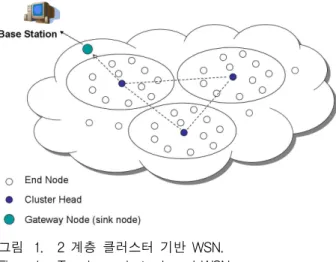
In this paper, we consider clustered WSNs in which each end node transfers data to its head and the head sends them to the sink (Figure 1). The previous MAC protocols, such as LEACH or BMA-MAC for a WSN, typically use a predefined duty cycle for working period. This mechanism makes the sensor node do the scheduling for the data transmission requirement. In centralized approach, for example, a cluster head and all end nodes have to turn on their radio interface to exchange data request information for the scheduling. It, however, leads unnecessary energy consumption under relatively long low-rate traffic or even during long silent period.
Thus, we propose a MAC protocol with simple traffic measurement to reduce the energy for the scheduling phase, called the traffic adaptive sleep based MAC (TAS-MAC).
The rest of this paper is organized as follows.
Section Ⅱ describes the previous related works for sleeping time control. Section Ⅲ illustrates the approach of the proposed MAC and it operations.
Through simulation, evaluation of the proposed MAC is conducted in section Ⅳ, and some issues related to traffic conditions are discussed. Finally, the conclusion and future work is presented in section Ⅴ.
Ⅱ. Related Works
S-MAC is a widely referred MAC protocol designed for WSN[5]. It uses periodic sleep schedules to reduce the energy consumption by idle listening.
Nodes have same periodic sleep-listen schedules form a virtual cluster. Neighboring nodes exchange their sleep schedules with each other by periodical synchronization. However, in a sense, the periodical synchronization is also a type of overhead[6], which is an energy-wasting process. In order to resolve sleep delay problem caused by periodic sleeping, an improved S-MAC named Adaptive-SMAC is proposed by the same author[7]. Adaptive-SMAC exploits an adaptive listening technique to reduce the sleep delay. If a node in adaptive listening state is the next hop, it starts the transmission immediately.
Same disadvantage of the above two protocols is the periodical sleep periods are predefined as constant, which is not adapt to variable traffic load.
TEEM (Traffic aware, Energy Efficient MAC) a traffic adaptive MAC based on S-MAC. It adopts a SYNC no data period to reduce unnecessary RTS/CTS packets exchange period. The SYNC packet in SYNC no data is broadcasted when a node does not have any outgoing data traffic[8]. MaxMAC (Maximally Traffic-adaptive MAC) is a contention based MAC protocol that adapts the duty cycle of nodes by adding Extra Wake-Ups. Extra Wake-Up occurs when the estimated rate of incoming traffic reaches predefined threshold values[9]. Both TEEM and MaxMAC are contention based schema, while this paper focuses on a adaptive approach for cluster based WSNs which has not studied deeply.
LEACH (Low Energy Adaptive Clustering Hierarchy) is a typical cluster based architecture for WSN. The MAC operation of LEACH is divided into
그림 1. 2 계층 클러스터 기반 WSN.
Fig. 1. Two-layer cluster based WSN.
rounds. Each round begins with a set-up phase when the clusters are organized, followed by a steady-state phase when data are transferred from end nodes to cluster head or base station. In set-up phase LEACH uses a distributed algorithm to select cluster head and construct clusters. At the end of set-up phase, the head node sets up a TDMA schedule and transmits the schedule to end nodes belong to its cluster. In steady-state phase time is divided into frames. Each frame uses the TDMA schedule from head node to carry out intra-cluster communication
[10~11].
BMA-MAC uses a Bit-Map-Assisted MAC control method to reduce the idle listening in steady-state phase of LEACH. It assumes a similar cluster formation algorithms, but the TDMA schedule of one frame is not decided in the setup phase. The frame of BMA-MAC is divided into three periods:
contention period, data transmission period, and idle period. The contention period is used by source nodes to reserve the time slot for transmission. In steady-state phase of BMA-MAC, the variable TDMA schedules reduce idle listening. However, when the offered traffic is extremely low in a certain period of steady-state phase, the fixed and regular contention periods also waste energy due to unnecessary scheduling[12].
Ⅲ. Traffic Adaptive Sleep based Medium Access Control Protocol
In this section, we introduce a simple traffic measurement for a cluster and propose two types of TAS-MAC protocols. The objective of the first one is to remove the energy consumption of investigation period (called scheduling period in previous protocols) with long sleep period. For the second case, we allow the multi-data transmission to reduce the data transfer delay.
A. Basic overview of TAS-MAC
The proposed TAS-MAC is typically based on the slotted TDMA approach. As depicted in Figure 2, the protocol separates the state of MAC operation into rounds. Each round consists of two phases, set-up phase and steady-state phase. And the steady-state phase is divided into frames. Sensor nodes are separated into several clusters at the beginning of each round. In each cluster, there is one head node and several end nodes. During each round, end nodes transmit data to head nodes and head nodes pass data to the sink. During the steady-state phase of a round, the head node of one cluster is changeless. All end nodes should collect sensing data and send them to cluster head. Therefore the cluster head detects the traffic variance in cluster during a certain period.
Finally, each frame in steady phase is further subdivided into three periods, investigation (I), transmission (T), and sleep (S) period.
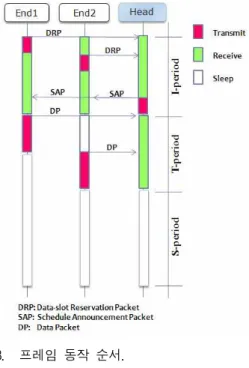
In the I-period of Figure 3, each end node has a control time slot to report its transmission
그림 2. TAS-MAC의 프레임 구조 Fig. 2. The frame structure of TAS-MAC.
그림 3. 프레임 동작 순서.
Fig. 3. The operation sequence of one frame.
requirements to cluster head. The requirement is a number of packets in the end node required to be transmitted. Every end node informs it to the head with data-slot reservation packet (DRP). After getting all transmission requirements from end nodes, cluster head estimates the immediate traffic load in that frame. The head node takes account of the requirement and considers traffic load in this frame.
After scheduling for data transmission, it broadcasts a schedule-announcement packet (SAP) as a response. Consequently, end nodes know the available time for data transmission and send their data packets (DPs) on allocated data slots.
B. The Effect of Unnecessary I-period TAS-MAC detects a long silent period to reduce energy consumption caused by unuseful scheduling in I-period. Figure 4 demonstrates one scenario of long silent period. For simplicity, we consider two different types of WSN applications. The high traffic load
and low traffic load may have different value. In a emergency monitoring application, indicates the input traffic load when some urgent events happen and represents one in normal state. In this case, we assume that the time period from to is a
long silent period (SLP). If we do not apply the adaptive approach and use the predefined frame size, the existing probability of unnecessary I-periods increases.
In TAS-MAC, at all end of I-periods, head node computes an active degree to reflect the immediate traffic load. Active degree means the proportion of active nodes in cluster, where actually is the node rate having data to be transmitted, defined by Equation (1)
(1) Where the number of active nodes and the total number of end nodes are denoted by and , respectively.
In order to show the effect of energy consumption in I-period, we assume there is a cluster with end nodes and one head node. The power of transmission and the power of reception are and , respectively. In addition, the number of control slot
그림 4. 긴 침묵 시간에 불필요한 I-period
Fig. 4. Unnecessary I-periods in long silent period.
그림 5. I-period 전력 소비 효과, { } Fig. 5. The effect of I-period power, { }.
for I-period and the number of data slot for T-period are and respectively. Thus, the energy consumption by the previous predefined frame based MAC protocol is calculated by Equation (2).
(2)
According to the parameters used in simulation of following section, we expect the required power rate for a I-period in Figure 5. The rate is defined as
. As shown, the high value of the rate means that the probability of unnecessary I-periods to be used increase and consume more energy.
Relatively, the power for I-period is more required than T-period.
C. Traffic Measurement and MAC Protocol If active degree for a frame is smaller than a predefined lowest active degree , this frame is considered as an inactive frame. In order to avoid the I-period usage in a LSP, an inactive frame count is used to record the sequential occurrences of inactive frames.
First, of -th frame is incremented by 1 when the current frame is also an inactive frame ( ).
If the current frame is an active frame ( ≥ ), means that is higher than , the count is immediately set to be 0.
According to continuous occurrences of inactive frames, head node decides the length of sleep period.
If there is a long serial of inactive frames during a certain period we should not use I-period in this LSP. When a LSP is detected, TAS-MAC determines the sleep period for the -th frame with exponential increase. If the -th frame is inactive ( ), is decided by × . If the frame is active ( ≥ ),
is depend on the number of active nodes and it is × .
There, however, might be an over-sleep problem in above sleep schema. When a LSP is very long the
sleep period might continuously increase. If some packets arrive during a LSP, the delay of the packets will be intolerable. In order to avoid the too much increase of sleep period, a variable sleep threshold
is used to control the maximum sleep time.
According to the aforementioned, the sleep period is determined by Equation (3).
min ≥ (3) Finally, we consider the minimum number of I-periods during a LSP. Thus, if is less than, the maximum sleep time of BMA, is
. Otherwise, is min . If we do not regard this factor, there are more I-periods in TAS-MAC operation and consume more energy, it is shown in following simulation section.
Thus, the following equation is the final version.
min max
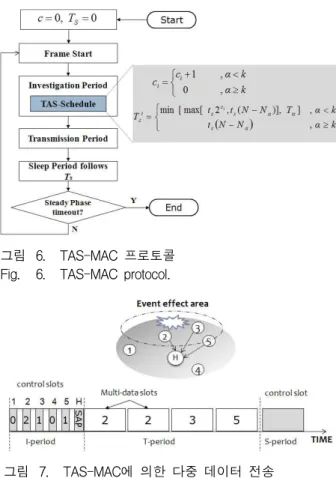
≥ (4) In Figure 6, the proposed TAS-MAC protocol is described with a flow-chart. After the initialization, the main process of frame in steady-state phase is continued until the time-out of the phase. Through the I-period, head node allocates time-slots for data transmission and decides the size of for that frame.
D. Multi-data transmission with TAS-MAC In order to transmit packets as quickly as possible, TAS-MAC allows sensor nodes send more than one packet during the T-period. Figure 7 shows a scenario when multi-data slots are used by a sensor node. There are five end nodes and a cluster head (H) in the cluster. Node 2, 3, and 5 are active. Node 2 has two data packets to transmit, but node 3 and node 5 just have one. These requirements are sent to the head by DRPs and the head response with SAP.
Thus, node 2 can use two data slots in the following T-period and eliminate the additional delay in queue of each sensor node.
그림 6. TAS-MAC 프로토콜 Fig. 6. TAS-MAC protocol.
그림 7. TAS-MAC에 의한 다중 데이터 전송 Fig. 7. Multi-data transmission with TAS-MAC.
Ⅳ. Simulation and Results
A. Simulation Environment
A simulator is created in Python to evaluate the performance of TAS-MAC. The program simulates one cluster with a head node and 20 end nodes. All end nodes directly transmit the data packets to cluster head. The configuration and basic parameters for simulation are listed in Table 1. The total number of nodes in cluster is decided according to LEACH.
The time slot for sleep and transmission is both 0.1s,
Time slot for control packet () 0.01s Time slot for data packet () 0.1s Sleep Threshold () 8s Total number of nodes in cluster ( ) 21 Transmission Power () 0.462w Reception Power () 0.346w
표 1. 기본적인 시뮬레이션 파라미터
Table 1. Basic simulation parameters.
and 0.01s for control packet. The sleep threshold is selected as 4 times of the longest sleep time of one BMA-MAC. Poisson distribution based random traffic sources are offered for the whole cluster. Arrived packets are randomly assigned to 20 end nodes.
Two types of Poisson traffic sources are used in simulation. One type is static poisson traffic (SPT), which just uses one offered load during the whole process. The other is variable poisson traffic (VPT) uses variable offered loads during the simulation. The VPT is separated into several sub-traffics and each sub-traffic is a SPT.
B. Under Static Poisson Traffic
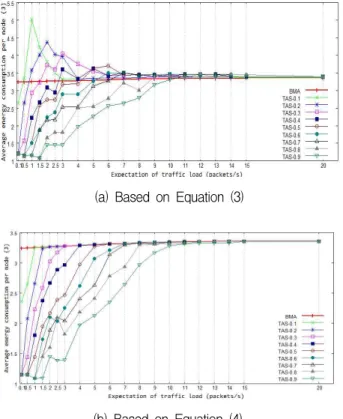
Firstly, we compare TAS-MAC with BMA-MAC under the SPT environment. The lowest active degree () is varied from 0.1 to 0.9. Simulation time for each steady traffic is 100 seconds. In Figure 8, the average energy consumption per node with different is compared. The TAS- means the performance of TAS-MAC with . The average energy consumption of each sensor node with BMA-MAC increases along with the expected traffic load, defined as the number of packets per second.
Loosely speaking, the energy consumption of TAS-MAC increases with the traffic load.
Furthermore, affects the energy consumption of TAS-MAC. The lower , the more energy reduction with TAS-MAC. In the case of TAS-0.3 of Figure 8(a), the energy consumption curve can be separated into three phases. When the traffic load is in (0.1, 1.5), the TAS-MAC can save more energy than BMA. When traffic load is in (1.5, 6) TAS-MAC consume more energy than BMA. It notes that if we use TAS-MAC based on Euqation (3) more I-periods are used in LSP than BMA-MAC. And when the traffic load is in (6, 20) the energy consumption of TAS-MAC and BMA-MAC are almost same.
Figure 9 shows the average delay of each received packet. This means that the delay of each packet in BMA increases along with the traffic load. The relationship between and TAS-MAC is obvious, that is when is bigger, the delay of TAS-MAC is
(a) Based on Equation (3)
(b) Based on Equation (4) Fig. 8. 평균 에너지 소비 대 기대 트래픽 부하.
Fig. 8. Average energy consumption per node vs.
Expectation of traffic load.
(a) Based on Equation (3)
(b) Based on Equation (4) Fig. 9. 수신 패킷 지연 대 기대 트래픽 부하.
Fig. 9. Average delay of each received packet vs.
Expectation of traffic load.
also longer. In both Figure 8 and Figure 9, while the energy performance of TAS-0.9 is perfect, the delay performance is really bad. The energy consumption of TAS-0.4 is good enough, and the delay performance of it is not bad (the delay difference to BMA-MAC is about one frame size). Usually, the importance of energy and delay depends on practical applications.
TAS-MAC save more energy when the traffic load is low. And the sacrifice of delay can be controlled by adjusting the lowest active degree .
C. Under Variable Poisson Traffic
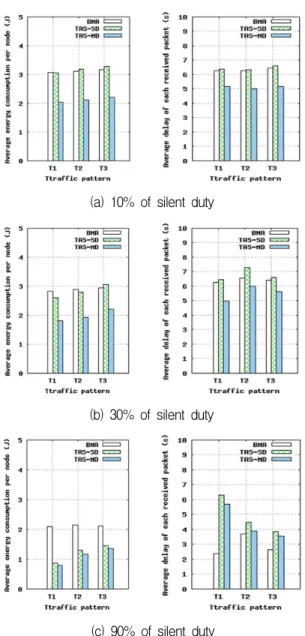
Three groups of variable traffic sources are used to evaluate TAS-MAC. The total simulation time for each traffic source is 100 seconds, and the traffic load expectation is either 0.1 or 10 packets/s. If we represent the percentage of 0.1 packets/s traffic phase by silent duty. Figure 10 shows traffic sources, which consists of three variants of traffic (T1, T2, T3) in silent duty 90%. For the various simulation, we use additional two traffic patterns and assume their silent duty are 10% and 30%, respectively.
The energy and delay performance of TAS-MAC with single data slot (TAS-SD) and TAS-MAC with multi data slot (TAS-MD) are both compared with BMA-MAC. The lowest active degrees for TAS-SD and TAS-MD are both selected as to
Fig. 10. Silent duty가 90일 때, 서로 다른 프레그먼트를 갖는 세 가지 트래픽 종류
Fig. 10. Three types of traffic separated into different fragments when silent duty is 90%.
(a) 10% of silent duty
(b) 30% of silent duty
(c) 90% of silent duty Fig. 11. 여러 가지 silent duty에 따른 비교..
Fig. 11. The comparison under different silent duty.
represent one type of application requirement. Figure 11(a) displays the performances of the protocols under the traffic sources with 10% silent duty. The left result shows the average energy consumption of each node versus traffic source. The right one compares the average delay of each received packet versus traffic source. It shows that TAS-SD neither save more energy nor transmit data packets faster than BMA. In case of TAS-MD, it saves more energy and transmit packets faster than BMA.
Figure 11(b) compares the performances of those three MAC protocols under traffic sources of 30%
silent duty. The TAS-SD seems working better than
its performance under traffic sources of 10% silent duty. However, its performance is still not better than BMA. On the other hand, TAS-MD is still performing better than BMA both in energy and delay. It means that each end node having multi-data can send them within one frame by using TAS-MD.
Figure 11(c) compares the performances under traffic sources of 90% silent duty. In this case, both TAS-SD and TAS-MD consume less energy than BMA. TAS-SD and TAS-MD just cost around half of the energy consumption by BMA. Whereas TAS-SD and TAS-MD have a length average delay, the delay of each received packet is tolerable.
Because the average delay of each received packet performance of BMA under traffic sources of 10%, 30% silent duties is about 6s. Figure 11(c) shows the maximum delay of TAS-SD and TAS-MD is about 6s when the traffic source is T1. Under T2 and T3, the delay of TAS-SD and TAS-MD are less than 6s.
Therefore the delay performance by TAS-SD and TAS-MD under traffic sources of 90% silent duty is acceptable.
V. Discussion
As mentioned above, the decision of is very important for the energy efficiency in the proposed TAS-MAC. In this section, we discuss an approach to determine this value according to the requirement of network manager or an application. By Equation (1), the head node compute the active degree of current frame. Thus, we define an Equation as follows, ′ is expected active degree with traffic measurement,
′ where ≤ ′ or≤ (5) If is 0, it means the MAC protocol is the same to BMA-MAC. It is the TAS-MAC described above if is 1. Therefore, if we are able to control the value of depending on WSN applications, we can fine reasonable values for energy efficiency and delay, and figure out the trade-off between them.
The expected active degree is calculated by using Equation (6) and it is updated by Equation (7), which is typically used in many protocol stack, for instance, the measurement of round trip time (RTT) in TCP.
′
․
(6)
′ ′ ′ (7) Where is the number of considered frames,
is the predefined frame time of BMA-MAC and
is the time period for traffic measurement.
TThe value of is generally 1/4.
Therefore, if is decided by someone, is dynamically calculated according to offered load in a WSN and we can achieve the required energy efficiency.
VI. Conclusions
In this paper, a traffic adaptive sleep based medium access control (TAS-MAC) protocol is proposed for clustered WSNs. The protocol exploits a lowest active degree to diagnose the traffic load state and detect the inactive frame. By counting the continuous inactive frames, TAS-MAC dynamically decides the length of sleep period to avoid energy waste in long silent period. On the other hand, it adopts a sleep threshold to prevent over-sleep problem and uses multi-data transmission to reduce transmission delay. Simulation results show TAS-MAC save more energy than BMA-MAC in variable low traffic load situation. Especially, when a high traffic load in variable poisson traffic accidently happens the proposed MAC save more energy and transmit data packets in time.
There, however, is a critical shortage of the current TAS-MAC design and evaluation. The lowest active degree and sleep threshold need to be predefined before operating a WSN. About this issue, we consider in discuss section and for ideal traffic
adaptation, the sleep threshold should also be decided according to the runtime traffic state. Therefore, as the near future issue, we are going to consider the application-given requirements such as energy saving factor or the delay limitation and apply a mechanism for quality of service.
References
[1] Akyildiz, I.F.; Melodia, T.; Chowdury, K.R.,
“Wireless multimedia sensor networks: A survey,” IEEE Wireless Communications, vol.14, no.6, pp.32-39, December 2007
[2] Potdar, V.; Sharif, A.; Chang, E., “Wireless Sensor Networks: A Survey,” International Conference on Advanced Information Networking and Applications Workshops 2009.
WAINA '09., pp.636-641, May 2009.
[3] Demirkol, I.; Ersoy, C.; Alagoz, F., “MAC protocols for wireless sensor networks: a survey,” IEEE Communications Magazine, vol.44, no.4, pp. 115-121, April 2006.
[4] Ramakrishnan, S.; Huang, H.; Balakrishnan, M.;
Mullen, J., “Impact of sleep in a wireless sensor MAC protocol,” Vehicular Technology Conference, 2004. VTC2004-Fall. 2004 IEEE 60th , vol.7, pp. 4621-4624, Sept. 2004.
[5] Wei Ye; Heidemann, J.; Estrin, D., “An energy-efficient MAC protocol for wireless sensor networks,” INFOCOM 2002.
Twenty-First Annual Joint Conference of the IEEE Computer and Communications Societies.
Proceedings., vol.3, pp. 1567-1576, June 2002.
[6] Wen-Hwa Liao; Hsiao-Hsien Wang; Wan-Chi Wu, “An Adaptive MAC Protocol for Wireless Sensor Networks,” 18th International Symposium on Personal, Indoor and Mobile Radio Communications, 2007 (PIMRC 2007), vol., no., pp.1-5, Sept. 2007.
[7] Wei Ye; Heidemann, J.; Estrin, D., “Medium access control with coordinated adaptive sleeping for wireless sensor networks,” IEEE/ACM Transactions on Networking, vol.12, no.3, pp.
493- 506, June 2004.
[8] Changsu Suh; Young-Bae Ko, “A traffic aware, energy efficient MAC protocol for wireless sensor networks,” IEEE International Symposium on Circuits and Systems (ISCAS 2005), pp. 2975- 2978 Vol. 3, 23-26 May 2005.
저 자 소 개 웅 홍 우(정회원)
2010년 8월 순천대학교 컴퓨터교육 정보학 석사
2011년 현재 순천대학교 과학정보융 합학과 박사과정
<주관심분야: 무선센서망 MAC, 라우팅 프로토콜, 컴퓨터 및 로봇 기반 교육>
소 원 호(정회원)-교신저자
대한전자공학회 논문지 제43권 TC편 1-14 참고 [9] Philipp Hurni; Torsten Braun, “MaxMAC: A
Maximally Traffic-Adaptive MAC Protocol for Wireless Sensor Networks” EWSN 2010, LNCS 5970, pp. 289–305, February 2010.
[10] Heinzelman, W.; Chandrakasan, A.; Balakrishnan, H., “Energy-efficient communication protocol for wireless microsensor networks,” Proceedings of the 33rd Annual Hawaii International Conference on System Sciences, vol.2, 10 pp., Jan. 2000.
[11] Heinzelman, W.; Chandrakasan, A.; Balakrishnan, H., “An application-specific protocol architecture for wireless microsensor networks,” IEEE Transactions on Wireless Communications, vol.1, no.4, pp. 660- 670, Oct 2002.
[12] Jing Li; Lazarou, G.Y., “A bit-map-assisted energy-efficient MAC scheme for wireless sensor networks,” Third International Symposium on Information Processing in Sensor Networks, 2004 (IPSN 2004), pp. 55-60, 26-27 April 2004.