수소 분위기에서 밀링에 의해 제조한 마그네슘-니켈 합금의 수소화물 형성 및 분해 속도
송명엽* † , 백성환*, 박혜령**
*전북대학교 신소재공학부, **전남대학교 응용화학공학부
Hydriding and Dehydriding Rates of Magnesium-Nickel Alloy Fabricated by Milling under Hydrogen
MYOUNGYOUP SONG* † , SUNGHWAN BAEK*, HYERYOUNG PARK**
*Division of Advanced Materials Engineering, Department of Hydrogen and Fuel Cells, Research Center of Advanced Materials Development, Engineering Research Institute, Chonbuk National
University, 664-14 Deogjin-Dong 1-Ga Deogjin-Gu Jeonju, Jeonbuk, 561-756, Korea
**School of Applied Chemical Engineering, Chonnam National University, 300 Yongbong-Dong Buk-Gu Gwangju, 500-757, Korea
ABSTRACT
A 76.5wt%Mg - 23.5wt%Ni (Mg-23.5Ni) sample was prepared by reactive mechanical grinding (RMG) and its hydriding and dehydriding properties were then investigated. Activation of the Mg-23.5Ni sample was completed only after two hydriding (under 12 bar H 2 ) - dehydriding (under 1.0 bar H 2 ) cycles at 593K.
The reactive mechanical grinding of Mg with Ni is considered to facilitate nucleation and shorten diffusion distances of hydrogen atoms. After hydriding - dehydriding cycling, the Mg-23.5Ni sample contained Mg2Ni phase.
KEY WORDS : H 2 -storage properties of Mg(Mg의 수소 저장 성질), Addition of Ni(Ni의 첨가), Reactive mechanical grinding(반응성 기계적 분쇄), Mg 2 Ni formation(Mg 2 Ni 형성), Mg(OH) 2 formation (Mg(OH) 2 형성)
† Corresponding author : [email protected]
[ 접수일 : 2011.10.24 수정일 : 2011.11.14 게재확정일 : 2011.12.27 ]
Nomenclature Mg-23.5Ni : 76.5wt%Mg - 23.5wt%Ni
H a : weight percentage of absorbed hydrogen H d : weight percentage of desorbed hydrogen n : number of cycles
1. Introduction
Efficient hydrogen storage technology is greatly
required in the forthcoming hydrogen economy, in
which energy is stored and transported using hy-
drogen as an energy carrier for mobile applications
(automobiles, aircraft, laptops, etc.). Most of the
research on this topic has focused on storing hy-
drogen safely in light weight, compact and high capacity systems. There are six storage methods currently being investigated: storing hydrogen as a gas, liquid hydrogen storage, the physisorption of hydrogen, and storing it in the form of metal hydrides, complex hydrides, and via chemical reactions.
Magnesium has many advantages for a hydrogen storage material such as large hydrogen storage capacity (7.6 wt%), low cost and abundance in the earth’s crust. In spite of these advantages, its hydriding and dehydriding rates are very low. A lot of work to ameliorate the reaction kinetics of magnesium with hydrogen has been done by alloying certain metals with magnesium 1-9) , mixing metal additives with magnesium 10) , plating nickel on the surface of magnesium 11) , or synthesizing MgH 2 by hydriding chemical vapor deposition 12) .
Song et al. 13-16) increased the hydriding and de- hydriding rates of Mg by mechanical alloying of Mg with Ni under Ar atmosphere. Bobet et al. 17) reported that mechanical alloying in H 2 (reactive mechanical grinding, RMG) for a short time (2 h) is an effective way to improve the hydrogen-storage properties of both magnesium and Mg + 10 wt%
Co, Ni or Fe mixtures.
Mechanically alloyed 75wt%Mg-25wt%Ni mixture showed high hydriding and dehydriding rates, and large hydrogen storage capacity 15,16) . Yim et al. 18) studied the hydriding properties of Mg - x wt%
Ni (x=13.5, 23.5 and 33.5) prepared by three different methods: gravity cast, melt spinning, and crystalli- zation heat treatment after melt spinning. The melt spinning process, which is a rapid solidification process, was used for the alloy preparation because a homogeneous mixing of constituent elements was expected in the liquid state of the melt before the spinning process. Among these nine samples, Mg-23.5wt%Ni heat-treated after melt spinning had the highest hydrogen-storage capacity and
hydriding rate.
However, this process for sample preparation (heat treatment after melt spinning) is very com- plicated and time-consuming. Therefore we chose a simpler process, mechanical grinding in H 2 (reactive mechanical grinding), to prepare a mixture with a composition 76.5wt%Mg-23.5wt%Ni in this work.
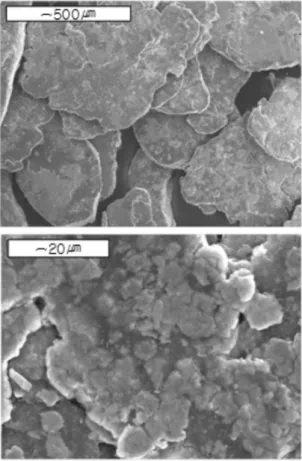
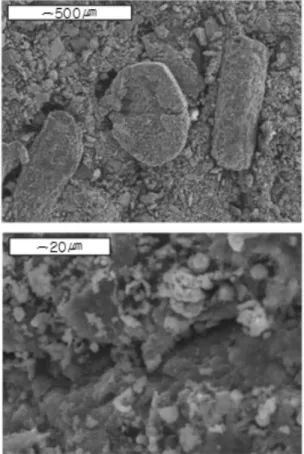
In this work, an Mg-23.5Ni sample was prepared by reactive mechanical grinding and its hydriding and dehydriding properties were then measured, and X-ray diffraction (XRD) analysis and observation of microstructure by scanning electron microscopy (SEM) were performed.
2. Experimental details
Pure Mg powder (particle size 297~100 ㎛, purity 99%, Fluka) and Ni (average particle size ~5 ㎛, purity 99.9%, Cerac) were used as starting materials.
Reactive mechanical grinding was done in a planetary ball mill (Planetary Mono Mill; Pulverisette 6, Fritsch). A mixture with the desired composition (total weight = 8 g) was mixed in a stainless steel container (with 105 hardened steel balls, total weight
= 360 g) sealed hermetically. The sample to ball weight ratio was 1/45. All sample handling was performed in a glove box under Ar in order to prevent oxidation. The disc revolution speed was 250 rpm. The mill container was then filled with high purity hydrogen gas (≈ 12 bar). The reactive mechanical grinding was performed for 4 h (milling 2 h + refilling with H 2 + milling 2 h).
The absorbed or desorbed hydrogen quantity was measured as a function of time by a volumetric method, using Sivert’s type hydriding and dehy- driding apparatus described previously 19) . XRD analysis was carried out for the as-milled powders and for the samples after hydriding-dehydriding cycling.
The micro structures were observed by SEM.
0 10 20 30 40 50 60 0
1 2
H
a(wt% H)
t (min)
n=1 n=2 n=3
Fig. 1 Variation of the H
aversus t curve with the number of cycles for as-milled Mg-23.5Ni at 593K under 12 bar H
20 10 20 30 40 50 60
0 1 2
H
d(w t% H )
t (min)
n=1 n=2 n=3
Fig. 2 Variation of the H
dversus t curve with the number of cycles for as-milled Mg-23.5Ni at 593K under 1.0 bar H
23. Results and discussion
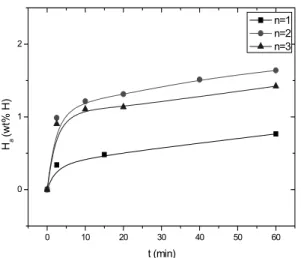
Fig. 1 shows the variation of weight percentage of absorbed hydrogen H a versus t curve with the number of cycles n for as-milled Mg-23.5Ni at 593K under 12 bar H 2 . The percentage of absorbed hydrogen H a is expressed with respect to the sample weight. For the measurement of the curve for n=1, the samples were dehydrided for 2 h in vacuum at 623K. Before obtaining the curves after n=1, measurements of dehydriding curves were performed, and then the samples were dehydrided for 2 h in vacuum at 623K. The expansion and contraction of the hydride - forming materials with the hydriding and dehydriding reactions is considered to make defects and cracks which bring about the fragmentation of the particles, leading to the increase in the hydriding rate from n=1 to n=2.
However, as the number of cycles increases from n=2 to n=3, absorbed hydrogen quantity after about 5 min decreases. The compaction and the sintering of the particles, due to the hydriding-dehydriding cycling at relatively high temperature (593K), are considered to decrease absorbed hydrogen quantity
after about 5 min. These H a versus t curves show that the activation is completed after n=2. This sample absorbs 0.93 wt% for 5 min, 1.11 wt% for 10 min, and 1.42 wt% for 60 min at n=3.
The variation of the H d versus t curve with the number of cycles for as-milled Mg-23.5Ni at 593K under 1.0 bar H 2 is shown in Fig. 2. The per- centage of desorbed hydrogen H d is also expressed with respect to the sample weight.
Before obtaining these curves, the sample was hydrided for 1h under 12 bar H 2 at 593K. As the number of cycles increases, the dehydriding rate increases. This sample desorbs 0.86 wt% for 5 min, 0.98 wt% for 10 min, and 1.18 wt% for 20 min at n=3.
Fig. 3 presents the H a versus t curves under 12bar H 2 for activated Mg-23.5Ni at 573K and 593K, and for activated pure Mg at 593K. The hydriding rate of the activated Mg-23.5Ni at 593K is higher than that at 573K in the beginning up to 20 min, but the hydriding rate at 593K is lower than that at 573K after 20 min.
This is considered due to the decrease in the
0 10 20 30 40 50 60 0
1 2
H
a(wt% H)
t (min)
Mg-23.5Ni 573K Mg-23.5Ni 593K pure Mg 593K
Fig. 3 H
aversus t curves under 12 bar H
2for activated Mg- 23.5Ni at 573K and 593K, and for activated pure Mg at 593K
-5 0 5 10 15 20 25 30 35 40 45 50 55 60 65 0
1 2