Kor. J. Pharmacogn.
42(3) : 240∼ 245 (2011)
240
HPLC-PDA 에 의한 사군자탕 중 Liquiritin과 Glycyrrhizin의 동시분석
서창섭·김정훈·신현규* 한국한의학연구원 한약EBM연구센터
Simultaneous Analysis of Liquiritin and Glycyrrhizin in Sagunja-tang by HPLC-PDA
Chang-Seob Seo, Jung-Hoon Kim and Hyeun-Kyoo Shin*
Herbal Medicine EBM Research Center, Korea Institute of Oriental Medicine, Yuseongdae-ro 1672, Yuseong-gu, Daejeon, 305-811, Korea
Abstract − A high-performance liquid chromatography (HPLC) method was developed for quantitative analysis of liquiritin and glycyrrhizin in Sagunja-tang (SGT, Sijunzi-tang in Chinese), a traditional Korean medicine. HPLC analysis was performed using a Gemini C18 column operating at 40oC, and photodiode array (PDA) detection at 254 nm and 280 nm for quantification of the two components in SGT. The mobile phase using a gradient flow consisted of two solvent systems. Solvent A was 1.0%
(v/v) aqueous acetic acid and solvent B was acetonitrile with 1.0% (v/v) acetic acid. Calibration curves were acquired with r2 values > 0.9998, and the relative standard deviations (RSDs, %) for intra- and inter-day precision were not exceed 4.0%. The recovery of each component was in the range of 91.85 - 108.62%, with a RSD less than 4.0%. The contents of the two com- ponents in SGT were 7.94 - 13.83 mg/g.
Key words − HPLC-PDA, Sagunja-tang (SGT), Simultaneous analysis, Herbal medicine
오늘날 의학의 발달과 생활수준 향상으로 인해 국민의 평 균 수명이 연장되는 가운데 생약 및 생약제제에 대한 수요 가 증가하고 있다. 이러한 생약제제는 예로부터 경험에 근 거하여 사용되어 왔으며, 여러 종류의 구성 생약과 성분들 을 함유하고 있어 다양한 효능을 나타내며 부작용이 적어 많이 이용되고 있다. 그러나 생약제제는 구성 생약의 기원, 산지 및 채집시기, 재배방법의 차이에 따라 구성 성분 및 효 능의 차이가 나는 특성을 지니고 있기 때문에 일정한 효과 를 나타내기 위해서는 효율적인 생약제제의 품질관리 설정 이 필요한 실정이다.1,2)
사군자탕은 宋代 「太平惠民和劑局方」에 처음 기재된 처방으로 營氣와 衛氣가 허약하고 臟腑의 기능이 아주 약 하여 헛배가 아주 많이 부르고 식욕이 전혀 없으며 腸鳴泄 瀉하는 嘔 吐逆하는 등의 병증에 사용되는 대표적인 補氣 健脾劑이다.3,4) 또한 사군자탕은 補氣濟의 基本處方이 되어 대부분의 補氣劑는 사군자탕에 약물을 가하여 구성된다. 사
군자탕은 기재된 醫書 마다 약물 용량에 차이는 있지만 인 삼, 백출, 복령 및 감초로 구성되어 있는 처방이다.5) 또한 경제 발전 및 국민 소득 수준의 향상으로 건강한 삶을 영위 하기 위한 수단으로 한약 조제 및 건강 기능식품 제조 등에 한약재의 사용이 증가되고 있는 가운데 한약재의 안전성에 대한 우려가 제시6,7)되고 있어 중금속, 잔류농약 및 잔류이 산화황 등에 대한 안전성 연구8,9)와 사군자탕의 급성10) 및 아급성11) 독성에 대한 연구가 보고 되었다. 또한 사군자탕 의 실험적 연구는 면역기능 강화와 항암효과,12) 항혈전,13) 성장촉진,14) 혈압 저하,15) 항염증 효과16) 등이 보고되었다.
사군자탕의 구성 생약의 성분에 대한 분석법 연구는 Soldati17) 와 Ma18) 등이 인삼의 성분인 ginsenoside 성분들을 대상으 로 HPLC 및 HPLC-APCI/MS를 이용하여 정량하였고, Wang19)등은 감초 중 flavonoid와 triterpenoid 성분에 대하 여 HPLC로 정량한 연구가 보고되었으며, Xu20)와 Seo21) 등 은 각각 온담탕과 평위산의 구성생약 중 하나인 감초의 liquiritin과 glycyrrhizin에 대하여 HPLC 동시분석하였으나 사군자탕에서의 지표물질에 대한 정량분석법 연구는 미비하다.
본 연구에서는 생약제제의 품질관리에 기초 자료를 제공
*교신저자(E-mail):[email protected] (Tel): +82-42-868-9464
하고자 방제학에서 補氣의 기본 처방으로 사용되는 사군자 탕을 선정하여 HPLC-PDA를 이용하여 정량법의 확립과 분 석법에 대한 validation을 실시하였다.
재료 및 방법
실험재료 − 본 실험에 사용된 사군자탕의 구성 한약재인 인삼 (Ginseng Radix), 복령은 (주)옴니허브 (Yeongcheon, Korea)에서 구입하였으며, 백출 (Atractylodis Rhizoma)과 감 초 (Glycyrrhizae Radix)는 (주)HMAX (Chungbuk, Korea) 에서 각각 구입하였다. 각각의 구성 한약재들의 표본 (2008- KE24-1 ~ 2008-KE24-4)은 한국한의학연구원 한약EBM연 구센터에 보관하였다.
시약 및 기기 − 표준물질인 liquiritin과 glycyrrhizin은 Wako Pure Chemical Industries, Ltd. (Osaka, Japan)로부터 구입하였으며, 각 표준물질의 순도는 98% 이상이었다. HPLC 분석을 위한 methanol, acetonitrile 및 water는 J.T. Baker (Phillipsburg, NJ, USA)에서 구입하였으며, acetic acid는 특 급시약으로 Junsei (Tokyo, Japan)에서 구입하여 사용하였다.
함량분석을 위한 HPLC는 LC-20A 시스템 (Shimadzu Co., Kyoto, Japan)을 사용하였고, 시스템은 pump (LC- 20AT), on-line degasser (DGU-20A3), column oven (CTO- 20A), autosampler (SIL-20AC) 및 PDA detector (SPD- M20A)로 구성되어 있다. 분석 data는 LCsolution software (Version 1.24)를 이용하여 처리하였다.
표준액의 조제 − Liquiritin과 glycyrrhizin의 표준용액은 무게를 정확하게 측정한 후 methanol로 녹여 모두 1,000 ug/
mL의 농도로 조제한 후 4oC에 보관하면서 사용 전에 희석 하여 사용하였다.
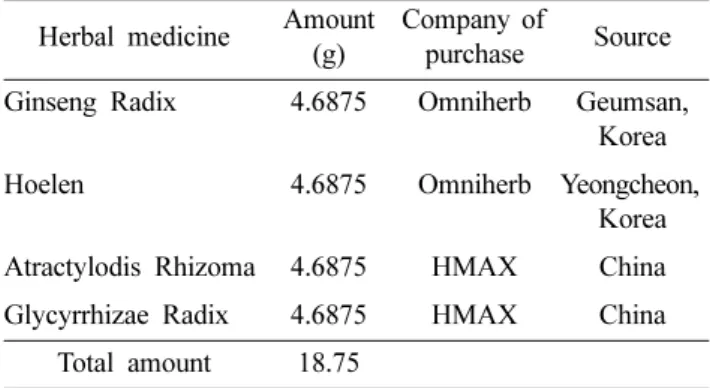
검액의 조제 − 사군자탕의 구성한약재를 Table I과 같이 무게 비율로 배합하여 약탕기 (Cosmos 660, Inchon, Korea) 에 넣고, 물을 시료의 10배로 첨가하여 100oC에서 2시간 전 탕한 후 농축 및 동결건조 하여 22.3%의 수율로 추출물을 얻었다. 추출물 200 mg을 정확히 측정한 후 물을 넣어 20 mL 로 맞춘 후 SmartPor GHP (0.2 um pore size, Woongki Science, Seoul, Korea)로 여과하여 검액으로 하였다.
HPLC 분석조건 − 사군자탕 내 주요성분인 liquiritin과 glycyrrhizin의 함량을 분석하기 위하여 Shimadzu사의 LC- 20A 시스템을 사용하여 측정하였다. 분석에 사용 된 칼럼은 Gminin C18 (5 um, 4.6×150 mm, Phenomenex, Torrance, CA, USA) 칼럼을 사용하였고, 칼럼온도는 40oC로 유지하 였다. 유속은 1.0 mL/min으로 흘려주었으며 주입량은 10 uL 였다. 이동상은 1.0% acetic acid가 함유된 water (A)와 1.0% acetic acid가 함유된 acetonitrile (B)을 사용하여 Table II와 같이 흘려주었으며, 검출파장은 254 nm와 280 nm에서 검출하였다.
분석법 Validation − 확립된 동시분석법에 대하여 직선성 (linearity), 범위 (range), 검출한계 (LOD), 정량한계 (LOQ), 재현성 (repeatability), 회수율 (recovery) 및 정밀성 (precision) 등을 판단하여 분석방법을 검증하였다.
1) 직선성, 범위, 검출한계 및 정량한계 (Linearity, Range, LOD, LOQ)
Liquiritin과 glycyrrhizin의 검량선은 2.34~300.00 ug/mL 및 3.91~500.00 ug/mL로 피크 면적에 대하여 각각 작성하 였으며, 상관계수 r2를 구하여 양호한 직선성을 나타내는지 확인하였다. 검출한계와 정량한계는 신호 (Signal, S) 대 잡 음 (Noise, N)의 비를 이용하여 각각 3과 10을 기준으로 정 하였다.
2) 피크면적과 머무름 시간에 대한 재현성 (Repeatability) 피크면적과 머무름 시간의 재현성은 표준용액을 가지고 시간의 변화에 따른 기계의 변화정도를 보기 위하여 6회 주 입하여 면적과 머무름 시간의 재현성을 확인하였다.
3) 회수율 시험 (Recovery)
정확성 평가를 위한 회수율 시험은 사군자탕 시료에 측정 하고자 하는 주요성분인 liquiritin과 glycyrrhizin의 일정 농 도 (저, 중 및 고농도)를 첨가한 후 분석을 통해 첨가된 주 요성분의 양을 확인하였다. 즉, 동결건조 된 사군자탕 200 mg 을 정확하게 측정 한 후 주요성분인 liquiritin의 최종 농도 Table I. Composition of Sagunja-tang
Herbal medicine Amount (g)
Company of
purchase Source Ginseng Radix 4.6875 Omniherb Geumsan,
Korea Hoelen 4.6875 Omniherb Yeongcheon,
Korea Atractylodis Rhizoma 4.6875 HMAX China Glycyrrhizae Radix 4.6875 HMAX China
Total amount 18.75
Table II. Condition of mobile phase for chromatographic separation
Time (min) Solvent A (%)a Solvent B (%)b
0 85 15
40 35 65
45 0 100
50 0 100
55 85 15
70 85 15
a1.0% (v/v) acetic acid in H2O
b1.0% (v/v) acetic acid in acetonitrile
16, 40, 80 ug/mL과 glycyrrhizin의 최종 농도 20, 50, 100 ug/mL가 되도록 첨가하여 검액의 조제 방법과 동일하게 전 처리하여 분석하였다. 회수율은 다음과 같은 식에 의해 계 산하였다.
회수율 (%)=
×100
4) 정밀성 시험 (Precision)
확립된 분석법의 정밀성은 균일한 검체로부터 여러 번 채 취하여 얻은 시료를 정해진 조건에 따라 측정하였을 때 각 각의 측정값들 사이의 근접성으로 상대표준편차 (%RSD)로 판단한다. 정밀성 평가는 일내 (intra-day)와 일간 (inter-day) 시험을 통하여 실시하였다. 각각의 실험은 3가지 농도의 혼 합표준용액을 3회 반복실험을 통하여 얻은 결과의 상대표 준편차를 구하여 평가하였다.
결과 및 고찰
분석조건의 확립 − 사군자탕의 구성 약재 중 감초의 주 요성분인 liquiritin과 glycyrrhizin을 분석 대상으로 1.0%
acetic acid가 함유된 water와 1.0% acetic acid가 함유된 acetonitrile을 기울기 용매 조건으로 하여 35분 이내에 분리 하였다. PDA 검출 파장은 glycyrrhizin은 254 nm, liquiritin 은 280 nm에서 검출하였다. 검액에서의 peak는 주요 성분 peak의 retention time과 UV 흡수 파장을 비교하여 확인하 였으며, 두 성분은 11.55분과 30.15분에 검출되었다 (Fig 2).
분석방법의 직선성 (Linearity), 검출한계 (LOD) 및 정 량한계 (LOQ) − Liquiritin의 peak 면적에 대한 검량선은
2.34 ~ 300.00 ug/mL의 농도 범위에서 상관계수 (r2) = 0.9999 의 직선성을 나타내었으며, glycyrrhizin은 3.91 ~ 500.00 ug/
mL의 농도 범위에서 상관계수 (r2) = 0.9998의 양호한 직선 성을 나타내었다. 또한 두 성분의 검출한계 (LOD)는 0.11 ug/mL과 0.14 ug/mL로 각각 나타났으며, 정량한계 (LOQ) 는 0.35 ug/mL과 0.48 ug/mL로 각각 나타났다 (Table III).
재현성 (Repeatability) − Liquiritin과 glycyrrhizin 두 성 분의 Peak 면적과 머무름시간 (retention time)에 대한 측정 재현성은 두 성분 모두 상대표준편차 (RSD)가 1.00% 이내 로 양호한 재현성을 나타내었다 (Table IV).
회수율 (Recovery) − 사군자탕에 표준물질의 서로 다른 3가지 농도로 첨가한 후 측정한 회수율 시험 결과 liquiritin 은 91.85 ~ 105.52%로 나타났으며, 상대표준편차도 3.72%
이하로 나타났다. Glycyrrhizin은 99.57 ~ 108.62%로 양호 표준품 첨가된 시료의 양−표준품 첨가되지 않은 시료의 양
첨가한 시료의 양
Fig. 1. Chemical structures of two constituents in Sagunja-tang.
Table III. Calibration graphs, linear ranges, LOD and LOQ (n=4) Analytes Linear range
(ug/mL) Slope Intercept Correlation coefficient
LOD (ug/mL)
LOQ (ug/mL) Liquiritin 2.34 - 300.00 16293.81 15144.59 0.9999 0.11 0.35 Glycyrrhizin 3.91 - 500.00 8201.43 21652.28 0.9998 0.14 0.48
Table IV. Repeatability of liquiritin and glycyrrhizin on retention time and peak area
Retention time (min) Peak area (mAU) Liquiritin Glycyrrhizin Liquiritin Glycyrrhizin 1 11.547 30.146 800435 817226 2 11.545 30.146 802128 820010 3 11.545 30.143 813370 831115 4 11.547 30.148 801898 818631 5 11.551 30.157 801840 818515 6 11.543 30.152 814979 829975
Mean 11.55 30.15 805775.00 822578.67 SD 0.003 0.005 6553.308 6243.737 RSD
(%)
0.024 0.017 0.813 0.759
한 회수율을 보였으며, 2.60%이하의 상대표준편차를 나타 냈다 (Table V).
정밀성 (Precision) − 직선성 범위 내에서의 일정한 3가 지 농도에서 측정한 일내 (intra-day)와 일간 (inter-day) 시 험 결과 일내는 0.17 ~ 3.54%의 상대표준편차를 나타내었 으며, 일간은 0.07 ~ 3.09%의 상대표준편차를 나타내었다 (Table VI).
사군자탕에서의 Liquiritin과 Glycyrrhizin의 함량분석 − 확립된 분석법을 이용하여 사군자탕의 감초 성분인 liquiritin 과 glycyrrhizin을 동시 분석하였다. 두 성분 모두 다른 성분 들의 peak에 영향을 받지 않고 11.55분과 30.15분에 각각 검출되었다. 사군자탕의 분석결과 liquiritin은 7.94 ~ 8.07 mg/g, glycyrrhizin은 13.66 ~ 13.91 mg/g으로 함유되어 있 었다 (Table VII).
Fig. 2. HPLC chromatogram of a standard mixture at 254 nm (A) and 280 nm (B) and Sagunja-tang extract at 254 nm (C) and 280 nm (D), Liquiritin (1), Glycyrrhizin (2).
Table V. Recovery levels of the liquiritin and glycyrrhizin in Sagunja-tang Compound Original conc.
(ug/mL)
Spiked conc.
(ug/mL)
Detected conc.
(ug/mL)
Recovery
(%) SD RSD
(%)
Liquiritin 81.91 16.00 98.80 105.52 3.93 3.72
40.00 119.09 92.93 0.42 0.45
80.00 155.39 91.85 2.55 2.78
Glycyrrhizin 137.30 20.00 159.02 108.62 2.83 2.60
50.00 187.08 99.57 1.36 1.37
100.00 237.33 100.04 0.99 0.99
결 론
사군자탕을 구성하는 인삼, 백출, 복령 및 감초의 4가지 구성 약재 중 감초의 주요 성분인 liquiritin과 glycyrrhizin에 대하여 동시분석하고 직선성, 정확성 및 정밀성 등의 실험 을 통하여 분석법에 대한 검증을 실시하였다. 그 결과 두 물 질의 성분 함량은 liquiritin이 7.94 - 8.07 mg/g, glycyrrhizin 이 13.66 - 13.91 mg/g으로 함유되어 있었다.
이상의 결과로 설정된 분석법은 사군자탕의 정량분석에 있어서 중요한 기초자료로 이용될 수 있을 것으로 사료된다.
사 사
본 연구는 한국한의학연구원에서 지원하는 ‘표준한방처방 EBM구축사업 (K11030)’에 의해 수행되었으며 이에 감사드 린다.
인용문헌
1. Jee, E. H., Kim, H. J., Jeong, S. H., Moon, J. H. and Jang, Y.
P. (2010) Assessment of the quality variance among com- mercial Hwang-Ryun-Hae-Dok-Tang by simultaneous anal- ysis of characterizing compounds. Kor. J. Pharmacogn. 41:
161-165.
2. Baek, J. H., Kim, S. M., Ahn, J. W., Cho, C. H., Oh, M. H., Cho, J. H., Lee, M. K. and Kim, H. J. (2008) Validation and determination of glycyrrhizic acid ass a marker substance in
Bu-Zhong-Yi-Qi-Tang by HPLC/DAD. Yakhak Hoeji 52: 7- 11.
3.韓醫科大學方劑學敎授共編著 (2003) 方劑學, 275. 永林社, 서울.
4.박영순 (2002) 한방의 약리해설, 692. 아카데미서적, 서울.
5. Lee, K. G., Huang, D. S., Yu, Y. B., Ma, J. Y., Ha, H. and Shin, H. K. (2006) A study on compositions, dosages and usages of Sagunjatang, Samultang, Palmultang, Sipjeondae- botang in literature. J. Oriental Medical Classics 19: 219- 225.
6. Oh, C. S., Seo, D. W., Yook, C. S., Lee, Y. J., Chang, S. Y., Ze, K. R., Park, J. Y., Lee, J. P., Seong, R. S., Park, J. Y., Ko, S. K. and Lee, P. J. (2007) The variation of residual sulfur dioxide and marker components of herbal medicines during drying process. Kor. J. Pharmacogn. 38: 299-304.
7. Yim, O. K., Han, E. J., Chung, J. Y., Park, K. S., Kang, I. H., Kang, S. J. and Kim, Y. J. (2009) The monitoring of some heavy metals in oriental herbal medicines and their intake rates. Anal. Sci. Technol. 22: 129-135.
8. Park, M. K. (2007) Concentration of heavy metals in Sagun- jatang, decoction and its ingredient herbal medicines. J. Envi- ronmental Sciences 16: 241-245.
9. Seo, C. S., Huang, D. S., Lee, J. K., Ha, H. K., Chun, J. M., Um, Y. R., Jang, S. and Shin, H. K. (2009) Concentration of heavy metals, residual pesticides and sulfur dioxide before/
after a decoction -In prescription consist of Sipjeondaebo- tang- J. Korean Oriental Med. 30: 108-117.
10. Ma, J. Y., Huang, D. S., Yu, Y. B., Ha, H. and Shin, H. K.
(2007) Acute toxicity study on Sagunja-tang (Sijunzi-tang) in Table VI. Precision of two marker compounds in Sagunja-tang
Compound
Spiked conc.
(ug/mL)
Intra-day (n=3) Inter-day (n=3)
Observed conc.
(ug/mL)
SD Precision (RSD %)
Accuracy (%)
Observed conc.
(ug/mL)
SD Precision (RSD %)
Accuracy (%) Liquiritin 16.00 17.41 0.62 3.54 108.81 17.49 0.54 3.09 109.34
40.00 39.38 0.95 2.41 98.45 39.83 0.71 1.77 99.59
80.00 80.03 0.44 0.55 100.04 79.78 0.39 0.48 99.73
Glycyrrhizin 20.00 21.17 0.29 1.38 105.85 21.19 0.20 0.93 105.96
50.00 49.39 0.22 0.45 98.78 49.45 0.08 0.16 98.89
100.00 100.07 0.17 0.17 100.07 100.04 0.07 0.07 100.04 Table VII. Analytical results (mg/g) of the two compounds in Sagunja-tang
Batch (#)
Content (mg/g)
Liquiritin Glycyrrhizin
Mean SD RSD (%) Mean SD RSD (%)
1 7.94 0.13 1.67 13.83 0.05 0.34
2 8.07 0.03 0.42 13.91 0.01 0.09
3 8.06 0.04 0.54 13.66 0.01 0.08
ICR mice. J. Korean Oriental Med. 28: 200-204.
11. Ma, J. Y., Yu, Y. B., Ha, H. Huang, D. S. and Shin, H. K.
(2007) Subacute toxicity study on Sagunja-tang (Sijunzi- tang) in SD rat. J. Korean Oriental Med. 13: 151-156.
12. Lee, N. K., Lee, C. H. and Ju, Y. S. (1987) Effect of Sagun- jatang on immune response and natural killer cells activity to SRBC in mice. J. Korean Oriental Med. 10: 115-122.
13. Ha, J. Y., Choi, S.H. and Ahn, K. S. (1988) Effect of Sam- ultang and Sagunjatang on the intravascular caogulation induced by endotoxin in rats. K. H. Univ. O. Med. J. 11: 113- 121.
14. Kang, J. S., Seong, N. G. and Shin, M. K. (1994) Effects of Sagoonjatang, Samooltang and Palmooltang on the hor- mones, metabolic substances and blood components in the recovery of starvation. J. Eastern Physiolosy 9: 35-60.
15. Ahn, S. H., Lim, G. S. and Lee, K. N. (1989) Effects of Sagunja-tang extract and Sagunja-tang added Radix Astragali extract on the granulation tissues. The Journal of Korean Ori- ental Medical Ophthalmology & Otolaryngology & Der- matology 2: 17-32.
16. Lee, J. A., Ha, H. K., Jung, D. Y., Lee, H. Y., Lee, N. H., Lee, J. K., Seo, C.S., Kim, J. H., Lee, M. Y. and Shin, H, K. (2010) Anti-inflammatory activities of Sagunja-tang (Sijunzi-tang).
The Korena Journal of Oriental Medical Prescription 18: 87- 94.
17. Soldati, F. and Sticher, O. (1980) HPLC separation and quan- titative dedtrmination of ginsenosides from Panax ginseng, Panax quinquefolium and from ginseng drug preparations.
2nd communication. Planta Med. 39: 348-357.
18. Ma, X. Q., Liang, X. M., Xu, Q., Zhang, X. Z. and Xiao, H.
B. (2005) Identification of ginsenosides in root of Panax gin- seng by HPLC-APCI/MS. Phytochem. Anal. 16: 181-187.
19. Wang, Y. C. and Yang, Y. S. (2007) Simultaneous quanti- fication of flavonoids and triterpenoids in licorice using HPLC. J. Chromatogr. B 850: 392-399.
20. Xu, D. and Cheng, K. (2011) Determination of liquiritin, nar- ingin, hesperidin and glycyrrhizic acid in extractive of Wen- dan formula by RP-HPLC. Zhongguo Zhong Yao Za Zhi 36:
45-47.
21. Seo, C. S., Lee, J. A., Jung, D., Lee, H. Y., Lee, J. K., Ha, H., Lee, M. Y. and Shin, H. K. (2011) Simulataneous deter- mination of liquiritin, hesperidin, and glycyrrhizin by HPLC- photodiode array detection and the anti-inflammatory effect of Pyungwi-san. Arch. Pharm. Res. 34: 203-210.
(2011. 6. 23 접수; 2011. 8. 11 심사; 2011. 8. 11 게재확정)