지각된 공정성의 보상의사소통과 직무만족에 대한 매개효과 검증
Mediating Effects of Perceived Justice between Compensation Communication and Job Satisfaction
솔로몬, 이정언 배재대학교 경영학과
Solomon Agbanyo([email protected]), Jeong Eon Lee([email protected])
요약
본 연구는 지각된 공정성이 보상의사소통과 직무만족의 관계를 매개할 수 있는지 실증적으로 검증하기 위한 목적으로 시도되었다. 보상이 이루어지는 시점에서 기업과 종업원의 적절한 정보교환을 포함한 의사 소통은 종업원의 직무만족을 가져올 수 있다. 또한 종업원이 보상과 관련된 정보교환의 과정에서 지각하는 공정성의 수준에 따라 직무만족의 변화가 이루어질 수 있다. 본 연구는 세 변수간의 관계를 실증 자료를 활용하여 검증함으로써 지각된 공정성의 실질적인 의미를 확인하였다. 실증분석 결과 보상의사소통은 직무 만족에 긍정적인 영향을 미치며, 종업원이 보상과 관련되어 조직에 대한 공정성을 지각하는 정도가 높을수 록 직무만족 역시 확대된다는 사실이 확인되었다. 본 연구는 실증연구의 결과를 바탕으로 보상이 이루어지 는 상황에서 조직의 관리자가 종업들의 직무에 대한 만족도를 높이기 위한 구체적이고 실천적인 방향을 제시하였다.
■ 중심어 :∣지각된 공정성∣보상의사소통∣직무만족∣매개효과∣
Abstract
The purpose of this study is to investigate whether there is a statistical relationship between compensation communication and job satisfaction. The empirical study indicates that there is a positive relationship between compensation communication and organizational justice. The results suggest that employees’fairness perception is enhanced when information about compensation is relevant, accurate, and timely. Furthermore, the statistical results proved that a significant positive relationship exists between organizational justice and job satisfaction. The findings of this study reveal that when employees understand how their compensation is determined and allocated, they feel more fairly treated. The research enhances past studies by utilizing the most widely accepted measure of job satisfaction dimensions, as well as all measures of organizational justice.
■ keyword :∣Perceived Justice∣Compensation Communication∣Job Satisfaction∣Mediating Effect∣
* 본 논문은 2016학년도 배재대학교 교내학술연구비 지원에 의하여 수행된 것임.
접수일자 : 2016년 01월 26일 수정일자 : 2016년 02월 17일
심사완료일 : 2016년 02월 17일
교신저자 : 이정언, e-mail : [email protected]
I. Introduction
Compensation has several benefits for both employer and employee. For the employer, it can be used as an instrument to influence key employees towards the attainment of organizational goals. For the employee, it serves as a means to meet financial needs. However, many firms do not spend much time and effort communicating to their employees about how compensation is determined[14]. Surveys show that many employees are dissatisfied about how well they understand their compensation[20]. It is seen as confirmation of one’s value to the organization, thus, it is important to understand the emotional and behavioral impact of compensation systems. Effective communication is one important way through which this perception could be achieved. In an attempt to understand the impact of compensation communication, the study focuses on the influence of perceptions of organizational justice perceived by employees. The organization justice concept is concerned with the fair treatment of employees, which affect employee’s attitudes and behaviors, and in turn lead to positive or negative employee satisfaction and performance[7][21].
Job satisfaction in this study has been a frequently studied subject in the work and organization literature. It has been shown to be positively related with organizational commitment. A substantial amount of study has investigated compensation, and its impact on employees’behavior. However, very little research exists that examines how compensation policies may affect employee’s behaviors[8].
This study proposes the relationships of compensation communication, job satisfaction, and justice perception.
The study investigates how employees’ perception about compensation communication affect justice perception and job satisfaction. In order to answer the problem definition, we identified the following
research questions: Do employees understand how their compensation is determined? Do employees recognize whether they are treated fairly by understanding how their compensation is determined?
Does employee’s perception of fair treatment relate to job satisfaction?
The study extends existing research on compensation communication: It attempts to explain the relationship between perceived compensation communication and job satisfaction by focusing on justice perceptions as mediators. Second, it uses a multiple-dimension measure of job satisfaction. Third, research in this area is extremely limited and therefore presents a strong foundation for further research.
Ⅱ. Background
1. Compensation and Communication
Compensation is an important job attribute and gives an opportunity to have a greater job satisfaction. A sound compensation system has the ability to attract the right kind of people. The positive relationship between different component of compensation and positive outcomes are usually not called into question.It is suggested that communication is one aspect of compensation administration. Research shows that HR professionals believe that compensation communication affects performance, satisfaction, and employee motivation. In an attempt to investigate and explain why improved communication about compensation, improve outcomes, Day (2011) proposed the relationship between compensation communication and satisfaction by incorporating organizational justice perception. The study further explained that compensation communication predicts satisfaction because knowledge about compensation enhances the worker’s perception that compensation
practices are fair[8].
Whereas employers may be reluctant to share compensation information for reasons such as protecting private employee data, it is important to communicate about compensation to employees.
Knowing how and why compensation systems are developed, or even what others in the organization are paid may enhance employee understanding of the business, minimize rumors and inaccurate estimations of others compensation[13]. Open systems that encourage divulging compensation information may increase employee trust, and perception of fairness, whereas limiting compensation information may negatively impact informational justice[5].
2. Organizational Justice
Organizational justice has emerged a useful concept for understanding of workplace attitudes and behaviors[7]. It concerns with the fair treatment of employees. Justice or fairness in organizations may include issues associated with the perception of fairness in compensation and equal opportunities for promotion. Perceptions of fairness in the organization have been found to be a strong predictor of outcomes such as satisfaction, commitment, and turnover[5].
Distributive justice relates to the fairness of the outcome, such as compensation or promotion.
Distributive justice focuses on the fairness of outcomes and plays a vital role in an individual job performance. Research supports the positive effect of distributive justice on organizational and individual outcomes. It is found that distributive justice to predict satisfaction, commitment, and citizenship behaviors[4]. Procedural justice means a provision of fair procedural practices which are used to determine outcomes. It occurs when employees perceive that the processes include aspects of consistency, precision, and indiscrimination[15]. It is an important predictor
of outcomes than distributive justice. Because personal outcomes such as satisfaction with compensation can be predicted by distributive justice while procedural justice is related to evaluating trust and commitment in the superior[6][18]. Interactional justice is the perceived fairness of how decisions are implemented by authorities, and is focused on interpersonal factors[4]. It focuses on employees’
perception of the interpersonal behavior exercised during the presentation of decisions and procedures[2]. It deals with how people are treated when executing procedures and determine outcomes.
It is about dignity and respect towards employee by managers[9]. Stecher and Rosse (2005) concluded that interactional justice has a stronger impact on negative emotions, intent to leave, and intent to reduce work effort than distributive justice.
3. Compensation and Job Satisfaction
Job satisfaction is a positive emotional state as a result of appraisal of one’s job experiences[16]. Hulin and Judge (2003) note that job satisfaction includes multidimensional psychological responses to an individual job, and these personal responses have cognitive, affective, and behavioral components. Job satisfaction reflects the degree of pleasure or happiness the job. It has intrinsic and extrinsic dimensions[11]. Intrinsic job satisfaction depends on individual traits. Extrinsic sources include compensation, promotion, and job security.Research shows that job satisfaction does predict job performance. Because it moderately correlates with task performance. Employees who are satisfied with their job do a better job performing their duties, which in turn foster creativity, improve problem solving, and decision making. Job satisfaction is also correlated moderately with citizenship behaviors.
Satisfied workers engage in more citizenship
behaviors. There is a positive and causal relationship between job and life satisfaction in the short term, and that over time, general life satisfaction becomes more influential in a person’s life.
The relationship between job satisfaction and life satisfaction makes sense when we examine how much time is spent at work. In explaining why some employees are more satisfied than others. Jason et al.
(2013) stated that employees are satisfied when their job provides the things that they value. They further elaborated that values are the things employees want to seek or attain, such as compensation, promotion, a sense of achievement etc. Igalens et al. (1999) and Banjoko (1996) found a strong correlation between employee compensation and job satisfaction[1][12].
Ⅲ. Hypotheses
Research shows that compensation communication can help communicate management’s intention to compensate fairly. Compensation communication is also associated with a number of positive outcomes, including performance improvement, retention, organizational commitment, and improved effectiveness[3][10]. This study tests a positive relationship between perceived compensation communication and job satisfaction, as well as investigates and explains why perceived compensation communication affects job satisfaction by examining the impact of interactional justice.
Day (2011) proposed that perceived compensation communication is more positively associated with perception of organizational justice[8]. Compensation communication will affect justice because such communication lays out the rules by which the compensation system works, and provide accurate information. In addition, compensation communication allows management to signal that it values workers
through its fair and systematically determined compensation[23].
H1. Perceived compensation communication will be positively associated with organizational justice perceptions.
Evidence exists that communication about management practices can increase job satisfaction, perception of compensation fairness, and encourage a positive psychological job contract[3]. Brown and Huber, (1992) showed that perceived understanding of the compensation system had a greater influence on satisfaction. The study points out that employees understand these systems and feel that organization’s plan will reward them equitably for their efforts.
H2. Compensation communication will be positively related with job satisfaction.
McFarlin and Sweeney (1992) showed that justice is a powerful predictor of job satisfaction[18].
Masterson et al. (2000) proved justice to be a significant predictor of job satisfaction[17]. There are other studies that have shown a strong correlation between procedural justice, distributive justice, informational justice, and job satisfaction. Mossholder et al. (1998) showed that justice context explains significant variance in employee job satisfaction[19].
Sania and Jamal (2013) show that a significant relationship exists between justice and job satisfaction[21].
H3. Organizational justice will be positively related with job satisfaction.
The research model shows the hypothesized relationships of compensation communication, organizational justice, and job satisfaction.
Fig. 1. Research model
Ⅳ. Methods
1. Questionnaires
The questionnaire comprised of the job descriptive index. The job descriptive item consisted of six items designed to measure satisfaction with respect to satisfaction with compensation, promotion, supervision, co-workers, and overall job satisfaction.
Compensation communication descriptive items were measured with a slightly modified form of Day (2011).
The six items of compensation communication measured the extent at which employees understand how their compensation is determined and allocated.
Organizational justice was measured with 14 items, measuring the degree to which employees felt procedures and distributions of compensation were fair. The instrument measured the degree at which employees felt their needs were considered, and explanations regarding their compensation were accurate, candid and timely[8][21]. Each item on the scales was measured from very dissatisfied to very satisfied. The instrument used to gather the data was hand-delivered to the employees at their workplace by the researcher.
2. Sample and Reliability Evaluation
The survey was conducted from October to November 2014. The population for the study comprised of employees working in the financialservices and education sector. A total of 300 questionnaires was sent to potential respondents. 258 usable questionnaires were returned, giving a response rate of 86%. Ages of the respondents ranged from below 30s to over 50. The majority of the respondents were under 30 years (38.4%) and between 30–39 years (33.7%). Most of them held bachelors degrees (75.6%). The majority of the respondents had been with their company for over 7 years and above (33.7%).
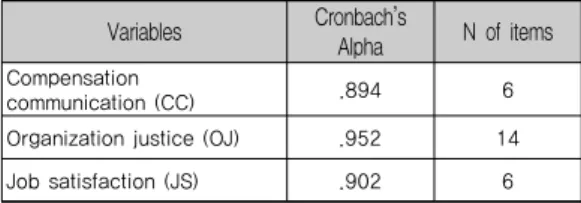
To establish a degree of reliability, Cronbach’s alpha internal consistency reliability test for the instrument was computed. The Cronbach’s alpha coefficient for compensation communication, organizational justice, and job satisfaction were .894, .952, .902, and .936 respectively, establishing a very high degree of reliability. [Table 2] summarizes the reliability statistics.
Variables Frequency(n) Percent(%)
Age
Under 30 99 38.4
30 - 39 87 33.7
40 and above 72 27.9
Education Highschool graduate 24 9.3 Under and post graduate 234 90.7
Working years
Under 1 37 14.3
Less than 3 51 19.8
Less than 5 44 17.1
Less than 7 39 15.1
7 and above 87 33.7
Table 1. Sample characteristics
Variables Cronbach’s
Alpha N of items Compensation
communication (CC) .894 6
Organization justice (OJ) .952 14
Job satisfaction (JS) .902 6
Table 2. Reliability test
3. Hypotheses Testing
Simple linear regression analysis was conducted for
testing the proposed hypotheses. The regression analysis of the causal effect of compensation communication on organizational justice shows a strong relation between two variables (Beta=.764, Sig.=.000). The R2 value is .584(Sig.=.000), indicating 58.4% of the variance in organizational justice is predicted by compensation communication. This indicates that the regression predicting organizational justice from compensation communication is statistically significant. The results support the hypothesis 1, which describes a positive relationship between compensation communication and justice.
Model (OJ)
Unstandardized coefficients
Standardized
coefficients t Sig.
B SE Beta
(Constant) 1.234 .108
.764 11.466
CC .664 .035 18.967 .000
Table 3. Causal effect of CC on OJ
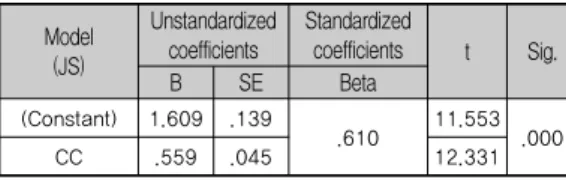
The R2 value of the regression equation relating the analysis of the causal effect of compensation communication on job satisfaction is .377(Sig.=.000).
The result shows that 37.7% of the variance in job satisfaction is explained by compensation communication. The result provides support for the hypothesis 2. It is found that there is a significant relationship between compensation communication and job satisfaction.
Model (JS)
Unstandardized coefficients
Standardized
coefficients t Sig.
B SE Beta
(Constant) 1.609 .139
.610 11.553 .000
CC .559 .045 12.331
Table 4. Causal effect of CC on JS
The R2 of the equation between organizational justice and job satisfaction is .731. This represents variations in job satisfaction that is explained by
organizational justice. F ratio is significant at p<.001, which indicates that the regression predicting job satisfaction of organizational justice is statistically significant. These results support the proposed hypothesis 3. A significant positive relationship between two variables has been found.
Model (JS)
Unstandardized coefficients
Standardized
coefficients t Sig.
B SE Beta
(Constant) 1.482 .125
.679 11.521 .000
OJ .602 .41 16.832
Table 5. Causal effect of OJ on JS
Three conditions were established in order to determine whether organizational justice mediate compensation communication and job satisfaction;
Compensation communication predicts job satisfaction and organizational justice. Organizational justice predicts job satisfaction. In order to test whether these three conditions are met, the regression coefficients for the three relationships were obtained.
Model (JS)
Unstandardized coefficients
Standardized
coefficients t Sig.
B SE Beta
(Constant) 1.234 .108
.764 11.466 .000
CC .664 .35 18.967
Table 6. Mediating effect of OJ
(Constant) .394 .111 3.538 .000
CC -.095 .046 -.104 -2.079 .039
OJ .984 .053 .934 18.715 .000
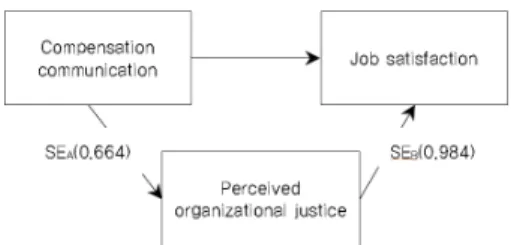
The result of Sobel test shows whether a mediator variable significantly carries the influence of an independent variable to a dependent variable. The test statistic for the Sobel test is 13.269 (a=.664; p=.000) and 13.259 (a=.984; p=.000). The result indicates that the association between compensation communication
and job satisfaction is reduced significantly by the inclusion of organizational justice. It means the evidence of mediation.
Fig. 2. Test of mediation by Sobel test
Ⅴ. Conclusion
The results of this study show that there is a positive relationship between compensation communication and job satisfaction. These findings are consistent with previous researches such as Brown and Huber(1992), who reported that perceived understanding of the compensation system has somewhat greater influence on job satisfaction[3][10].
The results also suggest that employees are satisfied with their job when they understand how their compensation is determined.
This study indicates that there is a positive relationship between compensation communication and organizational justice. These findings are expected and are consistent with Day’s (2011) study[8]. The results suggest that employees’ fairness perception is enhanced when information about compensation is relevant, accurate, and timely.
Furthermore, the statistical results proved that a significant positive relationship exists between organizational justice and job satisfaction. Confirming previous researches, organizational justice significantly predicts job satisfaction[17][18][21]. The findings of this study reveal that when employees understand how their compensation is determined and
allocated, they feel more fairly treated. In turn, these justice perceptions mediate the relationship between compensation communication and job satisfaction.
The result implies that perception of justice is essential to ensure that workers are satisfied with their job. In other words, the research shows that when efforts are made to make employees understand how their compensation is determined and allocated, these efforts enhances workers’ perception of fairness about their organization.
This research enhances past studies by utilizing the most widely accepted measure of job satisfaction dimensions, as well as all measures of organizational justice. Finally, showing that justice perception mediates the relationship between compensation communication and job satisfaction provides useful insight for both researchers and practitioners in understanding compensation administration dynamics.
참 고 문 헌
[1] S. A. Banjoko, Human resource management, Lagos: Saban Publishers, 1996.
[2] R. J. Bies and J. S. Moag, “Interactional Justice;
Communication Criteria of Fairness,” In: R. J.
Lewicki, B. H. Sheppard, and B. H. Bazerman (Eds.), Research on Negotiation in Organizations, Vol.1, pp.43–55, Greenwich: JAI Press, 1986.
[3] K. A. Brown and V. L. Huber,“Lowering Floors and Raising Ceilings: A Longitudinal Assessment of the Effects of an Earnings-At-Risk Plan on Pay Satisfaction,” Personnel Psychology, Vol.45, No.2, pp.279-311, 1992.
[4] J. A. Colquitt and J. Greenberg,“Organizational Justice: A Fair Assessment of the State of the Literature,”In: J. Greenberg (Ed.), Organizational
Behavior: The State of the Science, NJ:
Lawrence Erlbaum Publishers, pp.165-210, 2003.
[5] J. A. Colquitt, “On the Dimensionality of Organizational Justice,” Journal of Applied Psychology, Vol.86, No.3, pp.386-400, 2001.
[6] J. A. Colquitt, J. A. LePine, and M. J. Wesson,
Organizational Behavior: Improving Performance and Commitment in the Workplace, McGraw-Hill,
2013.[7] R. Cropanzano, D. E. Rupp, C. J. Mohler, and M.
Schminke, “Three Roads to Organizational Justice,”
In: J. Ferris (Ed.), Research in Personnel and
Human Resource Management, Vol.20, pp.1-113,
NY: JAI, 2001.[8] N. E. Day, “Perceived Pay Communication, Justice and Pay Satisfaction,”Employee Relations, Vol.33, No.5, pp.476-497, 2011.
[9] J. Greenberg, “Organizational Justice: Yesterday, Today and Tomorrow,” Journal of Management, Vol.16, No.2, pp.399-432, 1990.
[10] H. G. Heneman and T. A. Judge, “Compensation Attitudes”, In: S. L. Rynes and B. Gerhart (Eds.), Compensation in Organizations: Current
Research and Practice, Jossey-Bass, pp.61-103,
2000.[11] C. L. Hulin and T. A. Judge, “Job Attitudes,”
In: W. C. Borman, D. R. Ligen, and R. J. Klimoski (Eds.), Handbook of Psychology: Industrial and
Organizational Psychology, pp.255-276, NJ:
Wiley, 2003.
[12] J. Igalens and P. Roussel, “A Study of the Relationships between Compensation Package, Work Motivation and Job Satisfaction,” Journal of Organizational Behavior, Vol.20, No.7, pp.1003-1025, 1999.
[13] E. E. Lawler, “Secrecy and the Need to Know,”
In: H. Tosi, R. House, and M. D. Dunnette (Eds.), Managerial Motivation and Compensation, pp.455-476, East Lansing: Michigan State
University Press, 1972.
[14] E. E. Lawler, “Pay Practices in Fortune 1000 Corporations,” WorldatWork Journal, Vol.12, No.4, pp.45-54, 2003.
[15] G. S. Leventhal, “What Should be Done with Equity Theory? New Approaches to the Study of Fairness in Social Relationships,”In: K. J.
Gergen, M. S. Greenberg, and R. H. Willis (Eds.), Social Exchange: Advances in Theory
and Research, pp.27-55, NY: Plenum, 1980.
[16] E. A. Locke, “The Nature and Causes of Job Satisfaction,” In: M. D. Dunnette (Ed.), Handbook
of Industrial and Organization Psychology,
Chicago: Rand McNally, pp.1297-1349, 1976.[17] S. S. Masterson, K. Lewis, B. M. Goldman, and M. S. Taylor, “Integrating Justice and Social Exchange: The Differing Effects of Fair Procedures and Treatment on Work Relationships,” Academy of Management Journal, Vol.43, No.4, pp.738-748, 2000.
[18] D. B. McFarlin and P. D. Sweeney, “Distributive and Procedural Justice as Predictors of Satisfaction with Personal and Organizational Outcomes,” Academy of Management Journal, Vol.35, No.3, pp.626-637, 1992.
[19] K. W. Mossholder, N. Bennett, and C. L. Martin,
“A Multilevel Analysis of Procedural Justice Context,” Journal of Organizational Behavior, Vol.19, No.2, pp.131-141, 1998.
[20] S. L. Rogers, K. W. Lohwater, and H. Hager,
Communicating Total Rewards, Scottsdale:
WorldatWork, 2003.
[21] U. Sania and S. Jamal, “Impact of Distributive Justice, Procedural Justice, Interactional Justice, Temporal Justice, Spatial Justice on Job Satisfaction of Banking Employees,” Review of Integrative Business and Economics Research, Vol.2, No.1, pp.351-383, 2013.
[22] S. Sarwar and J. Abugre, “The Influence of Rewards and Job satisfaction on Employees in the Service Industry,” The Business & Management Review, Vol.3, No.2, pp.22-32, 2013.
[23] J. Schaubrooeck, D. R. May, and F. W. Brown, Procedural Justice Explanations and Employee Reactions to Economic Hardship: A Field Experiment,” Journal of Applied Psychology, Vol.79, No.3, pp.455-460, 1994.
저 자 소 개
솔 로 몬(Solomon Agbanyo) 정회원 ▪2015년 2월 : 배재대학교 대학원
경영학과 경영학 석사
<관심분야> : 임금관리, 직무만족, 형평성관리
이 정 언(Jeong Eon Lee) 종신회원
▪2008년 4월 : 독일 하노버대학교 경영학부(경영학박사)
▪1996년 3월 ~ 2001년 4월 : 한국 국방연구원 연구원
▪2010년 9월 ~ 현재 : 배재대학교 경영학과 교수
<관심분야> : 인사전략, 고용관계, 고용유연성