J http://dx.doi.org/10.13065/jksdh.2014.14.04.479 Original Article
Copyrightⓒ2014 by Journal of Korean Society of Dental Hygiene
This is an open-access article distributed under the terms of the Creative Commons Attribution Non-Commercial License (http://creativecommons.org/
licenses/by-nc/3.0/), which permits unrestricted non-commercial use, distribution, and reproduction in medium, provided the original work is properly cited.
JKSDH is available at http://www.jksdh.or.kr/ pISSN 2287-1705 / eISSN 2288-2294
▶ 본 논문은 2012년 The 2nd International Conference on Convergence Technology(2nd ICCT)에서 학술발표하였음.
Association between oral health knowledge, attitude and dental caries experience in Korean 12-year-old adolescents
Jong-Hwa Jang ․ Ji-Hee Kim1․ Kyeong-Hee Lee2
Dept. of dental hygiene, Hanseo University ․1Dept. of emergency, Kangwon University ․2Dept. of dental hygiene, Shinhan University
12세 청소년의 구강건강지식, 태도와 치아우식경험도와의 연관성
장종화⋅김지희1⋅이경희2
한서대학교 치위생학과⋅1강원대학교 응급구조학과⋅2신한대학교 치위생학과
Received : 5 May, 2014 Revised : 6 August, 2014 Accepted : 11 August, 2014
ABSTRACT
Objectives : The aim of the study is to investigate the oral health knowledge, attitude and dental caries experience in Korean 12-year-old adolescents.
Methods : The subjects were 2,196 adolescents living in Seosan, with an average age of 12.2 years. Data were collected using a self-administered questionnaire from April 10 through June 10, 2011. A trained investigator made an oral examination of them in natural light, using a mirror and an explorer to determine their DMFT index.
Corresponding Author Kyeong-Hee Lee
Department of Dental Hygiene Shin-han University
95 Hoam-ro, Uijeongbu Gyeonggi-do 480-701, Korea.
Tel : + 82-31-870-3452 + 82-10-9199-2072 Fax : + 82-31-870-3459 E-mail : [email protected]
Results : The prevalence rate of dental caries of adolescents was 59.1%. The DMFT index of the subjects was 1.98, which was lower than the national mean of 2.2 for the same age.
The DMFT index was significantly higher in the female(2.25) than the male group(1.72). The attitude of oral health was positively related to DMFT index in this study(OR=1.25; CI=1.01-1.54).
It appears that knowledge and attitude concerning oral health, among young Korean 12-year-old adolescents living in Seosan, are in need of improvement.
Conclusions : Based on the findings, dental caries experience is associated with attitude of oral health. This result suggests that the implementation of oral health promotion should be considered for various factors related to attitude of oral health in adolescents.
Key Words : adolescents, attitude, knowledge, Korean, oral health 색인 : 구강건강지식, 구강건강태도, 청소년, 한국인
Introduction
Dental caries is a chronic disease and has remarkably de- creased in the developed countries, but it is still increasing in the developing countries1-4).
World Health Organization(WHO) has used DMFT index of 12 year old adolescents as the oral health indicator, which shows the comparative oral health between the countries.
WHO reported DMFT index of 2001 was 1.74 and that of 2004 decreased to 1.61. DMFT index of 12 year old adoles-
cents in Korea was 0.6 in 1972, 3.0 in 1990, 3.3 in 2000 and 2.0 in 20105,6). The decreased index in 2010 was owing to the establishment of oral health division in 1997 and nation- wide oral health survey in 2000, but the DMFT index is still a high score in comparison to the OECD countries. In order to go down DMFT index, it is necessary to investigate the factors related to dental caries as the concept of health promotion.
The adolescence is a transition period of physical, mental, and social activity7), and the right dental health and behavior can have much influence upon the lifelong oral health and quality of life8). Dental caries is the major cause of dental morbidity and causes tooth pain and mastication disorder, which are related to normal permanent dentition. Therefore, adolescents should take care of the more active oral health management9,10). The incidence rate of dental caries in adoles- cents is higher than that of the adults, so the importance of oral health management in adolescents has been under debate for many years because lifelong dental care begins in adolescence. Therefore, the students are vulnerable to den- tal caries and the school age is the essential stage of lifelong oral health care. It is necessary to investigate the provocative factors of oral diseases11).
The preceding papers concerning adolescent oral health include dental health incidence surveys12-14), relation between oral diseases and socioeconomic status15,16), and relation be- tween depression and dental caries17). In order to set up an oral health care program, the survey for knowledge and atti- tude toward dental health must be considered, but there is only a survey on adult knowledge and attitude18). The aim of the present study is to provide basic data for the develop- ment of school oral health management program. Seosan is the city of urban and agriculture complex and the entire first grade of middle school students filled out the questionnaire on the knowledge and attitude of oral health. The data linked to DMFT index and dental caries experience revealed the provocative factors of dental caries.
Materials & Methods
1. Subjects
Seosan is the city of urban and agricultural complex, and
is located in Chungcheongnamdo. The population is 161,687 and 12 year old adolescents are 2,24119). The present study is the cross-sectional survey, focusing on the 2,241 first grade middle school students(mean age=12.5±1.06). A total of 2,209 sheets of questionnaire(98.5%) were analyzed, except 32 sheets of incomplete answer.
2. Study methods
From April 10 to June 10, 2011, the researchers visited the middle schools and explained the purpose of the present study. Students filled out the self-administered questionnaire after confirming the informed consent.
In accordance to the standard of WHO20), the oral health status were examined by two researchers who were trained by same condition, using a mirror and an explorer. DMFT index was calculated by decayed tooth(DT), missed tooth(MT), and filled tooth(FT).
The questionnaire consisted of general characteristics(2 questions), oral health knowledge(7 questions), and atti- tude(4 questions). The instrument for oral health knowledge and attitude was adapted and translated from that of Farsi21) and revised by two dental hygiene professors. The ques- tionnaire went through preliminary survey by 20 middle school students and was verified on the questions. The ques- tionnaire has 1 to 7 points, and the higher point means higher knowledge. Based on the mean score, 0 to 2 is lower knowl- edge, and 3 to 7 is higher knowledge. In the attitude, 0 to 2 means lower attitude and 3 to 4 means higher attitude.
Cronbach’s alpha was .750.
3. Statistics
The collected data were analyzed by SPSS 18.0 pro- gram(SPSS Inc, Chicago, IL, USA) and descriptive statistics was used for oral health knowledge and attitude. The differ- ence between the knowledge and attitude, according to den- tal caries experience and DMFT index, was analyzed by in- dependent t-test, one-way ANOVA, and Duncan’s multiple range test(post-hoc). The related factors of dental caries expe- rience were calculated by multiple logistic regression test.
Items Agree Do not
know Disagree
Knowledge
Using tooth brush helps preventing periodontal disease. 72.4 24.2 3.2
Using dental floss helps preventing periodontal disease. 42.7 43.4 13.9
There are people with good teeth no matter what they do, and others with bad teeth no matter what they do.
18.8 26.0 55.3
Even if you follow instruction of a dentist, you will still have dental problems.
20.0 50.8 29.1
Bleeding on brushing is a primary sign of gingivitis. 46.3 44.3 9.4
Periodontal disease can lead to bone resolution. 16.8 63.6 19.6
Dental problems can lead to other health problem. 30.4 52.3 17.2
Attitude
Periodontal disease makes me look bad. 59.8 29.6 10.5
Bad teeth affect my school progress. 18.6 42.8 38.6
Loosing teeth is a natural sequence of getting old. 32.3 34.9 34.9
Artificial teeth have fewer problems than natural teeth. 58.1 33.0 8.8
Table 1. The knowledge and attitude of oral health Unit : %
Variables N(%) Knowledge
p-value* Attitude
p-value
Mean±SD Mean±SD
Total 2,199(100.0) 2.46±1.51 1.88±1.11
Gender
Male 1,124(50.9) 2.51±1.48 0.121 1.87±1.09 0.771
Female 1,085(49.1) 2.41±1.53 1.89±1.12
Monthly income**
High group 556(33.0) 2.58±1.45a 0.002 1.94±1.08a 0.017
Middle group 763(45.3) 2.58±1.55a 2.00±1.09a
Low group 367(21.8) 2.26±1.45b 1.80±1.09b
SD=Standard deviation, *by the independent t-test or one way ANOVA test at α=0.05
a,b,c
means that different letters are significantly different at α=0.05
**Low group was < $1,480, middle group was from $1,480 to 2962, and high group was ≥ $2,963 Table 2. The knowledge and attitude of oral health according to general characteristics
Results
1. Oral health knowledge and attitude
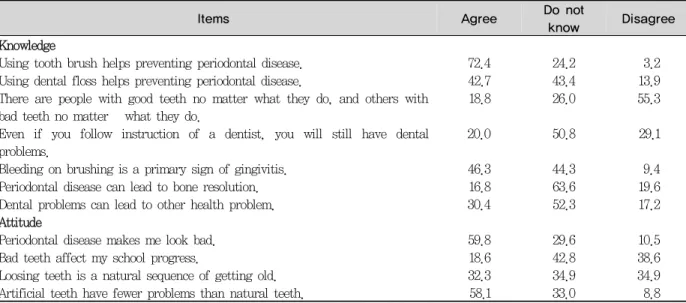
The oral health knowledge of 7 questions, including ‘agree’
and ‘do not know’, revealed 72.4% in ‘periodontal disease can be preventable by tooth brushing’. It was reported as follows. The gingiva bleeding means the early sign of perio- dontal disease(46.3%), dental floss can prevent periodontal disease(42.7%), the oral disease can develop the systemic disease(30.4%), and oral disease can still occur in spite of the dentist's advice(20.0%).
The oral health attitude disclosed higher response in the question, ‘periodontal disease gives me bad im-
pression’(59.8%). The crown and bridge is better than the natural teeth(58.1%), teeth mobility is the natural change by age(32.3%), and the bad oral hygiene influences school activ- ity(18.6%). These results mean the lower level of oral health attitude<Table 1>.
2. The oral health knowledge and DMFT index by demographical characteristics
The difference between oral health knowledge by demo- graphical characteristics showed that the lower income group had lower oral health knowledge and attitude, but there was no gender difference(p>0.05).<Table 2>. Cronbach’s alpha was .750.
Variables N(%) DMFT
p-value* Mean±SD
Total 2,208(100.0) 1.98±2.46
Gender
Male 1,123(50.8) 1.72±2.23 <0.001
Female 1,085(49.2) 2.25±2.65
Monthly income**
High group 556(33.0) 1.83±2.46a 0.036
Middle group 763(45.3) 1.85±2.29a
Low group 367(21.8) 2.21±2.71b
SD = Standard deviation, *by the independent t-test or one way ANOVA test at α=0.05
a,b,c
means that different letters are significantly different at α=0.05
**Low group was < $1,480, middle group was from $1,480 to 2962, and high group was ≥ $2,963 Table 3. DMFT index according to general characteristics
Variable N(%) Knowledge
p-value** Attitude
p-value‡
Mean±SD* Mean±SD†
DMFT=0 903(40.9) 2.56±1.48 0.007 1.97±1.10 0.001
DMFT≥1 1,305(59.1) 2.39±1.52 1.82±1.10
*Mean±Standard deviation and range was 0-7 point, **by the independent t-test at α=0.05.
†Mean±Standard deviation and range was 0-4 point, ‡by the independent t-test at α=0.05.
Table 4. The knowledge and attitude of oral health according to dental caries experience
Independent variables OR(95% CI)
Knowledge*
High group 1
Low group 1.21(1.00-1.49)
Attitude**
High group 1
Low group 1.25(1.01-1.54)
Gender
Male 1
Female 1.39(1.14-1.69)
Monthly income***
High group 1
Middle group 1.18(0.95-1.48)†
Low group 1.34(1.02-1.76)
OR = Odds Ratio, CI = Confidence interval
*Low group was 0-2 point and high group was 3-7 point at 0-7 point range
**Low group was 0-2 point and high group was 3-4 point at 0-4 point range
***Low group was < $1,480, middle group was from $1,480 to 2962, and high group was ≥ $2,963
†Not statistically significant at p<0.05
Table 5. Multiple logistic regression model predicting on the dental caries experience
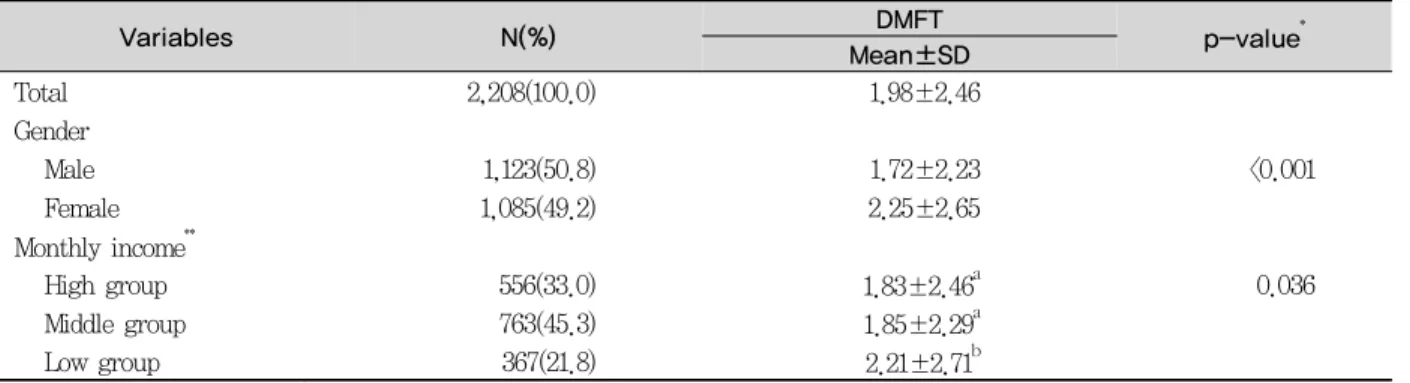
DMFT index by demographical characteristics revealed that permanent tooth index by gender marked higher score in women(2.25) than that of men(1.72)(p<0.001), and the lower
monthly income group had higher DMFT index(2.21) than that of the medium income group(1.85) and higher income group(1.83).(p=0.036)<Table 3>.
3. The relation between the oral health knowledge, attitude, and dental caries experience
Table 4 suggested the difference between oral health knowledge and attitude by dental caries experience. Oral health knowledge in caries free(DMFT=0) was 2.56 and that of caries(DMFT≥1) was 2.39(p=0.007). The attitude in caries free was 1.97 and this figure was higher than that of ca- ries(1.82)(p=0.001). In order to investigate the provocative factors to dental caries experience, categorical variable was made by the way of oral health knowledge and attitude score.
The multiple logistic regression by gender and monthly in- come<Table 5>, dental caries experience was higher in the group of lower knowledge(OR=1.21; CI=1.00-1.49) and lower attitude(OR=1.25; CI=1.01-1.54). Women had higher dental caries experience than men(OR=1.39; CI=1.14-1.69), and the lower monthly income group had higher dental caries experi- ence than the higher income group(OR=1.34; CI=1.02-1.76).
Discussion
The present study is a cross-sectional survey on oral health knowledge and attitude in the first grade middle school stu- dents, aged 12-year old in Seosan. The oral health is the dynamic process understood as social, cultural, and economic point of view. The oral health behavior is related to general characteristics, belief, attitude, oral health status, and oral health knowledge22). The dental caries and periodontal dis- ease are the most common dental problems and can be pre- ventable by diet and oral hygiene. In order to improve the cooperation and compliance of the trainees, the preliminary analysis of the oral health knowledge and attitude was able to predict the behavioral change23). The dental and oral hy- giene training and applying preventive methods reduced the dental caries and periodontal disease24).
The score of the oral health knowledge of the students was 2.46 of 7, and that of the attitude was 1.88. Seosan has been provided with water fluoridation since 2002 and the dental caries experience rate in middle school students was 59.1%. The dental caries index in men was 1.72 and that in women was 2.25. These figures were relatively low in comparison to 2010 nationwide oral health survey, but the
incidence rate of dental caries is still higher than those of the developing countries, so the activation oral health care management policy is required because the dental illness costs are a big burden for the individual and the community5). The dental caries experience index by gender revealed that girl students are epidemiologically more vulnerable to the dental caries4). The relation between the dental caries experi- ence and socioeconomic status suggested that family monthly income below 2,000 US dollars is more vulnerable to dental caries. Jones and Worthington revealed that the socio- economic status is directly proportional to dental caries preva- lence rate25). This finding reminds that in order to improve the oral health management, the individual effort and social support for the economic inequality is essential to solve the disease burden.
Gingivitis and dental caries begin in the adolescence and can be fully preventable by appropriate oral hygiene care.
Solhi et al.22) suggested that oral health education, based on health belief model(HBM), improved the oral health recognition. The responsibility on health problem relies on community, as well as individual, and the importance of health promotion in oral hygiene needs to converge on ado- lescent health risk behaviour and psychological consideration.
The oral health in students is the most important thing in public health, so the lifelong oral hygiene, including man- hood and senescence, can begin in the adolescence4). The school-based dental public health service in Korea is mainly provided to the primary school students by public health center. Therefore, it is necessary to expand the oral health service to the middle and high school students. The present was cross sectional study focusing on the 12 year old adolescents. It is necessary to investigate the follow up inter- vention study that connects the longitudinal study with oral health improvement behaviors.
Conclusions
The present study was carried out to provide the basic data for the adolescent oral health service program by investigating the relation between the oral health knowledge, attitude, and dental caries experience among the first grade middle school students in Seosan, Korea. Further survey is needed in rela- tion between the oral hygiene index, gingival status, and oral
health behavior.
It is reported that oral health knowledge and attitude of 12 year old students in Seosan showed a score of knowledge and attitude is proportional to high dental caries experience.
The activation of the school-based oral health education is indispensable to the right oral health behavior in the adolescents. Therefore, the expansion of school-based oral health program is the key solution to the continuing oral health care in the near future.
References
1. Blinkhorn AS, Davies RM. Caries prevention: a continued need worldwide. Int Dent J 1996; 46: 119-25.
2. Kaste LM, Selwitz RH, Oldakowski RJ, Brunelle JA, Winn DM, Brown LJ. Coronal caries in the primary and permanent dentition of adults in the United States, 1988-1991. J Dent Res 1996; 75:
631-41.
3. Winn DM, Brunelle JA, Selwiz RH. Coronal and root caries in the dentition of adults in the United States, 1988-1991. J Dent Res 1996; 75: 642-51.
4. Kim JB, Choi YJ, Moon HS, Kim JB, Kim DK, Lee HS, et al.
Public oral health. 4th ed. Seoul: Komoonsa; 2009: 52-5.
5. Ministry of Health and Welfare. 2010 Oral health survey. Seoul:
Ministry of Health and Welfare; 2011: 103-4.
6. Ministry of Health and Welfare. 2006 The second online survey of adolescent health behaviors. Gwacheon: Ministry of Health and Welfare Centers for Disease Control and Prevention; 2007.
7. Park NH, Kim MO. The Relationship between depression and health behavior in adolescents. J Korean Acad Child Health Nurs 2005; 11(4): 436-43.
8. Cassolato SF, Turnbull RS. Xerostomia: clinical aspects and treatment. Gerodontol 2003; 20: 64-77.
9. Ryu K, Jeong SH, Kim JY, Choi YH, Song KB. Effect of mothers`
oral health behaviour and knowledge on dental caries in their preschool children. J Korean Acad Dent Health 2004; 28(1):
105-14.
10. Vallejos-Sánchez AN, Medina-Solís CE, Casanova-Rosado JF Maupomé G, Minaya-Sánchez M, Pérez-Olivares S. Caries increment in the permanent dentition of Mexican children in relation to prior caries experience on permanent and primary dentitions. J Dent 2006; 34: 709-5. http://dx.doi.org/10.1016/
j.jdent.2006.01.003.
11. Kim MK, Han DH, Bae KH. The association between socioeconomic status and deciduous dental caries among 3-6 year old children in Pusan. J Korean Acad Dent Health 2006;
30(4): 447-51.
12. Lee SK. The ratio of tooth surfaces attacked by caries at 12 to 13 years old students in several cities of Chollabukdo, Korea. J Korean Acad Dent Health 2002; 6(3): 295-302.
13. Lim KO, Choi JH. Survey on oral health behavior and knowledge of middle school students. J Korean Soc Dent Hyg 2011; 11(2):
241-8.
14. Ryu KJ. A research on recognition of oral health care among high school students. J Korean Soc Dent Hyg 2010; 10(5):
925-33.
15. Kim SS, Jang JH. Dental health types in middle school students and their effects on dental caries -focusing on O middle school students in Suwon-. J Korean Soc School Health 2000; 13(2):
283-93.
16. Kim SJ, Ahn SH, Kim YH, Chung ES. Relationships between knowledge, attitudes, and behaviors about the dental health and the dental health conditions in elementary students in Pusan area. J Korean Soc Health Edu Promot 2004; 21(1): 69-84.
17. Jang JH, Kim SH. The relationship of health risk behavior, depression and dental caries experience in 12-year-old adolescents. J Korean Acad Dent Health 2007; 31(4): 593-601.
18. Tada A, Hanada N. Sexual differences in smoking behaviour and dental caries experience in young adults. Public Health 2002;
116: 341-6.
19. http://www.seosan.go.kr/main.do 2012 Seosan statistical yearbook.[Internet]. [cited 2014 May 20]. Available from:
http://www.seosan.go.kr/stat/move.do?usr_menu_cd=41020100 00&tsort=2&tcsort=1&csort=1&tpl_num=null.
20. World Health Organization. Oral health survey: basic methods.
4th ed. Geneva: World Health Organization; 1997.
21. Farsi JMA, Farghaly MM, Farsi N. Oral health knowledge, attitude and behaviour among Saudi school students in Jedish city. J Dent 2004; 32: 47-53.
22. Solhi M, Zadeh DS, Zadeh SF. The application of the health belief model in oral health education. Iranian J Publ Health 2010; 39(4): 114-9.
23. Kang MS, Kim CY, Kim HG, Kim BI. Influence of self perception, attitude, behavior and knowledge about oral health on caries experience and periodontal treatment need. J Korean Acad Dent Health 1994; 18(1): 144-68.
24. Jalili Z, Nakhaee N. Knowledge, attitude and preventive practice of woman concerning osteoporosis. Iranian J Publ Health 2007;
36(2): 19-24.
25. Jones CM, Worthington H. Water fluoridation, poverty and tooth decay in 12-year-old children. J Dent 2000; 28: 389-93.