*Corresponding author : Myung-Gyu Lee, Dept. of Environmental Engineering, Sangji University, Woosan- dong, Wonju 220-702, Korea. Tel: +82-33-730-0443, E-mail: [email protected] 2013 년 10월 24일 투고, 2013년 12월 15일 심사완료, 2013년 12월 18일 게재확정
가축분뇨의 관리를 위한 액비품질인증기준 방안도출 연구
전상준
1
⋅김수량2
⋅홍인기1
⋅김하제1
⋅김동균2
⋅이명규1
*1
상지대학교 환경공학과,2
상지대학교 동물자원학과A Study to Draw a Plan of Liquid Fertilizer Quality Certification Standards for Livestock Manure Management
Sang-Joon Jeon
1
, Soo-Ryang Kim2
, In-Gi Hong1
, Ha-Je Kim1
, Dong-Gyun Kim2
, Myung-Gyu Lee1
*1
Dept. of Environmental Engineering, Sangji University, Wonju 220-702, Korea,2
Dept. of Animal Life Resource, Sangji University, Wonju 220-702, KoreaABSTRACT
Establishment of a new concept of environmental friendly livestock manure management is required based on the facts. But now liquid fertilizer quality in korea shows a large difference among regions and the regulations are uncertain. Focusing on precedent study on main level-grading factors of liquid fertilizer quality certification, the study collected laws and standards related to liquid fertilizer of livestock manure at home and abroad and produced evaluation standards. Liquid fertilizer was divided into four factors (fertilizing value, harmfulness, stability and uniformity). According to each item, scores were awarded based on 16 details: fertilizing value (Nitrogen concentration, the whole concentration of Nitrogen, Phosphoric acid and Kalium), harmfulness (heavy metals, pathogenic microorganism and antibiotics), stability (maturity degree and odour), uniformity (EC, BOD, SS, moisture content and salt). The grade of liquid fertilizer, A (42~48), B (34~41), C (26~33) were rated using total scores.
(Key words : Livestock manure, Liquid fertilizer, Quality management, Evaluation standards, LFQC (Liquid Fertilizer Quality Certification)
서 론
가축분뇨공동자원화시설, 액비유통센터 액 비저장조 사업 등을 연차별로 확대 지원하고 있으나, 일부지역은 민원발생 등으로 사업추 진이 지연되고 있는 실정이다 (Kim et al., 2012).
또한 액비품질에 관한 명확한 기준이 없으며 지역별, 처리시설별 생산 액비의 이화학적 성
분함량도 균일하지 않다. 현재 국내 비료관리
법상의 “가축분뇨 발효액비”의 규정에는 상품
화 및 등급화에 대한 규정이 없어 세부적으로
농가 및 시장에 맞는 제품을 제조하지 못하고
있는 실정이다. 특히 시설원예, 관비 등 고소
득 작물재배를 위해 집약적으로 화학비료가
사용되고 있는 분야에 대해선 액비의 이용이
활성화되기 위해서는 액비의 품질이 안정적이
며 안전한 비료로서의 생산규정 또한 필요하 다. 본 연구는 선행연구 되었던 “가축분뇨 액 비품질인증제도 구축에 관한 목표요소에 관한 연구” (Jeon, 2012)를 통하여 축산시설현장조사 및 축산관련 인증제도자료를 토대로 가축분뇨 액비의 4가지 (비효성, 위해성, 안정성, 균질 성) 목표요소를 도출하였고, 또한 액비의 인 증제도 수립을 위해 필요한 국내외 가축분뇨 비료 및 소화액에 관한 법률조사를 수행하여 액비품질인증기준안을 도출하였다.
재료 및 방법 1. 조사방법
본 연구는 가축분뇨 액비품질인증제의 개 발에 있어서 국내외 가축분뇨액비와 관련된 법률 및 규정을 조사하였다. 국내의 경우 비 료공정규격, 가축분뇨의 자원화 및 이용촉진 에 관한 규칙, 친환경유기농자재 목록공시를 조사하였고, 국외의 경우 혐기소화액에 관련 된 관련 규정 독일의 RAL GZ 245, 영국의 PAS 규격, 스위스 퇴비 및 혐기소화액에 관 한 규정을 조사하였다.
결과 및 고찰
1. 국내 가축분뇨 발효액비에 관한 법률의 주요내용
Table 1 에서 보는 바와 같이 비료공정규격 의 “가축분뇨 발효액” 경우 N, P, K에 대한 전량 0.3%를 비효효과의 지표를 나타내고 있 으며, 이는 작물생육에 필요한 최소한의 농 도함량을 의미하며 N, P, K의 비율을 합계량 으로 규정함으로써 발효액의 특성상 균일하 지 못한 부분을 보완하고 있다. 중금속함량 과 NaCl의 경우 최대 한계량을 규정하여 토 양에 축적되어 나타나는 염류집적과 같은 토
양오염문제를 야기할 수 없도록 규정되어 있 으며, 병원성미생물의 경우 발효액을 토양에 시용하여 식물을 통해 사람에게 전염될 수 있는 위험요소를 제거하여 예방할 수 있도록 하고 있다.
친환경유기농자재 목록공시에 관한 규정은 유기농산물 생산을 위해 사용가능한 자재인 지 여부를 검토하여 그 결과를 공개하는 목 록 공시제로써 (Lee, 2009), 현재 가축분뇨를 원료로 하는 농자재에는 퇴비만이 인정되고 있으며 액비에 대해서는 무항생제, 유기축산 을 통한 원료로만을 인정하고 있다. 또한 병 원성미생물 (5종), 항생물질 (5종)을 포함한 중 금속농도는 비료공정규격의 1/2로 기준이 엄 격하다.
2. 국외 혐기소화액에 관한 법률 및 기준 의 주요내용
1980 년대부터 유기성 도시폐기물을 혐기성 소화를 통해 처리한 유럽의 경우, 바이오가 스화 시설에서 발생하는 부산물의 퇴ㆍ액비 및 부숙토 등 저비용, 친환경적인 방안으로 의 재활용에 관한 연구 (Min, 2011)를 추진하 고 혐기소화 부산물의 재활용에 대한 제도를 정비하는 등 부산물의 재활용을 적극적으로 추진해 왔다 (WRAP, 2010a).
(1) 스위스의 퇴비 및 혐기소화액 품질 가이드라인
퇴비 및 혐기소화액의 필요한 성분을 명확 하게 하기위해 품질 기준을 규정하고, 농 업․원예 및 환경, 문화보호에 대하여 가장 좋은 방법을 추천하기 위함이다. 본 기준은 1995년 농업화학 및 환경위생연구소에 의해
“ 최소품질 요건”이 공식 지정되었으며 현재 까지 유지되고 있다 (IEA Bioenergy, 2012).
Table 2 에서는 농업에서 사용되는 비료와 원
예에 사용되는 비료에 대한 기준이 명시되어
Table 1. The comparison of korean laws related to composts and liquid fertilizers using livestock manures.
Laws Legal criteria
Fertilizer standard specification
Livestock Manure Fermentation Liquid
0.3% or higher of the total amount of and the content of each substance such as Nitrogen, Phosphate and Potasium should be guaranteed (’10.3.29) (per kg).
1. Arsenic 5 mg, Cadmium 0.5 mg, Mercury 0.2 mg, Lead 15 mg, Chrome 30 mg, Copper 50 mg, Iron 130 mg, Nickel 5 mg
2. The following pathogenic microorganisms shouldn’t be detected (New Addition, ’11.11.1) Escherichia Coli O157:H7 ( Escherichia coli O157:H7), Salmonella ( Salmonella spp.)
◦ Salt (NaCl) : 0.3% or lower, Moisture Content : 95% or higher (1) Stored until fully fermented (’10.3.29).
(2) The Treatment Period : The Winter and Raining Seasons are Restricted.
(3) The Quarantine Area from 200m or farther from the Residence Area.
However, if the competent mayor or district head recognizes the application of liquid fertilization is uninfluential to residential facilities, the close application is allowed within the range of distance approved by the mayor or head of district (’10.3.29).
(4) The transference out of the farming area is prohibited.
(5) The Intensity of Foul Smell (Sensory Measure) : Follows the Level 2 of the Restriction of Foul Smelling Occurrence of the Atmospheric Environment Conservation Act.
(6) Only the types of materials defined in the Livestock Manure Fermentation Liquid of Chart 5 are allowed to use. However, agricultural byproducts and food wastes should be used for only 30% or less of productions in anaerobic digestion facilities (bio gas production facilities) (New Addition:
’10.3.29, ’11.11 .1, ’12.7.3.)
Laws regarding the recycle and the use
promotion of livestock manures
“The Criteria Defined in the Ordinance of the Ministry of Agriculture, Food and Rural Affairs” in No. 6, Paragraph 2 of Article 3 (Liquid Fertilizer) of Law refers the process specification of fermented fertilizers (liquids) of livestock manures pronounced according to No. 4, Article 2, 「Fertilizer Management Act.
However, the minimum content of Nitrogen should be 0.1 % or higher.
<Revision 2008.3.3>
The announcement of environmental
friendly organic agricultural material
list
- Composted livestock manures should be appropriate to Item C (5), No. 2 of the Certification Criteria, Chart 3 of the regulation,
- Pathogenic microorganisms (5 types) or antibiotic substances (5 types) of Chart 1 shouldn't be existing.
- Food waste/wastewater treatment sludge shall not be used.
- Soil ameliorater/materials for crop growing shall not exceed the fertilizer process specification.
- Concentrations of Hazardous Substances: As:20 mg Cd:2 mg Hg:1 mg Pb:50
mg Cr:90 mg Cu:120 mg Zn:400 mg
Table 2. Criteria for certification of anaerobic digestate and compost in switzerland.
Criteria
Agriculture Horticlutrue
Liquid digestate
Solid
digestate Compost
Compost for field hortculture
Compost for protected horticulture (greenhouse) Minimum quality Fulfilled according to “minimum quality” (FAC 1995)
Heavy metal Limit values Chem RRV
Xenobiotic compounds Fulfilled according to Chem RRV
Hygiene Fulfilled Fulfilled according to “minimum quality”, with temperature protocol
Nutrients P 2 O 5 , K 2 O, Mg,
Ca x x x x x
Decomposition Raw material no longer recognizably, except wood
Dry matter x x x >50% >50%
Organic dry matter x x x <50% <40%
pH x x x <7,8 <7,5
Screen size x x <25mm <15mm
Specific weight x x x x x
Colour of extract (Extinction 1cm cell 550
nm) (x) <1.1(~HZ 37) <0.5 (~HZ 37) <0.2 (~HZ 37)
Salts content x x x <20gKCleg/kg TS <10gKCleg/kg TS
Total N x x x >10g/kg TS >12g/kg TS
C/N ratio x x x x x
Ammonium-N >3 g/kgTS >600mg/kgTS <600mg/kgTS <200mg/kgTS <40mg/kgTS
Nitrate-N x >80mg/kgTS >160mg/kgTS
Nitrite-N (x) <20mg/kgTS <10mg/kgTS
N min >3 g/kgTS >600mg/kgTS >60mg/kgTS >100mg/kgTS >160mg/kgTS
Nitrate-N/Nmin-ratio (x) >0.4 >0.8
Plant tolerance:
Open cress >50% of ref. >75% of ref.
Closed cress (x) >25% of ref. >50% of ref.
Salad test >50% of ref. >70% of ref.
Beans test >70% of ref.
Ryegrass test >70% of ref.
Diseases suppression test (x)
있으며 농업분야에 사용하는 비료는 액상소 화액(Liquid digestate), 고형소화액(Solid digestate), 퇴비 (Compost)로 분류하였고, 원예분야에 사 용하는 비료는 노지용 원예퇴비(Compost for field horticulture), 시설원예퇴비(Compost for protected horticulture (green house))로 분류하여
각각의 항목에 관한 기준을 표시하였다.
(2) 독일의 RAL GZ 245
독일은 혐기소화와 관련된 연구가 가장 발
달한 것으로 알려져 있으며 퇴비 및 혐기소
화액에 대한 품질을 독일퇴비품질협회 (Bun-
Table 3. Criteria for certification of anaerobic digestate in germany (RAL GZ245).
Quality criteria Quality requirements
Hygienic aspects
- Proof for successful treatment for sanitization (heating of the input material to 70°C for at least 1 hour or input-output control)
- Proof of compliance with the hygienic requirements by temperature profiles (monitoring the process temperature)
- Maximum of 2 germinable weeds and sprouting plant parts per liter
- Salmonella not traceable
Impurities
- Maximum 0,5 M. -% dm selection and weighing of impurities (glass, plastics and metals > 2 mm
- With an impurity content > 0,1 M. -% dm: maximum area sum of the selected impurities shall not exceed 25 cm 2 /l fm
Degree of fermentation - Organic acids (total) ≤ 4.000 mg/l Odour - Free from annoying odours
Organic matter - Minimum 30 M. -% dm, determined by loss on ignition Heavy metal content
(Pb, Cd, Cr, Cu, Ni, Hg, Zn)
- Limit values correspond to the waste and fertiliser legislation
- For micro-nutrients Cu and Zn plausible value should not be exceed.
Parameter for declaration
Product type (digestate product liquid or solid), Name of producer, Bulk density (volume weight), Dry matter content, pH-value, Salt content, Plant nutrients (total) (N, P 2 O 5 , K 2 O, MgO, S), Nitrogen soluble (NH 4 -N; NO 3 -N), Micro-nutrients (according to fertiliser legislation), Organic matter, Alkaline effective matter (CaO), Benefit value index, Weight or volume, References for good practical use
desgute Gemeinschaft Komposte.V.; BGK)에서 담당하고 있다. BGK에서는 퇴비, 바이오폐기 물 유래 혐기소화액, 에너지작물 유래 혐기 소화액, 부식질 등에 대한 품질 인증을 하고 있으며 정기적인 모니터링을 통해 퇴비와 혐 기소화액과 관련한 기준을 설정하고 있다.
혐기소화액은 원료에 따라 품질과 공정이 달 라지기 때문에 투입물자의 유래를 파악하는 것이 공정과 품질인증에 필수적이다. Table 3 에 소개된 혐기소화액의 최소 품질기준은 유 기물과 양분 등의 비료 성분, 중금속이나 병 원균 등의 독성 잠재 물질, 이물질, 부숙 정 도로 나뉜다. 에너지작물 유래혐기소화액은 위생측면에서 약간 다른데 37℃ 이상의 온도 에서 20일 이상 중온 또는 고온 처리가 필수 적이며, 가축부산물의 경우 E. coli나 Enter- ococci와 같은 균의 제거를 위한 처리가 추가 적으로 필요하다 (Stefanie, 2008).
(3) 영국 PAS110
영국에서는 액비의 많은 장점에도 불구하 고 활발하게 사용되고 있지 못한 것으로 평 가되고 있다. 이러한 이유로 영국은 혐기소 화물질에 대해 공공활용규격 (Publicly Available Specification, PAS) 을 운영하여 혐기소화시스 템 활성화를 위해 노력하고 있다. PAS 규격은 재활용에너지협회 (Renewable Energy Assocition, REA)와 유기물질재활용협회 (Association for Organics Recycling) 가 공동으로 영국표준협회 (BSI)와 협력하여 제정하였다 (WRAP, 2012b).
Table 4 에 소개되어 있는 혐기소화 액비의 품
질기준인 PAS 110:2010에는 혐기소화물질의
범위, 품질관리시스템 (Quality Mangement System,
QMS), 위해요소중점관리기준 (HACCP), 혐기
소화공정관리, 소화물질의 샘플링 방법, 검증
등의 내용이 제시되어 있다 (IEA Bioenergy,
2012).
Table 4. Criteria for certification of anaerobic digestate in united kingdom (PAS110).
Parameter Upper limit and unit
Pathogens (human and animal indicator species) in WD / SL / SF ABP digestate: human and animal pathogen
indicatorspecies
As specified by the competent authority / Animal Health vet / Veterinary Service vet in the ‘approval in principal’ or
‘full approval’
Non-ABP digestate : E. coli 1000 CFU / g fresh matter Non-ABP digestate : Salmonella spp Absent in 25 g fresh matter Potentially Toxic Elements in WD / SL / SF.
If necessary, WD and SL may utilize the exemption provisions in 13.2, 14.1.6 and 14.1.7 with the declarations required under the * provision below in this table
mg/kg dry matter Cadmium (Cd) : 1.5, Chromium (Cr) : 100, Copper (Cu) : 200, Lead (Pb) : 200, Mercury (Hg) : 1.0, Nickel (Ni) : 50, Zinc (Zn) : 400
Stability of WD / SL / SF
Volatile Fatty Acids Screening value: 0.43 g COD / g VS
Residual Biogas Potential 0.25 l / g VS
Physical contaminants in WD / SL / SF
Total glass, metal, plastic and any ‘other’ non-stone, man-made fragments> 2 mm
0.5 % m/m dry matter, of which none are ‘sharps’ (see 3.72)
Stones > 5 mm 8 % m/m dry matter
Characteristics of WD / SL / SF for declaration, without limit values, that influence application rates
pH Declare as part of typical or actual characteristics
Total nitrogen (N), Total phosphorus (P), Total
potassium (K) Declare as part of typical or actual characteristics, units as appropriate (e.g. kg m-3 fresh matter and nutrient) units per 1000 gallons fresh matter) Ammonical nitrogen (NH 4 -N) extractable in potassium
chloride
Water soluble chloride (Cl-)
Water soluble sodium (Na) -
Dry matter (also referred to as total solids) Declare as part of typical or actual characteristics,
% m/m of fresh sample Loss on ignition (also referred to as volatile solids
and a measure of organic matter)
Declare as part of typical or actual characteristics, units as appropriate
Potentially toxic elements (Cd, Cr, Cu, Pb, Hg, Ni, Zn) in whole digestate or separated liquor if the digested material type exceeds any PTE limit in this table
If any PTE limit in this table is exceeded in whole digestate or separated liquor, declare results for all PTEs in the digested material type, either as actual results for the sampled portion of production or as typical characteristics (see 13.2), in mg / kg dry matter
* The same parameters apply to whole digestates (WD), separated liquor digestates (SL) and separated fibre digestates (SF).
* ABP : Animal by product.
3. 가축분뇨 액비관리를 위한 액비품질인 증기준 도출
선행연구인 “가축분뇨 액비품질인증제도의 목표요소”의 기준항목을 기초로 국내외 품질
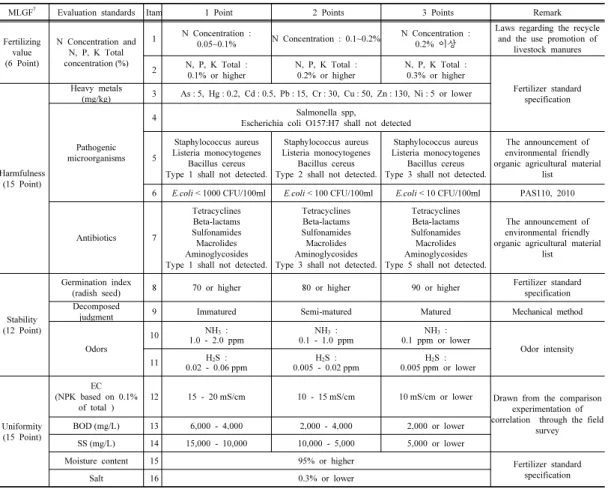
기준을 통하여 Table 5의 가축분뇨액비의 품
질인증을 위한 품질기준을 다음과 같이 도출
하였다. 가축분뇨 액비를 4가지의 목표요소
(①비효성, ②위해성, ③안정성, ④균질성)로
나누었으며, 각 항목에 따라 비효성 (N농도,
Table 5. The scoring rating (Plan) of evaluation standards in each main level-grading factors for liquid fertilizer quality certification (LFQC).
MLGF
†Evaluation standards Itam 1 Point 2 Points 3 Points Remark
Fertilizing value (6 Point)
N Concentration and N, P, K Total concentration (%)
1 N Concentration :
0.05~0.1% N Concentration : 0.1~0.2% N Concentration : 0.2% 이상
Laws regarding the recycle and the use promotion of
livestock manures 2 N, P, K Total :
0.1% or higher
N, P, K Total : 0.2% or higher
N, P, K Total : 0.3% or higher
Fertilizer standard specification
Harmfulness (15 Point)
Heavy metals
(mg/kg) 3 As : 5, Hg : 0.2, Cd : 0.5, Pb : 15, Cr : 30, Cu : 50, Zn : 130, Ni : 5 or lower
Pathogenic microorganisms
4 Salmonella spp,
Escherichia coli O157:H7 shall not detected
5
Staphylococcus aureus Listeria monocytogenes
Bacillus cereus Type 1 shall not detected.
Staphylococcus aureus Listeria monocytogenes
Bacillus cereus Type 2 shall not detected.
Staphylococcus aureus Listeria monocytogenes
Bacillus cereus Type 3 shall not detected.
The announcement of environmental friendly organic agricultural material
list 6 E.coli < 1000 CFU/100ml E.coli < 100 CFU/100ml E.coli < 10 CFU/100ml PAS110, 2010
Antibiotics 7
Tetracyclines Beta-lactams Sulfonamides Macrolides Aminoglycosides Type 1 shall not detected.
Tetracyclines Beta-lactams Sulfonamides Macrolides Aminoglycosides Type 3 shall not detected.
Tetracyclines Beta-lactams Sulfonamides Macrolides Aminoglycosides Type 5 shall not detected.
The announcement of environmental friendly organic agricultural material
list
Stability (12 Point)
Germination index
(radish seed) 8 70 or higher 80 or higher 90 or higher Fertilizer standard
specification Decomposed
judgment 9 Immatured Semi-matured Matured Mechanical method
Odors
10 NH
3:
1.0 - 2.0 ppm
NH
3: 0.1 - 1.0 ppm
NH
3: 0.1 ppm or lower
Odor intensity
11 H
2S :
0.02 - 0.06 ppm
H
2S : 0.005 - 0.02 ppm
H
2S : 0.005 ppm or lower
Uniformity (15 Point)
EC (NPK based on 0.1%
of total )
12 15 - 20 mS/cm 10 - 15 mS/cm 10 mS/cm or lower Drawn from the comparison experimentation of correlation through the field
survey
BOD (mg/L) 13 6,000 - 4,000 2,000 - 4,000 2,000 or lower
SS (mg/L) 14 15,000 - 10,000 10,000 - 5,000 5,000 or lower
Moisture content 15 95% or higher Fertilizer standard
specification
Salt 16 0.3% or lower
†MLGF: Main Level-Grading Factors.
N, P, K의 전량농도), 위해성 (중금속, 병원성 미생물, 항생제), 안정성(부숙도와 악취), 균 질성 (EC, BOD, SS, 수분함량, 염분)의 총16개 의 세부항목을 중심으로 점수를 산정하였다.
합계점수 (48점)에 따라 A (42~48점), B (34~
41점), C등급 (26점~33점)으로 등급화 하였다.
액비의 품질확보를 위해서는 A 등급을 기본 조건으로 상품화 및 친환경 유기농자재 등급 으로 유도토록 품질 기준표를 도출하였다.
결 론
현재 가축분뇨액비의 이용을 살펴보면 크 게 경종농가에서 자체처리 후 자가농지에 환
원하는 형태의 ‘농가형 액비’, 소규모농가에 서 수거하여 공동자원화에서 처리하는 ‘공동 형 액비’, 일부지역에서는 액비의 고품질화처 리를 통하여 판매를 하는 ‘상품형 액비’로 나눌 수 있다. 이에 따라 Table 5의 액비품질 인증기준을 적용하기 위해서는 현장에 맞는 적용이 필요할 것이다.
첫째, 농가형 액비는 가축분뇨 관리의 수
의방역적 측면인 위해성과 관련하여 중금속
농도, 병원성미생물의 검출여부를 최우선적
으로 고려하여야 한다. 또한, 위해요소 점검
후 액비의 질소 함유량에 따른 비효성 검토
와 액비 부숙도에 따른 관리가 필요할 것으
로 사료된다.
둘째, 공동형 액비는 가축분뇨 자원화에 있어 가장 핵심적 관리대상이며, 정부의 방 침 또한 공동자원화센터에 중점을 두고 있 기 때문에 관련 기준이 높아야 한다. 따라서 최소한의 지역 내의 품질균형을 위해 N, P, K 농도와 병원성미생물 (5종)의 불검춤, 부숙 도(종자발아법 혹은 액비부숙도측정기), 민원 관련 (악취), 환경부하 (BOD, EC)에 관련되어 야 한다.
셋째, 상품형 액비는 고품질의 퇴․액비의 생산은 결국 비료상품화로 인한 수익모델로 연결되기 때문에 농가형, 공동형액비의 기준 을 바탕으로 액비의 성분, 제조일자, 생산자, 항생제 제어가 추가적으로 관리되어야 한다.
가축분뇨의 양과 성분은 가축의 종류와 연 령 및 체중, 사료의 종류와 량, 급수량에 따 라 크게 변할 뿐 아니라 같은 축종 내에서도 사육조건 및 가축분뇨처리 이용 방식에 따라 많은 차이가 발생한다. 가축분뇨는 자원화에 있어서 긍정적인 측면에도 불구하고 대부분 의 경종농가가 가축분뇨 퇴․액비의 사용을 기피하는 가장 큰 이유는 품질이 균일하지 못하고, 덜 부숙된 퇴․액비의 유통과 이로 인한 악취문제 때문인 것으로 조사되고 있 다. 따라서 지속가능한 농축산업의 발전을 위해서는 가축분뇨 액비의 품질인증기준 개 발이 시급하며, 국내여건에 적합한 제도의 개선이 필요하다.
사 사
본 연구는 농촌진흥청 공동연구사업 ‘가축 분뇨 액비 품질 인증체계 구축 연구’(과제번 호 : PJ907185)과 ‘2013년도 상지대학교 교내 연구비 지원’ 및 환경부의 ‘지식기반 환경서 비스 (폐자원에너지화) 전문인력양성사업으로 지원되었음을 알려드리며 이에 감사드립니 다.
인 용 문 헌