• 검색 결과가 없습니다.

Grid-Connected Three-Phase Inverter System with Sub Inverter using Combination Type UPFC Structure

N/A
N/A
Protected

Academic year: 2021

Share "Grid-Connected Three-Phase Inverter System with Sub Inverter using Combination Type UPFC Structure"

Copied!
9
0
0

로드 중.... (전체 텍스트 보기)

전체 글

(1)

Grid-Connected Three-Phase Inverter System with Sub Inverter using Combination Type UPFC Structure

Seong-Mi Park

1

, Le Thi Tuan Vi

2

, Da-Woom Jeong

2

, Sung-Jun Park

2

, Jang-Sik Park

3*

<Abstract>

As the renewable energy market grows, grid-connected inverters have been improving and expanding in several fields in recent years because energy conversion devices are the main components of solar systems. In this paper, a high-precision new grid-connected three-phase inverter system is proposed. The proposed system consists of a main inverter, a sub inverter and a transformer. The main inverter operates at a low switching frequency and high power and transmits power to the grid. A sub-inverter connected in series with the transmission line through a matching transformer operates at lower power than the main inverter to provide input values to the transformer. The transformer acts as a power supply according to the voltage compensation value. This study is based on the principle of operation of the UPFC(Unified Power Flow Controller) structure used to regulate power flow in AC transmission lines. The grid-connected inverter system proposed in this paper is implemented with high precision and high resolution. The proposed system was verified through its ability to enhance and ensure the safety of the proposed system through simulation and experiment.

Keywords : Grid-connect Three-phase inverter system, UPFC(Unified Power Flow Controller) structure, High-precision

1 Main Author, Dept. of Lift Engineering, Korea Lift College, Associate Professor 2 Dept. of Electrical Engineering, Chonnam University, Master

2 Dept. of Electrical Engineering, Chonnam University, Ph.d. candidate 2 Dept. of Electrical Engineering, Chonnam University, Ph.d. Professor

3* Corresponding Author, Dept. of Electrical Engineering, Kyungsung University, Professor

(2)

1. Introduction

In recent years, with the growing in the market of Power Electronic Field, the connections of photovoltaic systems on the grid are increasingly industrialized to meet the needs of alternative powers for electrical equipment and to utilize renewable energy sources and carbon-free energy. The usage of grid-connected inverters is being increased at both generation and utilization points.

Grid-connected systems have an important and essential role in the production of distributed energy and improved power supply. On the generation end, they are used to integrate renewable sources of power with the AC grid. On the utility end, they are used in power factor correction, mitigating of harmonics drawn from the grid, and improving the quality of voltage at the load terminals. Therefore, the grid-connected inverters are being researched and developed for new configurations that can be widely applied in many applications [1].

2. The conventional grid-connected three-phase inverter

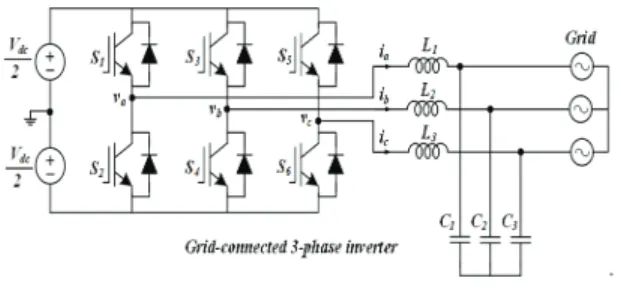
Three-phase inverters having simple configuration are widely used in many fields of applied research, such as renewable energy and public grid-connected systems. It converts DC voltage at the input to AC

voltage at the output. The grid-connected 3- phase inverter topology is shown in Figure 1.

Figure 1 describes structure of the conventional system. SPWM(Sinusoidal pulse width modulation) and space-vector pulse width modulation SVPWM methods are outstanding methods in the field of AC system control. Along with the success in enhancing reliability and operability, control technology has overcome analog control method. The advantages of numerical control are re-configuration ability, customizable energy mode ability, less affected by external factors, and less sensitive to temperature changes [2].

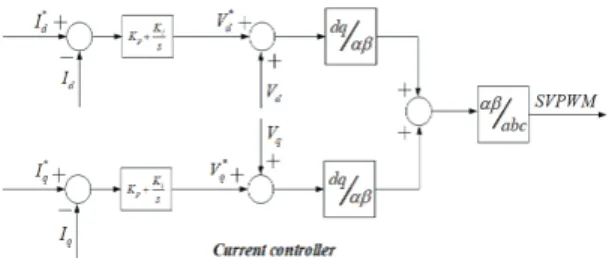
PI(Proportional integral) controller is suitable for applications used to control SISO(single input – single output) objects according to the feedback principle. PI controllers are quite common, easy to execute, and easy to calculate parameter sets.

If integral value is missing, the system may

not achieve the desired value. Taking the

results of transformation methods as the PI

controller input, the controller works to meet

the output reaches the desired value [3]. The

transformation of a balanced three phases

Fig. 1 The conventional sy stem structure

(3)

will certainly be conducted before creating SVPWM. These SVPWM pulses are inputs to the switches shown in Figure 2.

2.1 Introduction to UPFC

Nowadays, with the development of high-power electronics, high voltage, FACTS technology was born in the late 1980s, has made the power flow control process on the transmission lines quickly and flexibly.

America, Canada, Brazil, etc. are pioneering countries to use FACTS technology in transmission grid, commonly used devices such as: SVC, TSC, TCR, TCSC, STATCOM, and UPFC. In particular, UPFC is the device with the most flexible power flow control on the line, it allows control the active power, reactive power flow, voltage, and phase angle. The research of using this device is very essential, especially used on the exchange links between areas.

Unified Power Flow Controller (UPFC) is defined as a power flow control device. This uses compensation technology that controls the serial voltage vector on the transmission line. Therefore, it allows flexible control,

efficient operation, and enhancing the transmission capacity of the electrical system [3,4].

3. The proposed gird-connected three-phase inverter

3.1 The proposed grid-connected inverter

Grid-connected inverter is a system that transforms and supplement energy into the national grid. Conventionally, that system uses renewable energy sources directly, such as solar, wind, fuel cell, to meet the need of saving electricity costs and to reduce the shortage power issue of the national grid.

The diagram of the conventional system is described in Figure 3. The conventional system uses 220V of grid voltage and the frequency of 60Hz.

Fig. 3 The general structure of the conventional system

Fig. 4 The general structure of the proposed system

Fig. 2 Current controller block

(4)

The diagram of the proposed system is described in Figure 4. Differences from block diagram of the conventional system, a new system adds Vc, a dependent source that is responsible for V

L

voltage control, that performs the function as a voltage compensation device [5].

The voltage components in the system have a relationship with each other through the following equations (1)∼(3):

  

 





(1) 

  

 

(2) 

 

(3)

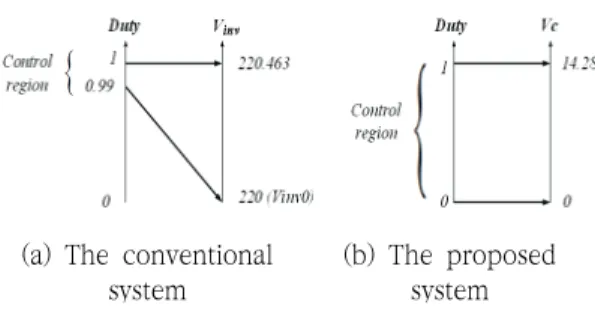
In case the inverter power is 100 kW and the inductor value is 250uH, as shown in Figure 5, the duty value in control region changes from 0.99 to 1. That makes V

inv

change from 220 to 220.463 V. The delta voltage is only 0.463 V, that small voltage makes it difficult to control the inverter. The conventional system controller has a high sensitivity. For the proposed system, the duty value in control region is from 0 to 1, and the VC value changes from 0 to 14.28 V.

The delta voltage is 14.28 V. The range of the control sensitivity of the proposed system is higher more than the conventional system and with a low sensitivity, the proposed system will be controlled. Therefore, the controller of the proposed system is used more easily.

(a) The conventional

system (b) The proposed system Fig. 5 Compare of the control sensitivity

Fig. 6 The proposed grid-connected three-phase inverter system diagram

In practice, the proposed system consists of two voltage-source inverters and a three- phase transformer, as presented in Figure 6.

3.2 The control algorithm

The proposed grid-connected inverter

system consists of three main part: main

inverter, sub inverter, and PI controller. For

connecting to the grid, main inverter’s

current must be zero. Grid voltage and main

inverter voltage are equal in both amplitude

and phase angle. The main inverter operates

by taking the voltage value from the grid

through sensors, and then transferring it to

(5)

the signal gates for modulating PWM pulses.

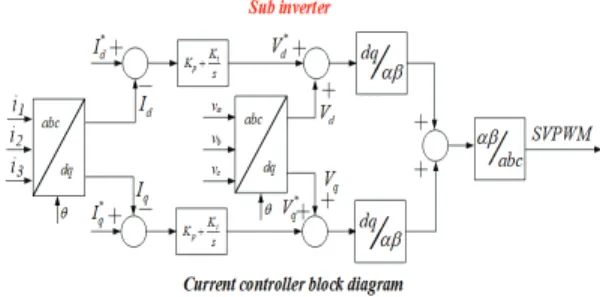
Meanwhile, the sub inverter is a main controller of the system to control grid-connected current [6].

Fig. 7 Main inverter controller block diagram

The main inverter does not play a controlling role and transform dq to modulate PWM, shown in Figure 7. By using PI controller, we can perform current control applications and use dq transformer to modulate PWM. The sub inverter is a compensation device for the whole system, shown in Figure 8. Moreover, the proposed system can meet the real-time requirements, as well as the pre-stabilization effect of noise on the system [7-8].

Fig. 8 Sub inverter controller block diagram

By using PI controller, the proposed system can also meet the real-time requirements, as well as the pre-stabilization effect of noise on the system [9].

4. Simulation and Experimental Rsults

4.1 Simulation results

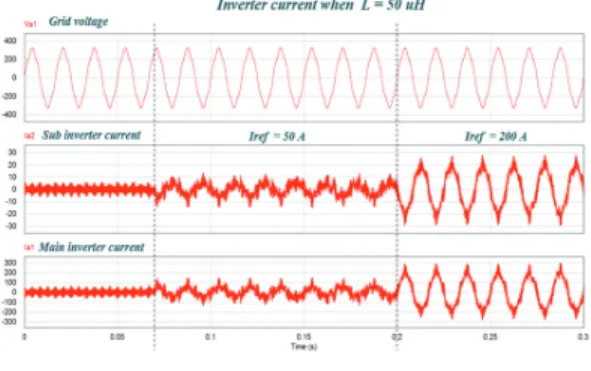
The simulation parameters of the proposed system are selected as listed in Table 1. The simulations were conducted with 3 values of the inductor, 50uH, 250uH and 500uH.

Simulation results include grid voltage, main inverter current, and sub inverter current.

When L = 500uH, the simulation results are expressed as Figure 9. The grid voltage waveform is a standard sin wave and stability. The waveforms of the main inverter and sub inverter current are good responses more than those of conventional system.

Moreover, this simulation results have higher resolution and precision at I

ref

= 50 A and I

ref

= 200A.

Basic Paramers Values

Input Voltage V

dc2

680[V]

Grid voltage V

ac phase

220 sin(wt) +harmonic

Main LC filter C 25[uF]

L 500[uH];250[uH];50[uH]

Transformer ratio 10:1

Switching frequency

Fsw 10[kHz]

Table 1. Simulation parameters of the proposed

system

(6)

As Figure 10 describes with value L = 250uH. The proposed system with grid voltage and inverter currents waveforms still

better works well, quickly response, high precision, high resolution and not inferior to value L = 500uH.

When L = 50uH, although the inductor value is lowest, the waveforms of main inverter current and sub inverter current are still better responses, ensuring for the grid-connected ability. It’s presented clearly through Figure 11.

When compared to the conventional grid-connected inverter system, this proposed system has provided better waveforms, more stable grid connection capability, higher precision, and less interfere with lowest inductor value. The waveform of grid voltage and inverter currents shows that the proposed system has a lower sensitivity to be controlled more easily. It’s also has higher resolution to increase precision for grid- connected issues. In addition, through the simulation results, the choice of the inductor value for the experimental model is completely grounded to make sure about ability and performance operation of the proposed system.

4.2 Experimental results

Basic parameter Values

Grid Voltage V

line-to-line

220[V]

3-phase inductor L 250[uH]

Switching frequency Fsw 4.2[KHz]

Transformer ratio 8:1

Table 2. Experiment parameters of the proposed system

Fig. 9 Simulation result of the proposed system when inductor is 500 uH

Fig. 10 Simulation results of the proposed system when inductor of 250 uH

Fig. 11 Simulation result of the proposed system

when inductor is 50 uH

(7)

The experiment parameters of the proposed listed in Table 2. According to the economic situation, to solve difficulties about the size and weight of the inductor, select the value of L = 250uH to ensure enforcement of the proposed system. The experiment of the proposed system is implemented by using DSP micro controller TMS320F28335 shown in Figure 12.

To increase verification about the operation of the proposed system, this experiment results are presented with the waveforms of grid voltage, grid currents, primary voltage and secondary voltage for the proposed system.

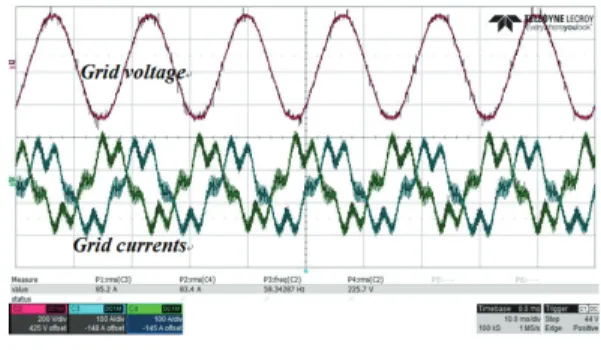
With the experiment results are described as Figure 13 and Figure 14, they show the shape of voltages and grid currents, the same value I

ref

=120A. It’s easy to recognize that the waveforms of grid currents have obvious differences. About the conventional system, grid voltage is sinusoidal, but standard non-sinusoid grid currents, the waveforms of grid currents have a lot of ripple. The grid currents ripple is larger than 50A. Therefore,

the conventional system is still not enough to respond the factors of precision and resolution. Besides, the proposed system with grid currents have smoother waveform, better output response, improve current ripple status.

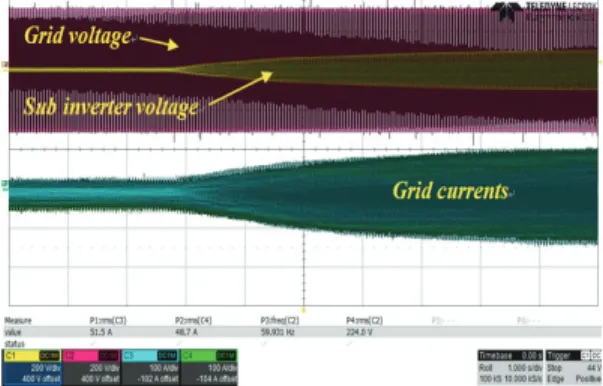
To increase the persuasion of the operational quality, experiment results on the state of voltage and current when I

ref

value increases and decreases are presented as Figure 15 and Figure 16. The grid voltage is still at a stable value to maintain the best grid connectivity. Integrated special features such as precise speed processing and high resolution, the grid currents and sub inverter Fig. 12 Experimental model of the proposed

grid-connected inverter system

Fig. 13 Experiment results of the conventional system with Iref=120A

Fig. 14 Experiment results of the proposed system

with Iref=120A

(8)

voltage control for quick response, stable operation process. When Iref increases from 0 to 120A (soft start operation), sub inverter voltage and grid currents also increased steadily. And vice versa, when Iref decreases from 120A to 0 (stop command), sub inverter voltage and grid currents gradually decrease.

Although the Iref value has changed to verify the responsiveness of the proposed system, grid voltage, sub inverter voltage and grid currents waveforms are still very smooth, for quick response and operate stably.

Fig. 15 Experiment results of the proposed system with soft start operation

Fig. 16 Experiment results of the proposed system with stop command

5. Conclusions

The proposed grid-connected inverter has been clearly presented in the paper and can respond quickly, high precision, high resolution, and efficiently. It has many applications as converter in many fields of application including renewable energies and is an effective application for grid-connected.

It solves the problem of voltage compensation effectively. Moreover, with application of UPFC, the proposed system prevents the system oscillation and the impact on power grid, and it provides the independent ability to control reactive power flow. So it has great practical significance.

References

[1] LE THI TUAN VI, “High Precision Grid- connected Inverter System Using UPFC Structure,” Master Thesis, Chonnam National University, August 2019.

[2] D. Hadiouche, L. Baghli, and A. Rezzoug,

“Space vector PWM techniques for dual three- phase AC machine: Analysis, performance evaluation, and DSP implementation,” IEEE Trans. Ind. Appl., vol. 42, no. 4, pp. 1112- 1122, Jul./Aug. 2006.

[3] J. Dannehl, F. W. Fuchs, and P. B. Thogersen,

“PI State Space Current Control of Grid- Connected PWM Converters with LCL Filters,”

IEEE Trans. Power Electron, vol. 25, no. 9, pp. 2320-2330, Sept. 2010.

[4] K. Gaurav and N. Saxena, “Power Quality

improvement using UPFC,” International Journal

(9)

of Electrical, Electronics and Computer Engineering, Vol.2, No.2, pp. 30- 33, 2013.

[5] E. Isen, and A. F. Bakan, “High efficient three-phase grid-connected parallel inverter system,” Joural of Modern Power Systems and Clean Energy, vol. 6, pp. 1079-1089, September 2018.

[6] Fang Zhuo, Yue-Wang, Zhaoan-Wang, “The configuration of main circuit and control strategy for active power filter in three-phase fourwire system,” IEEE 32 Annual Power Electronics Specialists Conference, PESC., vol.

3, pp. 1615-1618, June 2001.

[7] L. Chen, A. Amirahmadi, Q. Zhang; N.

Kutkut, and I. Batarseh, “Design and

Implementation of Three-Phase Two-Stage Grid-Connected Module Integrated Converter,”

Power Electronics, IEEE Transactions on, vol.

29, no. 8, pp.3881-3892, Aug. 2014.

[8] B. Meersman, B. Renders, L. Degroote, and L.

Vandevelde, “Overview of three-phase inverter topologies for distributed generation purposes”, i-SUP2010, April 18-21, 2010.

[9] Y. Shuitao, L. Yang, W. Xiaorui, G. Deepak, K. Uj j wal, and Z. P. Fang, “Modulation and Control of Transformerless UPFC,” IEEE Transaction on Power Electronics, Vol. 31, pp.

1050-1063, March 2015.

(Manuscript received July 2, 2020;

revised July 13, 2020; accepted July 22, 2020)

수치

Figure  1  describes  structure  of  the  conventional  system.  SPWM(Sinusoidal  pulse  width  modulation)  and  space-vector  pulse  width  modulation  SVPWM  methods  are  outstanding  methods  in  the  field  of  AC  system  control
Fig. 3 The general structure of the conventional system
Fig.  6  The  proposed  grid-connected  three-phase  inverter  system  diagram
Fig.  7  Main  inverter  controller  block  diagram
+4

참조

관련 문서