가이디드 이미지 필터를 이용한 다중 스케일 분할 톤 매핑 기법
Ming Gao
a), 정 제 창
a)‡Multi-scale Decomposition tone mapping using Guided Image Filter
Ming Gao
a)and Jechang Jeong
a)‡요 약
본 논문에서는 가이디드 이미지 필터를 이용한 다중 스케일 넓은 동적 영역 톤 매핑 알고리듬을 제안한다. 가이디드 이미지 필터는 이미지를 베이스 레이어와 디테일 레이어로 나누기 위해 사용된다. 이때 디테일 레이어의 동적 영역을 줄이기 위해 압축 함수가 사용 된다. 하지만 대부분의 경우의 이미지는 다양한 스케일의 디테일과 에지 정보를 포함하고있다. 즉, 특정 스케일로 디테일 특성을 표현 하는 것은 불가능하며 단일 스케일 이미지 분할 방법은 에지 주변에서 열화 현상을 야기시킨다. 이러한 문제를 해결하기 위해 다중 스 케일 이미지 분할 방법을 제안한다. 다중 스케일의 디테일 레이어들을 이용하여 에지 보존 정도를 조절한다. 실험 결과를 통해 제안하 는 알고리듬이 기존의 알고리듬 보다 에지 보존의 정도가 더 우수함을 보인다.
Abstract
In this paper, we propose a multi-scale high dynamic range (HDR) tone mapping algorithm using guided image filter (GIF). The GIF is used to divide an image into a base layer and a detail layer, then the range of the detail layer is reduced with a compression function to enhance the detail information of the image. However, in most cases, an image includes the detail and edge information in different scales. That is to say, it is difficult to represent all detail features under a certain scale, and a single-scale image decomposition method is not free from artifacts around edges. To solve the problems, the multi-scale image decomposition method is proposed. It utilizes the detail layers of several scale to determine how much edge is preserved.
Experiment results show that the proposed algorithm has better image performance in preserving edge compared to conventional algorithm.
Keywords : high dynamic range, tone mapping, guided image filter, multi-scale decomposition
Copyright Ⓒ 2016 Korean Institute of Broadcast and Media Engineers. All rights reserved.
“This is an Open-Access article distributed under the terms of the Creative Commons BY-NC-ND (http://creativecommons.org/licenses/by-nc-nd/3.0) which permits unrestricted non-commercial use, distribution, and reproduction in any medium, provided the original work is properly cited and not altered.”
a)한양대학교 전자컴퓨터통신공학과(Department of Electronic Computer Engineering, Hanyang University)
‡Corresponding Author : 정제창(Jechang Jeong) E-mail: [email protected] Tel: +82-2-2220-4370
ORCID:https://orcid.org/0000-0002-3759-3116
※이 논문의 연구 결과중 일부는 “IPIU 2018”에서 발표한 바 있음.
※이 연구는 미래창조과학부 및 정보통신기술진흥센터의 정보통신·방송 연구개발사업의 일환으로 수행하였음.[2014-0-00670, ICT 장비용 SW 플랫폼 구축]
※This work was supported by the ICT R&D program of MSIP/IITP [2014-0-00670, Software Platform for ICT Equipment].
・ Manuscript received May 3, 2018; Revised June 19, 2018; Accepted June 28, 2018.
특집논문 (Special Paper)
방송공학회논문지 제23권 제4호, 2018년 7월 (JBE Vol. 23, No. 4, July 2018) https://doi.org/10.5909/JBE.2018.23.4.474
ISSN 2287-9137 (Online) ISSN 1226-7953 (Print)
I. Introduction
Dynamic range is the ratio between the brightest lumi- nance value and the darkest luminance value [1]. HDR images are featured in well-structured objectives and rich visual information. Since the general display devices are not sufficient for displaying scenes with HDR, represent- ing HDR by low dynamic range (LDR) display needs a dynamic range transform process. This process is called tone mapping [2]. The goal of an HDR tone mapping al- gorithm is to compress the dynamic range of HDR image into the range acceptable for traditional display while preserving the details as much as possible without artifacts.
A layer decomposition method is the one of the tone mapping techniques and it has an advantage to control the detail preserving strength [3]. To decompose an image into the layer, edge-preserving image filters has developed into a valuable tool for a variety of applications in HDR tone mapping, such as bilateral filter (BLF) [4] and GIF [5] are proposed. The decomposition method based on BF is sim- ple and it processes a pixel by averaging its neighbors and Gaussian weighting by spatial and intensity/color distances.
Though BF is successful in removing small fluctuations while preserving edges, it may suffer from unexpected gra- dient reversal artifacts after tone mapping. Other pioneer attempts, with the anisotropic diffusion (AD) [6] and weighted least squares (WLS) [7] filters as representatives, utilize the gradients of the filtering image for the sake of structure-texture separation. The dominant assumption of these works is that gradients with large magnitudes should be preserved as they are of high probabilities to be on edges/boundaries and vice versa [8].
Besides the filtering input, one may also consider anoth- er image to act as the guidance. The principle behind is transferring the structure in the reference image to the tar- get one [9]. Then an approach called GIF was proposed which is a locally linear transform of the guidance image.
GIF has shown its promising performance in a number of applications, such as image smoothing, image enhancement and HDR compression [10]. The layer decomposition method using GIF can reduce the artifacts and the main idea of GIF is using a linear transform to represent the pix- el values in a window. An HDR enhancement algorithm based on GIF is proposed [11].
It is extremely important to have control over the spatial scale of the details captured by the detail layer in many of these applications [12]. In addition, it is usually neces- sary to operate on details at a variety of scales rather a sin- gle scale [13]. For example, in the post-processing of pho- tography, in order to add depth and increase detail clarity, a photographer might want to separately manipulate the tone at several different scales, and the final result might combine together several such manipulations [14]. Because of this, a multi-scale decomposition method is proposed [15]. It decomposes an input image into several scale detail layers to use enough detail information. In this paper, mul- ti-scale decomposition tone mapping method using GIF is proposed.
The organization of this paper is as follow. In Section II, the overview of GIF, the conventional GIF tone map- ping algorithm and Multi-scale image decomposition are described. Our proposed algorithm additional specific proc- ess is proposed in Section III. Section IV includes experi- ment results with analysis. Finally, we conclude the pro- posed algorithm in Section V.
II. Related work
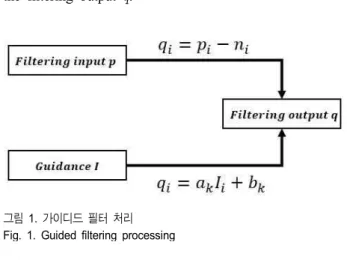
1. Guided Image FilterFig. 1 represents a linear translation-variant filtering process, which involves a guidance , a filtering input , and an output image . The key assumption of the guided filter is a local linear model between the guidance and
the filtering output .
그림 1. 가이디드 필터 처리 Fig. 1. Guided filtering processing
∀∈ (1)
where represents a linear transform of and the nota- tions of and are constants in window respectively.
The and can be obtained by minimizing a cost func- tion defined as:
∑∈
(2)
where is a regularization parameter penalizing large . The optimal values of and are computed as:
∑∈
(3)
(4)
where and are the mean and variance of , is the number of pixels, and is the mean of in
respectively. After and obtained, the filtering output can be got by (1).
In addition, each pixel is described by multiple linear functions as one pixel is included in multiple windows when calculating the coefficient for each window.
Therefore, the output value of a certain point needs to aver- age all the linear function values that contain the point as follow:
∈
(5)
Because the box window is symmetrical, ∑∈
∑∈
. (1) can be rewritten by
(6)
There,and are the mean values of and in the window, respectively computed as:
∑∈
(7)
∑∈
(8)
2. HDR Tone Mapping using GIF
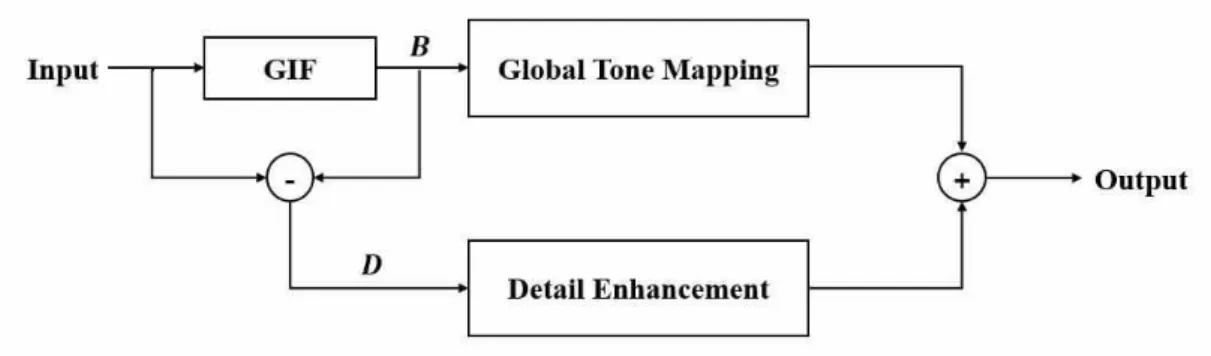
GIF is an edge-preserving filter that performing better than BLF or some the other edge-preserving filters. So it is often used for HDR tone mapping. Layer decom- position method of GIF is to divide the luminance image into a base layer and a detail layer by using GIF. The base layer performs global tone mapping while the de- tail layer performs an enhancement function. Finally, the two adjusted layers are combined to generate a restored HDR image.
Fig. 2 shows the flow chart of tone mapping algorithm which uses GIF for single scale decomposition [4]. An in- put luminance image is decomposed into base layer and de- tail layer. The detail enhancement and the gray scale con- trast adjustment are used at the same time one the two layers.
To multiply the detail layer by a suitable constant to enhance the detail while using the global mapping by gamma func
tion for base layer. Finally, a transferring coefficient is used to combine the adjusted layers back together to generate anew HDR image. This algorithm has the advantage of bet- ter color contrast and better color saturation.
However, because details and edge information are on different scales, if the image is decomposed only once, the base layer not only contains low frequency band, but also contains high frequency band. Therefore, the full details of the image features cannot be reflected [16]. The base layer still has residual high-frequency band. The conventional GIF tone mapping algorithm is limited to a single scale of the image. In order to solve the problems, the multi-scale image decomposition method is proposed. The main idea is to decompose the image into several detail layers for get- ting multi-scale detail information. Using multi-scale de- composition, several detail layers are obtained while the high-frequency parts of the base layer are separated effec- tively [17].
3. Multi-scale Image Decomposition
Image multi-scale decomposition can decompose the im- age into a basic layer and multiple detail layers. Let denote the input image that is decomposed at level, the
level of detail layers can be expressed as:
(9)
Following the idea, an image can be decomposed into a base layer and several detail layers. As a result, a mul- ti-scale decomposition is applied. The reconstructed origi- nal u can be expressed as:
(10)
Commonly used to solve in two ways: one is the im- age multiple filtering, filtering the same image at different filtering scales. the other is the image iterative filtering, en- larging the filtering scale layer by layer. Both methods can get a series of gradually coarsening images. The ex- perimental results show that the second method has the ef- fect of sub-smoothing out of the strong edge of the image and the effect of the cartoon appears [18].
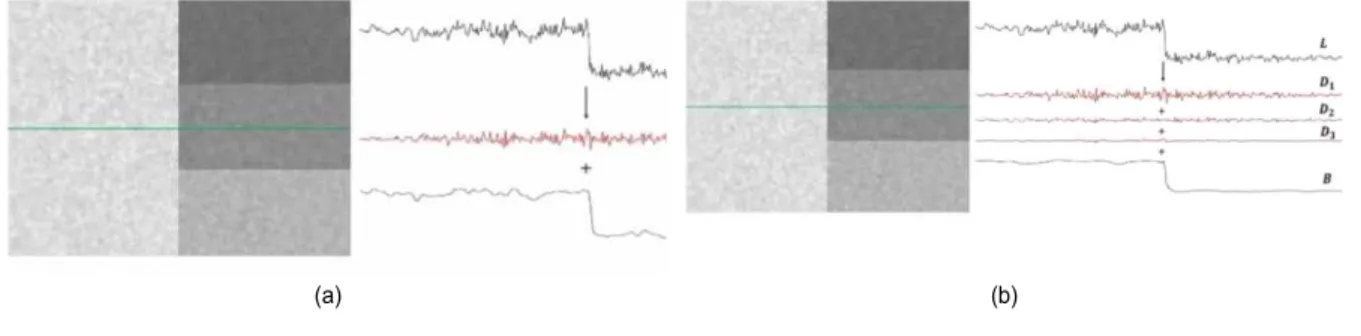
In this paper, we used the first method which can retain the edge much better. A comparison between single-scale decomposition (a) and multi-scale decomposition (b) is shown in Fig. 3. As we can see, using multi-scale decom- position, a smoother base layer and more details layers are obtained. This will make the final result have a better per- formance in the details.
그림 2. 가이디드 필터 사용한 톤매핑 Fig. 2. HDR tone mapping using GIF
III. Proposed algorithm
In this paper, we propose a multi-scale decomposition tone mapping method based on GIF which is shown as Fig. 4.
Firstly, the input HDR image has to be transformed into a luminance image ranging in [0, 1]. Then the luminance image is transformed into its logarithm domain as same as the typical operation of most methods. To sufficiently use the domain of the logarithm function, we arbitrarily magnify the luminance times. It is calculated as fol- lows:
∙ (11)
where represents the natural logarithm. Finally, the luminance image is found by scaling L into range [0, 1]
′ max (12)
where max(L) represent the maximum value of L. The lu- minance image is filtered twice using the GIF, resulting in two base layers which is and . In order to get the rough level of different base layer, here the two GIF pa- rameter settings are also different. The size of window are both × , while , . Then a series of progressively smoother images of with different filtering is defined by:
for and (13)
where represent smoother versions of . In these versions, the coarsest one will serve as the base image. A series of detail layers are given by:
그림 4. 제안 된 알고리즘의 순서도
Fig. 4. The flowchart of the proposed algorithm
(a) (b)
그림 3. (a) 단일 스케일 분해. (b) 다중 스케일 분해.
Figure 3. (a) Single-Scale Decomposition. (b) Multi-Scale Decomposition
f or (14)
In this paper, GIF is used twice for decomposition, so finally obtained two detail layers as follow:
(15)
Actually, detail images are oscillation signals around 0.
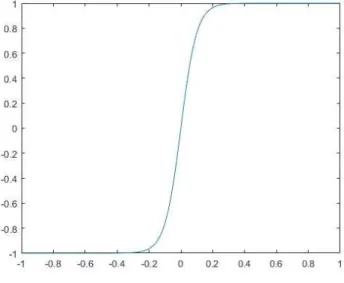
Then detail images of large scale produce large oscillations around 0, and the small ones produce small oscillations. In order to maintain the smoothness of the detail layers for bet- ter presented, the compression function is utilized for detail layers which is employed to compress the values far away from 0, and increase the ones near 0. To avoid gradient re- versal, one convex sigmoid function is used as follow:
(16)
Its shape is shown in Fig. 5. By using this function that values far away from 0 will be decreased and the ones near 0 will be increased. The detail information near 0 will be magnified to reproduce in LDR image, on the contrary the
그림 5. 압축 한수
Fig. 5. Compression function
unimportant ones far away from 0 will be compressed. This function can efficiently eliminate the noise and make the detail images smooth. Thereis the control of the details of the parameters. Through experiments, we found that when
, the results are better. For most cases, Sigmoid func- tions work well. However, those whose slopes are too steep near zero, may cause artifact enhancement.
After the detail layer is compressed, two enhanced detail layers are obtained. We use the layer as the last base layer. The result image is composed as:
′′ (17)
where ′′ denote the detail layers after compre- ssion. Considering noise and increasing the major pix- els’ contrasts 1% of pixels are cut at low and high values. And then, the range of Lout is linearly stretch- ed to [0, 1].
Lastly, to restore the color information proportional to its original ratio. All the process above is done on the lumi- nance channel of an HDR radiance map, which is simply an average of the three color channels in this study [19].
The equation we use is the same as:
∙ (18)where represents the three color channels, and , denote the luminance before and after HDR compression, respectively. function transforms the rela- tionship of colors at level to level . The exponent
performs like a gamma correction for colors to be suit- able for display. We find the exponent s values between 0.5 and 0.9 good for controlling color saturation of the re- sult image. The larger the value of s is, the more saturated the result is. We set in this study, since it gives good re- sults for most images.
IV. Experiment Results
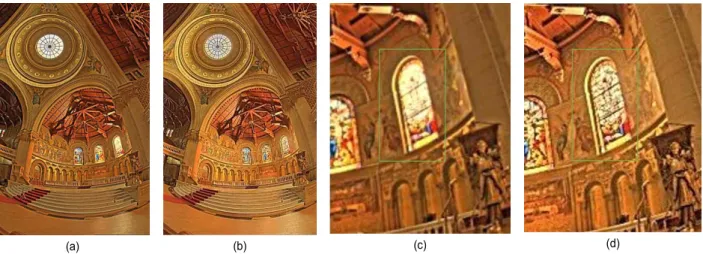
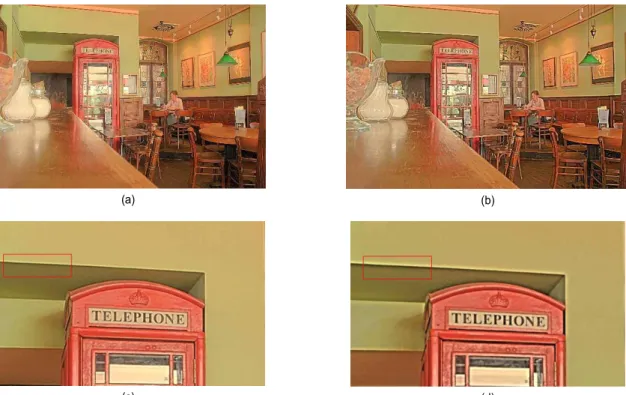
We used the windows10 64-bit operating system, intel core i7-4770K in MATLAB2017a for this experiment. In order to evaluate the algorithm proposed in this paper, we subjectively compared 30 tone mapped images using con- ventional algorithm and proposed algorithm. The result is shown in Fig. 6-9. Comparing the pictures (c) and (d) in Fig. 6 and Fig. 7, it is clear that the HDR image using the proposed algorithm shows more details and also has a better effect than which using the conventional algorithm.
However, in some case such as Fig. 8 and Fig. 9, proposed algorithm will generate halo artifact at the edge part of the image.
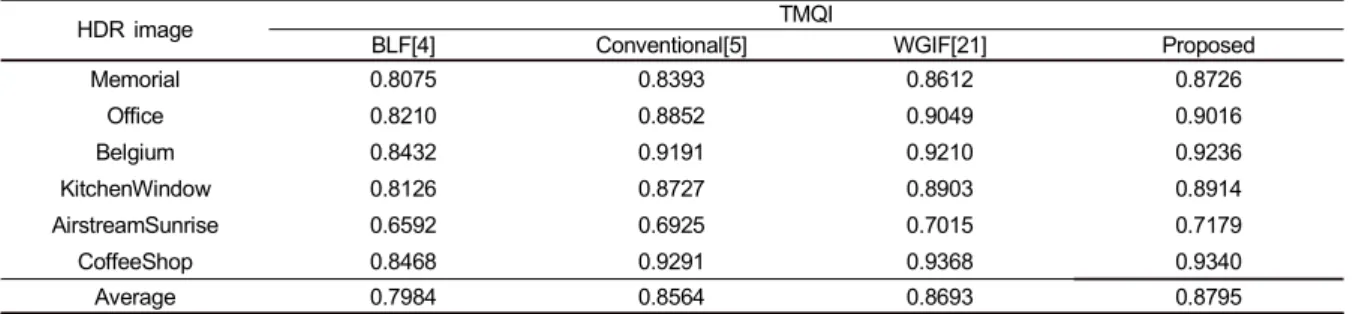
At present, there is no formal objective comparison method for tone mapping image. In this paper, a common objective comparison method for tone mapping proposed in [20] is used which is named tone mapped image quality index (TMQI). TMQI is reasonably correlated with sub- jective assessment of image quality. It is an objective mod- el to evaluate the quality of tone mapped images by com- bining a multi-scale structural fidelity measure and a stat- istical naturalness measure. The proposed measure not only provides the overall quality score of the image, but also creates a multi-scale quality map to reflect the structural fidelity variations across scale and space. In this paper, we select a number of tone mapped images to calculate their TMQI by using four TMOs. As can be seen from Table 1,
(a) (b) (c) (d)
그림 6. HDR 이미지 "Memorial"의 톤 매핑 결과 비교. (a) GIF에 의한 결과 이미지. (b) 제안 된 알고리즘에 의한 결과 영상. (c) (a)의 확장. (d) (b)의 확장.
Fig. 6. Comparison of tone mapping results of HDR image “Memorial”. (a) Result image by the GIF. (b) Result image by the proposed algorithm.
(c) Expansion of (a). (d) Expansion of (b).
(a) (b) (c) (d)
그림 7. HDR 이미지 "KitchenWindow"의 톤 매핑 결과 비교. (a) GIF에 의한 결과 이미지. (b) 제안 된 알고리즘에 의한 결과 영상. (c) (a)의 확장. (d) (b)의 확장.
Fig. 7. Comparison of tone mapping results of HDR image “KitchenWindow”. (a) Result image by the GIF. (b) Result image by the proposed algorithm. (c) Expansion of (a). (d) Expansion of (b).
the vast majority of TMQIs by the proposed algorithm are larger than the others, which objectively proves that the
tone mapped images using the proposed algorithm have better quality.
(a) (b) (c) (d)
그림 9. HDR 이미지 "Snowman"의 톤 매핑 결과 비교. (a) GIF에 의한 결과 이미지. (b) 제안 된 알고리즘에 의한 결과 영상. (c) (a)의 확장. (d) (b)의 확장.
Fig. 9. Comparison of tone mapping results of HDR image “Snowman”. (a) Result image by the GIF. (b) Result image by the proposed algorithm.
(c) Expansion of (a). (d) Expansion of (b).
(a) (b)
(c) (d)
그림 8. HDR 이미지 "CoffeeShop"의 톤 매핑 결과 비교. (a) GIF에 의한 결과 이미지. (b) 제안 된 알고리즘에 의한 결과 영상. (c) (a)의 확장. (d) (b)의 확장.
Fig. 8. Comparison of tone mapping results of HDR image “CoffeeShop”. (a) Result image by the GIF. (b) Result image by the proposed algorithm.
(c) Expansion of (a). (d) Expansion of (b).
V. Conclusion
In this paper, in order to show the better details of HDR images, we propose a multi-scale decomposition tone map- ping method based on the conventional GIF tone mapping.
Comparing to the conventional GIF tone mapping, it de- composes an input luminance image into several detail lay- ers with different coarse degree scale to use more detail information. Through experiments, the results prove that using the multi-scale decomposition processing can make HDR images show more details, with better performance results than GIF tone mapping even WGIF tone mapping [21]. However, this algorithm has some shortcomings, the obvious halo artifact will happen at the edge part of the image in some cases.
참 고 문 헌 (References)
[1] T. Mitsunaga and S. K. Nayar, “High dynamic range imaging: Spatially varying pixel exposures,” Proc. IEEE Comput. Soc. Conf. Computer Vision and Pattern Recognition, vol. 1, pp. 472–479, Jun. 2000.
[2] D.J.Jobson, Z.Rahman, and G.A.Woodell, “A multi-scale retinex for bridging the gap between color images and the human observation of scenes,” IEEE Trans. on Image Processing: Special Issue on Color Processing, vol. 6, no. 7, pp. 965–976, Jul. 1997.
[3] C. Tomasi and R. Manduchi, “Bilateral Filtering for Gray and Color Images,” Proc. Sixth Int’l Conf., Computer Vision, pp. 839–846, Jan.
1998.
[4] F. Durand and J. Dorsey, “Fast Bilateral Filtering for The Display of High Dynamic-range Images,” ACM Trans. Graph., vol. 21, no. 3, pp.
257–266, Aug. 2002.
[5] K. He, J. Sun, and X. Tang, “Guided Image Filtering,” IEEE Trans.
Pattern Anal. Mach. Learn., vol. 35, no. 6, pp. 1397–1409, Jun. 2013.
[6] Black, M., Sapiro, G., Marimont, D., and Heeger, D., “Robust aniso- tropic diffusion.” IEEE Trans. Image Processing, pp. 421–432, Mar.
1998.
[7] Z. Farbman, R. Fattal, D. Lischinshi, and R. Szelishi, “Edge-preserving Decompositions for Multi-Scale Tone and Detail Manipulation,” ACM Trans. Grap., vol. 27, no. 3, pp. 249–256, Aug. 2008.
[8] M. Ashikhmin, “A Tone Mapping Algorithm for High Contrast Images,” Proc. 13th Eurographics Workshop Rendering, pp. 145– 156, 2002.
[9] S. Bae, S. Paris, and F. Durand, “Two-Scale Tone Management for Photographic Look,” Proc. ACM Siggraph, 2006.
[10] L. Zhang, X. L. Wu, “An edge-guided image interpolation algorithm via directional filtering and data fusion,” IEEE Trans. Image Processing, vol. 15, no. 8, Aug. 2002.
[11] N. Liu, Y. Zhang, J. Xie, J. Yu, H. Xiao, and T. Min, “A Novel High Dynamic Range Image Enhancement Algorithm Based on Guided Image Filter,” Optik, vol. 126, no. 23, pp. 4581–4585, Aug. 2015.
[12] R. Fattal, D. Lischinshi, and M. Werman, “Gradient Domain High Dynamic Range Compression,” Proc. ACM Siggraph, 2002.
[13] S. Li, X. Kang, and J. Hu, “Image fusion with guided filtering,” IEEE Trans. Image Processing, vol. 22, no. 7, pp. 2864–2875, Jul. 2013.
[14] J. M. Dicarlo and B. A. Wandell, “Rendering high dynamic range im- ages,” Proc. SPIE, vol. 3965, pp. 392–401, May 2000.
[15] R. Fattal, M. Agrawala, and S. Rusinkiewicz, “Multiscale Shape and Detail Enhancement from Multi-Light Image Collections,” Proc. ACM Siggraph, 2007.
[16] F. Banterle, P. Ledda, K. Debattista, and A. Chalmers, “Inverse Tone Mapping,” Proc. Int’l Conf. Computer Graphics and Interactive Techniques (GRAPHITE), pp. 349-356, 2006.
[17] K. Ma and Z. Wang, “Multi-exposure image fusion: A patch-wise ap- proach,” Proc. IEEE Int. Conf. Image Process., pp. 1717–1721, Sep.
2015.
[18] Z. G. Li, J. H. Zheng, and S. Rahardja, “Detail-enhanced exposure fu- sion,” IEEE Trans. Image Process., vol. 21, no. 11, pp. 4672–4676, Nov. 2012.
[19] K. Subr, C. Soler, and F. Durand, “Edge-preserving multiscale image decomposition based on local extrema,” ACM Trans. Graph., vol. 28, no. 5, pp. 147–155, Dec. 2009.
HDR image TMQI
BLF[4] Conventional[5] WGIF[21] Proposed
Memorial 0.8075 0.8393 0.8612 0.8726
Office 0.8210 0.8852 0.9049 0.9016
Belgium 0.8432 0.9191 0.9210 0.9236
KitchenWindow 0.8126 0.8727 0.8903 0.8914
AirstreamSunrise 0.6592 0.6925 0.7015 0.7179
CoffeeShop 0.8468 0.9291 0.9368 0.9340
Average 0.7984 0.8564 0.8693 0.8795
표 1. TMQI의 객관적인 평가
Table 1. The objective evaluation by TMQI
[20] Hojatollah Yeganeh, and Zhou Wang, “Objective Quality Assessment of Tone-Mapped Images,” IEEE Trans. Image Process., vol. 22, no. 2, Feb. 2013.
[21] Z. Li, J. Zheng, Z. Zhu, W. Yao, and S. Wu, “Weighted guided image filtering,” IEEE Trans. Image Process., vol. 24, no. 1, pp. 120-129, Jan. 2015.
저 자 소 개
Ming Gao
- 2011년 9월 ~ 2015년 9월 : Xidian university 통신공학과 석사 - 2017년 3월 ~ 현재 : 한양대학교 전자컴퓨터통신공학과 석사 - ORCID : https://orcid.org/0000-0001-6854-8409 - 주관심분야 : 영상압축, 영상처리, HDR
정 제 창
- 1980년 02월 : 서울대학교 전자공학과 학사 - 1982년 02월 : KAIST 전기전자공학과 석사 - 1990년 : 미국 미시간대학 전기공학과 박사
- 1980년 ~ 1986년 : KBS 기술연구소 연구원 (디지털 및 뉴미디어) - 1990년 ~ 1991년 : 미국 미시간대학 전기공학과 연구교수 (영상 및 신호처리) - 1991년 ~ 1995년 : 삼성전자 멀티미디어 연구소 (MPEG, HDTV, 멀티미디어) - 1995년 ~ 현재 : 한양대학교 전자컴퓨터통신공학과 교수 (영상통신 및 신호처리) - ORCID : http://orcid.org/0000-0002-3759-3116
- 주관심분야 : 영상압축, 영상처리