• 검색 결과가 없습니다.

Effects of Various Light Spectra on Physiological Stress and DNA Damage by Thermal Stress in Juvenile Rock Bream (Oplegnathus fasciatus)

N/A
N/A
Protected

Academic year: 2021

Share "Effects of Various Light Spectra on Physiological Stress and DNA Damage by Thermal Stress in Juvenile Rock Bream (Oplegnathus fasciatus)"

Copied!
8
0
0

로드 중.... (전체 텍스트 보기)

전체 글

(1)

Article

http://dx.doi.org/10.4217/OPR.2017.39.2.107

Effects of Various Light Spectra on Physiological Stress and DNA Damage by Thermal Stress in Juvenile Rock Bream (Oplegnathus fasciatus)

Jong Ryeol Choe

1

, Yoon Sub Shin

1

, Ji Yong Choi

1

, Tae Hwan Kim

1

, Daehee Kim

2

, and Cheol Young Choi

1*

1

Division of Marine BioScience, Korea Maritime and Ocean University Busan 49112, Korea

2

Inland Fisheries Research Institute, National Insitute of Fisheries Science Gapyeong 12453, Korea

Abstract : In this study, we investigated the effects of light spectra on physiology stress and DNA damage in juvenile rock bream (Oplegnathus fasciatus) using light-emitting diodes (LEDs; green, 520 nm; red, 630 nm) at two intensities (0.25 and 0.5 W/m

2

) with application of thermal stress (25 and 30

o

C). We mea- sured the mRNA expression of heat shock protein 70 (HSP70) and the levels of plasma cortisol, glucose, aspartate aminotransferase (AspAT), and alanine aminotransferase (AlaAT). Additionally, DNA damage was measured using comet assays. Our findings showed that HSP70 mRNA expression and plasma cor- tisol, glucose, AspAT, and AlaAT levels were significantly higher after exposure to high temperatures and were significantly lower after exposure to green LED light. Thus, although high water temperatures induced stress in juvenile rock bream, green LED light inhibited stress. In particular, green LED light reduced stress and DNA damage to a greater degree than other light sources.

Key words : water temperature, light emitting diodes, juvenile rock bream, thermal stress, comet assay

1. Introduction

Factors inducing stress in fish include water temperature, salinity, and breeding density (Beckmann et al. 1990). In particular, changes in water temperature not only cause oxidative stress in the fish body but also have negative effects on physiological phenomena, such as antioxidant control ability, immunity, and sexual maturity (Machado et al. 2014; Jung et al. 2016).

When fish are exposed to rapid changes in water temperature, heat shock proteins (HSPs) are produced in large quantities. These HSPs act as chaperone proteins that repair proteins damaged by external environmental stressors and play a role in maintaining the normal functions of the cells (Welch 1991; Donaldson et al. 2008). In particular, HSP70 is highly expressed in various tissues and is known to play an important role in cellular

metabolism (Nakano and Iwama 2002).

In addition, cortisol is produced in the fish body to maintain homeostasis when the fish are exposed to environmental stress, such as rapid changes in water temperature (Bonga 1997). Cortisol is a well-known indicator of the stress response and directly affects cells through binding to the glucocorticoid receptor in the cell membrane following secretion into the blood, thereby controlling various physiological responses (Beato and Sánchez-Pacheco 1996). Cortisol is secreted through activation of the hypothalamus-pituitary-inter-renal gland axis (HPI axis); the first reaction in this process is the release of corticotropin-releasing hormone from the hypothalamus (Bonga 1997), followed by secretion of adrenocorticotropic hormone from the anterior pituitary gland, inducing cortisol synthesis in the inter-renal cells of the head kidney (Bonga 1997; Flik et al. 2006). Cortisol has been reported to directly increase the plasma concentrations of glucose, which is used as an energy

*Corresponding author. E-mail : [email protected]

(2)

source in cell metabolism, by promoting cortisol-mediated gluconeogenesis in the body in response to cell damage caused by stress (Begg and Pankhurst 2004; Small 2004).

In addition, stress caused by the external environment may cause liver damage (Cheng et al. 2005; Choi et al.

2015). Aspartate aminotransferase (AspAT) and alanine aminotransferase (AlaAT) are well known indicators of liver damage (Nemcsók and Benedeczky 1990).

The physiological stress responses of fish are mainly controlled by the endocrine system. In particular, light is an environmental factor that greatly influences the endocrine system (Pierce et al. 2008; Jin et al. 2009).

Recently, various physiological effects of different wavelengths of light from light-emitting diodes (LEDs) on fish have been studied (Villamizar et al. 2009; Choi et al. 2012; Song et al. 2016). LED in this study is a light source that can emit light with a specific wavelength, and is attracting attention as an eco-friendly light source with low energy consumption (Shin et al. 2011). Many previous studies have shown that specific LED wavelengths play a role in regulating/maintaining physiological responses such as homeostasis, immune, maturation, and growth in the body (Karakatsouli et al. 2008; Kim et al. 2016).

LEDs have been shown to be effective for influencing fish culture (Villamizar et al. 2009; Choi et al. 2015).

Rock bream was important to aquaculture industry as a major aquaculture species on the East Asian coast included Korea and Japan. In addition, acute changes in water temperature frequently occur due to current abnormal climate. It was confirmed to be a suitable fish species to investigate the effect of environmental changes, which is sensitive to environmental changes (Zhang et al. 2013).

Accordingly, in the present study, we investigated the effects of specific wavelengths of light on regulation of environmental stress (high temperature) by analyzing

changes in HSP70 mRNA in juvenile rock bream (Oplegnathus fasciatus). In addition, we measured cortisol and glucose levels to determine fluctuations in stress under different conditions and measured the concentrations of AspAT and AlaAT to determine the effects of stress on the liver. Finally, we analyzed nuclear DNA damage in juvenile rock bream liver cells in response to stress.

2. Materials and Methods

Experimental fish and environmental conditions For each experiment, juvenile rock bream (n = 150;

length, 10.6 ± 1.1 cm; mass, 8.7 ± 0.7 g) were purchased from a commercial aquarium (Jeju, Korea) and were allowed to acclimate in ten 100-L circulation filter tanks in the laboratory. Each tank (each experimental group) contained 15 fish. The fish in the control group were exposed to a white fluorescent bulb. For the experimental groups, the fish were exposed to either green (520 nm) or red (630 nm) LEDs (Daesin LED Co., Kyunggi, Korea), maintained at an intensity of approximately 0.25 or 0.5 W/m

2

in both cases (Fig. 1). The LEDs were placed 50 cm above the water surface and the depth of the middle layer water was 50 cm. The irradiance level at the middle layer of tanks with external light interception was maintained at approximately 0.3 or 0.6 W/m

2

using spectrometer (MR-16; Rainbow Light Technology Co.

Ltd., Taoyuan, Taiwan) and PHOTO-RADIOMETER (HD 2102.1; Delta OMH CO., Caselle di Selvazzano, Italy). The photoperiod consisted of a 12-h light (L)/12-h dark (D) cycle, with the photophase lasting from 07:00 to 19:00 h (the lights were turned on at 07:00 h and turned off at 19:00 h). The juvenile rock bream were reared in the presence of an automatic temperature regulation system (JS-WBP-170RP; Johnsam Co., Seoul, Korea) and

Fig. 1. Spectral profiles of the light-emitting diodes (LEDs; green, 520 nm; red, 630 nm) and white fluorescent bulb

(Cont.) used in this study. Each LED light source was set to two intensities: low, 0.25 W/m

2

or high, 0.5 W/m

2

.

Reprinted from Shin et al. (2011), with permission from Comparative Biochemistry and Physiology, Part-A

(3)

were allowed to acclimate to the conditions for 24 h after transfer to the tanks. The water temperature was then increased from 20

o

C to 30

o

C in daily increments of 1

o

C.

The fish received commercial feed twice daily until the day prior to sampling. The sampling was performed at the experimental temperatures (20, 25, and 30

o

C). All fish were anesthetized using tricaine methanesulfonate (MS- 222; Sigma, St. Louis, MO, USA) and were sacrificed prior to tissue collection. Liver samples were collected, immediately frozen in liquid nitrogen, and stored at −80

o

C until total RNA was extracted for analysis. Blood samples were centrifuged (4

o

C, 10,000 × g for 5 min) to separate plasma and serum. Then plasma samples were stored at

−80

o

C until analysis.

Total RNA extraction, cDNA synthesis, and quantita- tive real-time polymerase chain reaction (qPCR)

Total RNA was extracted from each sample using a TRIzol kit (Molecular Research Center, Inc., Cincinnati, OH, USA), according to the manufacturer’s instructions.

The concentration and purity of the RNA samples were determined by UV spectroscopy at 260 and 280 nm. Two micrograms of total RNA was reverse transcribed in a total volume of 20 μL, using an oligo-d(T) anchor and M- MLV reverse transcriptase (Promega, Madison, WI, USA), according to the manufacturer’s protocol. The resulting cDNA was diluted and stored at 4

o

C for use in qPCR. The qPCR analysis was conducted to determine the relative expression level of HSP70 mRNA using the total RNA extracted from the livers of juvenile rock bream. The qPCR primer pairs were designed to span the spliced exon-exon junctions using known rock bream sequences. Primers for qPCR were designed with reference to known rock bream sequences (GenBank accession numbers: HSP70, KT962121; β-actin, FJ975145): HSP70 forward (5′-CTA TGT GGC GTT CAC TGA C-3′) and reverse (5′-AGT CTC TTG GCA TCA AAC AC-3′) primers; and β-actin (internal control) forward (5′-CAG AGC AAG AGA GGT ATC C-3′) and reverse (5′-TCG TTG TAG AAG GTG TGA TG-3′) primers. We conducted qPCR amplification using a Bio-Rad iCycler iQ multicolor real-time PCR detection system (Bio-Rad, Hercules, CA, USA) and iQ SYBR Green Supermix (Bio- Rad), following the manufacturer’s instructions. As a control, the β-actin gene was also amplified for each sample, and all data were expressed as differences relative to the threshold cycle (Ct) of β-actin. The Ct values were defined as the PCR cycle in which the fluorescence signal crossed a set threshold during the exponential phase of the

amplification curve. The calibrated ΔCt value (ΔΔCt) per sample and that for their internal control (β-actin) were calculated as follows: (ΔΔCt = 2

−[ΔCtsample − ΔCtinternal control]

).

The qPCR data from three replicate samples were analyzed using a CFX96 Real-Time System (Bio-Rad) to estimate the transcript copy numbers in each sample.

Glucose, cortisol, and AspAT/AlaAT levels in plasma Plasma cortisol levels were analyzed using an immunoassay enzyme-linked immunosorbent assay (ELISA) kit (E08487f;

Cusabio Biotech, Hubei, China). Plasma glucose levels were analyzed using a biochemistry auto analyzer (Fuji Dri-Chem 4000). Absorbance was read at 450 nm. Plasma AspAT/AlaAT and glucose levels were measured using a dry multiplayer analytic slide method in a biochemistry auto analyzer (Fuji Dri-Chem 4000; Fujifilm, Tokyo, Japan).

Comet assays

The comet assay is a relatively simple and sensitive technique for quantitatively measuring DNA damage in eukaryotic cells (Bajpayee et al. 2005). Liver cells (1 × 10

5

cells/mL) were examined using a Comet Assay Reagent kit with single-cell gel electrophoresis assays (Trevigen Inc., USA), according to the method described by Singh et al. (1988), with some modifications. Cells were immobilized in agarose gels on Comet Assay comet slides and immersed in freshly prepared alkaline unwinding solution for 20 min. Next, slides were electrophoresed at 18 V for 30 min. The samples were stained with SYBR Green (Trevigen Inc.) for 30 min in the dark and then read using a fluorescence microscope (excitation filter 465 − 495 nm; Eclipse Ci, Nikon, Japan). At least 100 cells from each slide were analyzed. For quantification of comet assay results, we analyzed the tail length (distance of DNA migration from the head), percentage of DNA in tail (tail intensity/total intensity in tail), and tail moment (amount of DNA damage, product of tail length and percentage of DNA in tail) using comet assay IV image analysis software (version 4.3.2; Perceptive Instruments Ltd., UK).

Statistical analysis

All data were analyzed using the SPSS statistical package (version 10.0; SPSS Inc., USA). One-way analysis of variance (ANOVA) followed by Tukey’s post- hoc test was used to compare differences in the data (P <

0.05). The values are expressed as means ± standard

errors (SEs).

(4)

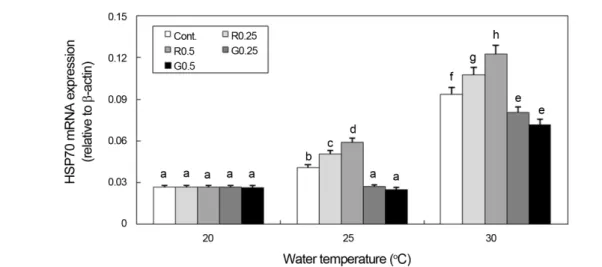
Fig. 2. Changes in HSP70 mRNA expression in juvenile rock bream. Results are shown for different water temperatures, wavelengths of green (G) and red light (R) at two light intensities (0.25 and 0.5 W/m

2

), and the white fluorescent bulb (Cont.). Lowercase letters indicate significant differences between different temperatures and LED spectra (P < 0.05). All values are means ± SEs (n = 5)

Fig. 3. The levels of cortisol (A) and glucose (B) in juvenile rock bream livers. Results are shown for different water

temperatures, wavelengths of green (G) and red light (R) at two light intensities (0.25 and 0.5 W/m

2

), and the

white fluorescent bulb (Cont.). Lowercase letters indicate significant differences between different temperatures

and LED spectra (P < 0.05). All values are means ± SEs (n = 5)

(5)

3. Results

Changes in HSP70 mRNA expression

HSP70 mRNA expression was increased significantly as the temperature increased in all experiment groups (Fig. 2). Additionally, the activity and expression of HSP70 in fish irradiated with green LED light were significantly lower than those in the control groups, although there were no significant differences in green LED irradiation groups exposed to 0.25 and 0.5 W/m

2

light. However, in groups irradiated with red LED light, HSP70 activity and expression were significantly increased as the light intensity increased.

Plasma cortisol and glucose levels

Plasma cortisol and glucose levels in all experiment groups were increased at high water temperatures (Fig. 3).

Additionally, plasma cortisol and glucose levels were significantly lower in groups irradiated with green LED light than those in the control group, although there were no significant differences between the groups of green light at different intensities. Additionally, plasma cortisol and glucose levels were significantly higher in groups irradiated with red LED light than those in the control group.

Plasma AspAT/AlaAT levels

Plasma AspAT/AlaAT levels in all experiment groups were increased at high water temperatures. Moreover, plasma AspAT/AlaAT levels were significantly lower in fish exposed to green light irradiation compared with that in the control group. In contrast, plasma AspAT and AlaAT levels were significantly increased in fish exposed to red light irradiation compared with that in fish exposed to control light (Fig. 4).

Fig. 4. The activities of plasma AspAT (A) and AlaAT (B) in juvenile rock bream. Results are shown for different

water temperatures, wavelengths of green (G) and red light (R) at two light intensities (0.25 and 0.5 W/m

2

),

and the white fluorescent bulb (Cont.). Lowercase letters indicate significant differences between different tem-

peratures and LED spectra (P < 0.05). All values are means ± SEs (n = 5)

(6)

Comet assays

A total of 100 cells were randomly chosen for analysis using a fluorescence microscope (Fig. 5), and the DNA damage response was determined by measuring the fraction of cells that had nuclear DNA comet tails (a phenomenon indicative of DNA breaks). At 20

o

C, the liver cells possessed normal nuclear DNA, but at 30

o

C, cells with damaged nuclear DNA were visible in all groups (Fig. 5A). The groups at 30

o

C exhibited significantly higher tail length, percentage DNA in tail, and tail moment than did the groups at 20

o

C (Fig. 5B). The cells of the control groups at 30

o

C sustained high levels of damage to their nuclear DNA and exhibited long tails, high percentages of DNA in the tail, and high tail moments. However, the high temperature group exposed to green-wavelength LED light exhibited significantly decreased tail length, percentage DNA in the tail, and tail moments, indicating that they sustained lower levels of damage to their nuclear DNA.

4. Discussion

In this study, we investigated the effects of specific wavelengths (green, 520 nm; red, 630 nm) and intensities

(0.25 and 0.5 W/m

2

) of light on the water temperature stress response of juvenile rock bream. The results showed that HSP70 mRNA levels increased as the water temperature increased. Moreover, HSP70 mRNA levels were significantly lower upon exposure to the green LED compared with that in the control group but significantly increased following exposure to red LED light. Thus, our findings provided important insights into the effects of environmental factors on stress responses in fish.

In a similar study, Kim et al. (2014) observed that as the temperature increased, the expression of HSP70 mRNA increased. Our results, which are consistent with the previous findings, suggested that HSP70 mRNA expression was significantly increased when rock bream was exposed to a high temperature environment and that green LED light effectively reduced the expression of HSP70 mRNA, regardless of the intensity of light. However, red LED light was found to increase the expression of HSP70 mRNA.

In this study, we also investigated changes in cortisol and glucose concentrations, which are controlled by the synthesis and release of HPI axis activity, in order to investigate the stress response induced by the high temperature environment. Our results showed that cortisol Fig. 5. Comet assay images (A) and comet assay parameters (B; tail length, percentage DNA in tail, and tail moment)

during thermal changes using a white fluorescent bulb (Cont.), green light (G), and red light (R) at 0.5 W/m

2

light intensity. White arrows indicate the damaged nuclear DNA (DNA breaks) of liver cells, which were

stained with SYBR-green. Scale bars = 100 µm. Lowercase letters indicate significant differences between dif-

ferent temperatures and LED spectra (P < 0.05). The asterisk (*) indicate the lowest value between different

LEDs within the same temperature. All values are represented as means ± SEs (n = 5)

(7)

and glucose concentrations differed according to light source, with significant increases upon exposure to green LED light compared with that in the control group.

However, cortisol and glucose concentrations were decreased following exposure to red light. In a similar study, Ming et al. (2012) showed that when wuchang bream (Megalobrama amblycephala) are exposed to a high temperature environment (34

o

C), the cortisol and glucose concentrations are increased significantly as the water temperature increases. Additionally, Kim et al.

(2014) showed that when goldfish are exposed to high temperatures, cortisol and glucose concentrations are increased significantly as water temperature increases.

Moreover, cortisol and glucose concentrations in fish exposed to the green LED light are significantly lower when compared with those in groups exposed to other types of light (fluorescent bulbs, blue, red, and purple LEDs). Consistent with these findings, our results showed that the cortisol and glucose concentration were significantly increased when rock bream were exposed to a high- temperature environment, although the green LED light effectively reduced the stress generated in the fish body.

Notably, we found that AspAT and AlaAT concentrations were increased as the water temperature increased.

Additionally, regardless of light intensity, AspAT and AlaAT concentrations were significantly lower following exposure to the green LED light compared with that in the control group; in contrast, AspAT and AlaAT concentrations increased with the intensity of red light. In a similar study, Ciereszko et al. (1998) reported that when rainbow trout are exposed to high temperatures (up to 40

o

C), AspAT and AlaAT concentrations are increased significantly as the water temperature increases. Moreover, Kim et al.

(2014) reported that when goldfish are exposed to high temperatures, AspAT and AlaAT concentrations are increased significantly as the water temperature increases.

Our results also showed that the green LED light reduced thermal-induced liver damage, as result decreased AspAT and AlaAT concentrations in the plasma, even for the lower light intensity (0.25 W/m

2

).

In this study, we performed comet assays to measure the degree of nuclear DNA damage in the liver cells of juvenile rock bream following exposure to high water temperatures. Notably, our results showed that high water temperatures caused nuclear DNA damage in liver cells.

However, exposure to green LED light significantly decreased nuclear DNA damage in juvenile rock bream liver cells. In a similar study, Jung et al. (2016) reported nuclear DNA damage in liver cells of goldfish (Carassius

auratus) exposed to high temperatures. Additionally, Kim et al. (2016) reported that when olive flounder are exposed to high temperatures (25 and 30

o

C), the nuclear DNA damage in cells is increased significantly as the water temperature increases. Taken together, these findings suggested that green LED light effectively reduced nuclear DNA damage in liver cells and repressed cellular damage caused by high water temperatures.

In conclusion, the results of this study suggested that the green LED light reduced environmental stress and nuclear DNA damage in juvenile rock bream and effectively mitigated water temperature stress, even when used at a low intensity (0.25 W/m

2

). In contrast, the red LED light caused stress and nuclear DNA damage, with increased alterations observed as the intensity of light increased. Further studies are required to assess the physiological effects of light wavelength and intensity in fish of various species. Our results may have applications in other basic studies of the effects of light on stress responses in fish.

Acknowledgments

This research was supported by the project ‘Innovative marine production technology driven by LED-ICT convergence photo-biology’, Ministry of Oceans and Fisheries, Korea, and by a grant from the National Institute of Fisheries Science (R2017038).

References

Bajpayee M, Pandey AK, Parmar D, Mathur N, Seth PK, Dhawan A (2005) Comet assay responses in human lymphocytes are not influenced by the menstrual cycle: a study in healthy Indian females. Mutat Res 565:163−172 Beato M, Sánchez-Pacheco A (1996) Interaction of steroid

hormone receptors with the transcription initiation complex.

Endocr Rev 17:587−609

Beckmann RP, Mizzen LE, Welch WJ (1990) Interaction of Hsp 70 with newly synthesized proteins: implications for protein folding and assembly. Science 248:850 −854 Begg K, Pankhurst NW (2004) Endocrine and metabolic

responses to stress in a laboratory population of the tropical damselfish Acanthochromis polyacanthus. J Fish Biol 64:133−145

Bonga SEW (1997) The stress response in fish. Physiol Rev 77:591 −625

Cheng W, Wang LU, Chen JC (2005) Effect of water

temperature on the immune response of white shrimp,

(8)

Litopenaeus vannamei to Vibrio alginolyticus. Aquaculture 250:592 −601

Choi CY, Shin HS, Choi YJ, Kim NN, Lee J, Kil G-S (2012) Effects of LED light spectra on starvation-induced oxidative stress in the cinnamon clownfish Amphprion melanopus. Comp Biochem Phys A 163:357 −363 Choi YJ, Yang S-G, Jung M-M, Kim B-S, Yun SG, Choi

CY (2015) Effects of waterborne selenium on toxic and physiological stress response in goldfish, Carassius auratus. Mol Cell Toxicol 11:35−46

Ciereszko A, Liu L, Dabrowski K (1998) Optimal conditions for determination of aspartate aminotransferase activity in rainbow trout and whitefish. J Appl Ichthyol 14:57−63 Donaldson MR, Cooke SJ, Patterson DA, Macdonald JS

(2008) Cold shock and fish. J Fish Biol 73:1491−1530 Flik G, Klaren PHM, van den Burg EH, Metz JR, Huising

MO (2006) CRF and stress in fish. Gen Comp Endocr 146:36 −44

Jin Y, Chen R, Sun L, Liu W, Fu Z (2009) Photoperiod and temperature influence endocrine disruptive chemical- mediated effects in male adult zebrafish. Aquat Toxicol 92:38 −43

Jung M-M, Kim TH, Choi YJ, Kim NN, Choi JY, Oh S-Y, Choi CY (2016) Variations in the antioxidant system and circadian rhythms of goldfish, Carassius auratus, exposed to ammonia: profile of the effects of green LED spectra.

Biol Rhythm Res 47:583 −596

Jung SJ, Choi YJ, Kim NN, Choi JY, Kim B-S, Choi CY (2016) Effects of melatonin injection or green-wavelength LED light on the antioxidant system in goldfish (Carassius auratus) during thermal stress. Fish shellfish Immun 52:157 −166

Karakatsouli N, Papoutsoglou SE, Panopoulos G, Papoutsoglou ES, Chadio S, Kalogiannis D (2008) Effects of light spectrum on growth and stress response of rainbow trout Oncorhynchus mykiss reared under recirculating system conditions. Aquacult Eng 38:36 −42

Kim B-S, Jung SJ, Choi YJ, Kim NN, Choi CY, Kim JW (2016) Effects of different light wavelengths from LEDs on oxidative stress and apoptosis in olive flounder (Paralichthys olivaceus) at high water temperatures. Fish Shellfish Immun 55:460 −468

Kim NN, Choi YJ, Shin HS, Lim JR, Han JM, Cho JH, Lee J, Kil K-S, Choi CY (2014) The effect of LED light spectra on antioxidant system by thermal stress in goldfish, Carassius auratus. Mol Cell Toxicol 10:47 −58

Machado C, Zaleski T, Rodrigues E, dos Santos Carvalho C, Cadena SMSC, Gozzi GJ, Donatti L (2014) Effect of temperature acclimation on the liver antioxidant defence

system of the Antarctic nototheniids Notothenia coriiceps and Notothenia rossii. Comp Biochem Phys B 172:21 −28 Ming J, Xie J, Xu P, Ge X, Liu W, Ye J (2012) Effects of emodin and vitamin C on growth performance, biochemical parameters and two HSP70s mRNA expression of Wuchang bream (Megalobrama amblycephala Yih) under high temperature stress. Fish Shellfish Immun 26:651 −661 Nakano K, Iwama GK (2002) The 70-kDa heat shock

protein response in two intertidal sculpins, Oligocottus maculosus and O. snyderi: relationship of hsp70 and thermal tolerance. Comp Biochem Phys A 133:79 −94 Nemcsók J, Benedeczky I (1990) Effect of sublethal

concentrations of phenol on some enzyme activities and blood sugar level of carp (Cyprinus carpio L.). Environ Monit Assess 14:377−383

Pierce LX, Noche RR, Ponomareva O, Chang C, Liang JO (2008) Novel functions for period 3 and exo-rhodopsin in rhythmic transcription and melatonin biosynthesis within the zebrafish pineal organ. Prog Brain Res 1223:11−24 Shin HS, Lee J, Choi CY (2011) Effects of LED light

spectra on oxidative stress and the protective role of melatonin in relation to the daily rhythm of the yellowtail clownfish, Amphiprion clarkia. Comp Biochem Phys A 160:221 −228

Singh NP, McCoy MT, Tice RR, Schneider EL (1988) A simple technique for quantitation of low levels of DNA damage in individual cells. Exp Cell Res 175:184 −191 Small BC (2004) Effect of isoeugenol sedation on plasma

cortisol, glucose, and lactate dynamics in channel catfish Ictalurus punctatus exposed to three stressors. Aquaculture 238:469 −481

Song JA, Kim NN, Choi YJ, Choi JY, Kim B-S, Choi CY (2016) Effects of light-emitting diode spectra on the vertebrate ancient long opsin and gonadotropin hormone in the goldfish Carassius auratus. Biochem Biophys Res Commun 476:541 −545

Villamizar N, Garcia-Alcazar A, Sánchez-Vázquez FJ (2009) Effect of light spectrum and photoperiod on the growth, development and survival of european sea bass (Dicentrarchus labrax) larvae. Aquaculture 292:80−86 Welch WJ (1991) The role of heat-shock proteins as

molecular chaperones. Curr Opin Cell Biol 3:1033 −1038 Zhang CI, Kwon HC, Kwon Y, Kim BY (2013) Age and

growth of striped beak perch Oplegnathus fasciatus in the Jeju marine ranching area. Kor J Ichthyol 25:25−32

Received Feb. 25, 2017

Revised May 1, 2017

Accepted May 5, 2017

수치

Fig. 1. Spectral profiles of the light-emitting diodes (LEDs; green, 520 nm; red, 630 nm) and white fluorescent bulb (Cont.) used in this study
Fig. 2. Changes in HSP70 mRNA expression in juvenile rock bream. Results are shown for different water temperatures, wavelengths of green (G) and red light (R) at two light intensities (0.25 and 0.5 W/m 2 ), and the white fluorescent bulb (Cont.)
Fig. 4. The activities of plasma AspAT (A) and AlaAT (B) in juvenile rock bream. Results are shown for different water temperatures, wavelengths of green (G) and red light (R) at two light intensities (0.25 and 0.5 W/m 2 ), and the white fluorescent bulb (

참조

관련 문서

under the transient condition using the Lock-in infrared thermography and predict the stress value and the dynamic stress concentration factor based on the

Second, the analysis of differences by affiliation showed that the controlled coaching actions were perceived higher in order of the general, secondary, and

• Accumulated microscopic damage develops into a crack or other  macroscopic damage

In other hands, the higher stress levels by parent, academics, appearance and material factors showed more atrophy, physical symptoms,

- Successful where low states of stress in the near field can induce discontinuous behavior of both the orebody and overlying country rock, or the stress is high enough

i) The physical dimensions of stress are force per unit area. ii) Stress is defined at a point upon an imaginary plane or boundary dividing the material into two parts. iii)

If the six stress components associated with any three mutually perpendicular faces are specified, it is possible to develop equations similar to (4.23)