DOI https://doi.org/10.9725/kts.2018.34.2.55
브레이크 마찰력 증가를 위한 상용차용 전기- 기계식 브레이크의 쐐기 설계
이상민1ㆍ박정훈1ㆍ남강현2ㆍ유창희3ㆍ박상신2,†
1
영남대학교 대학원 기계공학과,
2영남대학교 기계공학부,
3
상신브레이크 상용개발부
Design of Wedge in the Electro-Mechanical Brakes for Commercial Vehicles to Boost Braking Friction Forces
Sang Min Lee
1, Jeonghun Park
1, Kanghyun Nam
2, Chang-Hee Yoo
3and Sang-Shin Park
2,†1
Graduate School, Dept. of Mechanical Engineering, Yeungnam University, Kyungsan-city, Kyungbuk 38541, Korea
2
School of Mechanical Engineering, Yeungnam University, Kyungsan-city, Kyungbuk 38541, Korea
3
CV Brake Development Dept., Sangsin Brake Co., Ltd., Daegu Metropolitan City, Daegu 43023, Korea (Received February 21, 2018; Revised March 19, 2018: Accepted March 20, 2018)
Abstract − This paper proposes a new type of electro-mechanical wedge brake for commercial vehicles. The brake operates on a novel mechanism for self-boosting braking friction forces using eccentric shafts, and involves wedges that are inserted between the rampbridge and traverse; this self-boosting mechanism is explained herein.
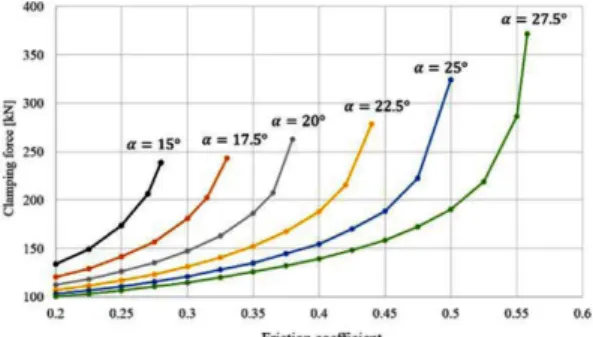
A dynamic analysis using ADAMS was conducted, and the findings are reported. The constraint and contact con- ditions are explained to verify the precision of the dynamic analysis. The dynamic analysis shows that in the pro- posed mechanism, the self-boosting effect occurs as desired. However, it is also noted that the system has a limitation in terms of the production of unlimited braking forces that can jam the roller inside the wedges. After demonstrating the self-boosting effect, dynamic analyses are performed for several values of the wedge angles and friction coefficients between the brake pads and disks. Conventionally, a lower wedge angle has been sug- gested owing to its provision of a larger clamping force for given friction coefficients. However, it is noted that lower wedge angles can lead to a higher probability of occurrence of undesirable high braking forces, which can jam the roller into the wedge; thus, a larger wedge angle is preferable for avoiding the undesirable jamming phe- nomena. These analysis results are presented and discussed herein.
Keywords − electro-mechanical wedge brake(전기-기계식 쐐기 브레이크), self-boosting(자기배력), clamping force( 브레이크력), wedge angle(쐐기각), friction coefficient(마찰계수)
1. 서 론
화석연료 에너지의 고갈 및 환경문제 등을 이유로 자 동차 업계에서는 기존의 내연기관을 이용한 자동차에서 벗어나, 전기 자동차의 연구 개발이 활발히 진행되고
있다. 이에 발맞추어 차량 제동 부문에 있어서도 전기식 브레이크 시스템 개발이 활발히 이루어 지고 있다[1].
특히, 상용차용 전기식 브레이크는 승용차에 비해 큰 제동력이 필요하고, 24V DC 전원 체계와, 구동 모터 의 출력의 한계 문제로 인하여 단순 모터 구동에 의한 전기식 브레이크가 아닌, 자기배력 기구를 이용한 전기 - 기계식 브레이크가 필요하며, 현재까지 전기-기계식 브 레이크의 자기 배력 메커니즘 관련하여 연구된 사례에 는 쐐기형(Wedge type)[2-4], 스크류형[5], 캠형[6] 등
†