유아 화재사고 예방을 위한 화재안전 교육프로그램 개발 방향 탐색
Fire Safety Education Programs for Preventing Fire Accidentof Young Children
윤선화 Sun-Hwa Yoon 한국생활안전연합
(2012. 3. 13. 접수/2012. 4. 6. 수정/2012. 4. 13. 채택) 요 약
본 연구에서는 유아들의 화재로 인한 피해실태와 문제점을 살펴보고, 미국의 화재안전교육 프로그램과 우리나라의 화재안전교육의 법적 근거를 고찰하여 유아 화재사고 예방을 위한 화재안전교육 프로그램의 방향을 탐색하고자 한다. 연구결과로 첫째, 우리나라 아동의 화재 및 화상사고로 인한 사망률이 영국, 독 일, 스웨덴에 비해 높았다. 둘째, 우리나라 유아화재안전교육은 아동복지법, 유치원교육과정, 표준보육과정 에서 의무적으로 실시하도록 법으로 명시하고 있다. 셋째, 유아 화재 사고 예방을 위해 유아의 발달에 적 합한 화재안전교육을 실시하여야 하며, 다양한 시청각 매체와 체험활동 프로그램을 제공해주어야 한다. 마 지막으로 체계적인 유아 화재안전교육을 위해 교사 및 보호자를 대상으로 하는 화재안전교육이 병행되어 야 한다.
ABSTRACT
The purpose of this study is to explore appropriate fire safety education programs for young chil- dren by both examining the actual damage condition and problems associated with fire accident in young children and considering fire safety education programs in America and legal basis for fire safety education in Korea. The results are as follows. First, the mortality of young children by fire accident in Korea is higher than that of U.K, Germany, and Sweden. Second, it is defined by the Child Welfare Law in Korea to implement the mandatory fire safety education for young children in kindergarten and preschool programs. Third, in order to activate fire safety education programs for young children, the fire safety education needs to be suitable for children’s developmental character- istics, and various audiovisual materials and activity programs should be developed and provided.
Fourth, fire safety education both for early childhood teachers and parents needs to be interrelated and systemized to reduce the risk of fire accident.
Key words : Fire safety education program, Young children, Fire accident
1. 서 론
1.1 연구의 필요성
불은 우리 생활 전반에 걸쳐서 다양하게 사용되는 필수불가결의 존재기도 하지만 잘못 사용될 경우에는 인간의 생명과 재산에 심각한 피해를 초래하고 평화로 운 삶에 위협을 가하는 공포의 대상이 되기도 한다.1) 불은 인간에게 유용한 것인 동시에 무서운 재해로 변
하기도 하는데 불로 인한 재해를 화재라고 부른다.2) 화재에 의해 발생되는 피해는 사망이나 부상 등의 인명피해와 재산의 손실을 유발하는 피해로 나눌 수 있다. 인명피해의 경우에는 화재피해의 영향이 미치는 반경 내에 있는 사람들 중 많은 경우 극도의 공포감으 로 정상적인 사고와 판단을 하지 못하는 정신적인 상 태인 패닉에 빠지게 되어 피해의 정도가 더 커지기도 한다. 나이에 따라 화재에 대한 반응과 대응은 달라지 는데 스스로 대피할 능력이 없는 유아가 가장 취약하 며 치명적인 피해를 입기가 쉽다.
E-mail: [email protected]
우리나라는 경제발전과 더불어 난방 및 취사연료의 형태가 전기, 가스, 유류 등으로 변화되었고 에너지의 다양화와 각종 위험물질의 증가에 따른 화재발생은 날 로 증가하고 있는 실정이다. 지난 1998년 33,857건이 던 화재발생건수가 2009년에는 47,318건으로 증가하여 10년 동안 거의 0.7배 정도 증가하였으며,3)경제성장에 따른 에너지 소비의 증가와 각종 건축물의 대형화, 고 층화 및 복잡다양한 각종 내부 인테리어로 화재 발생 이 앞으로도 계속 늘어날 것으로 예상된다. 2008년 전 체 화재 발생에서 단독주택화재의 비중이 13.7%로 가 장 큰 비율을 차지하고 있다. 2010년의 경우에는 4월
말까지 전체 화재건수가 14,875건에 이르는데 이중 아 파트와 공동주택을 포함한 주택화재가 3,736건으로 전 체 화재의 25.1%를 차지하였다.3,4)
우리나라 화재사고 발생장소가 점차 주택 및 아파트 등 주거시설에서의 화재가 증가하고 있어 집안에서 화 재가 발생했을 경우 큰 피해로 이어질 수 있다. 특히 스스로 대피할 능력이 없는 영유아는 화재발생 시 가 장 취약할 수 있으며 정신적으로 미숙하고 성인에 비 하여 운동능력이 부족한 영유아들은 치명적인 피해를 입기 쉽다.1)그러므로 영유아를 대상으로 화재의 위험 성과 화재 발생 시 대처요령, 화재대피훈련 등 적극적 인 화재안전교육을 실시해야 할 필요성이 대두된다.
이에 본 연구에서는 유아들의 화재 및 화상으로 인 한 피해실태와 문제점을 살펴보고, 미국의 화재안전교 육 프로그램과 우리나라의 화재안전교육의 법적 근거 를 고찰하여 유아 화재 사고 예방을 위한 화재안전교 육 프로그램의 방향을 탐색하였다.
1.2 연구의 내용
본 연구의 내용을 구체적으로 밝히면 다음과 같다.
첫째, 유아들의 화재 사고에 대한 실태와 문제점을 살펴본다.
둘째, 유아들의 화재 사고에 대한 문제점을 근거하 여 그 대안적인 방법으로 미국에서 개발된 유아화재안 전교육 프로그램을 분석하고, 우리나라의 화재안전교 육의 법적 근거와 기 개발된 화재안전교육 내용을 살 펴본다.
셋째, 유아 화재 사고 예방을 위한 화재안전교육 프 로그램의 방향을 탐색한다.
2. 유아의 화재로 인한 피해의 실태
2.1 유아 및 14세 이하 아동의 화재 사고의 국제 비교 WHO에서 발간된 건강데이타(health data) 중 OECD 국가들의 14세 아동의 화재사고로 인한 사망통계를 분 석하였다. 그 결과는 Table 1과 같다. 어린이 10만 명 당 화재 사고 사망자 수를 살펴보면 우리나라는 2004 년 기준 0.4명으로 나타나 영국(0.26명), 독일(0.23명), 프랑스(0.34명), 스웨덴(0명) 등 선진국에 비해 높은 상 태인 것으로 나타났다.
2.2 어린이 화재 및 화상 사망통계
통계청에서 발간한 사망통계연보를 분석한 결과는 Table 2와 같다.5) 14세 이하 어린이 화재 사고의 경우 2007년 7명에서 2008년 19명으로 증가하였다. 또한 연 Table 1. Fatal Fire-related Death Rates Per 100,000
Children by International Comparison (2001~2006) 2001 2002 2003 2004 2005 2006 Austria 0.09 0.27 0.31 0.16 0 0
Czech 0.06 0.22 0 0.37 0.23
Denmark 0.09
Finland 0 0.13 0.1 0.1 0.2
France 0.48 0.28 0.26 0.34 Germany 0.27 0.3 0.33 0.23
Greece 0.2 0.07 0.06 0 0 0
Hungary 0.78 0.18 0.5 0.3 0.13
Iceland 0 1.71 0 0 0
Ireland 1.03 0.51 0.61 0.36 0.46 Italy 0.12 0.04
Luxembourg 1.28 0 1.1 1.3 1.31 Netherlands 0.1 0.17 0.21 0.1
Norway 0.47 0.33 0.1 0.33 0.33 Poland 0.19 0.23 0.38 0.12 0.22 Portugal 0 0.25 0.26
Spain 0.17 0.2 0.22 0.18 0.37 Sweden 0.4 0.16 0.06 0
Switzerland 0.27 0.1 0 0 United
Kingdom 0.31 0.55 0.34 0.26 0.22 United States
of America 0.92
Japan 0.38
Republic of
Korea 0.7 0.5 0.6 0.4 0.2 0.5
*Source: WHO (2008). Mortality Database, European Mortality Databasease, Quoted in Yoon. SH, et al.1)
령에 따른 화재 및 화상사고 사망 실태를 살펴보면 10~14세, 0~4세 순으로 사고가 발생하고 있는 것으로 나타났다(Table 3 참조).
2.3 초등학생 이하 아동의 화재현장 인명피해 현황6) 서울특별시 소방재난본부에 따르면, 2011년 한해동 안 화재사고로 인해 총 197명의 인명피해가 발생하였 다. 이중에 초등학생이하의 아동은 총 9명이 다치거나
사망한 것으로 나타났다. 실제로 지체장애아동인 11세 의 여아가 단독주택에서 발생한 화재로 사망하였고 부 상당한 아동이 8명으로 나타나, 전체 인명피해의 4.57%
를 차지하였다. 초등학생 이하 아동의 구체적인 인명 피해내용은 Table 4와 같다.
또한 2011년 한해 동안 서울시에서 발생한 각종 안 전사고 발생현장에 구조를 위해 소방관들이 총 출동한 건수는 97,263회이며, 구조한 인원은 19,497명이었다.
Table 3. Unintentional Child Injury Deaths by Cause and Age Group (2008)
Age Traffic Fall Drowning Suffocation Fire Poisoning Other Total
0~4 68 31 20 58 3 1 91 272
25.0% 11.4% 7.4% 21.3% 1.1% 0.4% 33.5% 100.0%
5~9 90 13 32 9 1 0 67 212
42.5% 6.1% 15.1% 4.2% 0.5% 0.0% 31.6% 100.0%
10~14 56 6 26 0 15 1 48 152
36.8% 3.9% 17.1% 0.0% 9.9% 0.7% 31.6% 100.0%
Total 214 50 78 67 19 2 206 636
33.6% 7.9% 12.3% 10.5% 3.0% 0.3% 32.4% 100.0%
*Source: Korea National Statistical Office (2009). Annual report on the cause of death statistics.
Table 2. Unintentional Child Injury Deaths in Korea (2007~2008)
Total Traffic Fall Drowning Suffocation Fire Poisoning Other
2008 636 214 50 78 67 19 2 206
100.0% 33.6% 7.9% 12.3% 10.5% 3.0% 0.3% 32.4%
2007 648 259 58 78 70 7 4 172
100.0% 40.0% 9.0% 12.0% 10.8% 1.1% 0.6% 26.5%
*Source: Korea National Statistical Office (2009). Annual report on the cause of death statistics.
Table 4. The Fire Victims in Children Under Elementary School (2011)
Month Day Time Age Sex Degree Condition Cause of Victim Characteristic Place 04 07 09:43 13 male injury evacuating fall not applicable multiplex housing 07 27 22:38 01 female injury call for help inhalation of smoke sleeping apartment 07 27 22:38 05 female injury call for help inhalation of smoke sleeping apartment 08 29 16:16 04 male injury evacuating inhalation of smoke not applicable apartment 11 27 10:59 11 female death impossible inhalation of smoke, burn physical disability detached house 12 09 13:55 12 male injury other behavior inhalation of smoke, burn sleeping apartment 12 09 13:55 11 female injury other behavior inhalation of smoke, burn sleeping apartment 12 29 03:01 08 female injury call for help inhalation of smoke, burn sleeping multiplex housing 12 29 03:01 05 male injury call for help inhalation of smoke, burn sleeping multiplex housing
*Source: Seoul Metropolitan Fire & Disaster Headquarter (2012).
이중에서 화재로 인한 현장 구조인원은 전체 1,773명
(9.1%)이었는데, 이때 초등학생이하의 아동을 화재현장
에서 구조한 인원은 총 60명으로 구조인원의 3.38%를 차지하였다. 아동 구조자의 구체적인 연령과 구조장소 는 Table 5와 같다. 이중의 42명(70%)의 아동이 단독 주택이나 아파트 등과 같은 주거단지에서 화재사고가 발생하여 구조되었으며, 3명(0.5%)의 아동이 학교나 유 치원과 같은 교육기관에서 화재사고로 구조되었다. 이 렇게 볼 때 대부분의 초등학생이하 아동의 화재는 주 거지에서 발생하기에 영유아에 대한 화재안전교육의 필요성과 주택화재발생시 대처와 대응에 관한 교육이 중요하게 포함되어야 함을 시사한다.
3. 우리나라와 미국의 유아 화재안전교육의 방향
3.1 미국의 유아를 위한 화재안전교육 프로그램 분석7,8) 미국화재예방협회(National Fire Prevention Association) 에서는 1979년에 어린이화재안전교육과정으로 LNTB (Learn Not To Burn) 커리큘럼을 개발하여 보급하여 왔 Table 5. Child Rescues from Fire by Age and Place
Number Name Sex Age Place
1 Kang ○ ○ male 10 apartment 2 Kim ○ ○ female 6 apartment 3 Kim ○ ○ female 13 other
4 Kim ○ ○ male 2 detached house 5 Kim ○ ○ male 6 detached house
6 Kim ○ ○ male 3 other
7 Kim ○ ○ male 1 other
8 Kim ○ ○ male 11 building, office 9 Kim ○ ○ female 1 building, office 10 Kim ○ ○ male 5 other
11 Kim ○ ○ male 12 school, kindergarten 12 Na ○ ○ male 10 detached house 13 Na ○ ○ female 13 detached house 14 Kim ○ ○ male 12 apartment 15 Kang ○ ○ female 6 building, office 16 Kim ○ ○ male 13 apartment 17 Kim ○ ○ female 12 shopping center 18 Park ○ ○ female 7 shopping center 19 Park ○ ○ female 5 shopping center 20 Kim ○ ○ male 7 detached house 21 Kim ○ ○ female 5 detached house 22 Kim ○ ○ male 8 detached house 23 Jeong ○ ○ female 12 detached house 24 Jeong ○ ○ male 10 apartment 25 Hwang ○ ○ female 10 apartment 26 Shin ○ ○ female 10 apartment 27 Lim ○ ○ male 10 detached house
28 Oh ○ ○ male 3 detached house 29 Kim ○ ○ male 11 detached house 30 Cho ○ ○ female 12 apartment 31 Han ○ ○ female 13 apartment 32 Kim ○ ○ female 13 apartment 33 Kang ○ ○ male 13 apartment 34 Park ○ ○ male 10 detached house 35 Park ○ ○ female 3 building, office 36 Park ○ ○ male 1 building, office 37 Park ○ ○ female 7 apartment 38 Park ○ ○ female 7 apartment 39 Park ○ ○ female 9 apartment 40 Seo ○ ○ male 11 detached house 41 Seo ○ ○ female 13 detached house 42 Seo ○ ○ male 2 building, office 43 Song ○ ○ female 6 apartment 44 Song ○ ○ male 9 apartment 45 Shin ○ ○ male 13 apartment 46 An ○ ○ male 11 detached house 47 Lee ○ ○ male 2 other
48 Lee ○ ○ female 6 apartment
49 Lee ○ ○ male 12 school, kindergarten 50 Lee ○ ○ female 1 detached house 51 Lee ○ ○ male 8 apartment 52 Lee ○ ○ male 10 apartment 53 Jeong ○ ○ male 9 apartment 54 Jeong ○ ○ female 5 apartment 55 Jeong ○ ○ male 11 apartment 56 Jeong ○ ○ female 8 apartment 57 Cho ○ ○ female 8 detached house 58 Choi ○ ○ male 12 school, kindergarten 59 Hong ○ ○ female 13 building, office 60 Hong ○ ○ male 5 apartment
다. LNTB는 미국, 캐나다 등 북미 각 국은 물론 호주, 뉴질랜드, 영국 등의 국가들에도 보급되어 있다. 이 프 로그램은 세계적으로 권위있는 프로그램으로 20년 이상 미국 화재안전교육의 주도적인 역할을 해오고 있으며, 그 성과 또한 만족스러웠고, 미국, 영국, 캐나다의 250,000 개 이상의 학급에 보급되어 있다.7) LNTB 프로그램은 LNTB 커리큘럼(LNTB Curriculum), LNTB 학습교재 (LNTB Resource Books), 미취학아동용 LNTB프로그램 (LNTB Preschool Program) 등 3가지로 구성되어 있다.9)
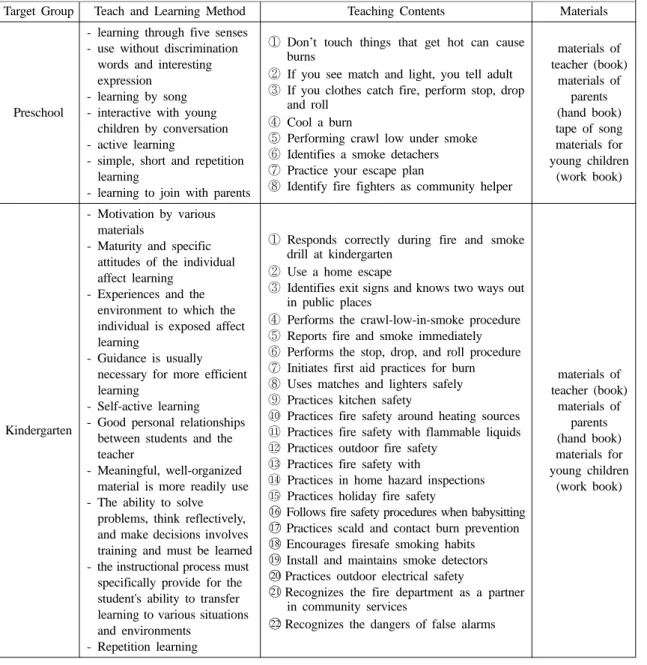
먼저 유아원과 어린이집에 다니는 유아를 위해서 미 취학아동용 LNTB프로그램(LNTB Preschool Program) 에 대해서 살펴보았다. NFPA가 1991년에 개발한 이 프로그램(LNTB Preschool Program)은 3~5세의 유아들 에게 화재 및 화상을 예방하는 8가지 행동을 가르치기 위해 만든 프로그램으로 노래와 게임 및 실제 동작을 해볼 수 있게 되어 있다. 또한, 60페이지에 달하는 교 사용 지침서에는 상세한 학습계획, 화재안전에 관한 정 보, 부모님에게 보내는 편지 및 배운 것을 실천해 보
Table 7. LNTB Preschool & Kindergarten Program
Target Group Teach and Learning Method Teaching Contents Materials
Preschool
- learning through five senses - use without discrimination
words and interesting expression
- learning by song - interactive with young
children by conversation - active learning
- simple, short and repetition learning
- learning to join with parents
① Don’t touch things that get hot can cause burns
② If you see match and light, you tell adult
③ If you clothes catch fire, perform stop, drop and roll
④ Cool a burn
⑤ Performing crawl low under smoke
⑥ Identifies a smoke detachers
⑦ Practice your escape plan
⑧ Identify fire fighters as community helper
materials of teacher (book) materials of
parents (hand book) tape of song materials for young children (work book)
Kindergarten
- Motivation by various materials
- Maturity and specific attitudes of the individual affect learning
- Experiences and the environment to which the individual is exposed affect learning
- Guidance is usually necessary for more efficient learning
- Self-active learning
- Good personal relationships between students and the teacher
- Meaningful, well-organized material is more readily use - The ability to solve
problems, think reflectively, and make decisions involves training and must be learned - the instructional process must specifically provide for the student's ability to transfer learning to various situations and environments
- Repetition learning
① Responds correctly during fire and smoke drill at kindergarten
② Use a home escape
③ Identifies exit signs and knows two ways out in public places
④ Performs the crawl-low-in-smoke procedure
⑤ Reports fire and smoke immediately
⑥ Performs the stop, drop, and roll procedure
⑦ Initiates first aid practices for burn
⑧ Uses matches and lighters safely
⑨ Practices kitchen safety
⑩ Practices fire safety around heating sources
⑪ Practices fire safety with flammable liquids
⑫ Practices outdoor fire safety
⑬ Practices fire safety with
⑭ Practices in home hazard inspections
⑮ Practices holiday fire safety
○16 Follows fire safety procedures when babysitting
○17 Practices scald and contact burn prevention
○18 Encourages firesafe smoking habits
○19 Install and maintains smoke detectors
○20Practices outdoor electrical safety
○21Recognizes the fire department as a partner in community services
○22Recognizes the dangers of false alarms
materials of teacher (book) materials of
parents (hand book) materials for young children (work book)
는 컬러시트가 포함되어 있고, 노래 카세트 테이프도 포함되어 있다.
둘째 유치원과 중학생까지의 아동을 위해서 LNTB 커리큘럼(LNTB Curriculum), LNTB 학습교재(LNTB Resource Books)를 개발하였는데, 이 교재는 22개 화 재안전을 위한 행동을 화재발생시의 보호(Protection), 화재발생 전의 예방(Prevention), 화재안전을 위한 타인 설득(Persuasion)의 3가지 범주로 나누어 가르치며, 연 령에 따라 3단계(유치원~2학년, 3~5학년, 6~8학년)로
Table 8. Fire Safety Education Program for Young Children by Korean Laws
Legislations Content Articles
The Child Welfare Act
Child Safety Education &
Practice
Law-Article 31, Enforcement Regulation-Article 4: the director of child care centers 「Young children care act」, the director of kindergartens 「Young children education act」 shall develop education plan and practice them.
The Prevention of School Accident and Compensation Act
School Safety Education &
Practice
Law-Article 8, Enforcement Ordinance-Article 2: The principle shall practice safety education to students and teachers in accordance to the regulations implemented by the Ministry of Science & Education.
Disaster and Safety Management Act
Disaster Prevention Education &
Management
Law-Article 34: The head of National Emergency Management Agency shall regularly practice safety education for preventing disaster as implemented by the President
Enforcement Regulation-Article 42: Under the article 34, the head of National Emergency Management Agency shall support schools to practice safety education and may request broadcasting safety education advertisement that they have made.
Fire Fundamental
Act
Safety Education &
Practice
Article 17: The head of National Emergency Management Agency, the chief of Fire Department, and the chief of Fire Station may practice fire safety education and fire drill in order to minimize casualty and property loss.
Establishing Safety Experience
Facility and Related Articles
Article 5: The head of National Emergency Management Agency and Governors may establish and run fire training centers in order to promote awareness of the dangers of fire.
Table 9. Contents of Fire Safety Education Program for 5 Year Children by Nuri Curriculum
Category Content Sub-Content
Safe Living Effective Preparation & Prevention for the event of emergency
Preparing effective plan for the even of natural disaster or accidents
Table 10. Contents of Fire Safety Education Program for Young Children by Kindergarten Curriculum
Content Sub-Content Differentiated Content
I II
Safe Living
Effective Plan for Dangerous Situation Effective Plan for Dangerous Objects and Situation.
Protection by Asking Help from Others Preparing effective Plan for Environmental
Pollution and Disaster
Participation in Drills for Protecting Ourselves from Accidents and Disaster
나누어져 있다. 아동은 이 교과과정을 통해 화재위험 으로부터 자신, 가족, 친구, 타인을 어떻게 지킬 것인 지 그리고 자신의 재산은 물론 타인의 재산도 화재로 부터 지킬 책임이 있다는 것을 배운다.
NFPA에서 개발된 유아용 화재안전교육 프로그램을 분석한 결과는 Table 7과 같다.
3.2 우리나라 유아를 위한 화재안전교육의 법적근거 우리나라에는 유아들에게 화재안전교육을 실시하기
위한 법적인 근거를 가지고 있다. 우선 아동복지법10) 에서 화재 및 재난 안전교육을 실시하도록 명시하고 있으며, 학교안전사고 예방 및 보상에 관한 법률11)에서 도 화재안전교육을 실시하도록 명시하고 있다. 또한 재 난 및 안전관리기본법,12)소방기본법13) 등에서도 유아 들에게 화재안전교육을 실시해야함을 강조하고 있다.
구체적인 법규의 내용은 Table 8과 같다.
또한 유아의 교육의 기본 과정이 되는 유치원교육과 정14)과 표준보육과정15)에서도 유아들에게 화재안전교 육을 실시하도록 그 내용을 규정하고 있다. 구체적인
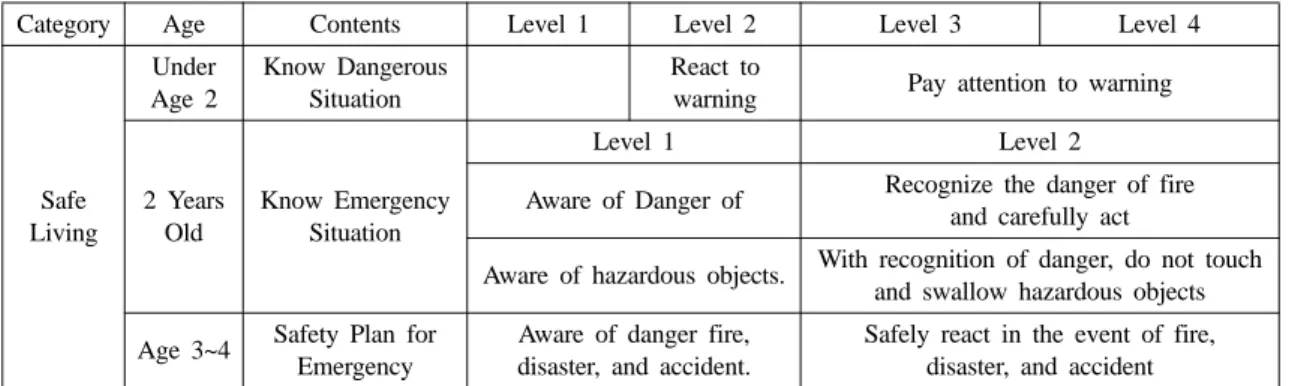
내용은 Table 9, 10, 11과 같다.
3.3 우리나라 화재안전교육 프로그램 분석
우리나라에서도 유아를 위한 화재안전교육 자료를 개발하여 보급하고 있는데 크게 소방방재청과 한국소 방안전협회에서 개발하여 보급한 자료가 활용되고 있 다. 2003년 한국소방안전협회에서 개발한 지도서는 만 5세부터 8세까지의 유아와 초등학교 저학년 아동을 위 한 교재로 교사용 지도서와 유아를 위한 CD-ROM이 보급되었다.16)
Table 11. Contents of Fire Safety Education Program for Young Children by Child Care Center Curriculum
Category Age Contents Level 1 Level 2 Level 3 Level 4
Safe Living
Under Age 2
Know Dangerous Situation
React to
warning Pay attention to warning
2 Years Old
Know Emergency Situation
Level 1 Level 2
Aware of Danger of Recognize the danger of fire and carefully act
Aware of hazardous objects. With recognition of danger, do not touch and swallow hazardous objects Age 3~4 Safety Plan for
Emergency
Aware of danger fire, disaster, and accident.
Safely react in the event of fire, disaster, and accident
Table 12. Fire Safety Education by Korea Fire Safety Association & National Emergency Management Agency Title
(Publisher) Teaching Method Teaching Content Teaching Materials
Child Fire Education Program Guidebook (Korean Fire
Safety Association)
- Learn Safety Rule - Experience
- Repeat Practice Drill - Methodical Education in
accordance to Children’s Developmental Levels - Educate Parents
① The benefits and bad of fire
② The cause of fire (electricity, gas, flame)
③ Alarm to other in the event of fire
④ Emergency Exit
⑤ Get out
⑥ Safe escape habits inside of building
⑦ Escape from smoke
⑧ Ring fire brigade and use of fire extinguisher
⑨ Put out fire on cloths or body
⑩ Deal with burn
⑪ Hazardous objects to cause burn
Material for Teachers (Books)
Materials for Children - CD-ROM (Game,
Animation, etc.)
Child Safety Education
Program (National Emergency Management
Agency)
- Comprehensive Education through Various Activity - Repetitive Education - Continuous Education
throughout the Year - Methodical Education in
accordance to Children’s Developmental Levels - Educate Parents
① The cause of burn and the objects that cause burn injury
② Treatment of burn
③ Alarm to other people
④ Fire alarm equipment
⑤ Dangerous act in the event of fire
⑥ Ways of escaping from smoke법
⑦ Ring fire brigade
⑧ Reaction to the fire on cloths
⑨ Fire fighters are helper
Materials for Children - Books (Story
Book Type) Material for Teachers (Various Teaching
Methods, CD) Material for Parents (Resources
in Paper)
또한 소방방재청에서 개발한 유아를 위한 안전교육 지도서는 2006년에 개발되어 보급된 후 2010년에 증 보되어서 다시 보급된 것으로 유아교사를 위한 지도서 와 유아용 동화책자형태의 자료등이 개발되었으며, 화 재 및 재난안전분야와 생활안전분야로 나뉘어서 보급 되었다.17) 이 연구에서는 화재안전분야 만을 분석대상 으로 삼았으며 그 내용은 Table 12와 같다.
4. 유아 화재사고 예방을 위한 화재안전 교육 프로그램 방향
4.1 화재안전교육의 이론적 근거
오기수 다카오·사이토우 키야시(荻須隆雄·濟藤 能)에 따르면, 안전교육이란 사고를 미연에 막고, 재 해를 최소화하기 위한 모든 능력을 기르는 교육이며,18) 자신과 타인의 생명을 존중하는 마음과 생명에 대한 경외하는 마음을 기르기 위한 생명존중교육으로 정의 하고 있다.21) 따라서 영유아를 위한 안전교육의 목적 은 영유아 스스로 위험으로부터 자신을 보호할 수 있 도록 안전에 때한 지식, 기술과 태도를 배워 건강하고 안전한 생활을 영위할 수 있도록 도와주는 교육으로 궁극적으로는 자신에 대한 보호뿐만 아니라 타인의 생 명을 존중하는 인간 개개인의 존엄성을 배우는 전인교 육이다.1) 이렇게 볼 때 화재안전교육은 소방안전을 책 임지고, 사람 스스로가 보다 안전한 행동을 할 수 있 는 능력을 배양시켜 주어서 보다 안전할 수 있도록 교 육시키는 것이고, 생명을 지키려는 인간의 본능을 기 본바탕으로 하여 각종 사고와 위험에 대처하기 위해서 실시하는 교육이다.19)
따라서 효과적인 화재안전교육을 위해서는 화재안전
에 대한 지식(위험물질, 상황, 지역 등에 대한 인식), 태도(자기존중, 타인존중, 준법정신 등), 기술(위험한 상 황에서 자기를 보호하고 안전하게 대처하는 능력 등) 의 세 요소가 포함되어야 한다.16)
4.2 화재안전교육의 목적 및 목표
화재안전교육의 궁극적인 목적은 유아가 불의 위험 성을 알고 화재가 발생하지 않도록 예방할 수 있으며, 화재가 발생했을 경우에는 안전하게 대피하는 방법을 익히고 올바르게 실천하여 자신과 타인의 생명을 안전 하게 지킬 수 있는 것이다.
이에 따른 화재안전교육의 구체적인 목표는 8단계로 나눌 수 있다.
첫째, 화재가 발생하는 이유에 대해서 알고, 화재의 위험성을 이해하여 화재를 예방하는 방법을 알고 실천 할 수 있다.
둘째, 화재가 발생했을 때 안전한 행동요령을 알고 실천할 수 있다(알린다, 나간다, 신고한다).
셋째, 화재가 발생하여 대피가 어려운 상황에 처했 을 때 적절한 행동요령을 알고 실천할 수 있다.
넷째, 옷에 불이 붙었을 때 안전한 행동요령을 알고 이를 실천할 수 있다.
다섯째, 소방서에 신고하는 방법을 알고 이를 실천 할 수 있다.
여섯째, 화상을 당했을 때 응급처치 요령을 알고 이 를 실천할 수 있다.
일곱째, 화재예방을 위한 여러 도구와 기계가 있음 을 알고 어떠한 역할을 하는지 이해할 수 있다.
여덟째, 소방서와 소방관의 역할을 알고 고마운 마 음을 갖는다.
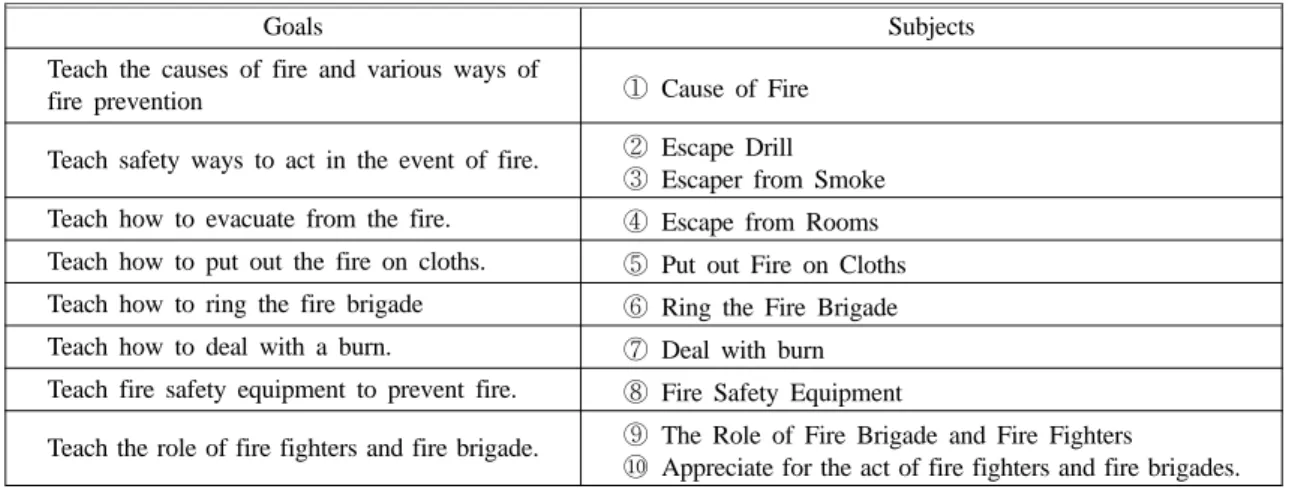
Table 13. Goals and Subjects of Fire Safety Education for Young Children
Goals Subjects
Teach the causes of fire and various ways of
fire prevention ① Cause of Fire
Teach safety ways to act in the event of fire. ② Escape Drill
③ Escaper from Smoke Teach how to evacuate from the fire. ④ Escape from Rooms Teach how to put out the fire on cloths. ⑤ Put out Fire on Cloths Teach how to ring the fire brigade ⑥ Ring the Fire Brigade Teach how to deal with a burn. ⑦ Deal with burn Teach fire safety equipment to prevent fire. ⑧ Fire Safety Equipment
Teach the role of fire fighters and fire brigade. ⑨ The Role of Fire Brigade and Fire Fighters
⑩ Appreciate for the act of fire fighters and fire brigades.
Table 14. Contents of Fire Safety Education for Young Children Teaching
Subject Teaching Strategy Contents
The Cause of
Fire
Explain that Fire has many uses, some good and some destructive. It is necessary tool to cook and to keep warm, but careless use of fire can cause dangerous situation.
- understands the benefits and dangers of fire;
- knows that some fires are good fires while others are bad fires.
- understands the characteristics of fire.
- Matches and lighters are tools for adults to use, not toys for children to play with. Children should not play with candles.
- Unattended cooking is the leading cause of home cooking fires
- Heating equipment poses a number of hazards, including tipping, which can start a fire; contact burns; and electrical fires caused by overloaded, frayed or defective cords and outlets.
- Many fires are caused by frayed cords and overloaded outlets.
- Touch electrical equipment with wet hands - Put nails or needles into plug
Escape Plan
Emphasize that escaping from the fire is the first thing to do. Explain that ringing the fire brigade is not the first thing to do, just escape from the fire. Also, emphasize that when escaping, it is necessary to alert other people of the fire.
- The first priority is to get out. Don’t stop for toys or pets.
- When getting out, blow a whistle or alert other family members of the fire.
- Do not use the lift or elevator. Use stairway.
- Ring the fire brigade from a neighbour’s phone.
Escape from Rooms
Explain specific steps to escape from rooms
- If the door is closed, check the doorknob and door with the back of your hand to see if they’re hot.
- If the door isn’t hot, open it slowly. If there is smoke outside, crawl low where the air is cooler and clearer. If it is too smoky to see, close the door and use your second exit if possible.
- If the doorknob or door is hot, do not open the door.
- If it’s impossible to escape, close the door and block the gap of the door with cloths. This will help to stop the spread of smoke and fire into the room.
- Go to the window, Wave, yell, scream, get attention for someone to help you. Wait for help.
- Do not open the door because there could be fire closed to door.
Escape from Smoke
Explain fire makes smoke. Explain the danger of smoke. Instruct how to escape from smoke: GO LOW IN SMOKE
- Smoke rises, so stay close to the ground and you’ll be able to breathe a bit better. Crawl low in smoke, the cleanest air is nearest the floor.
- Crawl to the door alongside the wall, so you don’t get lost.
- Crawl on your hands and knees until you get outside.
- With children, practice how to crawl on the floor - · Prepare black cloths
- · Pretending that the room is filled with smoke, and the black cloth is smoke
· Covering mouth and nose with hands, crawl to the door
Put Out Fire on Cloths
Explain that fire needs air to breathe.
Running only gives the flames more oxygen. Smothering the flames helps to put out fire. 3 Drills when clothes catch on fire: Stop, Drop, and Roll. STOP, DROP and ROLL is very effective in putting out flames.
- If your clothes catch fire, the best way to put the fire out is to Stop.
- Drop down on the ground or floor
- Covering face with hands, roll over to left and right.
- Roll over and over until the fire put out.
- Show different drills to put out the fire.
- · Fire on the front side of cloths: drop down on the ground.
- · Fire on head: cover the head with cloths.
- · Fire on the back side of cloths: lay down
4.3 화재 안전교육의 주제와 교육내용
화재 및 화상 예방교육의 8가지 세부목표를 바탕으 로 유아들에게 교육해야 할 화재안전 교육주제를 10가 지로 구체화할 수 있다(Table 13).
선정된 10가지의 교육주제를 바탕으로 교육전략과 교육 내용은 Table 14와 같다.
5. 결 론
본 연구는 유아 화재사고의 실태와 미국의 화재안전 교육협회에서 개발된 유아를 위한 화재안전교육자료를 분석하여 우리나라 유아를 위한 화재안전교육 프로그 램의 개발 방향을 모색하였다. 화재사고는 다른 사고 와 달리 대형사고가 될 수 있고, 특히 초고층 빌딩과 아파트의 증가로 주택화재가 발생했을 때 영유아가 다 른 연령층보다 가장 취약한 집단으로 희생자가 되기 쉽다. 따라서 유아화재사고를 예방하기 위해 영유아기 때부터 화재안전교육을 통해 화재안전의식을 고취시켜 야 한다. 또한 화재발생시 유아가 안전한 행동을 취할 수 있도록 훈련 프로그램 실시를 활성화해나가야 한다.
영유아 화재사고를 예방하기 위해 개발해 나가야 할
화재안전교육 프로그램의 방향은 두 가지 측면을 고려 해야 한다.
먼저 영유아의 발달에 적합한 화재안전교육 프로그 램을 개발하여야 하며, 이때 다양한 시청각 교재와 체 험활동으로 전개되어야 한다. 영유아기는 기본 생활습 관을 형성하는 중요한 시기이므로 영유아기부터 체계 적인 화재안전교육을 통하여 습관화되도록 해야 한다.
특히 영유아는 불에 의해 일어날 수 있는 위험을 이해 하는 것이 매우 부족하고, 오히려 불에 친근감을 갖기 도 한다. 즉 생일케이크의 촛불이나 불꽃놀이 등을 통 해 불과 관련된 경험은 재미있고, 편안한 느낌을 가질 수 있기 때문에 불을 조절하는 것이 어렵지 않다고 생 각하기도 한다. 또한 영유아는 조그마한 불씨가 집 전 체를 태울 만큼의 힘이 있다는 것을 이해하기 어렵다.
따라서 영유아의 발달단계에 적합한 내용을 가지고 영 유아의 개념과 이해수준에서 화재안전교육 프로그램이 개발되어야 한다. 즉 유아들에게 소화기사용법을 가르 치는 것보다 불이 났을 때 빨리 대피하는 것을 가르치 거나 불이 났다는 것을 성인에게 알리는 것이 중요하 다는 점을 가르치는 것이 더 유아의 발달에 적합한 화 재안전교육이 된다.
Table 14. Continued Teaching
Subject Teaching Strategy Contents
Ring 119
In the event of fire, it is important to ring 119. Ring 119 after escaping the fire.
- Find Phone.
- Push emergency button on the phone.
- Tell address and explain the situation of the fire.
- Wait until the fire fighter tells you to hang up.
- Tell your name, phone number, address.
Burn Injury
Explain that there are many objects that cause burn injury at home. Explain that burn injury cannot be easily cure. Teach methods to handle a burn.
- Put burnt skin under the cold water tap.
- Cool a burn for 10~15 minutes.
- Tell your parents or teachers.
- Do not put ice on the burnt skin
Fire Safety Equipment
Explain that fire safety equipment can save lives. Have children listen fire alarm, so that they can get used to it.
- Smoke alarms: A smoke alarm is one of the most effective ways to reduce fire related injuries.
- Fire alarm box: By pressing the emergency button, send alarm signal.
- Exit Signs: give escaper direction in the event of emergency - Extinguishers: The most effective tool to put out the fire
The Role of Fire Fighters and Fire Brigades
Describe the varied duties of the fire fighter. Ring 119 only in the event of emergency.
Bring children to fire brigades to have experience.
- knows fire fighters are our helpers - understands the varied duties of fire
fighters
- The role of fire fighters and fire brigades: Fire Prevention, Fire Extinguishing, Rescue.
- · Fire Prevention: Safety Check, Safety Education.
- · Fire Extinguishing: In the event of fire, their duty is to put out the fire.
- · Rescue: In the even of various accidents, fire fighters rescue people.
둘째, 유아를 대상으로 하는 화재안전교육 뿐만 아 니라 유아를 돌보는 보호자나 교사들을 대상으로 하는 화재안전교육 프로그램의 개발도 포함되어야 한다. 씨 랜드 화재 사고처럼 다수의 영유아가 희생되는 화재는 그 피해의 사회적 파장이 여타의 화재사고보다는 강하 고 길게 나타나는 특성이 있다. 화재가 발생한 현장에 서는 소방대원이라고 해도 어느 정도 긴장과 흥분을 하게 되는데 유아나 어린 아동은 이상 심리 상태가 되 어 패닉현상이 나타나게 된다. 이런 패닉으로 말미암 아 화재 그 자체의 원인에 의한 사망보다 압사, 질식 등으로 사망하는 경우가 많다. 화재발생시 영유아는 극 심한 공포감으로 패닉상태에 돌입하게 되며, 불이 났 을 때 영유아는 출입구와 계단 쪽으로 향하거나, 밝은 쪽으로 향하게 되는 경향이 있고, 화재와 연기에 대한 공포심을 지니게 된다. 그래서 심리혼란 상태가 지나 치면 좁은 공간이나 옷장 안으로 들어가는 등의 대피 행동을 보이게 되고, 정상을 벗어난 이상적인 행동을 하게 된다. 이런 상황에 직면했을 때 안전한 행동을 취 하기 위해 유치원과 어린이집에서 피난대피훈련을 상 시화해 나가야 하고, 교사 자체가 패닉에 빠져들지 않 도록 훈련을 받아야 하며, 화재 발생시 영유아의 행동 특성을 숙지하고 영유아들을 원활하게 대피가 이루어 지도록 이끌어나가야 한다. 또한 주택화재가 증가한다 는 점에서 보호자를 대상으로 하는 화재안전교육이 병 행되어야 체계적인 유아 화재 안전교육이 이루어질 수 있을 것이다.
참고문헌
1. S.H. Yoon, Y.K. Jung, and K.S. Lee, “Safety Education and Safety Educational Program for the Young Children”, Korean Association of Safe Communities (2010).
2. C.S. Lee, “The Current Situation of Child Fire Accident in Korea”, The 1st Child safety Symposium and Workshop, Korean Safety Education Association (2000).
3. The National Emergency Management, “2009 Actual Condition of Fire Accident in Korea”, The National Emergency Management(2010).
4. S.C. Park and J.C. Cho, “A Study on the Development of the Single Station Fixed Temperature Detector of Low Power Consumption for Residential Fire Prevention”, Korean Institute Fire Sience and Engineering, Vol.24, No.6, pp.61-68(2010).
5. The Korea National Statistical Office, “Annual Report
on the Cause of Death Statistics”, The Korea National Statistical Office(2009).
6. Seoul Metropolitan Fire & Disaster Headquarters,
“Seoul Fire Statistic”, Seoul Metropolitan Fire &
Disaster Headquarters(2012).
7. National Fire Prevention Association, “Learn Not To Burn Curriculum Level 1”, NFPA(1987).
8. National Fire Prevention Association, “Learn Not To Burn Preschool Program”, NFPA(1991).
9. K.J. Kim, “Studies on a Fire Prevention & Safety Program for Elementary School”, A Graduate School of Public Hoseo University(2002).
10. The child welfare Act, The draft enforcement ordinance of the child welfare(2011).
11. The prevention of School accident and compensation Act(2012).
12. Disaster and safety management Act, The draft enforcement ordinance of Disaster and safety management Act(2012).
13. Fire fundamental Act(2011).
14. Ministry of Education, Science and Technology,
“Kindergarten Curriculum”, Ministry of Education, Science and Technology(2012).
15. Ministry of Health and Welfare, “The 2st Standard Educare Curriculum”, Ministry of Health and Welfare (2012).
16. S.H. Yoon, H.J. Shin, and K.S. Lee, “Child Fire Eduation Program Guidebook for Teather (5~8 year old)”, Korean Fire Safety Association(2003).
17. S.H. Yoon, Y.K. Jung, K.S. Lee, N.R. Yoon and J.E.
Sim, “Safety Educational Program for the Young Children”, The National Emergency Management (2010).
18. D. Okisu and K. Saitou, “Child Accident and Safety Education”, Okugawa University Press(1997).
19. S.H. Hyun, J.M. Cha, Y.S. Song, and K.H. Park, “A Study on the Measures for Activating the Fire Fighting Safety Education of Elementary School Students - Focusing on the Fire Fighting Science Class of Gyeonggi-do Goyang Fire Station”, Korean Institute Fire Sience and Engineering, Vol.23, No.2, pp.67-77(2009).
20. S.H. Yoon, “Korean Early Childhood Teacher’s Fire Safety Practice”, The Journal of Korean Society of Safety Education, Vol.5, No.1, pp.99-113(2002).
21. S.H. Yoon, “Cause of the Play with Fire and Arson by Children and Measure”, The research of Educational Facility and Disaster 2006 autumn, pp.8-13, Educational Facility and Disaster Insurance Foundation(2006).