− 127 −
SiTe에 Cr을 치환한 화합물의 자기적 성질
Kalpana Landge·Beata Bialek·이재일*
인하대학교 물리학과, 인천시 남구 용현동 253, 402-751
(2011년 6월 2일 받음, 2011년 8월 16일 최종수정본 받음, 2011년 8월 16일 게재확정)
암염구조를 가진 SiTe에서 일부 Si를 Cr로 치환한 화합물에 대한 전자구조와 자성을 교환상관퍼텔셜에 일반기울기 근 사를 쓴 full potential linearized augmented plane wave 에너지 띠 계산방법을 이용하여 연구하였다. Si 대신 25 %의 Cr을 치환한 CrSi3Te4 및 50 %를 치환한 CrSiTe2를 고려하였다. 총에너지 계산으로 CrSi3Te4는 11.64 a.u, CrSiTe2는 a = 7.89 a.u., c = 11.13 a.u.의 평형격자상수를 가짐을 알았다. CrSiTe2는 단위부피당 정수인 4 µB의 자기모멘트를 가지는 반쪽금속성을 나타냈으며, CrSi3Te4는 단위부피당 자기모멘트가 4 µB보다 미세하게 컸다. 두 화합물 모두에서 치환되어 들 어간 Cr은 3.6 µB정도의 자기모멘트를 가졌으며, Si나 Te는 약하게 자기화되었다. 계산된 스핀분극 상태밀도를 이용하여 이 두 화합물의 자성을 논의하였다.
주제어 : DMS, 자기적 성질, 자기 모멘트, CrSi3Te4,CrSiTe2,스핀 분극
Magnetic Properties of Cr Substituted SiTe Compounds
Kalpana Landge, Beata Bialek, and Jae Il Lee* Deperatment of Physics, Inha University, Incheon 402-751, Korea
(Received 2 June 2011, Received in final form 16 August 2011, Accepted 16 August 2011)
In this paper, we study the electronic and magnetic properties of Cr substituted SiTe in the rock-salt structure compound using the full potential linearized augmented plane wave method within the generalized gradient approximation to the exchange correlation potential. Two stoichiometries are studied: CrSi3Te4 with 25 %, and CrSiTe2 with 50 % Cr substitution. We found, from the total energy calculations, that the equilibrium lattice constant for cubic CrSi3Te4 is 11.64 a.u. and a = 7.89 a.u. and c = 11.13 a.u. for tetragonal CrSiTe2. The integer value of the calculated magnetic moment per unit cell, 4µB for CrSiTe2 suggests that this compound is half- metallic. The magnetic moment per unit cell for CrSi3Te4 is slightly larger than 4µB. The magnetic moment on Cr atoms are 3.61 and 3.62µB in the CrSi3Te4 and CrSiTe2, respectively. The presence of Cr atoms causes that the other atoms become slightly magnetized in both compounds. The electronic properties and the magnetism are discussed with the calculated spin-polarized density of states.
Keywords : DMS, magnetic properties, magnetic moment, CrSi3Te4,CrSiTe2,spin polarization
I. Introduction
Diluted magnetic semiconductors (DMS’s) have stimulated a great deal of interest because of their potential applications in spintronics [1, 2]. The intensity of research in this area, both theoretical and experimental, is very high. There has been an intense searching for ferromagnetic ordering in doped DMS’s focusing on possible spin-transport properties, which has many interesting device applications. Spintronic devices such as spin-valve transistors, spin light-emitting
diodes, non-volatile memory, logic devices, optical isolators and ultra-fast optical switches are some of the areas of interest for introducing the ferromagnetic properties at room temperature in a semiconductor [3-5]. In most of DMS’s related studies so far, it is believed that the 3d transition metal elements are necessary to display magnetic state regardless of hosting semiconductor materials. The DMS’s are created by doping the magnetic ions like Cr, Mn, Fe, Co, or Ni, (having net spin) into a semiconducting host such as GaAs, GaN, ZnO and ZnTe [6-13].
DMS’s, which have both ferromagnetic and semiconduc- ting properties, are unique type of promising materials for
*Tel: (032) 860-7654, E-mail: [email protected]
the fast emerging field of spintronics. Combined with the conventional semiconductor devices using the s and p electrons and conventional magnetic devices using d electrons, the DMS’s materials-based spintronic devices are proposed to use both s and p electrons of host semiconductors and d electrons of transition-metal (TM) impurities to perform their semiconducting and magnetic functions [14, 15]. DMS’s have opened a way for the manipulation of spin degree of freedom of electrons through interaction between the local magnetic moments of doped magnetic ions and the spins of charge carriers in the host semiconductors. DMS materials with a small fraction of the host cations replaced by transition metal ions have different magnetic properties from the host semiconductor, but the metal ions act just like dopants and leave the important nature of the semiconductor practically unchanged.
Doping of IV-VI semiconductors with transition metal impurities is of a special interest since the position of the respective impurity levels may be, in principle, tuned by the magnetic field. The III-V or II-VI DMS’s with transition metals, such as Cr, have received particular interest in order to obtain materials with higher Curie temperature [16, 17]. Fukuma et al. investigated magnetic properties of IV-VI GeTe based DMS’s with the 3d transition metals (from Ti to Ni) [18].
Recently, there has been a theoretical try to make half- metallic ferromagnets by substituting transition metal ele- ments for a group IV element in semiconducting material.
Zhao et al. found four half metallic ferromagnets by substituting Cr and V (25 % and 50 %) for Ge in the rock-salt semiconductor GeTe [19]. In the case of 25 % substitution of Cr and V for Ge in GeTe results in cubic structure of CrGe3Te4 and VGe3Te4, and 50 % substitution does tetragonal structure of CrGeTe2 and VGeTe2. The Cr substituted compounds (CrGe3Te4 and CrGe3Te4) and V substituted compounds (VGe3Te4 and VGe3Te4) revealed half-metallic properties with integer values of magnetic moments, 4 and 3 µB, respectively.
It is then of interest to study related compounds as new possible materials for electronics. In this paper we report the results of computational studies of the electronic and the magnetic properties of not yet synthesized ternary compound based on rock-salt SiTe containing two different amounts of Cr substitution.
II. Computational Method
For the study of the properties of Cr doped SiTe, we chose two compounds that differed in the content of the Cr dopant. In the first compound, CrSi3Te4, Cr atom substituted 25 % of Si atoms in SiTe, and in the second
compound, CrSiTe2, Cr replaced 50 % of Si atoms. The conventional unit cell of the rock salt SiTe consists of one anion fcc lattice of Te and one cation fcc lattice of Si. In the case of 25 % substitution by Cr atoms, one transition metal atom is placed at one of the four sites of the Si fcc lattice, which have cubic structure with the space group Pm-3m. The 50 % substitution is realized by replacing two of the four Si atoms in the Si fcc lattice by the transition metal atom, which gives the tetragonal structure (P4/mmm).
In this paper, we used the full-potential linearized augmented plane wave (FLAPW) method [20] as embodied in the QMD-FLAPW package within generalized gradient approximation (GGA) [21] to the exchange-correlation potential for the investigation of electronic and magnetic properties and equilibrium structure determination. This approach allows solving the Kohn-Sham equation [22] for the investigated system. Lattice harmonics with l≤ 8 were employed to expand the charge density, potential, and wave functions inside the muffin-tin (MT) radii of 2.20, 2.40, and 2.50 a.u. for Cr, Si, and Te atoms, respectively.
The number of basis functions was about 200 per atom.
Integration inside Brillouin zone (BZ) was replaced by summation over 500 k-points for the CrSi3Te4 and 700 k- points for the CrSiTe2 inside the wedge of the irreducible Brillouin zone. All core electrons were treated fully relativistically, while valence states were treated scalar relativistically. For a more accurate treatment of extended core electrons that are not entirely contained within muffin tin spheres (also known as semicore states), and which break the orthogonality between semicore and valence states, the method of explicit-orthogonalization (XO) scheme [23]
was used in all calculations. The self-consistent calculations were considered to be converged when the integrated charge difference per formula unit between the input and the output charge densities was less than 1 × 10⁻⁴.
In order to calculate the equilibrium lattice constants of the CrSi3Te4 and CrSiTe2 compounds, we have calculated the total energies by varying the lattice constants. The equilibrium lattice constants are then determined by using the polynomial fitting to the total energy curves.
III. Result and Discussion
We first present the equilibrium lattice constants for the CrSi3Te4 and CrSiTe2 compounds determined by the total energy calculations. The calculated equilibrium lattice constant for the cubic CrSi3Te4 is 11.16 a.u. (5.91 Å), and those of tetragonal CrSiTe2 are a = 7.89 a.u. (4.17 Å) with the value of c/a = 1.4102. These values are similar to those of Ge3CrTe4 and GeCrTe2 : the value of the CrSi3Te4 is
little bit smaller than that of Ge3CrTe4 (5.93 Å), while the values of CrSiTe2 are little bit larger than those of GeCrTe2 (a = 4.144 Å, c = 5.844 Å) [19]. The difference in the lattice constant is considered to come from the different bonding characteristics of each compound.
In order to describe the magnetic properties, we calculated the l-decomposed spin-up and down electrons within each MT sphere of atoms of CrSi3Te4 and CrSiTe2 as well as the total magnetic moment of each compound. The calculated magnetic moment (MM) of tetragonal CrSiTe2
is exactly 4µB which implies the half-metallicity of this compound, while the total MM of the cubic CrSi3Te4 is slightly larger than 4µB.
In Table I, the results concerning the numbers of l- decomposed spin-up and spin-down electrons within the MT sphere of all atoms types in CrSi3Te4 and CrSiTe2, together with the values of magnetic moments (MM) on the atoms, are collected. We find that the Cr atoms in these compounds have large values of MM, 3.61µB and 3.62µB in the CrSi3Te4 and CrSiTe2, respectively. The presence of Cr atoms causes the other atoms become magnetized in both compounds. The Si atoms in both compounds are positively spin-polarized and the calculated MM of the Si atom is 0.02 and 0.03µB for CrSi3Te4 and CrSiTe2, respectively. There are two types of Te atoms in both compounds, Te1 and Te2, with different surroundings.
Both types of the Te atoms are negatively polarized: the calculated MMs are −0.01 µB and −0.17 µB on Te1 and Te2 in CrSi3Te4, and they are −0.07 µB and −0.12 µB, in CrSiTe2, respectively.
The negative polarization of Te1 and Te2 atoms is the result of greater occupancy of spin-down than spin-up electronic states. The most important role is played here by p electrons of Te atoms, which are the valence electrons.
Te1 and Te2 d electrons are very weakly polarized, and
the s electrons are not sensitive to the presence of Cr atoms in their surroundings (the only exception is Te2 atom of CrSiTe2). A larger total number of electrons on Te atoms of both types in CrSiTe2 than in CrSi3Te4
suggest that the ionicity of Te atoms is greater in the compound in which Si atoms are substituted by 50 %. Si atoms are polarized stronger in CrSiTe2 than in CrSi3Te4. The calculated MM on Si atom in CrSiTe2 is 0.03µB, which is about 40 % larger than that on Si atom in CrSi3Te4. As far as Cr atoms are concerned, the magnetic polarization comes mostly from the electrons occupying d orbitals and, in a smaller degree, from polarization of the valence s electrons.
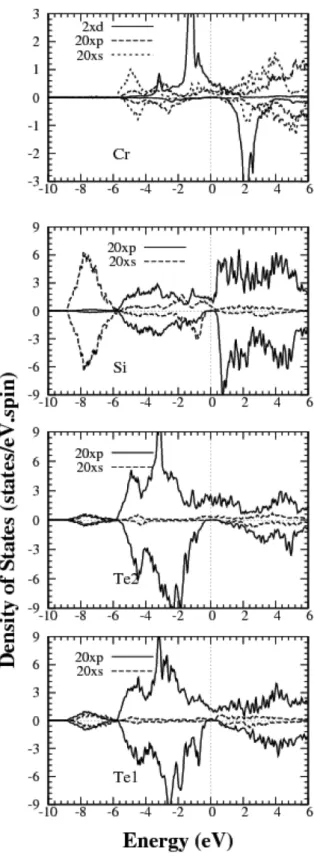
The magnetic properties of the CrSi3Te4 and CrSiTe2 revealed in the above discussion are confirmed by the calculated densities of states (DOS) in the two systems. In Fig. 1, the atom-projected DOS’s are shown as calculated for the atoms in CrSi3Te4. The minority spin states are represented by negative values and the Fermi levels are set to zero. The almost zero value of the minority DOS’s of all the atoms implies nearly half-metallic characters of this compound. From the DOS of Cr atom, we see that the contribution by the spin-up and spin-down electrons differ much from each other, which is the result of the magnetic properties of the isolated Cr atoms. The other DOS, i.e. those calculated for Te1, Te2, and Si atoms, are much more symmetric in the plot, as a result of a weak polarization of the electrons localized within the MT spheres.
The polarization of the electrons on non-magnetic atoms is due to the hybridization of the electronic states with the localized d electrons on Cr atom. Sharp peaks in the DOS pictures calculated for Te1 and Te2 atoms are evidence of the hybridization. In CrSi3Te4, d electrons of Cr atom strongly interact with p electrons for Te1 atom. Since the Si atom is surrounded by Te atoms only, its electronic Table I. Number of l-decomposed majority and minority spin-electrons inside muffin-tin spheres, and magnetic moments (µB) for CrSi3Te4 and CrSiTe2.
CrSi3Te4
Atom s (↑/↓) p (↑/↓) d (↑/↓) Total (↑/↓) MM [µB]
Cr 0.14 (0.09/0.05) 0.11 (0.06/0.05) 3.94 (3.75/0.19) 04.21 (3.91/0.30) −3.61
Si 1.35 (0.67/0.68) 0.93 (0.48/0.45) 0.10 (0.05/0.05) 02.38 (1.20/1.18) −0.02
Te1 1.49 (0.73/0.73) 2.16 (1.07/1.09) 9.99 (5.00/4.99) 13.63 (6.81/6.82) −0.01
Te2 1.49 (0.73/0.73) 2.20 (1.06/1.14) 9.99 (5.00/4.99) 13.65 (6.79/6.86) −0.07
CrSiTe2
Atom s (↑/↓) p (↑/↓) d (↑/↓) Total (↑/↓) MM [µB]
Cr 0.14 (0.09/0.05) 0.11 (0.06/0.05) 3.95 (3.76/0.19) 04.20 (3.91/0.29) −3.62
Si 1.34 (0.66/0.68) 0.93 (0.49/0.44) 0.10 (0.05/0.05) 02.39 (1.21/1.18) −0.03
Te1 1.49 (0.73/0.73) 2.20 (1.06/1.14) 9.99 (5.00/4.99) 13.65 (6.79/6.86) −0.07
Te2 1.48 (0.73/0.72) 2.23 (1.05/1.18) 9.99 (5.00/4.99) 13.68 (6.78/6.900 −0.12
properties are not influenced directly by the presence of the TM element.
In Fig. 2, the calculated atom-projected DOS’s for the atoms in CrSiTe2 are shown. In this structure, there are Fig. 1. The atom-projected spin-polarized density of states for
the atoms in CrSi3Te4. The negative values represent spin down states and the Fermi levels are set to zero.
Fig. 2. The atom-projected spin-polarized density of states for atoms in CrSiTe2. The negative values represent spin down state and the Fermi levels are set to zero.
twice as many Cr atoms as there were in CrSi3Te4. Therefore, the interactions of Cr with Si atoms are stronger, even though they are still indirect. These interactions are helpful to manifest the half-metallicity in the compound.
We observe around 1 eV band gap in the minority spin states.
The spin-up d states of Cr are more strongly localized than the Cr atom in the CrSi3Te4, and the exchange splitting between the majority- and the minority spin DOS is
~3.6 eV. The electronic states of Te1 and Te2 atoms are slightly different to those of Te1 and Te2 atoms in the CrSi3Te4. This is due to the different symmetry of the two compounds and so different surroundings of the Te atoms.
IV. Conclusion
We have investigated the electronic structure and the magnetic properties of ternary CrSinTen + 1 (n = 1, 2) com- pounds by the FLAPW band method. The compounds were obtained by partially substituting the 3d transition metal for Si in the Si fcc sublattice of the rock-salt SiTe lattice. The calculated total MM of 50 % substituted SiTe is 4µB and of 25 % substituted compound the total MM is slightly larger than 4µB. This implies that the half metallicity is obtained for tetragonal CrSiTe2 but the cubic CrSi3Te4 is nearly half metallic. The presence of Cr atoms causes the other atoms become slightly polarized in both the cubic CrSi3Te4 and the tetragonal CrSiTe2. The presence of Cr in the structures causes negative polarization of Te atoms and positive polarization of Si atoms. The two compounds are expected to be applied in spintronics because of their half-metallicity or nearly half-metallicity.
References
[1] Y. D. Park, A. T. Hanbicki, S. C. Erwin, C. S. Hellberg, J. M. Sullivan, J. E. Mattson, T. F. Ambrose, A. Wilson, G. Spanos, and B. T. Jonker, Science 295, 651 (2002).
[2] S. Cho, S. Choi, S. C. Hong, Y. Kim, J. B. Ketterson, B. J. Kim, Y. C. Kim, and J. H. Jung, Phys. Rev. B 66, 033303 (2002).
[3] A. Punnoose, K. M. Reddy, J. Hays, A. Thurber, and
M. H. Engelhard, Appl. Phys. Lett. 89, 112509 (2006).
[4] S. A. Chambers, Mater. Today 5, 34 (2002).
[5] D. Chiba, M. Yamanouchi, F. Matsukara, and H. Ohno, Science 301, 943 (2003).
[6] V. I. Litvinov and V. K. Dugaev, Phys. Rev. Lett. 86, 5593 (2001).
[7] X. Luo and R. M. Martin, Phys. Rev. B 72, 035212 (2005).
[8] M. V. Schilfgaarde and O. N. Mryasov, Phys. Rev. B 63, 233205 (2001).
[9] H. Saito, V. Zayets, S. Yamagata, and K. Ando, Phys.
Rev. Lett. 90, 207202 (2003).
[10] M. J. Seong, H. Alawadhi, I. Miotkowski, A. K. Ramdas, and S. Miotkowska, Phys. Rev. B 63, 125208 (2001).
[11] S. Jun Hu, S. Shen Yan, M. Wen Zhao, and L. Mo Mei, Phys. Rev. B 73, 24520 (2006).
[12] R. D. McNorton, T. M. Schuler, J. M. MacLaren, and R. A. Stern, Phys. Rev. B 78, 075209 (2008).
[13] S. A. Chambers and B. Gallagher, New J. Phys. 10, 055004 (2008).
[14] T. Jungwirth, J. Sinova, J. Masek, J. Kucera, and A. H.
MacDonald, Rev. Mod. Phys. 78, 809 (2006).
[15] I. Zutic, J. Fabian, and S. D. Sarma, Rev. Mod. Phys. 76, 323 (2004).
[16] M. Yamada, K. Ono, M. Mizuguchi, J. Okabayashi, M.
Oshima, M. Yuri, H. J. Lin, H. H. Hsieh, and C. T. Chen, H. Akinaga, J. Appl. Phys. 91, 7908 (2002).
[17] H. Saito, W. Zaets, S. Yamagata, Y. Suzuki, and K. Ando, J. Appl. Phys. 91, 8085 (2002).
[18] Y. Fukuma, H. Asada, J. Miyashita, N. Nishimura, and T.
Koyanagi, J. Appl. Phys. 93, 7667 (2003).
[19] Y. H. Zhao, W. H. Xie, L. F. Zhu, and B. G. Liu, J. Phys.:
Condens. Matter 18, 10259 (2006).
[20] E. Wimmer, H. Krakauker, M. Weinert, and A. J. Free- man, Phys. Rev. B 24, 864 (1981), and references therein; M. Weinert, E. Wimmer, and A. J. Freeman, ibid.
26, 4571 (1982).
[21] J. P. Perdew, K. Burke, and M. Ernzerhof, Phys. Rev.
Lett. 77, 3865 (1996).
[22] W. Kohn and L. J. Sham, Phys. Rev. A 140, 1133 (1965).
[23] M. Weinert, G. Schneider, R. Podloucky, and J. Redinger, J. Phys.: Condens. Matter 21, 084201 (2009).