카모마일 꽃 추출물의 Candida albicans 기인성 감염성 관절염에 대한 효과
김정현·김송이*·홍유나**·김영식**·한용문#
동덕여자대학교 약학대학 면역·미생물학교실, *식품의약품안전평가원 의약품심사부,
**서울대학교 약학대학 천연물연구소
(Received June 30, 2014; Revised August 28, 2014; Accepted September 26, 2014)
Effect of Chamomile Flower Extract on Septic Arthritis due to Candida albicans
Jeonghyeon Kim, Songyi Kim*, Yuna Hong**, Yeong Shik Kim** and Yongmoon Han# College of Pharmacy, Dongduk Women’s University, Seoul 136-714, Korea
*National Institute of Food and Drug Safety Evaluation, Osong 361-709, Korea
**College of Pharmacy, Seoul National University, Seoul 151-742, Korea
Abstract — In the present studies, we examined effect of chamomile flowers extract (CH-Ex), which has traditionally been used as antiphlogistics in Europe for many centuries, against Candida albicans-caused septic arthritis. Candida albicans is a major etiological agent among fungal septic arthritis. This effect was investigated in a murine model of the septic arthritis.
That is, mice that were given an emulsion form of C. albicans cell wall (CACW) via footpad route were treated intra- peritoneally with the CH-Ex for 3 times every 3 days. Degrees of the footpad-swellings were measured with dial gauger.
Data showed that the CH-Ex resulted in the reduction of swelling. For instance, at Day 9 when swelling reached the highest peak, there was up to app. 60% reduction of edema in mice injected with the CH-Ex, compared to that of the control mice that received no treatment (P<0.05). This therapeutic anti-arthritic activity appeared to be mediated by inhibitions of NO (nitric oxide) production from activated RAW264.7 macrophages and proliferation of Con A-treated T lymphocytes. Analysis by HPLC revealed that the CH-Ex contained eight polyphenolic compounds including chlorogenic acid (CRA) and rutin. We have reported the CRA and rutin respectively have the anti-arthritic activity. This correlation implicates that CRA and rutin in the CH-Ex may be responsible for the activity. Combined all together, the CH-Ex has anti-arthritic activity against C. albi- cans-caused septic arthritis, possibly by inhibiting NO production and proliferation of T cells. This activity seems to be con- tributed by, at least, CRA and rutin among the compounds in the CH-Ex.
Keywords □ chamomille flowers extract, Candida albicans, septic arthritis, macrophage, T lymphocyte, chlorogenic acid, rutin
관절염은 관절기형으로 인한 통증 때문에 일상생활에 지장을 초래하는 고질적인 질환의 한 종류로, 일반적으로 관절염은 노 화로 인한 퇴행성 관절염인 골관절염(osteoarthritis)과 류마티스 관절염(rheumatoid arthritis)으로 구분된다. 류마티스 관절염은 감염이 진행되는 동안 발생하는 일시적 관절염과, 감염병 치료 후에도 관절염이 지속되는 만성적 관절염이 있다. 후자의 경우 를 감염성 관절염(Septic arthritis 또는 Infectious arthritis)이라
고 한다. Septic arthritis의 원인이 되는 세균으로는 황색포도상 구균(Staphylococcus aureus)이 가장 대표적이며 진균 중에서는 Candida albicans가 대표적이다.1-3) C. albicans 기인성 관절염은 최근에 증가하는 추세이다.2,3) 세균성 관절염 치료에는 항생제와 항류마티스 약물(예: DMARDs, Disease-Modifying Anti- Rheumatic Drugs)을 병용하며, 진균성 관절염은 Azole 계열 약 물과 amphotericin B와 같은 polyene 계열의 항진균제를 단독 또는 병용한다.4) DMARDs는 항관절염 효과가 낮고 신독성과 간 독성의 부작용이 있으며 장기복용 시 약물에 대한 내성증가 및 기회감염의 증가 때문에 사용에 제한이 있다.5-7) NSAIDs(non- steroidal anti-inflammatory drugs)의 경우에는 통증과 경직성 증 상의 감소효과는 있으나 연골조직보호 같은 근본적 치료를 기대 할 수가 없고, COX-1 효소도 함께 억제하기 때문에 위장관 장
#Corresponding Author Yongmoon Han
College of Pharmacy, Dongduk Women's University, Seoul 136- 714, Korea
Tel.: 02-940-4521 Fax.: 02-940-4195 E-mail: [email protected]
종설
애, 간 기능과 신장 기능의 저하, 고혈압발생 등의 부작용이 수 반되기도 한다.7) 그러므로 부작용이 적고 효과가 높은 새로운 항 관절염 약물의 발견이 필요하다. 이런 관점에서 본 연구실에서 는 문헌조사와 기초 탐색연구를 통해서 German chamomile (Matricaria chamomilla, a family of Compositae)을 선정하였다.
유럽에서는 오래 전부터 카모마일은 항염증제로 사용해왔는 데,8) 최근에 과학적으로 카모마일의 항염증효과가 규명되었
다.9,10)이 외에도, 카모마일은 진경 및 진정작용11,12)그리고 항
당뇨 효과13)등 다양한 약물 효능 등이 있는 것으로 보고되고 있다. 이들 효능 중에서도 특히 카모마일의 항염증효과는 페놀 성 화합물(polyphenolic compound)에 연유하는 것으로 알려져
있다.9,10,14-16)카모마일 페놀성 화합물은 apigenin, quercetin,
patuletin, luteolin이 있는데,14-16) luteolin이 항염효과에 주요성 분으로 알려져 있다.9)그러나 이렇게 카모마일 페놀성 화합물의 항염효과가 잘 알려진 반면, 관절염과 같은 특정 염증유발질환 에 대한 카모마일의 효능에 대해서는 알려진 것이 거의 없다.
이에, 카모마일 추출물의 항관절염 효과를 규명하기 위해 본 연구실에서 고안한 C. albicans 기인성 관절염 동물모델17-19)을 사용하여 그 효능을 조사하였다. 아울러 항염증 작용기전도 검 색하였다. 작용기전 검색을 위해서 NO(nitric oxide) 생성억제 효과와 CD4+T 임파구 증식억제 여부를 조사하였다. 이 연구 주제의 선택 이유는 다음과 같다. 관절염 형성 과정에는 macrophage, B 임파구, mast cells, fibroblast-like synoviocyte 등 의 과다 활성으로 인해 분비되는 염증 유발물질이 관여하고,20-22) CD4+T 임파구 증식에서 발생되는 염증성 cytokine 분비가 관 절염 유발에 주요한 원인이 되기 때문이다.23-25)그러므로 CD4+
T 임파구의 증식을 억제하는 인자는 관절염을 조절할 수 있을 것으로 간주된다. 끝으로, 본 연구에서 사용한 카모마일 추출물 에 함유된 페놀성 성분의 종류들을 분석하여 항관절염 효과에 관 련된 페놀성 화합물의 연관성을 아울러 평가하였다.
실험재료 및 방법
실험동물
6~7주령의 BALB/c 암컷생쥐(Charles River Lab, NY, USA) 를 사용하였고 멸균된 사료(Central Lab, Animal Inc. Seoul, Korea) 및 물을 제공하였으며, 실험동물이 이를 자유롭게 먹도록 하였다. 이들 생쥐는 동물실 환경에서 1주일간 적응시킨 후 실 험에 사용하였다. 동물관리는 동덕여자대학교 동물관리규정과 동 물사용윤리위원회 승인[IRB: 동덕동물201403-02]에 따라 동물을 관리 및 사용하였다.
Chamomile flowers extract (CH-Ex)
10 gram의 카모마일 꽃봉오리(Chamomillae Flos, Chamomile
flowers)를 100% 증류수(100 ml)에 시킨 후 열수 추출방법을 통 해서 60분씩 3회 추출 후 건조한 다음에 본 실험에 사용하였다.
본 추출물에 함유한 페놀성 성분의 종류를 확인하기 위해 HPLC 방법으로 분석하였다. 사용된 HPLC에서 이동상은 0.5%
phosphoric acid을 용매 A로 사용하고 용매 B로는 메탄올 사용 하였다. 유출초기는 0.5% phosphoric acid을 포함하는 메탄올 20%에서 시작하여 65분까지 최종 메탄올 농도가 60%까지 점차 증가하는 농도차(Gradient)를 이용하였다. 시료(0.2 µg/ml) 10 µl 을 Cosmosil 5C18-AR-II(4.6×150 mm) 칼럼에 주입한 후 유속 을 0.8 ml/min으로 조절하여 용출액을 파장(340 nm)하에서 측정 하였다. 분석결과는 각 표준품을 상기 동일한 방법으로 용출한 결과(retention time)과 비교하여 동정하였다. 적용한 표준품으로 는 chlorogenic acid, ferulic acid, luteolin-5-O-glucoside, rutin, hyperoside, apigenin-7-O-glucoside, luteolin, apigenin를 사용하 였다.
C. albians cell wall extract (CACW)의 분리
C. albians의 세포벽 분리는 본 연구실에서 개발한 방법을 사 용하였다.26-28)이 방법을 간략히 기술하면 다음과 같다. GYEP (glucose-yeast extract peptone) 액체배지에 배양한 C. albicans 균을 수집하여 disodium EDTA와 trisodium EDTA으로 연속 처 리하고, 2-mercaptoethanol로 처리한 후 상등액을 수집하여 투 석막(membrane cut-off=12,000 Da)에 넣고 멸균된 탈 이온수를 투석액으로 하여 3일간 투석하였다. 투석이 완료된 후 투석막 내 부물질을 동결 건조하여 분말화 하였다. 추출한 세포벽은 desiccator안에 저장·보관하였다.
C. albicans 기인성 관절염에 대한 효과검색
본 연구실의 기 연구에서 정립된 관절염 동물모델17-19)을 사용 하여 카모마일 추출물(CH-Ex)의 항관절염 효과를 검색하였다.
실험방법을 간략히 기술하면 다음과 같다. 1 ml 광유(mineral oil) 와 동일부피의 DPBS(Dulbecco's phosphate buffered saline solution; Sigma)에 용해한 C. albicans cell wall(CACW; 1 mg) 을 혼합하여 sonicator로 유화시킨 후, syringe를 이용하여 50 µl/
mouse 용량으로 생쥐의 발바닥 피하에 주사하였다. 이틀 후 족 부종이 발생한 생쥐에 CH-Ex를 1회 1 mg/mouse 농도로, 3일 에 한번씩 3회(Day 3, 6, 9) 복강 내 투여하였다. 양성대조군 생쥐에는 Indomethacin(60 µg/mouse)을 투여하였다. 족부종의 생성 정도는 지정한 날짜에 dial calipers(Mitatoyo Co., IL, USA)를 사용하여 측정하였다. 각 그룹은 생쥐 5마리씩으로 구 성하였으며, 부종 억제정도는 [(대조군의 일정시간 후의 평균 부종율−약물투여군의 일정시간후의 평균 부종율)/대조군의 일 정시간 후의 평균부종율]×100으로 계산하여 부종 억제율(%)로 환산하였다.
Nitric oxide(NO) 생성억제 검색
본 연구실의 기 실험에 고안한 방법17-19)을 사용하여 CH-Ex 의 NO 생성 억제여부를 검색하였다. 즉, RPMI 1640 배지 (Sigma)에 배양한 RAW264.7 monocyte/macrophage cell line을 LPS로 처리한 후, 다양한 농도의 CH-Ex로 처리하고 Griess 시 약을 사용하여 NO 생성억제 유무를 조사하였다. 대조군으로 LPS (Lipopolysaccharide; Sigma)만으로 처리한 RAW264.7 macrophage 를 사용하였다.
T-임파구의 증식 억제효과
이 효과 측정을 위해 기 실험에서 고안한 방법을 사용하였
다.18,19,29)생쥐에서 적출한 비장(spleen)에서 splenocyte를 분리
하여 RPMI 1640 배지에 넣고 35oC-CO2배양기에서 24시간 배 양한 후, 이 splenocyte(5×10⁶cells/well)에 concanavalin A(5 µg/ml; Sigma)를 투여하고 다양한 농도(5~80 µM)의 CH-Ex를 첨가하였다. 72시간 배양한 다음에 CCK-8(Cell Count Kit-8)을 투여하고 3시간 추가 배양 후 T-임파구의 증식 억제효과를 검색 하였다.
통계 처리
실험결과는 평균±표준오차(Mean±S.E.)로 계산하였다. 각 군 간의 유의성 검증은 Student's t-test를 사용하였고 P<0.05 일 때에 유의성이 있는 것으로 판정하였다.
실험결과 및 고찰
C. albicans 기인성 관절염에 대한 치료효과
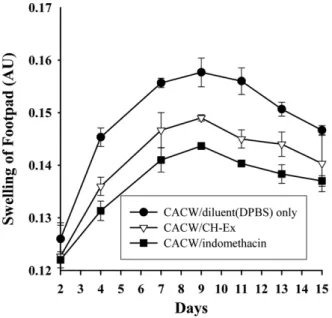
생쥐 발바닥에 C. albicans 세포벽(CACW) 주사로 족부종이 생긴 다음에 CH-Ex를 투여 받은 생쥐위 경우는 CH-Ex 대신에 DPBS 완충용액을 투여 받은 음성대조군에 비해서 15일 간의 관 측기간 전반적으로 족부종이 감소되었다(Fig. 1). 일예로, 족부종 이 가장 피크에 도달한 관측 9일째 실험군과 음성대조군을 상호 비교하면 약 60% 정도의 족부종이 억제되었다(P<0.05)(Fig. 1).
족부종 억제효과는 총 관찰기간 종료 때까지 지속적으로 유지되 었다. 그러나 CH-Ex의 억제효과는 indomethacin을 투여 받은 양성대조군에 비해서 효능이 떨어지는 것으로 관측되었다(Fig.
1). 반복 실험에서도 유사한 결과가 관찰되었다.
NO 생성 억제효과
CH-Ex의 항관절염 작용기전을 조사하기 위해 LPS로 활성화 된 macrophage에서 분비되는 NO(nitric oxide) 생성에 대한 억 제효과를 측정하였다. 그 결과, CH-Ex로 처리한 macrophage에 서의 NO 생성량은 LPS 만으로 처리한 macrophage와 비교해서 농도 의존적으로 감소되었다(Fig. 2). 일예로, 40 µg/ml 농도의
Fig. 1 − Extract of Chamomillae Flos (CH-Ex) has therapeutic anti- arthritic activity against C. albicans cell wall (CACW)- caused septic arthritis. Footpad-swellings of mice having septic arthritis caused by C. albicans cell wall reduced by CH-Ex treatment. Repeated experiments displayed the similar results. Thickness of the edema was measured by a dial gauger in arbitrary unit (AU). Each group contained five mice. Bar indicates SE.
Fig. 2 − The CH-Ex inhibits the production of nitric oxide (NO) from LPS-treated macrophages. To determine if CH-Ex blocks NO production, RAW 264.7 macrophage cell line was activated by LPS before CH-Ex addition. Data indicate that the extract results NO production from LPS-activated macrophages. For example, CH-Ex at 40µg/ml reduced approximately 70% of NO production as compared with the activated macrophages that received only DPBS (diluent) (P<0.05). These values were averages of triplicate repeated experiments. Bar indicates SE.
CH-Ex에서 대조군에 비해서 약 70%의 NO 생성이 억제되었다 (P<0.05)(Fig. 2). 이 결과로 CH-Ex는 항염 효과가 있음이 확인 되었다.
T-임파구의 증식 억제효과
T-임파구는 관절염을 악화하므로 CH-Ex의 T-임파구 증식에 대해 조사하였다. 증식이 억제되면 이 또한 작용 기전으로 간주 할 수 있기 때문이다. T-임파구 증식을 촉진하는 concanavalin A (Con A)로 처리한 T-임파구에 CH-Ex를 첨가하여 증식억제 여 부를 조사한 결과, 20 µg/ml와 40 µg/ml의 농도에서는 각각 56%
와 78% 이상의 증식이 억제되었다(P<0.05)(Fig. 3).
CH-Ex 내의 성분 분석
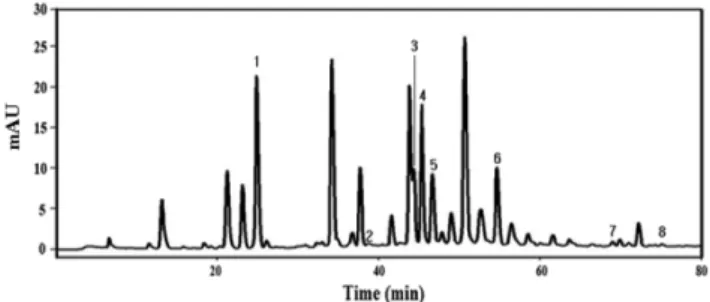
CH-Ex에 함유된 성분을 HPLC 방법으로 분석하였다. 시료 주 입 후 생성된 피크는 80분 이내에 모두 유출되었다. 본 추출물 에 함유된 페놀성 성분은 column으로부터 유출되는 순서에 따 라 chlorogenic acid, ferulic acid, luteolin-5-O-glucoside, rutin, hyperoside, apigenin-7-O-glucosidse, luteolin, apigenin 등 모두 여덟 종류가 검출되었다(Fig. 4). 이 검색 결과는 타 연구자의 결
과9,14-16)와 거의 유사하고, mAU value를 비교해 볼 때 그 value
가 가장 큰 성분은 luteolin, apigenin과 이들 성분의 배당체였다
(Fig. 4). 또한 CH-Ex에는 chlorogenic acid와 rutin가 감색되었 는데, 본 연구실의 기 연구에서 두 성분은 각각 C. albicans 기 인성 관절염에 치료효과가 있음을 보고한 바 있다.18,19)
결 론
카모마일은 주로 허브차(Herb tea)와 방향제 성분 등으로 국 내에서 사용되고 있지만, 유럽에서는 오래 전부터 항염제로 사 용되어 왔다. 최근에 이 약용식물의 추출물에 대한 약물학적 연 구 결과가 보고 되었지만, 진균 중에서 가장 많은 문제를 야기하 는 C. albicans로 기인하는 감염성 관절염에 대한 효과는 아직 보고된 적이 없다. 이에, 본 연구에서는 카모마일 꽃봉오리 (Chamomillae Flos; Chamomile flowers)의 추출물의 항관절염 효과를 조사하였다. 본 연구에서 사용한 관절염 동물모델은 기 연구결과의 발표를 통해서 검증된 것이다. 연구결과를 보면, CH- Ex는 감염성 관절염에 대해 치료 효과가 있으며, 이 치료 효과 의 작용 기전은 활성화 된 macrophage에서 분비되는 NO(nitric oxide) 생성의 억제가 관여하는 것으로 평가되었다. 일반적으로 관절염이 유발되면 macrophage가 그 관절염 발생 부위로 유입 되어부종이 형성되고,21,30,31)자극된 macrophage에서 NO가 분 비되어 주변의 세포와 조직을 파괴하기 때문에 통증이 야기되는
것이다.20,23)그러므로 CH-Ex가 염증 부위에 유입된 macrophage
에서 NO 생성의 억제 효과가 있다는 것은 매우 중요한 작용 기 전으로 간주된다. 두 번째 작용 기전 검색으로, CH-Ex 추출물은 T-임파구의 증식을 억제함을 규명하였다. 이는 관절염유발에 관 여하는 CD4+T 임파구 제거를 위해 단항체요법(anti-CD4 T- lymphocyte monoclonal antibody)이 관절염 치료제로 작용하는 것과 일맥상통하다고 사료된다. 다른 흥미로운 점은, 본 추출물 에 chlorogenic acid와 rutin이 함유되어 있다는 점이었다. 사실 본 연구는 오직 문헌고찰을 통해서 카모마일을 선정하여 시작하 게 되었고, 이 후에 약용식물의 추출물 효과를 조사하면서 추출 물 내에 chlorogenic acid와 rutin이 함유되어 있음을 인지하게 되었다. 그래서, CH-Ex의 C. albicans 기인성 관절염에 대한 치 Fig. 3 − The CH-Ex suppresses the proliferation of Con A-treated T
cells dose-dependently. To determine if T-cells are involved in reduction of the septic arthritis, CH-Ex effect on T-cell proliferation was examined. Results displayed that the proliferation was inhibited by the CH-Ex treatment. At 20 and 40µg/ml of CH-Ex, there were almost 56% and 78%
reduction of the proliferation, respectively (P<0.05). These values were averages of triplicate repeated experiments.
Bar indicates SE.
Fig. 4 − The polyphenol profile in the CH-Ex. HPLC analysis was utilized to determine polyphenolic compounds in the CH- Ex. This determination revealed 8 kinds of polyphenols in the extract as compared with their respective standards.
료 효능을 더 확신할 수가 있었다. 그 이유는 상기에 언급하였듯 이 이 두 성분의 항관절염 효과를 기 연구에서 이미 규명하였기 때문이다. 한편, CH-Ex에 함유된 다른 페놀성 성분들(예: luteolin)
도9,10)항관절염 효과에 일조하였을 것으로 추정은 하지만 직접
적인 데이터는 없다. 이와 관련하여, 나머지 성분들의 본 감염성 관절염에 대한 효과 검색이 고려된다. 결론적으로, 본 연구를 통 해서 카모마일 추출물이 Candida 감염성 관절염에 효능이 있고, 이 결과를 통해서 부작용이 심한 기존의 관절염 치료제를 대신 할 수 있는 대체의약품의 가능성을 제시하였다.
References
1) Cuende, E., Barbadillo, C. E., Mazzucchelli, R., Isasi, C., Trujillo, A. and Andreu, J. L. : Candida arthritis in adult patients who are not intravenous drug addicts: report of three cases and review of the literature. Semin Arthritis Rheum. 22, 224 (1993).
2) Lerch, K., Kalteis, T., Schubert, T., Lehn, N. and Grifka, J. : Prosthetic joint infection with osteomyelitis due to Candida albicans. Mycoses. 46, 462 (2003).
3) Azaceta, G., Olave. T., de los Martires, L. D., Delgado, C., Gutierrez, M. and Palomera, L. : Successful lipid-complexed amphotericin B treatment of Candida arthritis in a lymphoma patient. Rev. Rhum. Engl. 66, 434 (1999).
4) Choi, I. S., Kim, S. J., Kim, B. Y., Joh, J. W., Kim, Y. I., Lee, S. K., Huh, W. S., Oh, H. Y., Kim, D. J., Kim, Y. G., Kim, M. K., Ko, Y. H. and Lee, B. B. : Candida polyarthritis in a renal transplant patient: case report of a patient successfully treated with amphotericin B. Transplant Proc. 32, 1963 (2000).
5) Lee, D. M. and Weinblatt, M. E. : Rheumatoid arthritis. Lancet.
358, 903 (2001).
6) Felson, D. T., Anderson, J. J. and Meena, R. F. : Use of short- term efficacy/toxicity tradeoffs to select second-line drugs in rheumatoid arthritis: a metaanalysis of published clinical trials.
Arthritis Rheum. 35, 1117 (1992).
7) Bauer, H. and Marker-Hermann, E. : Therapy with nonsteroidal anti-inflammatory drugs. Orthopade. 32, 1088 (2003).
8) Drummond, E. M., Harbourne, N., Marete, E., Martyn, D., Jacquier, J., O'Riordan, D. and Gibney, E. R. : Inhibition of proinflammatory biomarkers in THP macrophages by polyphenols derived from chamomile, meadowsweet and willow bark. Phytother Res. 27, 588 (2013).
9) Taliou, A., Zintzaras, E., Lykouras, L. and Francis, K. : An open-label pilot study of a formulation containing the anti- inflammatory flavonoid luteolin and its effects on behavior in children with autism spectrum disorders. Clin Ther. 35, 592 (2013).
10) Bhaskaran, N., Srivastava, J. K., Shukla, S. and Gupta, S. :
Chamomile confers protection against hydrogen peroxide- induced toxicity through activation of Nrf2-mediated defense response. Phytother Res. 27, 118 (2013).
11) Kagawa, D., Jokura, H., Ochiai, R., Tokimitsu, I. and Tsubone, H. : The sedative effects and mechanism of action of cedrol inhalation with behavioral pharmacological evaluation. Planta Med. 69, 637 (2003).
12) Abebe, W. : Herbal medication: potential for adverse interactions with analgesic drugs. J. Clin. Pharm. Ther. 27, 391 (2002).
13) Weidner, C., Wowro, S. J., Rousseau, M., Freiwald, A., Kodelja, V., Abdel-Aziz, H., Kelber, O. and Sauer S. : Antidiabetic effects of chamomile flowers extract in obese mice through transcriptional stimulation of nutrient sensors of the peroxisome proliferator-activated receptor (PPAR) family.
PLoS One. 8, e80335 (2013).
14) McKay, D. L. and Blumberg, J. B. : A review of the bioactivity and potential health benefits of chamomile tea (Matricaria recutita L.). Phytother Res. 20, 519 (2006).
15) Trouillas, P., Calliste, C. A., Allais, D. P., Simon, A., Marfak, A., Delage, C. and Duroux, J. L. : Antioxidant, antiinflammatory and antiproliferative properties of sixteen water plant extracts used in the Limousin countryside as herbal teas. Food Chem.
80, 399 (2003).
16) Mueller, M., Hobiger, S. and Jungbauer, A. : Anti-inflammatory activity of extracts from fruits, herbs and spices. Food Chem.
122, 987 (2010).
17) Han, Y. : Ginkgo terpene component has an anti-inflammatory effect on Candida albicans-caused arthritis. Int.
Immunopharmacol. 5, 1049 (2005).
18) Lee, J. H., Park, J. H., Kim, Y. S. and Han, Y. : Chlorogenic acid, a polyphenolic compound, treats mice with septic arthritis caused by Candida albicans. Int. Immunopharmacol. 8, 1681 (2008).
19) Han, Y. : Rutin has therapeutic effect on septic arthritis caused by Candida albicans. Int. Immunopharmacol. 9, 207 (2009).
20) Kinne, R. W., Brauer, R., Stuhlmuller, B., Palombo-kinne, E.
and Burmester, G.-R. : Macrophages in rheumatoid arthritis.
Arthritis Res. 2, 189 (2000).
21) Nissler, K., Pohlers, D., Huckel, M., Simon, J., Brauer, R. and Kinne, R. W. : Anti-CD4 monoclonal antibody treatment in acute and early chronic antigen induced arthritis: influence on macrophage activation. Ann. Rheum. Dis. 63, 1470 (2004).
22) Paniagua, R. T., Sharpe, O., Ho, P. P., Chan, S. M., Chang, A., Higgins, J. P., Tomooka, B. H., Thomas, F. M., Song, J. J., Goodman, S. B., Lee, D. M., Genovese, M. C., Utz, P. J., Steinman, L. and Robinson, W. H. : Selective tyrosine kinase inhibition by imatinib mesylate for the treatment of autoimmune. J. Clin. Invest. 116, 2633 (2006).
23) Colic, M., Vucevic, D., Kilibarda, V., Radicevic, N. and Savic, M. : Modulatory effects of garlic extracts on proliferation of T- lymphocytes in vitro stimulated with concanavalin A.
Phytomedicine. 9, 117 (2002).
24) Gao, X., Deeb, D., Media, J., Divine, G., Jiang, H., Chapman, R. A. and Gautam, S. C. : Immunomodulatory activity of resveratrol: discrepant in vitro and in vivo immunological effects. Biochem. Pharmacol. 66, 2427 (2003).
25) Ranjan, D., Chen, C., Johnston, T. D., Jeon, H. and Nagabhushan, M. : Curcumin inhibits mitogen stimulated lymphocyte proliferation, NFkappaB activation, and IL-2 signaling. J. Surg. Res. 121, 171 (2004).
26) Han, Y. and Cutler, J. E. : Antibody response that protects against disseminated candidiasis. Infect Immun. 63, 2714 (1995).
27) Han, Y., Kozel, T. R., Zhang, M. X., MacGill, R. S., Carroll, M. C. and Cutler, J. E. : Complement is essential for protection by an IgM and an IgG3 monoclonal antibody against experimental, hematogenously disseminated candidiasis. J.
Immunol. 167, 1550 (2001).
28) Han, Y., Ulrich, M. A. and Cutler, J. E. : Candida albicans mannan extract-protein conjugates induce a protective immune response against experimental candidiasis. J. Infect.
Dis. 179, 1477 (1999).
29) Kim, J., Joo, I., Kim, H. and Han, Y. : 18β-glycyrrhetinic acid induces immunological adjuvant activity of Th1 against Candida albicans surface mannan extract. Phytomedicine. 20, 951 (2013).
30) Lotito, A. P., Muscara, M. N., Kiss, M. H., Teixeira, S. A., Novaes, G. S., Laurindo, I. M., Silva, C. A. and Mello, S. B. : Nitric oxide-derived species in synovial fluid from patients with juvenile idiopathic arthritis. Rheumatol. 31, 992 (2004).
31) Pohlers, D., Nissler, K., Frey, O., Simon, J., Petrow, P. K., Kinne, R. W. and Brauer, R. : Anti-CD4 monoclonal antibody treatment in acute and early chronic antigen-induced arthritis:
influence on T helper cell activation. Clin. Exp. Immunol. 135, 409 (2004).