Factors that Predict Clinical Benefit of EGFR TKI Therapy in Patients with EGFR
Wild-Type Lung Adenocarcinoma
Seo Yun Kim, M.D.
1,* , Jae Kyung Myung, M.D.
2,*, Hye-Ryoun Kim, M.D.
1, Im Il Na, M.D. Ph.D.
3, Jae Soo Koh, M.D., Ph.D.
2, Hee Jong Baek, M.D., Ph.D.
4and Cheol Hyeon Kim, M.D., Ph.D.
11
Division of Pulmonology, Department of Internal Medicine,
2Department of Pathology,
3Division of Hematology/Oncology, Department of Internal Medicine,
4Department of Thoracic Surgery, Korea Cancer Center Hospital, Korea Institute of Radiological and Medical Sciences, Seoul, Korea
Background: Epidermal growth factor receptor ( EGFR ) mutations in non-small cell lung cancers have emerged as key predictive biomarkers in EGFR tyrosine kinase inhibitor (TKI) treatment. However, a few patients with wild-type EGFR also respond to EGFR TKIs. This study investigated the factors predicting successful EGFR TKI treatment in lung
adenocarcinoma patients with wild-type EGFR .
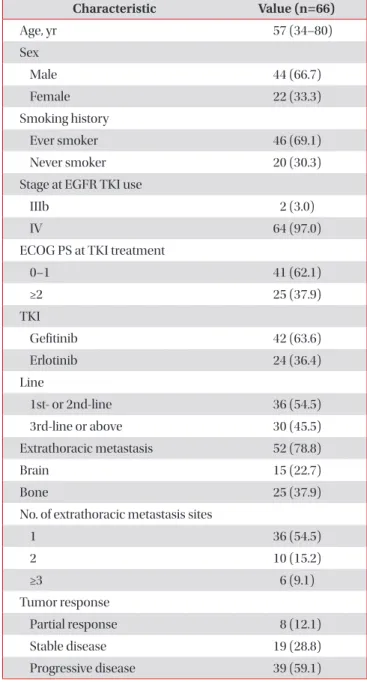
Methods: We examined 66 patients diagnosed with lung adenocarcinoma carrying wide-type EGFR who were treated with EGFR TKIs. The EGFR gene copy number was assessed by silver in situ hybridization (SISH). We evaluated the clinical factors and EGFR gene copy numbers that are associated with a favorable clinical response to EGFR TKIs.
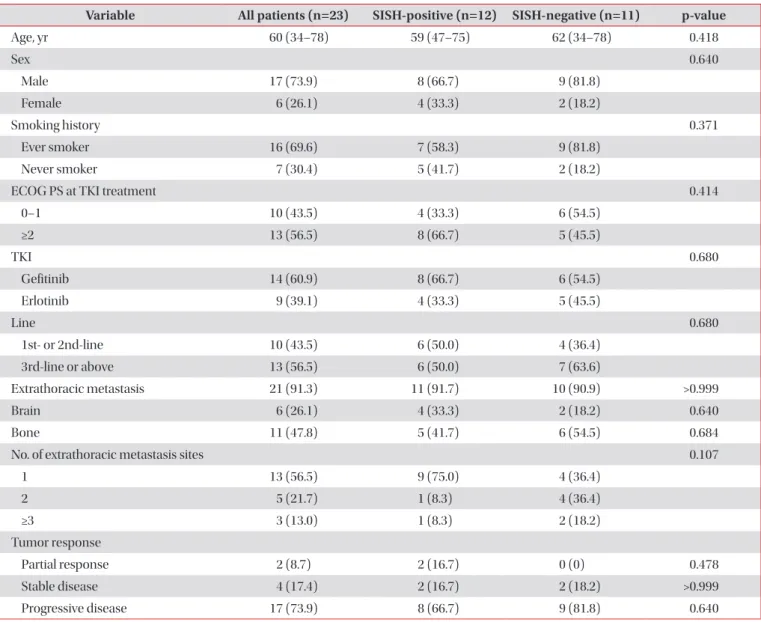
Results: The objective response rate was 12.1%, while the disease control rate was 40.9%. EGFR SISH analysis was feasible in 23 cases. Twelve patients tested EGFR SISH–positive, and 11 were EGFR SISH–negative, with no significant difference in tumor response and survival between EGFR SISH–positive and –negative patients. The overall median progression-free survival (PFS) and overall survival (OS) of 66 patients were 2.1 months and 9.7 months, respectively.
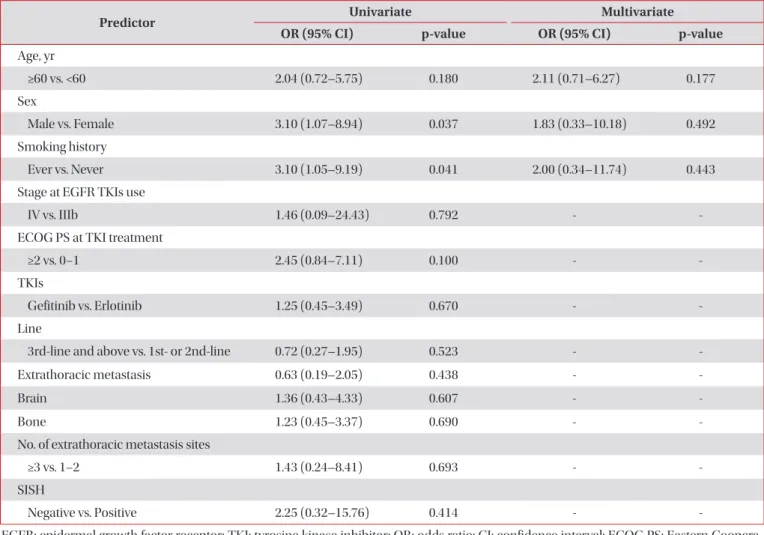
Female sex and Eastern Cooperative Oncology Group (ECOG) performance status (PS) of 0–1 were independent predictors of PFS. ECOG PS 0–1 and a low tumor burden of extrathoracic metastasis were independent predictors of good OS.
Conclusion: Factors such as good PS, female sex, and low tumor burden may predict favorable outcomes following EGFR TKI therapy in patients with EGFR wild-type lung adenocarcinoma. However, EGFR gene copy number was not predictive of survival.
Keywords: Adenocarcinoma; Receptor, Epidermal Growth Factor; Lung Neoplasms
Address for correspondence: Cheol Hyeon Kim, M.D., Ph.D.
Division of Pulmonology, Department of Internal Medicine, Korea Cancer Center Hospital, Korea Institute of Radiological and Medical Sciences, 75 Nowon-ro, Nowon-gu, Seoul 01812, Korea
Phone: 82-2-970-1209, Fax: 82-2-970-2438, E-mail: [email protected]
*Seo Yun Kim and Jae Kyung Myung contributed equally to this work.
Received: Jan. 9, 2018, Revised: Feb. 19, 2018, Accepted: Mar. 24, 2018, Published online: Jun. 19, 2018
cc