한 국 방 재 학 회 논 문 집 제9권 2호 2009년 4월
pp. 11 ~ 15
구조물방재
Elastic Stability of Thin-Walled Arches subjected to Uniform Bending - Linear Bending Normal Strain Distribution -
Ryu, Hyo-Jin* · Lim, Nam-Hyoung** · Lee, Chin-Ok***
···
Abstract
This paper is concerned with the elastic buckling of thin-walled arches that are subjected to uniform bending. Nonlinear strain- displacement relations with the initial curvature are substituted into the second variation of the total potential energy to obtain the energy equation including initial curvature effects. The approximation for initial curvature effects that the bending normal strain distribution is linear across the cross section is applied consistently in the derivation process. The closed form solution is obtained for flexural-torsional buckling of arches under uniform bending and, it is compared with the previous theoretical results.
Key words : Thin-walled arch, Curvature effects, Flexural-torsional buckling, Stability equation
요 지
본 논문에서는 균일 모멘트 하중을 받는 박판 아치의 탄성 좌굴에 관한 연구를 수행하였다. 초기 곡률을 고려한 비선형 변 형률-변위 관계식을 전체 포텐셜 에너지 방정식의 이차 변분에 대입하여 초기 곡률 효과를 포함하는 에너지 방정식을 유도하였 다. 휨 모멘트에 의한 단면 내 법선 변형률이 선형으로 분포한다는 초기 곡률 효과에 대한 가정사항을 유도과정에 일관되게 적용하였다. 균일 모멘트 하중을 받는 아치의 휨-비틀림 좌굴하중에 관한 제차해를 제시하고 타 연구자의 결과와 비교하였다.
핵심용어 : 박판 아치, 곡률 효과, 휨-비틀림 좌굴, 좌굴방정식
···
1. Introduction
This study investigates the stability of arches in the elastic range. The elastic buckling of thin-walled arches that are sub- jected to uniform bending has been studied by a number of researchers. Vlasov (1961) presented closed form solutions for arches subjected to uniform bending by substituting the curva- ture terms of the curved beam in the straight beam equilibrium equations. Yoo (1982) formulated stability equations by substi- tuting the curvature terms of the curved beam in the potential of the straight beam equilibrium equations. Yang and Kuo (1986) used the principle of virtual displacements to obtain differential equilibrium equations and closed form solutions for the buckling of arches with doubly symmetric cross section in uniform bend- ing. Papangelis and Trahair (1987) presented buckling equations by substituting the nonlinear strain-displacement relations in the second variation of the total potential. Kang and Yoo (1994) pre- sented equilibrium equations and closed form solutions for the buckling of doubly symmetric arches using the principle of min- imum total potential energy. Pi et al. (1995) presented energy equations and closed form solutions including the effect of the prebuckling in-plane deformation for the buckling of arches in
uniform bending by substituting the nonlinear strain-displace- ment relations obtained by the position vector in the second variation of the total potential. Lim and Kang (2004) used the principle of minimum total potential energy to obtain governing differential equations using the condition that the bending nor- mal strain distribution is nonlinear. The terms of curvature effects in governing differential equation were approximated by using the binomial series and closed form solutions were obtained for monosymmetric arches subjected to uniform bending.
In this paper, in order to obtain the energy equation including curvature effects for the elastic buckling of arches, the linear bending normal strain distribution is assumed across the cross section and, this approximation for curvature effects is applied consistently in the derivation process. The closed form solution is obtained for flexural-torsional buckling of arches under uni- form bending.
2. Strains and Displacements The basic assumptions made in this study are as follows:
(a) The cross sections retain their original shape.
(b) The shear strains due to change of normal stresses, such as
*충남대학교 대학원 토목공학과 박사과정 (E-mail:[email protected])
**정회원·충남대학교 공과대학 토목공학과 교수(교신저자)
***정회원·충남대학교 공과대학 토목공학과 교수
bending and warping normal stresses, are negligibly small.
(c) The length of the beam is much larger than any other dimensions of the cross section.
(d) The shear strains along the middle surface of the thin- walled cross section are negligibly small.
(e) The normal strain due to bending is linearly distributed in a cross section.
Fig. 1 shows the curvilinear coordinate system of a thin- walled arch. The longitudinal normal strain ε in the coordinate system (x, y, z) shown in Fig. 1 can be written as follows (Usami and Koh, 1980; Kang and Yoo, 1994a):
(1) where u, v, and w are the components of the displacement in the x, y, and z directions, respectively. Note that the normal strain e varies nonlinearly with y as a result of the term. For the case of a curved beam subjected to bending, the normal strain distribution is shown in Fig. 2.
In the curved beam formula proposed by Oden (1967), the non- linearity of the strain is due to the quantity . However, if the value of h/R is small in comparison with unity, the strain distribution is essentially a linear function of y (Oden, 1967). Uti- lizing the result by Oden and the real structure condition where the value of h/R is very small, the variation of ε with y is assumed to be linear with ignoring the term. With this assump- tion, the normal strain in Eq. 1 can be approximated as
(2)
The shear strain due to bending and warping of the thin-
walled section are neglected. The shear strain due to uniform torsion is approximated by
(3) where n is the distance from the mid-thickness surface and k is the twist.
The displacement components are functions of the coordinates, x, y, and z. Using the approaches of Usami and Koh (1980), the displacement at any point can be written in terms of shear center as
(4a)
(4b)
(4c)
where u
oand v
oare a displacement of the shear center in the principal centroidal coordinate system (x, y); θ is a rotation of the cross section about the z-axis; w
cis the longitudinal dis- placement of a cross section, which is same on a cross section, and referred to the average longitudinal displacement; y
ois coor- dinate of the shear center; ω is the normalized warping function according to the principal sectorial coordinate system.
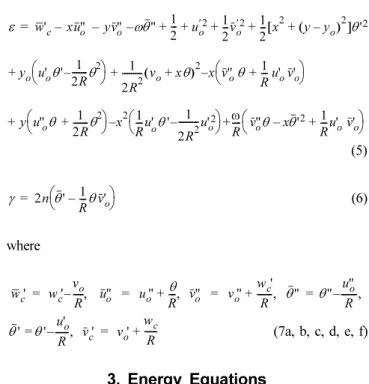
Substituting the displacements given in Eq. 4 into Eq. 2 and 3, the nonlinear longitudinal normal strain and shear strain at a point on the cross section are obtained as follows:
(5)
(6)
where
(7a, b, c, d, e, f)
3. Energy Equations
The critical state of equilibrium is that the second variation δ
2Π of the total potential energy Π is equal to zero, which indi- cates a possible transition from a stable state to an unstable state.
This energetic criterion of buckling state can be written as
ε R
R – y ---
⎝ ⎠
⎛ ⎞ ∂w
--- ∂z v R ---
⎝ – ⎠
⎛ ⎞ 1
2 --- R R – y ---
⎝ ⎠
⎛ ⎞
2∂v --- ∂z w
R ----
⎝ + ⎠
⎛ ⎞
2v
R ---
⎝ ⎠ ⎛ ⎞
2∂u
∂z ---
⎝ ⎠ ⎛ ⎞
2+ +
+
=
R R ⁄ – y
( )
R R ⁄ – y
( )
R R ⁄ – y
( )
ε ∂w --- ∂z v R ---
– 1
2 --- ∂v
∂z --- w R ----
⎝ + ⎠
⎛ ⎞
2v
R ---
⎝ ⎠ ⎛ ⎞
2∂u --- ∂z
⎝ ⎠ ⎛ ⎞
2+ +
+
=
γ = 2nk
u u
o– ( y – y
o) θ 1 2 ---x θ2
–
=
v v
ox θ – ( y – y
o) 1 2 --- θ2
+
=
w w
cx v'
ow
c--- R
⎝ + ⎠
⎛ ⎞ θ u' +
o– y v'
ow
c--- R
⎝ + ⎠
⎛ ⎞ u' –
oθ –
=
ω θ′ u'
o--- R
– θ
R --- v'
ow
c--- R
⎝ + ⎠
⎛ ⎞
– –
ε w'
c– xu''
oyv''
o– ωθ '' 1
2 --- u
o′21 2 ---v
o′21
2 --- x [
2+ ( y – y
o)
2]θ '
2+ + + +
–
=
y
ou'
oθ ' 1 2R --- – θ
2⎝ ⎠
⎛ ⎞ 1
2R
2--- v (
o+ x θ )
2x v''
oθ 1 R --- u'
ov'
o⎝ + ⎠
⎛ ⎞
–
+ +
y u''
oθ 1 2R --- θ
2⎝ + ⎠
⎛ ⎞ x
21
R ---u'
oθ ' 1 2R
2--- – u'
o2⎝ ⎠
⎛ ⎞
– +ω
R ---- v''
oθ xθ ' –
21 R ---u'
ov'
o⎝ + ⎠
⎛ ⎞
+
γ 2n θ ' 1 R --- θ v'
o⎝ – ⎠
⎛ ⎞
=
w
c' w
c' v
o--- u'' R ,
o– u
o'' θ
R --- v'' ,
o+ v
o'' w
c' --- R , θ ''
+ θ '' u''
o--- R , –
= = = =
θ ' θ ' u'
o--- R , –
= v
c' v
o' w
c--- R +
= Fig 1. Curvilinear Coordinate System of Arches
Fig 2. Normal Strain Distribution in a Cross-Section of Curved
Beam
(8)
where σ and τ denote the longitudinal normal stress and shear stress, respectively; V and L denote the volume of the arch and the devel- oped length of the arch, respectively; M
exdenotes external moment.
By considering v
o= w
c= 0 during the flexural-torsional buck- ling and substituting Eq. 5 and Eq. 6 into Eq. 8, the energy equation then becomes
(9)
in which E is the Young’s modulus of elasticity; G is the shear mod- ulus of elasticity; I
yis the second moment of inertia of the cross-sec- tion about the minor axis oy; I
ωis the warping constant of the cross- section; K
Tis the Saint-Venant torsional constant of the cross-section.
The stress resultants given in Eq. 9 is defined as
(10a, b)
(10c, d, e, f)
where W is the Wagner coefficient.
4. Arches in Uniform Bending
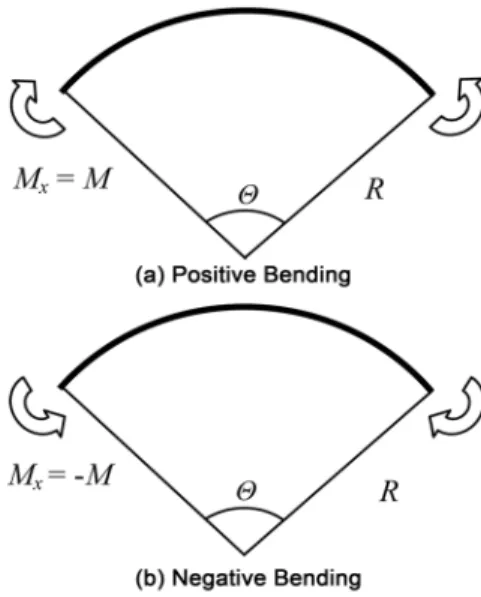
Fig. 3 shows a simply supported circular arch of radius R sub- jected to uniform bending M
x, and its axial force and horizontal reactions are equal to zero.
Substituting F
z= 0 and σ = M
xy / I
xinto Eq. 9, the differential equilibrium equations for out-of-plane behavior of an arch under uniform bending can be obtained as
(11a) for bending about the minor axis oy, and
(11b)
for torsion about the shear axis oz.
in which
(12a, b)
(12c, d, e, f)
where β
xdenotes the monosymmetry parameter.
The buckling displacements for the laterally simply supported arch may take the form of
(13a, b) in which a and b are the maximum values of u
oand θ, respec- tively; λ = nπ / L; and n is the number of buckled half waves around the arc length L. Substituting Eq. 13 into Eq. 11, one obtains two characteristic equations as
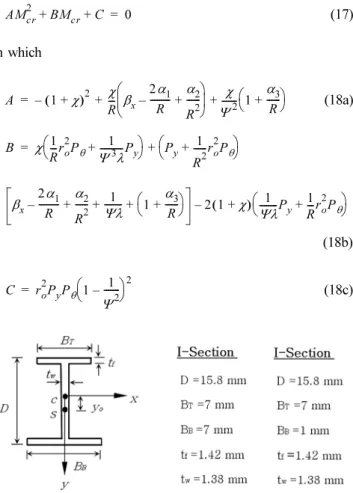
(14)
in which
(15a)
(15b)
(15c) δ 2Π = ∫
Vσδ
2ε dV + ∫Vτδ
2γ dV + ∫Vδσ ε δ dV + ∫Vδτ γ δ dV
δσ ε δ dV + ∫Vδτ γ δ dV
M
exδ
2v'
0 L
∑
,– = 0
δ
2Π EI
yδ u
o'' 1 R --- δ θ
⎝ + ⎠
⎛ ⎞
2EI
ωδ θ '' 1 R --- – δ u
o''
⎝ ⎠
⎛ ⎞
2L